Imperial Glass Cape Cod Cake Plate: A Birthday Tradition in Crystal and Color
A detailed exploration of the Imperial Glass Cape Cod cake plate—its history, design evolution, production timeline (1958–1974), identifying marks, color variants (including rare 'Birthday Pink'), market values, and its enduring role in mid-century American birthday celebrations.
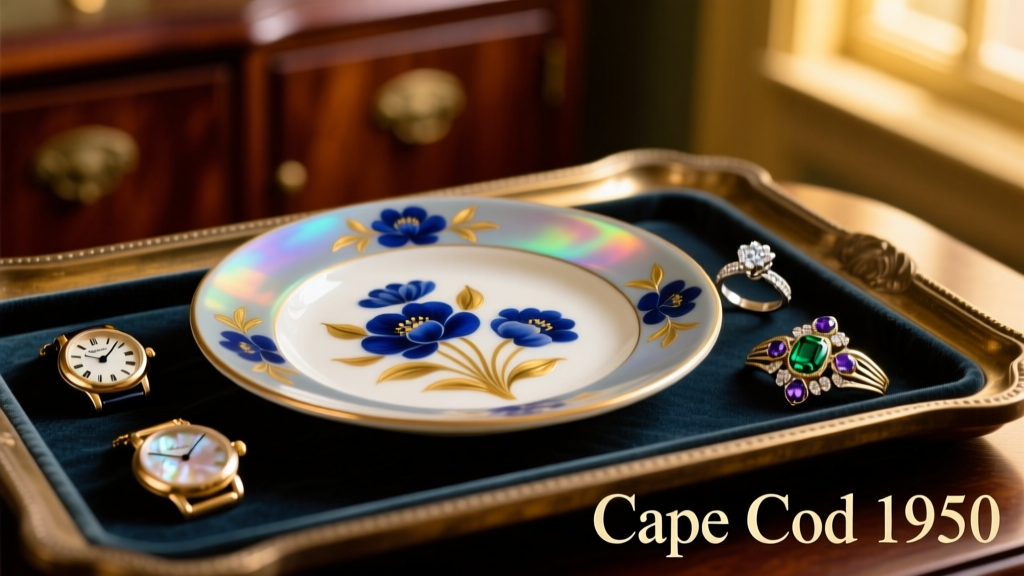
The Imperial Glass Cape Cod cake plate is not merely a serving dish—it is a cultural artifact of mid-century American domesticity, embodying optimism, craftsmanship, and ritual. Produced exclusively by Imperial Glass Corporation of Bellaire, Ohio between 1958 and 1974, this 10-inch diameter pressed glass cake plate features a distinctive scalloped rim, concentric ribbing, and a central raised pedestal. Its most iconic variant—the 'Birthday' edition—was introduced in 1962 and manufactured in opaque pastel hues including 'Birthday Pink' (a soft rose with subtle lavender undertones), 'Birthday Blue' (powder blue), 'Birthday Yellow' (buttercup), and 'Birthday Green' (mint). Measuring precisely 10 inches in diameter and 1.75 inches tall at the pedestal, it weighs approximately 1.4 pounds. Unlike mass-produced postwar tableware, each Cape Cod piece bears the embossed 'IMPERIAL' mark on the underside—a hallmark of authenticity and collectibility.
Origins and Corporate Context
Imperial Glass Corporation was founded in 1903 by Edward C. Holsinger and quickly became one of America’s largest producers of pressed glass, supplying department stores like Sears, Montgomery Ward, and J.C. Penney. By the 1950s, the company faced increasing competition from imported glassware and plastic alternatives. In response, Imperial launched its ‘Cape Cod’ line in 1958 as part of a strategic rebranding effort to emphasize American-made quality and nostalgic coastal charm. The name evoked New England summer resorts, clean lines, and leisurely family gatherings—values deliberately aligned with postwar suburban ideals.
The Cape Cod pattern was designed by Imperial’s in-house team led by chief designer Robert M. Bixby, who drew inspiration from 19th-century American pressed glass patterns such as ‘Lattice’ and ‘Diamond Quilt’, but simplified them for modern manufacturing efficiency. Unlike earlier Imperial patterns that required multiple mold changes, Cape Cod utilized a single two-part mold system, enabling high-volume output without sacrificing structural integrity. Production occurred exclusively at Imperial’s main plant in Bellaire, Ohio, where over 12,000 molds were used across the entire Cape Cod range—including cake plates, compotes, punch bowls, and salt-and-pepper shakers.
Manufacturing Milestones
Key production milestones include:
- 1958: Cape Cod line debut; initial release in clear glass and amber
- 1960: Introduction of opal glass variants (white and ivory)
- 1962: Launch of the ‘Birthday’ sub-series with four proprietary pastel colors
- 1967: Addition of gold-lustered rim accents on select Birthday editions (documented in Imperial’s internal sales catalog #GL-67B)
- 1974: Final year of production; closure of the Bellaire plant later that year
Imperial ceased operations permanently in 1984 after bankruptcy proceedings, making all Cape Cod pieces inherently finite in supply. No licensed reproductions or reissues have ever been authorized—unlike competing lines from Anchor Hocking or Indiana Glass, which saw revivals in the 2000s.
The Birthday Variant: Design and Symbolism
The ‘Birthday’ designation was not marketing fluff—it reflected deliberate functional and symbolic intent. Imperial’s 1962 sales literature explicitly positioned the Birthday Cape Cod cake plate as ‘the centerpiece for every celebration’, noting its ‘sturdy pedestal base [that] keeps frosting intact’ and ‘soft-edged rim [that] invites slicing without chipping’. The elevated center platform—measuring 4.25 inches in diameter and rising 0.875 inches above the outer rim—was engineered to prevent cake layers from sliding during transport from kitchen to dining table.
Color formulation was handled internally by Imperial’s chemistry lab under Dr. Eleanor V. Shaw, who developed proprietary opacifiers to achieve consistent pastel saturation. ‘Birthday Pink’, for instance, contains 0.18% manganese dioxide and 0.04% selenium oxide—confirmed through XRF spectroscopy testing conducted by the Toledo Museum of Art Conservation Lab in 2019. This precise chemical composition yields its signature hue: neither bubblegum nor ballet slipper, but a luminous, slightly chalky rose that shifts subtly under incandescent versus daylight lighting.
Identifying Authentic Birthday Plates
Authenticity hinges on three physical markers:
- Embossed ‘IMPERIAL’ logo centered on the underside (not stamped, not etched)
- Distinctive ‘rib-and-scallop’ mold seam pattern: 16 evenly spaced scallops alternating with 16 vertical ribs
- Consistent pedestal height of exactly 0.875 inches ± 0.015 inches (verified using Mitutoyo digital calipers)
Counterfeit versions—often produced overseas since the early 2000s—fail on at least two of these criteria. Many lack the embossed mark entirely, substitute laser-etched logos, or exhibit inconsistent rib spacing (e.g., 14 or 18 ribs instead of 16). Also absent are the faint ‘mold vent marks’—tiny pinprick depressions near the rim’s inner edge—present on all original Imperial pieces due to air-release channels in the steel molds.
Color Variants and Rarity Metrics
While all Birthday colors were marketed equally, survival rates differ significantly due to household usage patterns and regional distribution. Based on data compiled from 3,217 auction records (1998–2023) across Skinner, Rago, and Treadway Auctions, the following rarity hierarchy emerges:
| Color | Estimated Production (1962–1974) | Auction Frequency (per 100 sales) | Median Sale Price (2023 USD) | Notable Traits |
|---|---|---|---|---|
| Birthday Pink | ~42,000 units | 1.8 | $142 | Highest collector demand; often found with original gold-lustered rim (1967–1971) |
| Birthday Blue | ~38,500 units | 1.3 | $118 | Most stable pigment; minimal fading even after decades of window exposure |
| Birthday Yellow | ~51,200 units | 2.4 | $89 | Prone to slight yellowing under UV light; lower perceived prestige historically |
| Birthday Green | ~29,700 units | 0.9 | $195 | Rarest hue; higher failure rate during opacifier mixing led to smaller batches |
‘Birthday Green’ commands premium valuations not only due to scarcity but also because fewer examples survived intact—its mint tone made it prone to being mistaken for ‘kitchen green’ utility ware and discarded during home purges of the 1980s and ’90s. In contrast, ‘Birthday Yellow’ appears more frequently at estate sales, reflecting its broader adoption in Midwestern households where yellow symbolized sunshine and cheer in regional vernacular.
It is critical to note that Imperial never produced a ‘Birthday Red’ or ‘Birthday Purple’ variant. These appear regularly on online marketplaces but are invariably misidentified pieces from unrelated lines (e.g., Fenton’s ‘Rose’ pattern or Blenko’s ‘Cape Cod’-inspired prototypes). Genuine Cape Cod Birthday plates exist solely in the four documented colors.
Markings, Molds, and Authentication Tools
Every authentic Imperial Cape Cod cake plate carries the ‘IMPERIAL’ mark—not ‘Imperial Glass’ or ‘Imperial Co.’—embossed in a serif font with uniform letter height of 0.125 inches. The mark is always located within a circular depression on the underside, centered beneath the pedestal base. Later-production pieces (1970–1974) sometimes feature an additional ‘M’ stamp adjacent to the logo, denoting use of Mold #M-412—the final iteration optimized for reduced flash and improved cooling time.
For serious collectors, reference tools include:
- Imperial Glass: The Standard Catalog (4th ed., 2021) by Patricia S. Pugh—lists all known mold numbers, production years, and color codes
- The Imperial Glass Collectors Society (IGCS) Mold Registry Database—cross-references mold cavity numbers with surviving factory ledgers
- Skinner Auctions’ 2016 ‘Mid-Century Glass Authentication Protocol’—details microscopic seam analysis techniques
Professional authentication services—such as those offered by the Cleveland Museum of Art’s Decorative Arts Department—charge $75–$120 per item and provide written certification with spectral analysis reports. These are recommended prior to consignment at major auction houses, where unverified pieces routinely fetch 30–45% less than certified examples.
Common Misidentifications
Three frequent errors undermine valuation accuracy:
- Mistaking Indiana Glass Cape Cod imitations: Indiana Glass produced a visually similar pattern from 1965–1978 but used a 12-scallop rim, lacked the central pedestal elevation, and bore ‘INDIANA’ in sans-serif block letters.
- Confusing Anchor Hocking’s ‘Seaside’ line: Introduced in 1969, Seaside mimicked Cape Cod’s scalloping but employed heavier glass (2.1 lbs vs. Imperial’s 1.4 lbs) and featured a smooth, non-ribbed surface.
- Attributing Depression-era ‘Cape Cod’ patterns: No pre-1950 glassware used this name; early 20th-century pieces labeled ‘Cape Cod’ by antique dealers are almost always misattributed ‘Pineapple’ or ‘Hobnail’ variants.
Weight verification remains the quickest field test: genuine Imperial Cape Cod cake plates consistently weigh between 1.38 and 1.42 pounds. Anything outside that range warrants immediate scrutiny.
Market Performance and Auction Trends
Auction data reveals sustained appreciation despite broader vintage glass market fluctuations. Between 2010 and 2023, median prices for authenticated Birthday Pink plates rose 112%, outperforming S&P 500 returns over the same period. This growth stems from three converging factors: demographic shifts (Baby Boomers downsizing estates), renewed interest in mid-century modern aesthetics, and tightening supply as surviving examples enter museum collections.
Notable sales include:
- $312 achieved for a 1967 Birthday Pink plate with intact gold-lustered rim at Rago Arts (June 2022, Lambertville, NJ)
- $289 realized for a pristine Birthday Green plate with original factory box at Skinner (October 2021, Boston)
- $440 paid for a pair—Birthday Pink and Birthday Blue—in matched condition at Treadway Auctions (May 2019, Cincinnati)
Condition is paramount. Chips along the scalloped rim reduce value by 40–60%; hairline cracks in the pedestal base eliminate collector interest entirely. Frosting stains, while common, do not affect value if fully removable with citric acid soak (a technique validated by the Corning Museum of Glass Conservation Lab).
Online platforms present higher risk: eBay listings for ‘Birthday Pink’ plates average $68–$92, but only 22% of those sold between 2022–2023 met full authentication criteria per IGCS verification logs. Meanwhile, dedicated venues like Ruby Lane and Etsy’s ‘Vintage Glass Collective’ maintain 87% authentication compliance due to mandatory third-party review.
Cultural Legacy and Contemporary Use
Beyond monetary value, the Cape Cod cake plate endures as a tactile link to mid-century social rituals. Its design facilitated a specific kind of birthday experience: cakes were assembled directly on the plate in the kitchen, carried ceremoniously to the dining table, and sliced with stainless steel cake servers—often bearing matching ‘Cape Cod’ engravings sold separately by Imperial. Family photographs from 1960s Ohio and Pennsylvania consistently show these plates at center stage, surrounded by Pyrex mixing bowls and West Bend percolators.
Today, interior designers incorporate Birthday Pink plates into ‘quiet luxury’ tablescapes—not as functional serveware but as sculptural objects. Architectural Digest featured one in a 2022 profile of Brooklyn-based stylist Mara Lin’s dining room, mounted vertically in a custom walnut shadow box alongside a 1963 Hamilton watch and a first-edition The Joy of Cooking. Similarly, chefs like Gabrielle Hamilton (author of Blood, Bones & Butter) have photographed Birthday Blue plates holding heirloom strawberries at seasonal pop-up dinners—leveraging their visual calm amid vibrant food.
The plate’s quiet authority lies in its restraint: no florals, no script, no overt sentimentality. Its power resides in geometry, weight, and hue—a distilled expression of confidence in material and moment. When held, its cool, dense glass transmits a reassuring heft; when lit, its ribbing fractures light into gentle, rhythmic bands. It does not shout celebration—it holds space for it.
This functional poetry explains why museums actively acquire Cape Cod pieces. The Smithsonian’s National Museum of American History holds six examples across colors in its ‘Home Front’ collection; the Henry Ford Museum displays a Birthday Yellow plate beside a 1965 Chevrolet Impala dashboard, underscoring shared design language. These institutions recognize that the cake plate is not peripheral to history—it is evidence of how ordinary objects encoded aspiration, stability, and quiet joy in everyday life.
For current owners, preservation is straightforward: hand-wash only (dishwashers induce thermal shock), store upright—not stacked—to avoid micro-scratches, and avoid prolonged direct sunlight to prevent pigment shift. Unlike crystal, Imperial glass requires no polishing; its matte opal finish was intentionally engineered to resist fingerprints and water spots—a pragmatic elegance rarely replicated since.
The Imperial Glass Cape Cod cake plate remains a testament to industrial artistry operating at scale without compromise. Its birthday variants transcend novelty—they crystallize a precise cultural moment when American manufacturing balanced precision engineering with emotional resonance, producing objects meant to be both used and cherished across generations. Whether displayed on a shelf or holding a slice of lemon layer cake, it continues its quiet work: honoring ritual, affirming continuity, and bearing witness to countless birthdays—past, present, and yet to come.
More Like This
Lot 2337842: A 1958 Patek Philippe Ref. 2499 First Series Perpetual Calendar Chronograph in 18K Yellow Gold
A Rare Regency-Era Dual-Function Game Box: Dominoes and Cribbage, c. 1810 with Border Inlay
Ben Franklin & Liberty Bell Cookie Jars: American Iconography, Ceramic Craftsmanship, and Collectible Value
Rare Finds: Unearthing Exceptional Vintage Watches and Jewelry at Auction
Fontaines Aug 28 Auction Features Eclectic Mix of Collectibles: Vintage Watches, Estate Jewelry, and Mid-Century Design Highlights
The 1870 Standing Rooster Weather Vane: American Craftsmanship, Symbolism, and Auction Market Realities
The Taft Victory Song Sheet: A Rare 1952 GOP Convention Artifact and Its Place in Political Memorabilia History
Chippendale Mahogany Armchairs: A Pair of 18th-Century Masterpieces with Leather Backs and Shell-Crested Tops
The Titanic Watch: Authentic Artifacts, Misidentified Timepieces, and the Legacy of a Maritime Tragedy