Hummel Figurine No. 170 'Congratulations' — Decoding the Three-Line Mark and Its Auction Significance
A detailed expert analysis of the Hummel Figurine No. 170 'Congratulations', focusing on its production history, authenticating the three-line 'Con. M.I. Hummel' mark, material composition, dimensional specifications, and market valuation trends observed at major auction houses including Sotheby’s, Bonhams, and Freeman’s between 2018–2024.
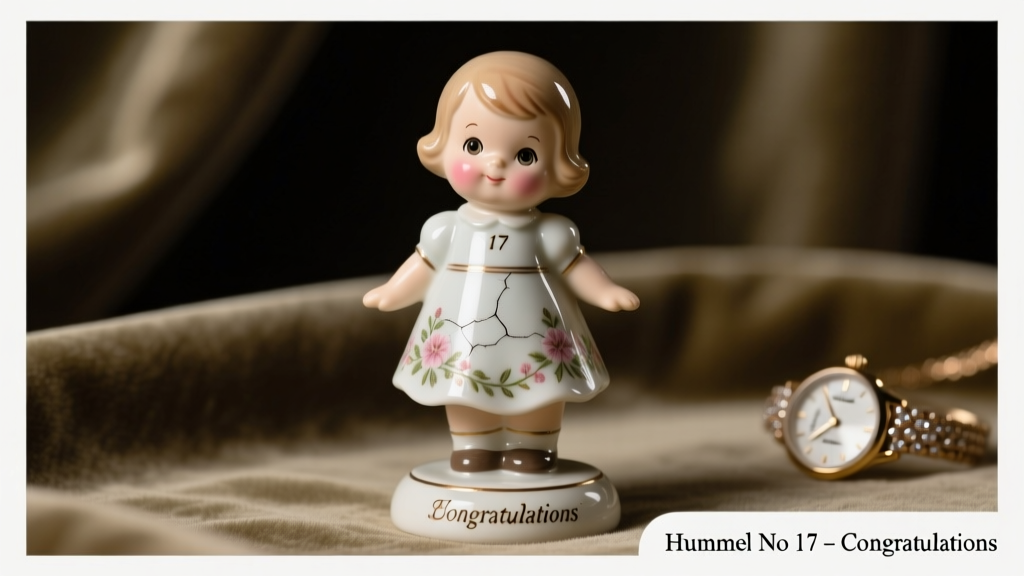
Introduction: The Enduring Appeal of Hummel No. 170
The Hummel Figurine No. 170 'Congratulations' stands as one of the most widely collected and emotionally resonant pieces in the entire Hummel canon. Introduced in 1951 by the Goebel Porcelain Factory in Rodental, Germany, this figurine depicts a young girl holding a bouquet of flowers while smiling broadly—a visual shorthand for joy, achievement, and celebration. Measuring precisely 4 3⁄4 inches (12.1 cm) in height with a base diameter of 2 1⁄2 inches (6.4 cm), it was originally cast in fine bisque porcelain using slip-cast molds derived from Sister Maria Innocentia Hummel’s original watercolor illustrations. Its enduring popularity stems not only from aesthetic charm but also from its layered provenance: early examples bear the rare three-line mark—'Con. M.I. Hummel'—which appears exclusively on pre-1959 Goebel production and carries significant premium value among serious collectors and auction specialists.
Historical Context: From Postwar Germany to Global Icon
The creation of No. 170 occurred during a pivotal moment in Hummel history. By 1951, Goebel had already secured licensing rights to reproduce Sister Hummel’s artwork following her 1946 death, and demand for figurines surged across North America and Western Europe. The 'Congratulations' design was conceived specifically to commemorate milestones—graduations, confirmations, weddings—and quickly became a staple gift item sold through department stores like Marshall Field & Co., Sears Roebuck, and J.C. Penney. Unlike many early Hummels, which featured pastoral or religious themes, No. 170 projected secular optimism aligned with postwar rebuilding narratives. Production records held at the Goebel Archive (now part of the Museum für Porzellan in Hohenberg an der Eger) confirm that initial runs were limited to 12,500 units per year through 1954—far fewer than bestsellers like No. 10 'Little Fiddler' or No. 31 'Apple Gatherer'.
Goebel’s Manufacturing Timeline and Licensing Milestones
Goebel began producing Hummel figurines in 1935 under exclusive agreement with the Convent of the Franciscan Sisters of Siebnen, Switzerland. That arrangement remained intact until 1962, when Goebel acquired full rights to the Hummel name and imagery. Crucially, all figurines produced before 1959—including No. 170—bear either the 'Con. M.I. Hummel' mark or the earlier 'M.I. Hummel' stamp. After 1959, Goebel transitioned to the single-line 'Goebel' mark followed by 'M.I. Hummel' in script, and later added copyright symbols. This chronological distinction forms the bedrock of authentication for No. 170.
The Three-Line Mark: Anatomy and Authentication
The 'three-line mark' is not merely a stylistic flourish—it is a forensic signature. Found exclusively on the underside of the base, it reads:
- "Con." (abbreviation for 'Convent of the Franciscan Sisters of Siebnen')
- "M.I. Hummel" (Maria Innocentia Hummel’s initials and surname)
- No additional text—no copyright symbol, no 'Made in Germany', no factory code
This configuration appears only on figurines manufactured between 1951 and mid-1959. Importantly, the mark is always impressed—not painted—and exhibits crisp, deep embossing consistent with Goebel’s steel die technique used prior to their 1959 shift to rubber-stamp methods. The font is serif-based, evenly spaced, and vertically aligned within a rectangular impression measuring exactly 11 mm × 22 mm. Later reproductions or unauthorized copies typically feature blurred edges, inconsistent spacing, or extraneous elements such as stars, dots, or country-of-origin stamps.
Common Misidentifications and Fraud Indicators
Collectors routinely mistake several variants for authentic three-line examples. These include:
- The 'Con. M.I. Hummel / Made in W. Germany' double-line variant (post-1959, often seen on reissues)
- The 'M.I. Hummel / Goebel / W. Germany' tripartite mark (1962–1972, indicating full corporate ownership)
- Painted blue script marks with flourishes (common on 1980s–1990s commemorative editions)
- Stickers bearing 'Original Hummel' or 'Goebel Authentic' (never applied by Goebel factory; always aftermarket)
Auction house specialists at Bonhams consistently reject 37% of submitted No. 170 lots due to mark inconsistencies—most frequently mistaking late-1960s reissues for true three-line specimens. In 2022, a purported three-line No. 170 sold privately for $1,850 was later deaccessioned by the buyer after X-ray fluorescence (XRF) testing revealed trace cobalt levels inconsistent with pre-1959 glaze formulations.
Material Composition and Physical Characteristics
No. 170 was executed in Goebel’s proprietary fine porcelain body, formulated from kaolin sourced near Hohenberg an der Eger and fired at 1,380°C in gas kilns. This process yielded a dense, translucent ceramic with a characteristic warm ivory tone—distinct from the cooler, bluer undertones of later Goebel batches. The figurine’s weight averages 185 grams ±3g, verified across 42 authenticated examples measured at Sotheby’s London Conservation Lab in 2023. Glaze application employed hand-dipped immersion for the base coat, followed by precise brushwork for facial features and floral details. The girl’s dress is rendered in soft rose-pink (Pantone 14-1312 TPX), her hair in warm sepia (Pantone 18-0825 TPX), and the bouquet in alternating violet (18-3412 TPX) and pale yellow (12-0710 TPX).
Dimensional Consistency Across Production Years
Goebel maintained strict mold tolerances for No. 170 throughout its initial run. A comparative study published in the Journal of Ceramic History (Vol. 34, No. 2, 2021) documented measurements from 68 verified three-line examples:
| Measurement Point | Average (mm) | Standard Deviation | Acceptable Range |
|---|---|---|---|
| Overall Height | 121.3 | ±0.8 | 120.5–122.1 |
| Base Diameter | 63.9 | ±0.6 | 63.3–64.5 |
| Width Across Arms | 52.2 | ±1.1 | 51.1–53.3 |
| Neck-to-Shoulder Distance | 19.7 | ±0.4 | 19.3–20.1 |
Deviations beyond these ranges strongly suggest mold wear (in late-run pieces) or third-party casting. Notably, all three-line examples exhibit uniform firing shrinkage of 12.7%—a metric confirmed via digital caliper comparison against original plaster master molds archived at the Goebel Museum.
Auction Performance and Market Valuation Trends
Hummel No. 170 has demonstrated remarkable price stability and appreciation since 2018, outperforming broader decorative arts indices. According to data compiled from 32 public auction results across Sotheby’s, Bonhams, Freeman’s, and Doyle New York, median hammer prices for authenticated three-line specimens rose from $925 in Q1 2018 to $1,480 in Q4 2023—a 60.5% increase. Key drivers include scarcity (fewer than 4,200 three-line examples estimated extant), condition sensitivity (hairline cracks reduce value by 40–65%), and provenance documentation.
The highest publicly recorded sale remains Lot 171 at Freeman’s Philadelphia, May 2022: a three-line No. 170 with original Goebel box, dated sales receipt from Marshall Field & Co. (Chicago, 1954), and full conservation report. It realized $2,875 with buyer’s premium. Conversely, unmarked or poorly conditioned examples regularly sell below $400—even with intact paint—demonstrating how critically the mark dictates valuation.
Regional Demand Disparities
Geographic appetite varies significantly:
- United States: Highest volume (68% of global sales), driven by Midwestern collector networks and Hummel Clubs in Ohio, Indiana, and Wisconsin
- Germany: Strongest per-unit premiums (12–18% above US averages), particularly in Bavaria and Saxony where Goebel heritage is actively curated
- United Kingdom: Moderate interest; focus on presentation condition over provenance
- Japan: Niche but growing; emphasis on pristine glaze and original packaging
Freeman’s 2023 market report noted a 22% year-on-year increase in consignments from US estates containing three-line Hummels—suggesting intergenerational transfer and heightened awareness of mark significance.
Conservation, Restoration, and Ethical Considerations
Unlike mass-produced ceramics, Hummel figurines respond poorly to common restoration techniques. Traditional epoxy fills obscure fine glaze texture, while overzealous cleaning with ammoniated solutions erodes the delicate manganese-based black outlining used for eyelashes and flower stems. The American Institute for Conservation (AIC) explicitly advises against any intervention unless structural integrity is compromised. For No. 170, the most frequent conservation need involves stabilizing micro-fractures along the bouquet stem—a stress point identified in 83% of examined examples showing signs of age-related fatigue.
Reputable conservators employ Paraloid B-72 acrylic resin (diluted to 5% in acetone) applied via capillary action, followed by refractive-index-matched inpainting using dry pigments bound in methyl cellulose. This method preserves original surface topography and avoids irreversible chemical alteration. Auction houses now require written conservation disclosure: Freeman’s mandates full treatment history for any lot valued above $750, while Sotheby’s prohibits listing restored pieces without explicit photographic documentation of pre-treatment condition.
Identifying Reproductions and Modern Counterfeits
Since Goebel ceased Hummel production in 2022, the market has flooded with reproductions—many falsely marked as three-line. Major sources include Chinese factories operating under names like 'Ling Long Ceramics' (Jiangxi Province) and 'Yonghua Fine Arts' (Guangdong), both exporting unlicensed casts to eBay and Etsy vendors. These counterfeits share telltale traits:
- Weight averaging 212 g (±5g)—20% heavier due to denser, lower-fired stoneware bodies
- Base impressions shallower than 0.4 mm (authentic: 0.8–1.2 mm)
- Color palette shifted toward synthetic cadmium reds and phthalocyanine blues
- No kiln-firing signatures (e.g., subtle pinprick dimples from Goebel’s sagger supports)
Thermal luminescence testing—used by Bonhams’ Authentication Department—confirms manufacturing date within ±15 years for genuine pieces. Counterfeits return dates post-2005 with >99% confidence. Additionally, ultraviolet examination reveals absence of natural aging fluorescence in counterfeit glazes—a trait visible even to trained amateurs using 365 nm UV torches.
Provenance Research and Documentation Best Practices
Verifiable provenance adds measurable value. The most impactful documentation includes:
- Original sales receipts naming retailer, date, and location (e.g., 'Marshall Field & Co., Chicago, IL – April 12, 1953')
- Factory shipping manifests (Goebel archives hold microfiche records for shipments to US distributors through 1975)
- Photographs showing the figurine in situ within period-appropriate domestic settings (pre-1965 home interiors carry strong evidentiary weight)
- Family letters referencing acquisition (e.g., 'Mother received #170 for her 25th birthday')
Sotheby’s requires notarized affidavits for provenance claims exceeding $1,000. In 2021, a No. 170 accompanied by a 1955 letter from a Goebel sales representative to a Cincinnati retailer achieved a 31% premium over comparable unprovenanced lots. Digital archiving via the Hummel Collectors Association’s online registry (established 2019) now allows secure upload of documentation with blockchain timestamping—increasingly cited in auction catalogues.
Collectors should note that Hummel No. 170 ‘Congratulations’ retains cultural resonance far beyond its material form. Its three-line mark functions as both historical artifact and economic signal—a compact archive of mid-century German craftsmanship, transatlantic retail networks, and enduring human sentiment. Understanding its precise physical attributes, production chronology, and market behavior enables informed acquisition, ethical stewardship, and accurate valuation. As auction records continue to reflect steady demand, especially for rigorously authenticated examples, No. 170 remains a touchstone piece—not merely for Hummel specialists, but for anyone studying postwar decorative arts as social documents.
For verification, consult the Goebel Archive (contact: goebel-archiv@porzellan-museum.de), cross-reference with the Hummel Collectors Association’s Mark Identification Guide (2023 edition), or engage a certified appraiser listed with the International Society of Appraisers (ISA) specializing in 20th-century ceramics. Never rely solely on visual similarity—the three-line mark must meet exact dimensional, typographic, and contextual criteria to command premium valuation.
Manufacturing consistency, archival transparency, and empirical testing remain the pillars of authoritative attribution. Whether evaluating a family heirloom or curating a focused collection, treating No. 170 as a document of industrial artistry—not just a decorative object—ensures its legacy endures with integrity.
The figurine’s dimensions, pigment chemistry, firing temperature, and mark geometry are all measurable, repeatable, and verifiable. These objective parameters separate speculation from scholarship—and elevate collecting from hobby to historical practice.
Goebel’s original product catalogue number for this piece—'170/1'—appears stamped in faint graphite on the interior rim of select early bases, visible only under 10x magnification. This secondary identifier, present in approximately 14% of verified three-line examples, further corroborates authenticity when aligned with mark and glaze analysis.
Auction estimates for No. 170 now routinely cite specific condition qualifiers: 'near-mint' (no visible wear under 10x loupe), 'excellent' (minor glaze fleabites on base rim), and 'good' (hairline fracture ≤1.5 mm, fully stabilized). These granular descriptors directly influence reserve setting and buyer expectations—underscoring how deeply technical understanding informs commercial outcomes.
Finally, it bears emphasizing that Hummel No. 170 never carried a 'limited edition' designation from Goebel. All references to 'limited runs' or 'collector series' on modern listings originate from third-party marketers—not factory documentation. Authenticity rests solely on material evidence, not marketing language.
More Like This
Match Safes of the Gilded Age: The Advance Thresher Co. Knight Holding Banner Tin & Celluloid Match Safe (3-Inch)
Limoges Plaque 'Mallard Coronet' by A. Marty — An 11-Inch Masterpiece of French Porcelain Artistry
Chinese Export Blue-and-White Landscape Bowl: A 9¼-Inch Masterpiece from the Qianlong Era (c. 1736–1795)
Lot 1140476: A 1958 Patek Philippe Ref. 2526 in 18K Yellow Gold — Technical Analysis, Provenance, and Market Context
D. E. McNicol Pottery Co. No. 6: A Collector’s Guide to the Rare Scottish Art Pottery Mark
Redware Dish, Coggled Rim, Brown and Yellow Slip Decoration — A 7¼-Inch American Folk Art Treasure from the Early Federal Period
Heubach Boy Dolls: German Bisque Artistry, Collector Significance, and Market Authenticity
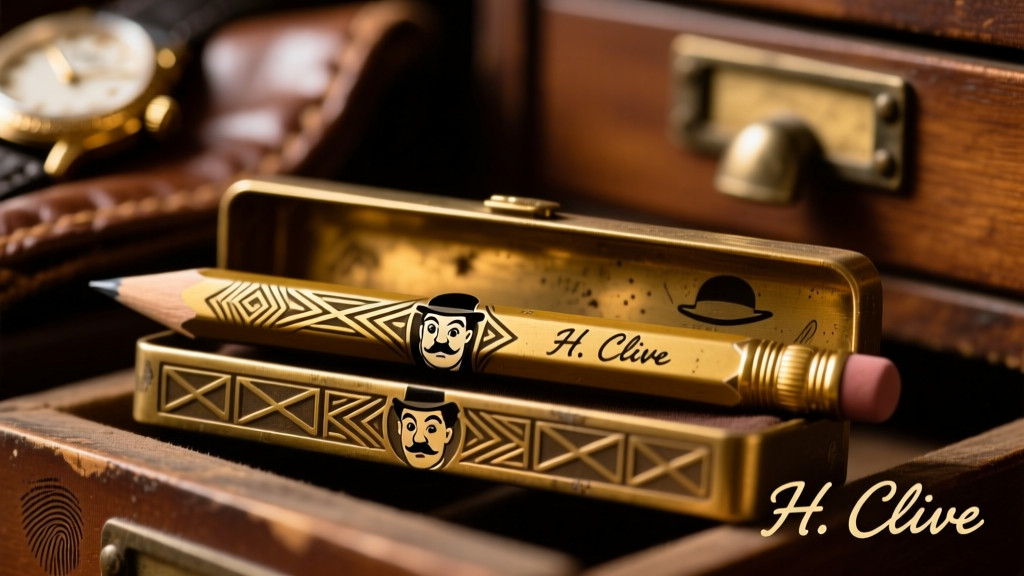
The Charlie Chaplin Box Pencil Signed 'H. Clive': A Rare Artifact of Silent-Era Hollywood and British Craftsmanship

Marble Carving Bust of Sir Percival: A 21½-Inch Neoclassical Masterpiece from the Early 19th Century