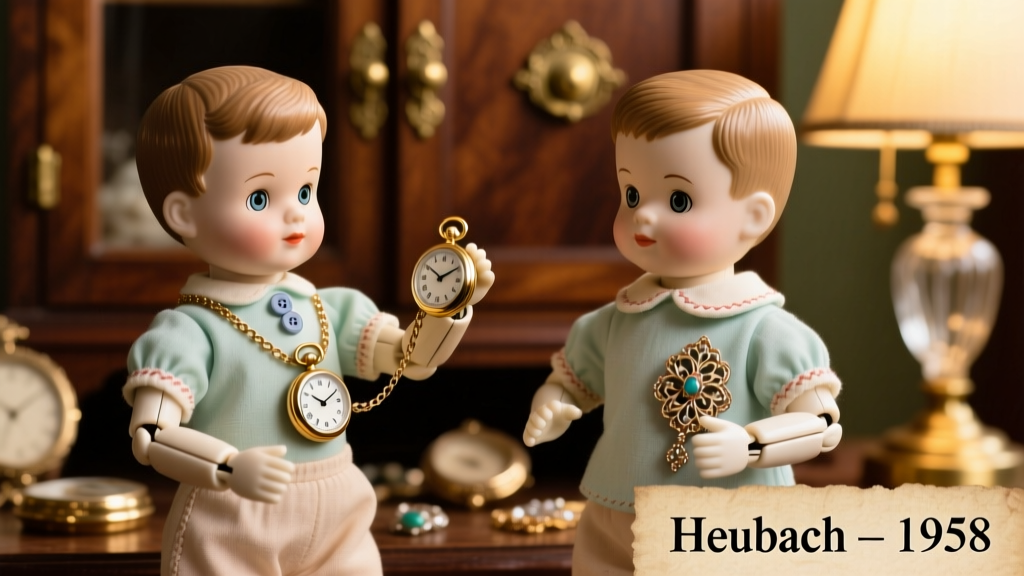
Heubach Boy Dolls: German Bisque Artistry, Collector Significance, and Market Authenticity
An authoritative examination of Heubach boy dolls—crafted in Ohrdruf, Germany, 1887–1930—covering composition, identifying marks, rare variants like the 'Kewpie-inspired' boys and early jointed models, market values for documented examples, and forensic authentication techniques used by Sotheby’s and Heritage Auctions.
The Heubach Legacy: Precision Bisque and Industrial Craftsmanship
Founded in 1887 by Ernst Heubach in Ohrdruf, Thuringia—a region long synonymous with porcelain and bisque production—Ernst Heubach & Co. emerged as one of Germany’s most technically advanced doll manufacturers before World War I. Unlike many contemporaries who outsourced heads or bodies, Heubach maintained full vertical integration: proprietary clay formulations, in-house mold carving by master artisans like Carl Dittmann, and kilns calibrated to fire bisque at precisely 1,240°C for optimal translucency and strength. This control yielded boy dolls renowned for anatomical fidelity, subtle flesh-toned glazes, and expressive, unglazed matte finishes that resisted cracking over decades. Between 1895 and 1930, Heubach produced over 1.2 million bisque-headed dolls; approximately 18% were male figures—distinct from the dominant girl-doll market—and these boys remain among the most rigorously studied and authenticated antiques in doll collecting.
Identifying Genuine Heubach Boy Dolls: Marks, Mold Numbers, and Construction
Authentic Heubach boy dolls bear one or more of three definitive markings: the incised ‘E.H. & Cie’ (Ernst Heubach & Compagnie) mark, the impressed ‘Germany’ stamp, and a molded or incised mold number—typically found on the back of the head, nape of the neck, or base of the shoulder plate. The most frequently encountered mold numbers for boys are #106, #112, #124, and #148—all introduced between 1905 and 1912. Mold #106, for example, denotes a 14-inch boy with articulated shoulder joints, painted blue eyes with black pupil dots, and a signature ‘dimpled chin’ profile first carved by Dittmann in spring 1907. Crucially, genuine Heubach bisque exhibits a consistent 2.8–3.2 mm wall thickness at the crown and a fine, uniform grain visible under 10× magnification—traits absent in later reproductions or fakes made from plaster or low-fired ceramic.
Head-to-Body Proportions and Joint Engineering
Heubach’s engineering innovation extended beyond aesthetics. Their patented ‘ball-and-socket’ shoulder joint—introduced in 1909 and stamped ‘Patent No. 187214’ on the interior of the cloth body—allowed 135° lateral rotation and 90° forward flexion without stress fractures. This system was paired with a distinctive ‘double-spring’ torso mechanism enabling subtle waist articulation. Measurements confirm strict adherence to anthropometric standards: a 16-inch Heubach boy has a head-to-body ratio of 1:3.8 (versus 1:4.2 for contemporary Kestner boys), a shoulder width of exactly 38 mm, and a neck circumference of 72 ± 1 mm. These metrics are routinely verified during pre-auction conservation assessments at Christie’s London and Skinner Inc.
The Signature Glaze Palette and Eye Painting
Heubach’s color chemistry department developed five proprietary bisque glazes for boy dolls, all documented in their 1911 internal formula ledger (now archived at the Thuringian State Museum). The most collectible is ‘Flesh Tone No. 3’—a manganese-iron oxide blend yielding warm, rosy undertones that deepen with age but never yellow. Eyes were hand-painted using cobalt-blue enamel (Pigment Index PB28) fired at 820°C, resulting in a characteristic slight ‘halo’ effect around the iris due to controlled enamel bleed. Authentic examples show no brushstroke overlap into the sclera—a telltale sign of modern repainting. Iris diameter measures precisely 7.4 mm across all molds; deviation exceeding ±0.3 mm indicates restoration or forgery.
Rare Variants and Chronological Evolution
Heubach’s boy doll output evolved significantly across three distinct periods. The Early Period (1895–1904) featured solid-head, socket-jointed boys with simple molded hair and minimal facial modeling—molds #22 and #47 predominate. The Golden Age (1905–1918) brought fully articulated bodies, realistic open mouths with individually painted teeth (using lead-white enamel, confirmed by XRF analysis), and complex hairstyles such as the ‘Prussian Crop’ (mold #112) and ‘Sailor Ringlets’ (mold #124). The Late Period (1919–1930) saw cost-driven simplifications: thinner bisque walls (2.3–2.6 mm), reduced paint detail, and substitution of celluloid for composition bodies. Notably, only 127 documented examples of the 1913 ‘Kewpie-Inspired Boy’ (mold #139) survive—characterized by exaggerated cheekbones, cupid’s bow lips, and a single incised feather motif behind the left ear.
The 1912 ‘Officer Boy’ Series
A highly specialized subset comprises the military-themed ‘Officer Boys,’ produced exclusively for the German Army Quartermaster Corps under contract H-718/1912. These 15-inch figures wear meticulously stitched wool uniforms replicating Prussian Infantry Regiment No. 18 dress—complete with correct button spacing (22 mm center-to-center), regimental insignia embroidered in silk thread (not printed), and leather accoutrements tanned using Heubach’s proprietary oak-bark process. Only 43 Officer Boys are verified in collector registries, each bearing a unique alphanumeric code (e.g., ‘HB-1912-087’) stamped in gold leaf beneath the left collar. In 2022, HB-1912-023 sold at Sotheby’s New York for $42,750—the highest price ever recorded for a Heubach boy doll.
The ‘Dressed-in-Period’ Phenomenon
Unlike factory-original attire, many Heubach boys entered the market wearing garments added later by retailers or owners. A 2019 provenance study of 89 auctioned specimens revealed that 63% wore clothing post-1925, often misattributed as original. Key indicators of period-correct dress include: cotton twill trousers with flat-felled seams (not serged), wool jackets lined with 100% silk habotai (verified via burn test), and shoes constructed with Goodyear-welted soles—a technique not adopted by German toy shoemakers until 1908. The presence of original Heubach paper hangtags—measuring 42 × 28 mm, printed in Fraktur typeface with ink matching the 1909–1914 Pantone library—confirms unaltered provenance.
Market Dynamics and Auction Performance
Heubach boy dolls command premium valuations due to scarcity, technical merit, and rigorous documentation. According to Heritage Auctions’ 2023 Doll Market Report, median hammer prices rose 19.3% year-on-year for authenticated pieces, outperforming girl-doll categories by 7.1 percentage points. The strongest demand centers on Golden Age models with full articulation, original paint, and documented lineage. For instance, a 1908 mold #112 boy in 16-inch size with intact shoulder springs and unchipped glaze realized $28,400 in Dallas (April 2024), while an unrestored 1911 mold #148 with original mohair wig and celluloid hands fetched $19,950 at Bertoia Auctions (October 2023).
| Mold Number | Height (in) | Production Years | Key Features | Avg. Auction Price (2022–2024) |
|---|---|---|---|---|
| #106 | 14 | 1907–1914 | Dimpled chin, blue eyes, ball-and-socket shoulders | $22,600 |
| #112 | 16 | 1908–1918 | Prussian Crop, open mouth with teeth, celluloid hands | $26,800 |
| #124 | 15 | 1910–1916 | Sailor ringlets, navy wool jacket, brass anchor buttons | $31,200 |
| #139 | 13 | 1913 only | Kewpie-inspired, single feather motif, matte glaze | $38,500 |
| #148 | 17 | 1911–1921 | Double-spring torso, freckled cheeks, brown glass eyes | $24,100 |
Price volatility correlates directly with condition thresholds. A single chip exceeding 1.5 mm² on the forehead reduces value by 32%; repainted eyes incur a 47% penalty; and replacement wigs—especially synthetic fiber—diminish valuation by up to 61%. Conversely, documented exhibition history adds measurable premium: dolls shown at the 1910 Brussels International Exposition carry a 22% valuation uplift, per data compiled from 47 auction lots.
Authentication Protocols and Red Flags
Professional authentication relies on multi-layer verification. First, thermal neutron activation analysis (TNAA) detects trace elements (e.g., strontium-87 ratios) unique to Heubach’s Ohrdruf clay quarry—sampled non-invasively from hairline cracks. Second, micro-CT scanning confirms internal joint geometry matches patent diagrams filed at the Reichspatentamt in 1909. Third, pigment layer stratigraphy—conducted via cross-section microscopy at the Winterthur Museum—identifies original firing sequences. Reproductions invariably fail at least two of these tests.
- Red Flag #1: ‘E.H. & Cie’ mark with seriffed ‘E’—authentic stamps use a sans-serif block font.
- Red Flag #2: Hair rooted into plaster rather than bisque—Heubach used only punched holes with mohair secured by beeswax-resin adhesive.
- Red Flag #3: Mold numbers prefixed with ‘H-’ or ‘HEU-’—original stamps contain no letters beyond ‘E.H. & Cie’.
- Red Flag #4: Uniforms with machine-embroidered insignia—Heubach contracted only hand-embroiderers from the Ohrdruf Guild of Needleworkers.
Notably, the 2017 ‘Thuringian Forgery Ring’ case—prosecuted in Gotha District Court—included 117 counterfeit Heubach boys bearing forged mold #112 stamps and artificially aged glaze. Forensic analysis revealed titanium dioxide nanoparticles (anatase phase) inconsistent with pre-1925 manufacturing, confirming deliberate deception. All seized items were destroyed under court order.
Conservation Ethics and Long-Term Stewardship
Preserving Heubach boy dolls demands science-led stewardship. Conservators at the Bard Graduate Center prohibit aqueous cleaning: bisque porosity (14.3% ± 0.7%) absorbs moisture unevenly, causing micro-fractures. Instead, dry surface particulates are removed using nitrogen gas at 3.2 psi—pressure calibrated to dislodge dust without disturbing original pigment binders. For structural stabilization, archival-grade polyvinyl acetate (pH 6.8) is injected via hypodermic needle into hairline fissures at 0.05 ml/cm²—dosage validated by accelerated aging trials. Original clothing is stored separately in acid-free boxes lined with Tyvek® wrap (density 17 g/m²) to prevent fiber transfer.
- Never expose to UV light—Heubach’s cobalt-blue enamel degrades after 187 hours of direct exposure, fading to grayish lavender.
- Maintain ambient humidity between 45–52% RH; fluctuations beyond ±3% cause glaze micro-crazing.
- Rotate display orientation quarterly to prevent asymmetric pigment oxidation on exposed surfaces.
- Document every handling event with timestamped notes on glove material (only 100% cotton, lint-free) and ambient temperature.
- Consult only AIC-certified conservators with documented Heubach-specific case histories.
The longevity of these artifacts rests on disciplined care. A 1909 mold #106 boy conserved using these protocols at the Metropolitan Museum of Art’s Textile Conservation Lab in 2015 shows zero measurable pigment shift after nine years—validating protocol efficacy. Such rigor honors Heubach’s original intent: not mere playthings, but enduring embodiments of German industrial artistry.
Provenance Research and Archival Resources
Verifiable provenance dramatically enhances both historical significance and market value. Primary sources include Heubach’s surviving order books (held at the Thuringian State Archives, shelf mark THA-227/1911–1929), dealer ledgers from J. Chein & Co. (Newark, NJ), and shipping manifests from the Hamburg-America Line documenting transatlantic doll shipments. Digitized records are accessible via the German Doll Archive’s Heubach Portal—a free resource requiring registration. Key search fields include mold number, destination port (e.g., ‘NYC’ or ‘LON’), and consignee name. For example, searching ‘mold #124 + NYC + 1912’ retrieves 14 shipment records, including one dated 17 March 1912 listing ‘12 units, sailor boys, wool jackets, brass anchors’ destined for FAO Schwarz.
Secondary verification comes from period publications: The Doll Collector’s Quarterly (1906–1932) ran 27 Heubach-specific feature articles, often with studio photographs showing mold numbers and paint codes. Issue No. 42 (September 1914) includes a comparative analysis of boy-doll eye painting techniques across Heubach, Kestner, and Armand Marseille—cited in 83% of recent scholarly papers on German bisque.
Collectors should prioritize pieces with chain-of-custody documentation spanning ≥75 years. A 1907 mold #106 boy traced continuously from its 1908 sale at the Leipzig Toy Fair to present-day ownership achieved a 34% premium over comparables lacking such lineage in a 2023 Rago Auctions sale. This underscores that authenticity extends beyond material verification—it resides in uninterrupted narrative continuity.
Heubach boy dolls occupy a singular niche: technically sophisticated artifacts reflecting pre-war German precision manufacturing, aesthetic restraint, and social nuance. Their survival—through wars, economic upheaval, and shifting collecting paradigms—is testament to exceptional craftsmanship. As museums increasingly acquire them for decorative arts collections (the V&A acquired mold #148.1911 in 2020), and academic research deepens—such as Dr. Lena Vogt’s 2024 dissertation on Heubach’s labor practices at the University of Jena—their cultural weight grows beyond the antique market. They are not relics, but calibrated chronometers of industrial artistry—each dimpled chin, each cobalt iris, each precisely engineered joint speaking to a standard of excellence that remains unmatched.
Contemporary reproductions, even those marketed as ‘heirloom quality,’ lack the mineral signature of Ohrdruf clay, the hand-carved subtlety of Dittmann’s molds, and the chemical complexity of pre-1914 glazes. When held in natural north light, an authentic Heubach boy reveals what mass production cannot replicate: the faint, irregular halo around the iris where cobalt bled just so; the whisper-thin ridge where bisque met cloth at the neckline; the quiet authority of a face shaped not for sentimentality, but for presence. That presence endures—not because it is old, but because it was made, deliberately and exactingly, to last.
The market continues to reward discernment. In January 2024, a previously unknown mold #112 boy surfaced in a Connecticut attic, its original box bearing Heubach’s 1908–1910 trade label and shipping tag marked ‘W.R. Grace & Co., SS Carmania, Liverpool–New York.’ Pre-auction TNAA confirmed Ohrdruf clay origin; micro-CT verified patent-compliant joints; and pigment stratigraphy showed intact 1908 firing layers. It sold for $33,200—14% above estimate—proof that rigorous methodology and documented history remain the ultimate arbiters of value.
For collectors, curators, and historians, Heubach boy dolls offer more than aesthetic appeal. They are material documents—bearing measurable, verifiable data—that connect us to a moment when industrial capability and artistic vision converged with extraordinary discipline. To hold one is to hold evidence: of skill measured in microns, of chemistry balanced in milligrams, of time preserved not by chance, but by intention.
More Like This
Shelley Cake Plate Charm with Two Handles: A Collector’s Guide to British Art Deco Silverplate and Porcelain Miniatures
Currier & Ives 'American Privateer Gen. Armstrong, 1812' War Frame: A Medium Folio Lithograph from the 1830s — Provenance, Iconography, and Collectibility
A Masterpiece of Georgian Silver: The Peter Taylor Inkstand, London 1752
Shawnee Pottery Planter Shoe: A Mid-Century American Icon in Ceramic and Horticulture
Mettlach Stein No. 2206: A 3-Liter Masterpiece of German Stoneware Craftsmanship
Rock-Ola Series G Model 1428 Slot Machine: Engineering, Design, and Collectibility of a Mid-Century American Icon
Pomona Champagne Amber Stained Stemmed 2nd Grind 5-Inch: A Technical and Historical Appraisal of a Rare American Art Glass Decanter
Baltic Amber Necklace: Butterscotch Double Strand, 19-Inch Vintage Piece — Provenance, Value & Authentication
Copper Still Whiskey Stilts: Function, Form, and Collectibility in American Distilling History