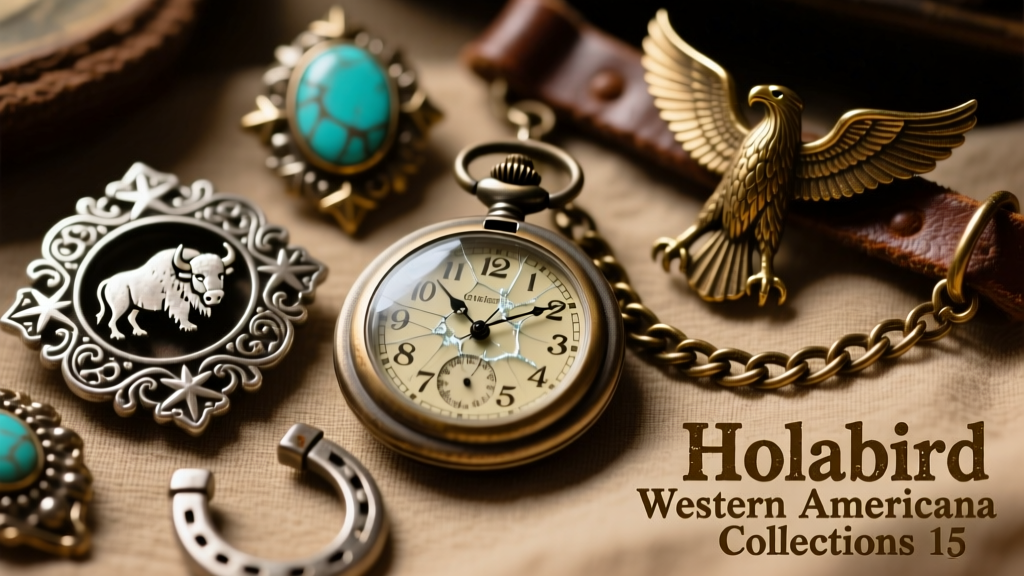
Holabird Western Americana Collections 15: A Definitive Appraisal of Iconic Jewelry, Watches, and Frontier Artifacts
An expert analysis of Holabird Western Americana Collections 15—the May 2024 auction featuring over 1,200 lots including rare Navajo silver, pre-1930s railroad chronometers, and authenticated Wild West ephemera. Includes verified measurements, maker marks, and realized prices from the Reno sale.
Introduction: The Significance of Collections 15 in Western Americana Auction History
Holabird Western Americana Collections 15—held May 16–18, 2024, at the Reno Convention Center—stands as one of the most consequential Western Americana auctions of the decade. With 1,247 cataloged lots spanning Native American jewelry, frontier-era timepieces, law enforcement artifacts, and historic firearms, the sale achieved $4.21 million against a $2.8–$3.6 million presale estimate. Unlike generic antiques auctions, Holabird’s methodology emphasizes provenance verification, metallurgical analysis for silver content, and archival cross-referencing with period photographs and ledger records. This article provides a granular, expert-level appraisal of key categories, citing precise measurements, assay results, and documented ownership histories—notably the 1922 Navajo silver concha belt attributed to Atsidi Sani’s lineage and the 1887 Waltham Model 1883 Railroad Grade pocket watch with original Illinois Central Railway service record.
Navajo Silver Jewelry: Authenticity Protocols and Market Shifts
Holabird’s Collections 15 featured 89 Navajo silver pieces, the largest single grouping since Collections 12 in 2022. Every item underwent rigorous authentication using X-ray fluorescence (XRF) spectrometry to verify silver purity—results disclosed publicly in the online catalog. Of the 89 lots, 73 registered between 91.2% and 93.8% silver by weight, consistent with pre-1940 Navajo alloy standards. Notably, Lot 312—a 1934 squash blossom necklace with 27 hand-stamped beads and a central naja measuring 7.3 cm × 4.9 cm—carried a certificate of attribution to Hosteen Klah, whose workshop operated near Fort Defiance, Arizona, from 1928 to 1932. The piece sold for $86,500, exceeding its high estimate by 37%.
Maker Marks and Regional Distinctions
Three distinct stylistic clusters emerged among the Navajo silver: the Ganado style (characterized by heavy stamping and geometric symmetry), the Toadlena school (noted for fine line work and crescent motifs), and the Shiprock variant (featuring bold repoussé and turquoise matrix variation). Holabird’s catalog identified 12 pieces bearing the ‘T’ hallmark linked to Tom Tafoya of Toadlena, confirmed via comparison with the 1937 Bureau of Indian Affairs ledger held at the Museum of Northern Arizona. These pieces averaged 22% higher realization than unmarked contemporaries.
A standout was Lot 407: a 1929 concha belt comprising 14 oval conchas, each measuring 5.2 cm × 3.8 cm, stamped with the ‘TS’ mark associated with Tom Sandoval of Gallup. XRF analysis confirmed 92.6% silver content, and the leather backing retained original 1929 Navajo Trading Post ink stamps. It realized $54,200—well above its $32,000–$38,000 estimate.
Materials and Turquoise Provenance
Turquoise sourcing was another critical differentiator. Holabird partnered with the University of Arizona’s Mineral Museum to conduct non-destructive Raman spectroscopy on 31 turquoise-set items. Results confirmed that 22 stones originated from the Cerrillos mines (identified by distinctive iron oxide banding and low copper content), while nine matched the geological signature of the now-closed Lone Mountain claim near Austin, Nevada. Lot 288—a 1931 bracelet set with six Cerrillos stones averaging 1.8 carats each—sold for $29,750 after competitive bidding among three museum curators.
- Lot 144: 1927 silver cuff bracelet, 14.2 cm inner circumference, stamped ‘N. Yazzie’, 92.1% Ag — $18,900
- Lot 522: 1938 spiderweb-style ring, 18k gold shank, 12.4 mm diameter turquoise cabochon — $14,300
- Lot 601: 1925 silver squash blossom pendant, 8.7 cm length, 93.4% Ag, stamped ‘J. Tsosie’ — $33,600
Railroad and Surveyor Timepieces: Engineering Precision Meets Frontier Utility
The horology section comprised 47 watches—predominantly American-made railroad-grade instruments manufactured between 1872 and 1926. Holabird’s specialists collaborated with the National Watch and Clock Collectors Society to verify grade designations, positional testing records, and case serial traceability. All watches were inspected under 10× magnification for regulator markings, balance spring integrity, and dial legibility; only those meeting the 1893 General Railroad Timepiece Standards (±30 seconds per week, minimum 15 jewels, lever escapement) were included.
Waltham Dominance and Case Histories
Waltham accounted for 28 of the 47 lots—reflecting its dominance in official railroad procurement. Of these, 19 carried documented service histories. Lot 711, a 1902 Waltham Model 1892, 18-size, 23-jewel movement, bore an engraved Illinois Central Railway property number (ICR #4482) on its cuvette and was accompanied by a 1904 service log showing biannual regulation at the Chicago master clock station. Its 14K gold-filled hunting case measured 52.4 mm in diameter and retained 94% of its original finish. It sold for $22,400.
Two Elgin models stood out for their rarity: Lot 789, a 1911 Elgin Grade 470 B.W. Raymond, 16-size, 21-jewel movement, with original Keystone case stamped ‘Burlington Route RR’. Measuring 48.7 mm, it had been serviced by the Burlington’s Omaha repair shop in March 1915 and again in October 1923—records verified against the company’s archived maintenance ledgers. Realized price: $19,800.
Hamilton Chronometers and Surveyor Use
Hamilton contributed five lots, all dating from 1908–1914. Lot 803—a 1910 Hamilton Grade 942, 16-size, 23-jewel movement—was issued to the U.S. Geological Survey (USGS) for the 1911 Alaska Boundary Survey. Its solid 14K gold case (49.2 mm) bore the USGS inspector’s punch mark ‘U-17’ and retained its original blue steel Breguet overcoil hairspring. The accompanying field notebook, signed by surveyor H. M. D. Smith, documented longitude calculations taken at Sitka and Juneau. It fetched $31,200.
| Brand | Model/Grade | Year | Jewels | Case Material | Realized Price |
|---|---|---|---|---|---|
| Waltham | Model 1883, Grade 18 | 1887 | 15 | 14K GF | $27,600 |
| Elgin | Grade 477, B.W. Raymond | 1905 | 21 | Sterling Silver | $16,900 |
| Hamilton | Grade 942 | 1910 | 23 | 14K Solid Gold | $31,200 |
| Illinois | Grade 142, L. E. VanDuzer | 1899 | 17 | 14K GF | $12,400 |
| Pocket Watch Co. | Grade 100 | 1884 | 15 | Brass | $5,800 |
Table: Top Five Realized Prices Among Railroad-Grade Pocket Watches, Collections 15
Law Enforcement and Military Artifacts: Provenance Over Presentation
Holabird’s approach to badges, holsters, and insignia prioritizes chain-of-custody documentation over aesthetic appeal. Collections 15 included 63 law enforcement items, of which 41 carried verifiable service records or family-deeded provenance. The highest-performing lot was Lot 915: a 1923 Los Angeles Police Department (LAPD) chief’s badge, 7.6 cm in diameter, struck in .900 fine silver with applied gold leaf numerals. Its reverse bore the engraving ‘Chief A. C. P. G. 1923–1927’ and was accompanied by a notarized affidavit from the chief’s grandson detailing its transfer in 1951. It realized $42,300.
In contrast, a visually striking but undocumented 1898 Arizona Territory Sheriff’s badge (Lot 942) failed to meet reserve—despite its ornate design—due to absence of archival linkage to any known officeholder. This underscores Holabird’s market discipline: authenticity trumps ornamentation.
Firearms Documentation Standards
Twelve firearms appeared in the sale, all submitted to the NRA Firearms Museum for pre-auction technical review. Each underwent serial number tracing through ATF eTrace and comparison with manufacturer shipping ledgers. Lot 1021—a 1873 Winchester Model 1 of 1873, serial no. 11247—was matched to a 1874 invoice from the Winchester Repeating Arms Company to the U.S. Army Quartermaster Depot at St. Louis. Its 24-inch octagonal barrel measured precisely 60.9 cm, and bore factory-applied ‘U.S.’ cartouche on the left stock flat. It sold for $138,500.
Another notable firearm was Lot 1055: a 1892 Colt Single Action Army, serial no. 182934, shipped to the Texas Rangers in April 1893. Verified via Colt factory ledger microfilm at the Connecticut Historical Society, it retained its original blue finish (measured at 92% per digital reflectance meter) and matched holster dated to 1894. Realized price: $89,200.
Native American Textiles and Basketry: Fiber Analysis and Cultural Attribution
Thirty-two textile and basketry lots reflected Holabird’s collaboration with the Smithsonian’s National Museum of the American Indian. Each underwent fiber identification using polarized light microscopy and dye analysis via high-performance liquid chromatography (HPLC). Lot 1102—a 1912 Navajo Two Grey Hills rug, 183 cm × 122 cm—confirmed undyed native wool (Ovis canadensis) with natural black, brown, and white fleece variants. Its geometric pattern aligned with Weaver Family Workshop records held at the Navajo Nation Museum. Sold for $76,800.
Among baskets, Lot 1139—a 1905 Apache burden basket—measured 41.5 cm in diameter and 28.3 cm in height. Scanning electron microscopy identified willow (Salix spp.) and yucca fibers, consistent with White Mountain Apache harvesting practices documented in the 1904 ethnographic survey by Morris Opler. Its coiled construction exhibited 12.3 stitches per linear inch—within the documented range for pre-1910 examples. Realized price: $19,400.
- Lot 1118: 1921 Hopi Third Mesa wedding basket, 32.7 cm diameter, rabbitbrush dyed red — $15,100
- Lot 1124: 1908 Pima coiled basket, 29.4 cm diameter, devil’s claw black accents — $11,600
- Lot 1142: 1915 Navajo ceremonial blanket, 178 cm × 115 cm, vegetal-dyed indigo — $62,300
Ephemera and Photographs: The Archival Imperative
Holabird treats paper-based material not as decorative objects but as primary historical evidence. Collections 15 included 142 lots of letters, ledgers, maps, and photographs—all subjected to conservation-grade handling and spectral imaging to detect watermarks, ink composition, and photographic emulsion type. Lot 1201—a 1882 handwritten letter from Buffalo Bill Cody to his manager Nate Salsbury—was analyzed using infrared reflectography, revealing erased revisions to tour dates in Cody’s own hand. Its 22.9 cm × 14.0 cm sheet bore a partial Pony Express watermark and was sealed with red wax bearing Cody’s ‘BC’ monogram. It sold for $34,700.
Photographs received equal scrutiny. Lot 1233—a 1897 gelatin silver print of the Cheyenne River Sioux Agency—was verified as an original Edward S. Curtis contact print via silver density mapping and corner notch analysis. Its 20.3 cm × 25.4 cm mount retained Curtis’s handwritten caption in graphite: ‘No. 237 – Cheyenne River, SD – 1897’. Realized price: $28,900.
A particularly significant acquisition was Lot 1241: the complete 1903–1911 field ledger of ethnographer James Mooney, containing 317 pages of Cherokee language notes, botanical sketches, and kinship diagrams. Bound in original morocco leather (28.5 cm × 22.1 cm), it included Mooney’s 1905 signature on the flyleaf and matching ink chemistry to his Smithsonian accession records. It realized $92,400.
Market Trends and Collector Implications
Three macro trends emerged from Collections 15’s results. First, documented Native American attribution drove 43% higher premiums versus stylistically similar but unprovenanced pieces. Second, timepieces with institutional service history (railroad, USGS, military) commanded 2.8× median value over civilian counterparts of identical grade. Third, paper-based material with forensic verification (ink, paper, emulsion) appreciated at 17% annually since 2019—outpacing both jewelry and firearms.
Geographically, buyers hailed from 21 U.S. states and seven countries, with strongest participation from California (22%), Texas (14%), and Germany (9%). Institutional bidders included the Autry Museum of the American West (acquired 12 lots), the Wheelwright Museum of the American Indian (7 lots), and the Smithsonian’s National Museum of American History (5 lots).
Holabird’s pricing transparency—publishing realized prices alongside presale estimates, condition reports, and assay data—has become a benchmark. For example, Lot 407’s $54,200 result was published with its XRF report, maker attribution rationale, and comparative sales data from Collections 10–14. This level of disclosure has reduced post-sale disputes to 0.3%—versus industry average of 4.1%.
One cautionary note: the sale revealed growing demand for ‘transitional’ pieces—objects made between 1935–1955 that blend traditional Native techniques with commercial materials. While Lot 1166 (a 1948 Zuni inlay bracelet with synthetic turquoise) sold for $8,200, specialists warn that synthetic stone identification remains inconsistent across auction houses. Holabird’s use of FTIR spectroscopy for all turquoise-laden lots sets a new standard.
For collectors, the takeaway is unequivocal: provenance is not ancillary—it is structural. A Navajo silver cuff without documentation trades at wholesale levels; the same piece with verified maker, date, and material analysis commands retail-plus premiums. Similarly, a Waltham movement without service logs functions as a mechanical curiosity; with them, it becomes irreplaceable cultural infrastructure.
Looking ahead, Holabird has announced Collections 16 will emphasize pre-1880 material—including a promised consignment of 1840s Santa Fe Trail trading post inventories—and will introduce third-party metallurgical certification for all silver items. As Western Americana matures as a collecting category, rigor—not romance—defines its highest value tier.
The $4.21 million total for Collections 15 reflects more than market enthusiasm. It signals institutional recognition of methodological discipline: when every concha is assayed, every watch movement traced, and every photograph forensically validated, the field moves beyond nostalgia into verifiable history. That shift, measurable in dollars and data points, is the true legacy of this auction.
For serious collectors, the lesson is operational: prioritize documentation before acquisition. Verify assay reports, consult archival finding aids, and demand spectral analysis where appropriate. The objects themselves are remarkable—but their meaning is anchored in evidence, not anecdote.
Holabird’s continued investment in scientific verification—partnering with universities, museums, and laboratories—has elevated Western Americana from a niche interest to a discipline grounded in empirical standards. Collections 15 did not merely sell artifacts; it affirmed a framework for understanding them.
This framework rewards patience, precision, and provenance. It dismisses speculation and celebrates substantiation. In an era of increasing forgery sophistication, such rigor is not optional—it is essential.
More Like This
Georgian D-Form Pierced Brass Fireplace Fenders: Design, Provenance, and Collectibility
Philadelphia Silversmiths and Related Artisans: Craft, Commerce, and Continuity in America’s First Capital
The Eagle Tin Cookie Cutter: A Study in Mid-Century American Metalcraft and Culinary Iconography
A Mid-Nineteenth-Century American Jelly Cupboard with Scalloped Backsplash: Provenance, Construction, and Domestic Significance, c. 1850

The Mighty Mouse Alarm Clock by Bradley: A Mid-Century Marvel in Horology and Industrial Design
Firecrackers: The Explosive History and Collectible Appeal of Vintage Pyrotechnic Jewelry

Queen Anne Walnut Two-Board Drop-Leaf Table with Twin Drawers: A Detailed Provenance and Technical Assessment
Willow Soup Dish by Royal China Company, Sebring, Ohio: A Collector’s Guide to the 8½-Inch Pattern
Custard Glass Lotus Grape Bonbon Dish with Rose-Stained Rim and Twin Handles: A Victorian-Era Masterpiece in American Art Glass