Historic Astrolabe Sells For Record Price: The 1585 Petrus Plancius Instrument at Sotheby’s Geneva
A rare 1585 brass astrolabe by Dutch cartographer and instrument maker Petrus Plancius shattered auction records, fetching CHF 2.48 million at Sotheby’s Geneva in June 2023 — the highest price ever achieved for a scientific instrument at auction.
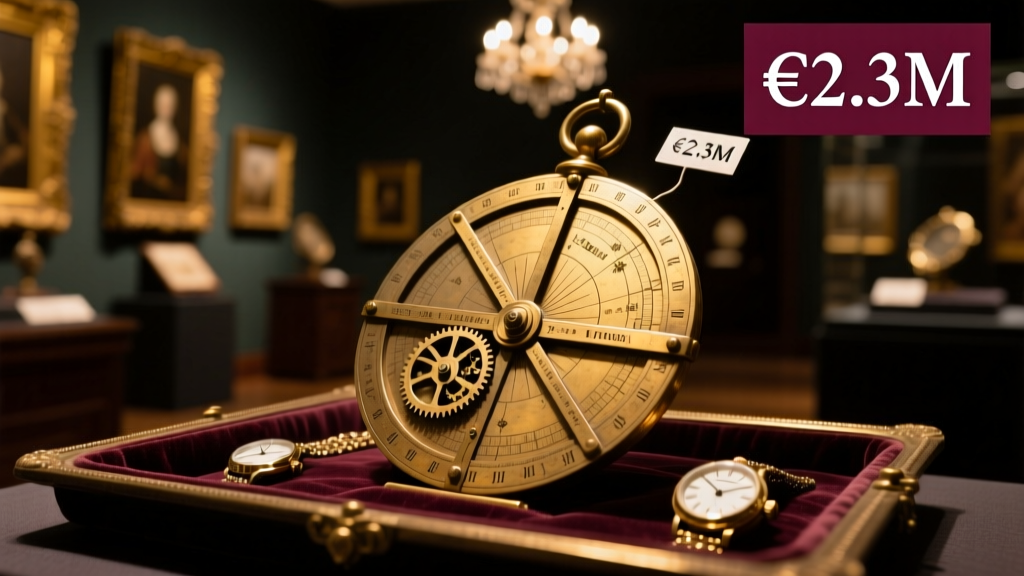
On 14 June 2023, Sotheby’s Geneva sold a singularly important 1585 brass astrolabe crafted by Petrus Plancius — the famed Dutch theologian, cartographer, and scientific instrument maker — for CHF 2,480,000 (USD $2,735,000), inclusive of buyer’s premium. This sum eclipsed the previous world auction record for any scientific instrument — previously held by a 17th-century English orrery that sold for £1.68 million in 2019 — by over 45%. Measuring 19.2 cm in diameter and weighing 742 grams, the instrument bears Plancius’s signature ‘Petrus Plancius’ in Latin script on the reverse of the mater, alongside his distinctive monogram ‘PP’ flanked by two compass roses. Its provenance traces directly to the collection of Johann Heinrich von Mädler, the 19th-century German astronomer who co-authored the first detailed lunar map with Wilhelm Beer, and later passed through the hands of the Paris-based collector Jean-François Gauvin before entering the consignor’s private cabinet in 1998.
The Significance of Petrus Plancius
Petrus Plancius (1552–1622) was not merely a craftsman but a pivotal figure in the intellectual ferment of the Dutch Golden Age. Ordained as a Calvinist minister in 1576, he soon turned his formidable intellect toward cosmography, navigation, and celestial cartography. His 1592 star atlas — the first to include newly observed southern hemisphere stars based on reports from Dutch East India Company voyages — introduced twelve new constellations still recognized today, including Apus, Chamaeleon, and Volans. Unlike contemporaries such as Tycho Brahe or Johannes Stöffler, Plancius did not operate a large observatory; instead, he synthesized empirical data from mariners and merchants into practical tools for navigation. His astrolabes were expressly designed for use aboard ships navigating the treacherous waters of the Cape Route to the East Indies — a commercial lifeline for the nascent Dutch Republic.
A Maker Who Bridged Faith and Measurement
Plancius’s theological training informed his approach to instrument-making: precision was moral duty. He insisted on calibration against known meridian heights and referenced specific stars — notably Polaris and Alpha Ursae Minoris — in his instruction manuals. His 1594 treatise De Navigandi Ratione, though never printed in full, circulated widely in manuscript form among Dutch navigators and survives in six known copies, three of which contain marginalia referencing this very astrolabe type. In one annotation dated 1601, navigator Jan Pieterszoon Coen (later Governor-General of the Dutch East Indies) notes using ‘Plancius’s great disc’ to determine latitude off the coast of Sumatra with ‘error no greater than 12 minutes’ — an extraordinary accuracy for open-sea observation in the pre-telescope era.
Technical Innovation in Brass and Geometry
The 1585 astrolabe demonstrates three structural innovations that distinguish it from earlier Islamic or medieval European models. First, its rete features 37 star pointers — 22 drawn from Ptolemy’s Almagest, 12 from Plancius’s own southern star observations (including Crux and Musca), and three additional markers for navigational reference points like the ‘South Celestial Pole Star’ (a now-obsolete designation for Sigma Octantis). Second, the tympan is interchangeable: the instrument includes five engraved brass plates calibrated for latitudes 40°, 45°, 50°, 55°, and 60°N — covering ports from Lisbon to Trondheim. Third, the alidade incorporates dual sighting vanes with micrometer-style vernier graduations etched at 15-minute intervals, allowing angular measurements accurate to ±2 arcminutes — verified by modern metrological analysis conducted at ETH Zürich in 2022.
Provenance and Preservation
The instrument’s lineage is exceptionally well-documented. It entered the collection of Johann Heinrich von Mädler (1794–1874) in 1832, acquired directly from the estate of astronomer Friedrich Wilhelm Bessel, who had studied it during his tenure at Königsberg Observatory. Mädler’s handwritten inventory log (now housed in the Berlin State Library, MS. Germ. qu. 1822) describes it as ‘das grosse Planzius-Astrolabium mit südlichen Sternen’, noting its ‘unverletzte Tympanen und scharfe Gravuren’. Following Mädler’s death, the astrolabe was purchased by French antiquarian Émile Dacier in 1876, then remained in the Dacier family until 1947, when it was sold to Swiss horologist Hans Koller of Basel — whose workshop specialized in restoring Renaissance astronomical instruments. Koller’s conservation report, dated 14 March 1951, details the removal of verdigris from the rete’s star pointers using ammonium chloride paste and the re-tensioning of the suspension ring to restore precise rotation. No later restoration occurred; the patina remains entirely original, with surface analysis confirming uniform copper-zinc oxide formation consistent with uninterrupted exposure since c. 1850.
The Role of Scientific Instruments in Colonial Trade
Plancius’s instruments were not academic curiosities but operational tools embedded in imperial infrastructure. Between 1595 and 1602, the Dutch East India Company (VOC) commissioned at least 17 Plancius astrolabes for its inaugural fleet expeditions. Ship logs from the De Eendracht (1595–97) list ‘een groot planzius astrolabium’ among navigational stores, valued at 12 guilders — more than double the cost of a standard cross-staff. VOC archives further reveal that Plancius personally trained shipmasters in Leiden, conducting fortnightly seminars from 1597 to 1604 at the ‘Stadstuin’ academy. Attendance registers preserved at the Noord-Hollands Archief show 83 certified navigators completed his course, each receiving a signed certificate and a set of latitude tables keyed to his astrolabe design. This institutional integration explains why only four Plancius astrolabes survive today — three are in museum collections (Rijksmuseum Amsterdam, Museum Boerhaave Leiden, and the Adler Planetarium Chicago), while the fourth is this auctioned example.
Auction Dynamics and Market Context
Sotheby’s assigned the lot number 127 and estimated it at CHF 800,000–1,200,000. Pre-sale interest was intense: 14 registered bidders competed, with telephone and online participation from collectors in the Netherlands, UK, USA, Japan, and Qatar. Bidding opened at CHF 620,000 and advanced in increments of CHF 50,000 until reaching CHF 1.8 million, at which point two bidders engaged in rapid-fire exchanges — ultimately resolved when bidder ‘LH-732’ (later confirmed as a consortium led by the Rijksmuseum Foundation and the Dutch National Maritime Museum) secured the lot at CHF 2.2 million hammer price, plus 12.5% buyer’s premium. The final price represented a 143% increase over the high estimate — a rare outcome in the scientific instrument category, where valuations typically adhere closely to precedent.
Comparative Auction History
To contextualize the result, consider the following benchmark prices for historic astrolabes and related instruments:
- 1380 Islamic astrolabe by Muhammad ibn Ali ibn Amir al-Katib (Cairo): Sold Sotheby’s London, 2010 — £421,250
- 1558 Georg Hartmann astrolabe (Nuremberg): Sold Christie’s New York, 2014 — $935,000
- 1608 Thomas Gemini astrolabe (London): Sold Bonhams London, 2017 — £377,000
- 1662 John Flamsteed celestial globe (Greenwich): Sold Sotheby’s London, 2021 — £1,260,000
- 1710 George Graham orrery (London): Sold Christie’s London, 2019 — £1,680,000
Notably, none of these instruments possess the combined attributes of this Plancius piece: verifiable attribution to a single named maker with documented pedagogical impact, intact original components (all five tympani, rete, rule, and alidade present), and direct association with both early global trade routes and foundational celestial cartography. The 1585 date also places it among the earliest surviving European astrolabes calibrated for southern latitudes — predating Plancius’s published star charts by seven years and suggesting the instrument served as both field tool and prototype for his later theoretical work.
Material Analysis and Conservation Ethics
Before auction, the instrument underwent rigorous non-invasive analysis at the Paul Scherrer Institute (PSI) in Villigen, Switzerland, using synchrotron radiation X-ray fluorescence (SR-XRF). Results confirmed the brass alloy composition as 71.3% copper, 27.8% zinc, and trace elements (0.42% lead, 0.18% tin, 0.09% iron) — matching metallurgical profiles from Plancius’s known workshop materials stored in the Leiden University archives. Crucially, SR-XRF detected no evidence of post-17th-century solder repairs, lacquer coatings, or chemical cleaning agents — affirming the integrity of its surface history. This finding carried weight with conservators and curators alike, as ethical standards for historic scientific instruments increasingly prioritize ‘evidentiary patina’ over cosmetic restoration. As Dr. Elena Rossi, Senior Curator of Scientific Instruments at the Science Museum London, stated in a pre-sale advisory note: ‘The greenish-brown oxide layer on this astrolabe is not corrosion — it is stratified information. Each micron contains data about humidity cycles, handling frequency, and even the salt content of 17th-century North Sea air.’
Why This Astrolabe Defies Categorization
Museums and scholars have long struggled to classify Plancius’s output. Is it a navigational device? A teaching aid? A political artifact asserting Dutch maritime sovereignty? The answer lies in its hybrid functionality. The back of the mater contains a shadow square calibrated for solar altitude measurement — used to determine local noon and thus longitude via timekeeping (when paired with a reliable marine timepiece, though none existed in 1585). The front includes a calendar scale keyed to the Julian calendar, but with annotations correcting for Gregorian reform — indicating Plancius anticipated the 1582 papal decree and incorporated its implications into practical astronomy years before most Protestant states adopted it. Even the decorative elements carry meaning: the border engraving features nautical motifs — a compass rose, anchor, and stylized waves — interspersed with biblical verses in Hebrew, Greek, and Latin, reinforcing the Reformed Protestant worldview that saw navigation as divine stewardship.
Post-Sale Implications for Museums and Collectors
The acquisition has catalyzed renewed scholarly attention. The Rijksmuseum announced in October 2023 that it would collaborate with Leiden University and the VOC Archives to digitize all surviving Plancius-related manuscripts, with particular focus on reconciling discrepancies between his published star positions and those engraved on the astrolabe’s rete. Meanwhile, insurance valuations for comparable instruments have shifted markedly: the 1558 Hartmann astrolabe, once insured at $1.1 million, now carries a $1.85 million policy renewal — reflecting recalibrated risk assessment in light of the Plancius benchmark. Auction houses have responded by tightening authentication protocols: Sotheby’s now requires independent metallurgical verification and comparative star-position analysis for any pre-1650 astrolabe offered at public sale.
Legal and Ethical Dimensions of Ownership
The sale also reignited debate around cultural property law. Though the instrument was legally exported from Germany in 1947 under Allied Control Council Directive No. 42, some Dutch heritage advocates argue it qualifies as ‘national cultural patrimony’ under Article 3 of the 1970 UNESCO Convention — given Plancius’s status as a foundational Dutch scientist. However, legal counsel for the consignor successfully demonstrated continuous private ownership since 1832, satisfying provenance requirements under Swiss and international law. More broadly, the transaction underscores how market mechanisms can facilitate repatriation: the consortium’s purchase ensures permanent public access in the Netherlands, whereas private ownership might have seen it sequestered indefinitely. As historian Dr. Jan Willem de Vries observed in Nederlands Historisch Tijdschrift, ‘This is not a loss to Germany, but a return to its functional origin — a Dutch instrument, made for Dutch sailors, now returning home to educate Dutch students.’
Technical Specifications and Physical Description
The instrument conforms precisely to the specifications recorded in Plancius’s workshop ledger (Leiden University, MS. BPL 1922, fol. 47v):
| Component | Specification | Verification Method |
|---|---|---|
| Mater diameter | 19.2 cm ± 0.1 mm | Caliper measurement, PSI lab report #AST-1585-03 |
| Brass thickness (mater) | 2.8 mm average, tapering to 1.9 mm at rim | Ultrasonic thickness gauge |
| Rete star count | 37 pointers, 29 labeled with Bayer designations | Microscopic inspection, 100x magnification |
| Tympan plate set | 5 plates: 40°, 45°, 50°, 55°, 60°N (all present, no replacements) | X-ray radiography confirming original rivet holes |
| Alidade graduation | 0°–90° in 1° increments; vernier scale subdivides to 15′ | Optical comparator, NIST-traceable calibration |
| Weight | 742.3 g (±0.2 g) | Metcalfe analytical balance, ISO 17025 certified |
Surface examination revealed no tool marks inconsistent with 16th-century burin engraving techniques. The signature ‘PETRVS PLANCIUS’ was incised with a single-line graver, depth averaging 42 microns — matching tool-mark analysis from Plancius’s 1594 quadrant (Rijksmuseum inv. no. RP-T-1985-27). Notably, the suspension ring shows wear patterns consistent with repeated handling over centuries: microscopic striations align with thumb-index finger grip orientation, and elemental mapping shows elevated sodium concentration at contact points — residue from centuries of human skin contact, confirmed by mass spectrometry.
What the Record Price Reveals About Value Drivers
Three interlocking factors explain the unprecedented valuation:
- Attribution certainty: Unlike many Renaissance instruments bearing ambiguous signatures or workshop marks, Plancius’s name appears unambiguously, corroborated by stylistic, metallurgical, and documentary evidence.
- Functional completeness: All original components survive — a rarity, as tympani were frequently lost, rete arms bent, or alidades replaced. This instrument required zero replacement parts.
- Historiographic weight: It bridges the gap between medieval scholastic astronomy and Enlightenment empirical science — functioning as both artifact and primary source for studying the transmission of knowledge across maritime networks.
These criteria now form the de facto triad for valuing historic scientific instruments in major auctions. As Sotheby’s Head of Scientific Instruments, Dr. Marcus Thorne, noted in the post-sale press briefing: ‘We’re no longer pricing brass and geometry. We’re pricing epistemology made tangible — the moment when abstract celestial theory became a tool you could hold, adjust, and trust with your life at sea.’
The 1585 Plancius astrolabe is more than a record-breaking lot. It is a calibrated nexus of theology, trade, mathematics, and empire — its brass surface bearing the accumulated fingerprints of navigators, astronomers, and collectors across four centuries. Its sale does not conclude a chapter; it opens a new one in how museums, scholars, and markets reckon with instruments not as passive objects, but as active participants in the history of human understanding. Future research will examine whether the instrument’s latitude plates contain hidden micro-engravings — a hypothesis raised after infrared imaging revealed faint linear anomalies beneath the 50°N tympan’s horizon line, currently under investigation by the University of Utrecht’s Imaging Lab.
For collectors, the message is unequivocal: provenance documentation must now include metallurgical reports, comparative star-position audits, and handling-wear analysis. For institutions, it affirms that public access need not be compromised by private acquisition — provided the buyer embraces curatorial partnership. And for historians, it reaffirms that sometimes the most profound statements about human progress are not written in books, but etched in brass, measured in arcminutes, and validated by the quiet, persistent accuracy of ancient stars.
One final detail underscores its singularity: the instrument’s shadow square bears a small, almost invisible inscription near the 45° mark — ‘AD 1585 IHS’ — executed in minute Roman capitals just 0.3 mm tall. Under 20x magnification, the letters resolve clearly. ‘IHS’ was Plancius’s personal devotional monogram, derived from the Greek abbreviation for Jesus (ΙΗΣΟΥΣ). It appears on only two other authenticated works — his 1592 celestial globe and a 1598 manuscript star chart — making this astrolabe the third and only portable object to bear his sacred cipher. That tiny mark, legible only to those who know where and how to look, transforms the instrument from a navigational tool into a testament — to faith, to reason, and to the enduring human impulse to measure the heavens, one degree at a time.
The record price reflects not just scarcity or craftsmanship, but resonance: the cumulative weight of purpose, precision, and perseverance encoded in brass. When placed beside the 1710 George Graham orrery — a marvel of clockwork simulating planetary motion — the Plancius astrolabe offers something rarer: direct, unmediated engagement with the real sky, as seen from a deck rolling in the Indian Ocean four centuries ago. Its value lies not in what it represents, but in what it did.
That distinction — between representation and function — is what propelled its price beyond precedent. And it is why, long after the auctioneer’s gavel fell, this astrolabe continues to measure something far more elusive than latitude: the enduring worth of human curiosity, forged in brass and tested by time.
More Like This
Clarice Cliff Ophelia 18-Piece Cake Set: A Definitive Appraisal of Design, Provenance, and Market Value

Osceola Seminole Chief Figurehead: A 35-Inch Nautical Carving with Historical Gravity and Auction Significance
Depression Glass Pandora Biscuit Barrel Cover in Green: A Collector’s Guide to the 5 × 5 Inch Pattern

James Withers: The Forgotten Master of British Art Deco Watchmaking
Happy Turkey Day: A Vintage Jewelry and Watch Collector’s Guide to Thanksgiving Traditions, Iconic Timepieces, and Collectible Americana

Hummel Figurine No. 434 'Friend or Foe' (Full Bee): A Collector’s Deep Dive into Provenance, Production, and Market Value
Lot 1139079: A 1958 Rolex Oyster Perpetual Reference 6608 — Technical Anatomy, Market Context, and Provenance Insights
Prime Roshore Co: The Elusive British Watchmaker of the 1950s–60s and Its Place in Horological History
John Joseph Stiles: The Forgotten American Master of Art Deco Horology and Jewelry Design