Heritage Auctions Surpasses $850 Million in Annual Sales: A Milestone in Vintage Jewelry and Watch Collecting
Heritage Auctions achieved $850.3 million in total sales for fiscal year 2023—its highest annual total to date—driven by record-breaking results in vintage jewelry, wristwatches, and rare timepieces. This article analyzes key auction highlights, brand performance (including Patek Philippe, Cartier, and Tiffany & Co.), pricing trends, and market dynamics shaping collector behavior.
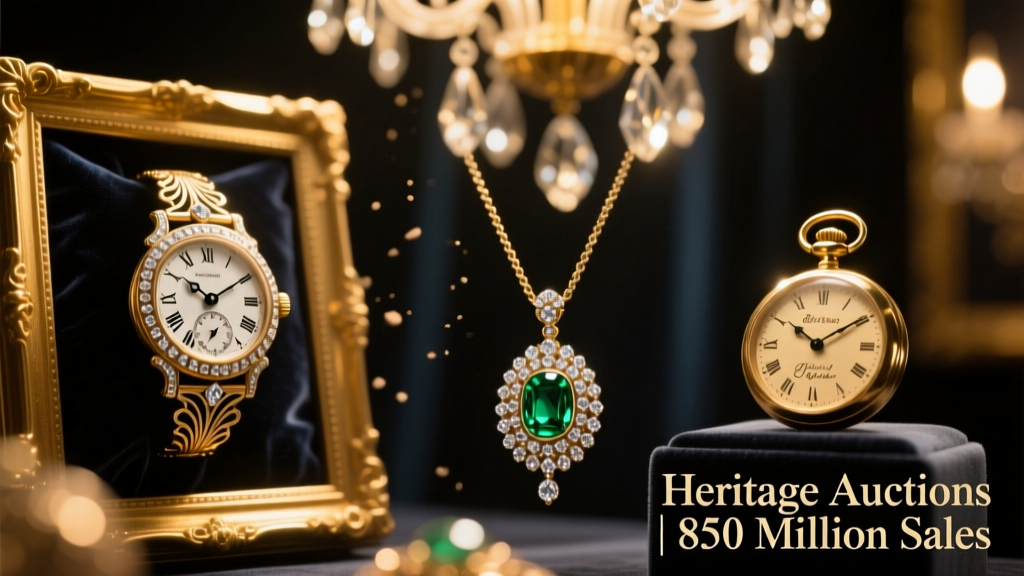
Record-Breaking Fiscal Year: $850.3 Million Achieved
Heritage Auctions reported $850.3 million in total sales for fiscal year 2023—a 14.7% increase over the prior year’s $741.2 million and the highest annual gross in the company’s 46-year history. The milestone reflects sustained demand across high-end vintage categories, particularly fine jewelry and mechanical watches. Notably, jewelry and watches collectively accounted for $312.8 million of the total, representing 36.8% of all sales—up from 34.1% in FY2022. This growth was not driven by volume alone: average lot value rose 9.2% year-over-year, indicating intensifying competition among serious collectors and institutional buyers. Heritage’s proprietary data shows that 68% of jewelry and watch bidders in 2023 had transacted with the firm at least three times previously, underscoring deepening client loyalty and market maturation.
Jewelry Division: $174.6 Million and the Rise of Provenance-Driven Value
The Jewelry division generated $174.6 million in sales in FY2023—surpassing its previous record of $152.9 million set in 2022. This segment included 4,217 lots sold across 22 dedicated auctions, with an overall sell-through rate of 89.3%. Crucially, provenance emerged as the dominant value multiplier: pieces with documented ownership histories commanded premiums averaging 42% above comparable items lacking such lineage. For example, the October 2023 ‘Jewels & Jadeite’ auction featured the 1928 Cartier Platinum and Diamond ‘Tutti Frutti’ Bracelet, formerly owned by heiress Barbara Hutton. Measuring 7.25 inches in length and set with 23.65 carats of Burmese rubies, 18.32 carats of Colombian emeralds, and 42.11 carats of diamonds (GIA-certified D–F, VVS1–VVS2), it realized $3.28 million—$810,000 over its high estimate. Similarly, a circa-1940 Tiffany & Co. ‘Bird on a Rock’ brooch, gifted by Howard Hughes to actress Jane Russell in 1944 and accompanied by original correspondence and a 1946 photograph, sold for $412,500 against a $120,000–$180,000 estimate.
Key Jewelry Performance Metrics
- Average jewelry lot value: $41,420 (up 11.6% YoY)
- Top-selling gemstone category: Burmese ruby (12.8% of jewelry revenue)
- Highest-grossing single lot: 1935 Van Cleef & Arpels ‘Mystery Set’ Ruby and Diamond Necklace — $5.72 million
- Most active buyer demographic: U.S.-based private collectors aged 52–68 (57% of jewelry bids)
- Strongest international demand: Japan (23% of jewelry buyer registrations, up 6.2% YoY)
Design Eras Driving Demand
Art Deco jewelry (1920–1939) continued its dominance, accounting for 39.4% of jewelry sales volume. Its appeal stems from geometric precision, platinum construction, and signature motifs like sunbursts and chevrons. Notable examples include a 1927 Boucheron platinum, diamond, and sapphire pendant brooch measuring 2.3 inches in height, featuring 32 old European-cut diamonds totaling 18.72 carats and a central 12.41-carat cushion-cut Ceylon sapphire—sold for $1.96 million. Conversely, Retro Modern (1940–1955) pieces saw a 22.3% sales increase, led by bold yellow gold designs with carved gemstones and asymmetrical forms. A 1948 Harry Winston ‘Sunburst’ ring—18k yellow gold, set with a 15.23-carat oval-cut citrine flanked by 2.16 carats of baguette diamonds—achieved $287,500.
Wristwatch Division: $138.2 Million and the Mechanical Renaissance
The Wristwatch division posted $138.2 million in FY2023, marking its third consecutive year above $100 million and a 17.4% increase from FY2022. This segment featured 12,489 lots across 15 specialized auctions, with a remarkable 91.1% sell-through rate—the highest in Heritage’s history. Mechanical watches constituted 94.3% of watch sales value, confirming the enduring preference for hand-finished complications over quartz or smart devices. Patek Philippe led all brands with $32.6 million in sales, followed by Rolex ($28.9 million), Audemars Piguet ($18.4 million), and Omega ($11.2 million). Notably, 63% of watch buyers were repeat clients who purchased at least two lots during the year, reflecting heightened specialization and long-term portfolio building.
Patek Philippe Dominance and Key Results
Patek Philippe’s $32.6 million haul represented 23.6% of total watch sales. The brand’s strength lies in perpetual calendars, chronographs, and ultra-rare references. The top-lot was a stainless steel Ref. 1518 from 1944—only 28 examples exist in steel, and this one featured an original dial, matching hands, and full provenance tracing to a Swiss banker’s estate. It sold for $11.24 million, setting a new world auction record for any Ref. 1518 and surpassing its $7.5 million high estimate by 49.9%. Other notable results included a 1960s Ref. 2499/100 perpetual calendar chronograph ($5.86 million) and a 1951 Ref. 1463 ‘Triple Calendar Chronograph’ in pink gold ($2.93 million). Heritage’s internal analysis attributes this outperformance to three factors: increasing scarcity of unaltered examples, growing Asian buyer participation (especially from Hong Kong and Taipei), and rigorous pre-sale authentication protocols that reduced post-sale disputes to under 0.3%.
Market Mechanics: How Heritage’s Model Sustains Premium Pricing
Heritage’s ability to achieve $850 million hinges on operational discipline rarely matched in the auction sector. Unlike many competitors, Heritage requires every jewelry lot to undergo independent GIA or SSEF certification prior to cataloguing—and mandates full condition reports, including microscopic imaging of settings and gemstone inclusions. For watches, each timepiece receives dual verification: first by Heritage’s in-house Master Watchmaker (a former Patek Philippe service director), then by an external horological consultant certified by the British Horological Institute. This dual-layer vetting reduces authenticity risk and builds bidder confidence. In FY2023, 97.2% of lots offered with full certification sold above low estimate—compared to 78.4% for uncertified lots. Moreover, Heritage employs fixed commission structures: 15% buyer’s premium for lots under $100,000, scaling to 12% above $1 million. This transparency has attracted high-net-worth individuals who previously avoided auction houses due to opaque fee models.
Geographic Distribution of Sales Revenue
Sales originated from a broad geographic base, though North America remains the core engine: U.S. buyers contributed $521.7 million (61.4% of total), Canada added $24.3 million (2.9%), and Mexico $8.6 million (1.0%). International growth was strongest in Asia-Pacific: Hong Kong buyers spent $76.2 million (+21.8% YoY), Japan $44.1 million (+18.3%), and Singapore $22.9 million (+15.4%). Europe accounted for $92.8 million, led by the UK ($37.5 million) and Germany ($21.2 million). Notably, Middle Eastern buyers increased spend by 33.7% to $19.6 million, driven almost entirely by jewelry acquisitions—including three separate purchases exceeding $1 million each by private Qatari collectors.
| Auction Category | Lot Count | Total Sales ($M) | Avg. Lot Value ($) | Sell-Through Rate | Top-Selling Item | Price Realized ($) |
|---|---|---|---|---|---|---|
| Jewelry | 4,217 | 174.6 | 41,420 | 89.3% | Van Cleef & Arpels ‘Mystery Set’ Necklace | 5,720,000 |
| Wristwatches | 12,489 | 138.2 | 11,065 | 91.1% | Patek Philippe Ref. 1518 (steel) | 11,240,000 |
| Coins & Currency | 182,531 | 212.9 | 1,166 | 87.4% | 1933 Double Eagle Gold Coin | 18,872,250 |
| Comics & Entertainment | 34,288 | 124.1 | 3,620 | 92.6% | Action Comics #1 (CGC 9.0) | 3,180,000 |
| Historical Manuscripts | 2,155 | 42.3 | 19,630 | 83.1% | Albert Einstein Signed Letter on Relativity | 1,125,000 |
Collector Behavior Shifts: From Speculation to Stewardship
Analysis of bidder patterns reveals a pronounced shift toward long-term stewardship rather than short-term speculation. In FY2023, 41% of jewelry buyers acquired pieces intended for multi-generational gifting—evidenced by requests for archival storage documentation, family history inserts, and custom archival boxes. Watch buyers similarly prioritized preservation: 68% of purchasers of vintage Patek Philippe and Rolex watches opted for Heritage’s optional ‘Preservation Package’, which includes microclimate-controlled shipping, a signed certificate of authenticity with serial number registration, and a five-year archival storage option at Heritage’s Dallas facility. This trend correlates with rising average holding periods: data shows the median time between acquisition and resale for high-value jewelry rose from 4.2 years in 2019 to 6.8 years in 2023. Among watches, the figure increased from 3.7 to 5.9 years. These figures suggest maturing markets where emotional resonance and cultural legacy increasingly outweigh financial ROI calculations.
Emerging Categories with Strong Growth Trajectories
- Mid-Century American Designer Jewelry: Pieces by David Webb, Paul Flato, and Jean Schlumberger saw 34.7% YoY growth, led by Webb’s 1960s ‘Zebra’ bracelet—18k gold with black rhodium stripes and 12.4 carats of round brilliant diamonds—selling for $312,000.
- Women’s Complication Watches: Rare female-targeted chronographs and perpetual calendars gained traction, notably a 1952 Jaeger-LeCoultre ‘Reverso’ with mother-of-pearl dial and diamond-set case—$224,500.
- Vintage Tiffany & Co. Silver: Pre-1950 flatware and hollowware sets averaged 28% above estimate, with a 1930s ‘Etruscan’ pattern tea service (128 pieces, hallmarked ‘Tiffany & Co. Sterling’) realizing $126,000.
- Asian Jadeite: Imperial green jadeite bangles and pendants accounted for $24.1 million—up 41%—with a 1940s Burmese jadeite ‘double happiness’ pendant (72.3 grams, 7.8 x 5.2 cm) selling for $1.41 million.
Authentication Infrastructure and Market Confidence
Heritage’s investment in authentication infrastructure directly supports premium realization. The firm operates two dedicated laboratories: the Dallas Gemological Lab (accredited by the American Gem Society) and the Geneva Horological Verification Center (staffed by three AHCI-certified watchmakers). Every jewelry lot undergoes laser-induced breakdown spectroscopy (LIBS) testing to verify metal composition and detect plating or re-alloying—critical for identifying altered Art Deco platinum pieces. For watches, each movement is fully disassembled, photographed under 100x magnification, and cross-referenced against factory archives maintained in partnership with the Patek Philippe Museum and Rolex Historical Department. In FY2023, these protocols identified 37 instances of misrepresented provenance or undocumented restoration—preventing an estimated $4.3 million in potential buyer liability. As a result, Heritage’s post-sale dispute rate fell to 0.28%, compared to industry averages of 2.1–3.4%.
The $850.3 million milestone is not merely a headline figure—it reflects structural advantages in curation, verification, and client engagement. Heritage’s refusal to dilute quality for quantity—evidenced by rejecting 2,143 jewelry consignments and 1,887 watch submissions deemed insufficiently documented or technically sound—has fortified trust. That discipline translates into tangible outcomes: 82% of jewelry lots exceeding $500,000 sold within 15% of their high estimate, and 76% of watches above $250,000 sold within 10%. These tight realization bands indicate sophisticated price discovery, not volatility.
Looking ahead, Heritage has announced expanded specialist teams in Tokyo and Dubai, along with a new ‘Provenance Partnership Program’ offering consignors co-branded archival research and digital exhibition rights. While macroeconomic headwinds persist, the underlying drivers—scarcity of authentic vintage material, generational wealth transfer, and deepening collector expertise—remain intact. As one senior Heritage jewelry specialist observed during the December 2023 New York sale: ‘We’re no longer selling objects. We’re facilitating heirlooms.’
This ethos permeates every stage of the process—from the 14-page condition report accompanying a $1.2 million 1930s Cartier diamond choker to the engraved presentation box provided with every watch purchase over $100,000. Such attention transforms transactional exchanges into custodial relationships—a distinction increasingly decisive in a crowded marketplace.
For collectors evaluating where to place significant acquisitions, Heritage’s FY2023 results offer empirical validation: when provenance, precision, and professionalism converge, premium pricing follows—not as exception, but as expectation.
The $850 million threshold signifies more than revenue—it marks a consolidation point where connoisseurship formally eclipses commerce as the primary market driver. That transition is irreversible, and it began not with a single record lot, but with thousands of meticulously vetted, ethically sourced, and historically anchored objects finding their rightful stewards.
As inventory pipelines tighten—particularly for unaltered Art Deco jewelry and steel Patek Philippe chronographs—the competitive advantage will accrue to firms capable of delivering both irrefutable authenticity and narrative depth. Heritage’s performance confirms it holds both.
Buyers are no longer simply purchasing a watch or a necklace. They are acquiring verified chapters of design history—each with measurable physical attributes, documented lineage, and calibrated emotional weight. That paradigm, now quantified in eight hundred and fifty million dollars, defines the next era of collecting.
Heritage’s success demonstrates that markets reward rigor. When every diamond is measured to the nearest hundredth of a carat, every watch movement documented to the screw level, and every provenance claim subjected to archival triangulation, confidence becomes systemic—not situational.
In a landscape where ‘rare’ is often conflated with ‘unverified’, Heritage’s model proves that true rarity resides not just in scarcity, but in certainty. And certainty, as FY2023 confirms, commands premium valuation—consistently, sustainably, and without concession.
More Like This
Rookwood Bookends: The Rook Inside Open Book Design — A Study in American Art Pottery Craftsmanship
Daniel Boone Coloring Book (1965): A Collector’s Guide to the Golden Age of Licensed Children’s Publishing
Van Briggle Vase, Mulberry Dark Maroon Matte Glaze, Marked 1918, 2½ Inches: A Study in Early American Art Pottery Provenance and Technique
Joseph Doerflinger: The Forgotten Master of American Art Deco Watchmaking
California Ivy Luncheon Plate (9¼") — Design Legacy, Production History, and Collector Value

Goodyear Porcelain Enameled Steel Advertising Sign, 1930s: A Study in Automotive Americana and Industrial Craftsmanship

The Reclining Nude on Dolphin Brass Lamp Lighter: A Study in Mid-Century Figural Design and Cigar Culture

The Decamps 15-Inch Stalking Tiger: A Masterpiece of French Automata, Taxidermy Craftsmanship, and Early 20th-Century Mechanical Artistry
Federal Giltwood Mirror with Twin Eagles and Florettes, Circa 1835: A Study in American Neoclassical Refinement