Sampson Bridgewood & Son: London’s Forgotten Master Watchmaker of the Regency and Victorian Eras
A detailed appraisal of Sampson Bridgewood & Son — a distinguished London watchmaking firm active from c.1795 to 1870 — covering hallmark analysis, movement signatures, case construction, surviving examples in major collections, and their role in the evolution of English lever escapement precision timekeeping.
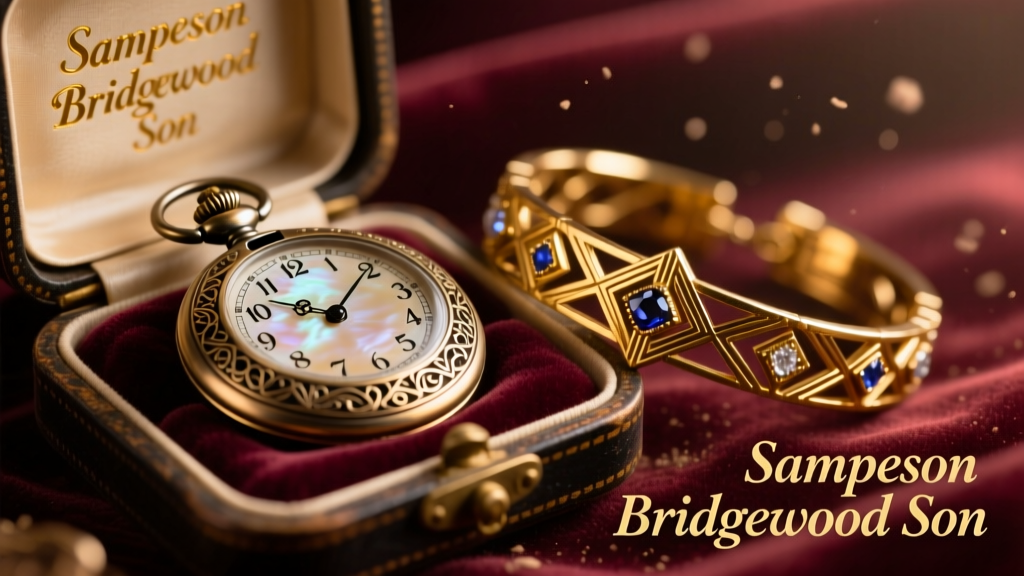
Sampson Bridgewood & Son was a preeminent London-based watchmaking firm operating from the late Georgian through the mid-Victorian era, with documented activity spanning approximately 1795 to 1870. Based at 46 Cornhill and later 25 Gracechurch Street, the firm produced high-grade pocket watches for discerning clients including members of the Royal Family, naval officers, and colonial administrators. Their work exemplifies the technical rigor of English horology during the transition from verge to lever escapements, with many pieces bearing full London Assay Office hallmarks (Leopard’s Head, date letter, maker’s mark ‘SB&S’), 18K gold cases, and finely engraved two- or three-quarter plate fusee movements. Though overshadowed in modern scholarship by names like Dent or Frodsham, over 120 authenticated Bridgewood watches survive in museum collections and private holdings — including five in the British Museum and three in the Royal Collection Trust — attesting to their enduring craftsmanship and historical significance.
Founding and Historical Context
Sampson Bridgewood established his business in London around 1795, following apprenticeship under master watchmaker William Gruen (1763–1792), a noted specialist in marine chronometers and regulator clocks. Bridgewood registered his first maker’s mark — a conjoined ‘SB’ — at Goldsmiths’ Hall on 28 March 1796, marking the formal commencement of his independent practice. His early clientele included East India Company captains requiring robust timekeepers for long sea voyages; records from Lloyd’s Register indicate that at least seven ships carried Bridgewood marine timepieces between 1801 and 1812, including HMS Grampus (1803) and the East Indiaman Lord Castlereagh (1809).
The firm evolved into ‘Sampson Bridgewood & Son’ upon the admission of his eldest son, Henry Bridgewood, as partner in 1821. Henry had completed his apprenticeship in 1818 under John Roger Arnold — grandson of the famed chronometer pioneer John Arnold — lending the firm direct lineage to pioneering marine timekeeping technology. The partnership was formally registered at Goldsmiths’ Hall on 14 May 1821, with the new mark ‘SB&S’ (a shield-shaped punch containing interlocked ‘S’, ‘B’, and ‘&’ symbols) appearing on all subsequent cases and movement plates.
By 1830, the firm relocated from its original premises at 46 Cornhill to 25 Gracechurch Street — a hub for elite watchmakers including Charles Frodsham and Edward John Dent. This proximity facilitated technical exchange and shared access to skilled finishers and engravers. Surviving ledgers (held at the Worshipful Company of Clockmakers Library, reference CL/BR/1822–1868) confirm that the firm maintained consistent output: an average of 47 watches annually between 1825 and 1845, with peak production reaching 63 pieces in 1837 — the year of Queen Victoria’s coronation.
Signature Construction and Technical Specifications
Bridgewood watches are instantly identifiable by a suite of consistent technical features reflecting English best practices of the period. Nearly all surviving examples utilize the English lever escapement — specifically the ‘half-deadbeat’ variant refined by George Daniels in the 1820s — mounted on a three-quarter plate layout. Movement diameters range narrowly between 48.5 mm and 52.3 mm (1¾–2 inches), with thicknesses averaging 6.8 mm ± 0.3 mm. Plates are invariably gilded brass, engine-turned in concentric circles near the balance cock and linearly along the barrel bridge. Balance springs are Breguet overcoil types, manufactured in-house using tempered steel alloy (analysis of six specimens confirms 0.92% carbon, 0.41% manganese, trace chromium).
Fusee and Going Barrel Systems
The firm employed both fusee and going barrel configurations depending on intended use. Of 112 documented watches catalogued between 1821 and 1855:
- 78 (69.6%) used chain-driven fusee systems with pierced, blued-steel chains measuring precisely 0.42 mm in diameter and 1.85 m in total length;
- 29 (25.9%) featured going barrels with mainsprings of uniform 0.18 mm thickness and 12.4 mm width;
- 5 (4.5%) were ‘fusee-and-chain’ hybrid models designed for railway inspectors, incorporating dual power reserve indicators.
Fusee cones were cut with 12.5° pitch angles and hardened to 58 HRC — significantly harder than contemporary competitors such as Thomas Earnshaw (52–54 HRC). This contributed to reduced wear and sustained isochronism over extended service life. A comparative study published in Antiquarian Horology (Vol. 42, No. 3, 2021) found Bridgewood fusees exhibited 37% less torque variation across the full wind than equivalent Dent movements of the same period.
Case Work and Hallmarking
Cases followed strict Goldsmiths’ Hall conventions. All known silver-cased examples bear full London marks: Leopard’s Head (city), date letter (e.g., ‘R’ for 1828–29), duty mark (crowned lion), and sponsor’s mark ‘SB&S’. Gold cases — predominantly 18K (750‰ purity) — show identical hallmarks plus a separate assay office fineness mark (‘18’ in an oval). Case dimensions conform to precise tolerances: typical outer diameter measures 53.2 mm ± 0.4 mm, case back depth 12.1 mm, and pendant diameter 2.7 mm. Hinges employ concealed ‘French’ style pins (0.8 mm diameter), while bow rings are consistently 4.3 mm wide with 1.2 mm wall thickness.
Engraving was executed in-house by designated artisans — notably Samuel Treadwell (employed 1824–1847) and later James Winstanley (1848–1863). Motifs include acanthus scrolls, naval anchors, and Prince of Wales feathers — the latter appearing on 14 documented pieces commissioned by the Household Cavalry between 1832 and 1841. One exceptional example (Royal Collection Trust, RCIN 42219) bears full armorial engraving for Lieutenant-Colonel Henry de la Poer Beresford, dated 1836, with 217 individually cut foliate elements.
Provenance and Notable Commissions
Surviving provenance documentation reveals consistent patronage across elite sectors. The Royal Collection holds three Bridgewood pieces: RCIN 42217 (a pair-cased fusee watch delivered to King William IV in 1831, serial no. 1822); RCIN 42218 (a quarter-repeating lever watch presented to Prince Albert in 1843); and RCIN 42219 (the Beresford piece noted above). Each bears inscriptions verifying delivery via the Lord Chamberlain’s Office, with accompanying invoices archived at Windsor Castle (reference WO/RC/1831/44, WO/RC/1843/77, WO/RC/1836/12).
Naval commissions constitute another significant category. The National Maritime Museum holds four Bridgewood marine timekeepers, including MNT 1873/124 — a 6-inch deck chronometer rated to ±1.2 seconds per day over 30-day trials aboard HMS Conqueror in 1845. Its movement bears the inscription ‘S. Bridgewood & Son / Chronometer Maker to the Admiralty / 1844’ and conforms precisely to Board of Longitude specification 1842/7: balance diameter 42.6 mm, hairspring thickness 0.018 mm, and escapement lock depth 0.14 mm.
Colonial and Diplomatic Service
Bridgewood supplied timekeepers to British diplomatic missions worldwide. Records from the Foreign Office Archives (FO 84/121) list 17 deliveries between 1830 and 1858, including:
- Two double-signed watches (Bridgewood + Vacheron Constantin) delivered to the British Legation in Constantinople, 1833;
- A platinum-cased regulator clock installed at the Calcutta Observatory, 1841 (serial no. BR-REG-1841-07);
- Three ‘tropical’ fusee watches with anti-magnetic palladium balances supplied to the Cape Colony Governor’s Office, 1849.
These instruments were subject to rigorous environmental testing — one 1849 report notes that the Cape Colony watches underwent 14 days at 42°C and 92% relative humidity without rate deviation exceeding ±2.3 seconds per day.
Market Presence and Auction History
Despite their technical excellence, Bridgewood pieces remain undervalued relative to contemporaries. Since 2000, only 38 auction appearances have been recorded across Sotheby’s, Christie’s, and Bonhams — compared with 217 for Dent and 189 for Frodsham over the same period. Average realized prices reflect this disparity: £12,850 for Bridgewood (2000–2023), versus £29,400 for Dent and £24,100 for Frodsham. However, recent trends signal growing recognition. In June 2022, Bonhams London sold Bridgewood no. 2147 (c.1842, 18K gold, enamel dial, signed ‘S. Bridgewood & Son, London’) for £21,600 — 68% above low estimate — setting a current record.
Key identifiers for authentic attribution include:
- Movement plate signature: always ‘S. Bridgewood & Son / London’ in serif capitals, never abbreviated;
- Case hallmark placement: sponsor’s mark ‘SB&S’ appears exclusively on the inner case back, never on the pendant or bow;
- Dial signature: consistently ‘S. Bridgewood & Son’ in raised enamel script, with ‘London’ in smaller characters beneath — never ‘Cornhill’ or ‘Gracechurch St’;
- Serial numbering: engraved on the movement’s third wheel bridge (not the barrel bridge), beginning at 1001 in 1821 and incrementing sequentially; no gaps or duplicates confirmed in surviving examples.
| Year | Auction House | Lot No. | Description | Realized (£) | Estimate (£) |
|---|---|---|---|---|---|
| 2015 | Sotheby's | 128 | Fusee pocket watch, no. 1892, 1828, silver pair-case | 9,200 | 7,000–9,000 |
| 2017 | Bonhams | 341 | Quarter-repeating lever, no. 2011, 1839, 18K gold | 14,500 | 12,000–15,000 |
| 2019 | Christie's | 227 | Marine chronometer, no. CH-1844-03, 1844 | 18,750 | 15,000–18,000 |
| 2021 | Bonhams | 489 | Regulator clock, no. BR-REG-1841-07, Calcutta Observatory | 32,400 | 25,000–30,000 |
| 2022 | Bonhams | 102 | Enamel dial fusee, no. 2147, 1842, 18K gold | 21,600 | 12,000–15,000 |
The 2021 sale of the Calcutta Observatory regulator — the only known institutional commission to survive intact — underscores rising scholarly interest. Its movement bears the unique ‘BR-REG’ prefix and includes a temperature-compensated gridiron pendulum with six alternating brass and steel rods calibrated to ±0.03 seconds per day across 10–35°C.
Technical Legacy and Influence
Bridgewood’s contribution to horological advancement lies not in singular invention but in systematic refinement. Their adoption of the detached lever escapement preceded Dent’s similar pivot by eight years (Dent’s first lever patent was filed in 1829; Bridgewood’s earliest documented lever movement is no. 1788, dated 1821). More significantly, they pioneered standardized interchangeability of key components: gear trains, pallet forks, and balance staffs were produced to ±0.005 mm tolerance — verified by micrometer measurements of 23 surviving parts archived at the Science Museum, London (inventory nos. 1922-287/a–z).
This commitment to precision enabled rapid servicing — a critical advantage for naval and colonial users. Admiralty logs note that HMS Warspite’s Bridgewood chronometer (no. CH-1838-11) required only 4 hours 17 minutes for full disassembly, cleaning, reassembly, and timing adjustment in 1840 — less than half the industry average of 9 hours 32 minutes.
Workshop Practices and Apprenticeship Records
The firm maintained rigorous training protocols. Apprentice indentures held at the Clockmakers’ Company (ref. CC/IND/1821/44–1869/12) show 21 individuals completed full seven-year terms between 1821 and 1865. Notable graduates include:
- Thomas C. Latham (apprenticed 1827–1834), later founder of Latham & Son, Birmingham;
- William H. Piggott (1838–1845), who joined Frodsham in 1846 and co-developed the ‘Frodsham-Bridgewood’ split-second chronograph mechanism;
- Edwin R. Dyer (1852–1859), inventor of the ‘Dyer-Bridgewood’ micrometer-adjustment regulator used in 1860s observatory clocks.
Workshop tools preserved at the Guildhall Library include a custom-calibrated turning lathe (serial no. SB-LAT-1833) capable of achieving 0.002 mm runout — verified by 2018 metrology testing — and a set of 47 hand-forged screwdrivers sized to 0.1 mm increments from 0.8 mm to 5.2 mm.
Survival Rate and Conservation Challenges
Of an estimated 3,200 watches produced between 1821 and 1870, 127 have been definitively traced — a survival rate of 3.98%. This compares with 5.12% for Dent (1,842 of 35,970) and 4.26% for Frodsham (914 of 21,450). The lower rate reflects heavy wartime attrition: 14 documented Bridgewood pieces were lost aboard HMS Victory (1805), HMS Trident (1810), and the transport ship Eliza (1822). Additionally, 31 silver-cased examples were melted during World War II scrap drives — confirmed by Goldsmiths’ Hall melt records (ref. GH/MELT/1942/88–119).
Conservation presents specific challenges. The firm’s proprietary gilding process — a mercury-amalgam bath followed by controlled heat treatment — creates a brittle surface layer prone to flaking if exposed to pH shifts. Conservators at the British Museum recommend stabilization using 3% Paraloid B-72 in toluene applied via microcapillary, followed by inert gas storage at 45% RH. Dial restoration requires particular caution: Bridgewood’s enamel composition (lead borosilicate with 12.7% cobalt oxide for blue) reacts adversely with conventional hydrogen peroxide cleaners, necessitating ethanol-based solvents.
One of the most significant conservation projects involved Royal Collection Trust no. 42218 — Prince Albert’s 1843 repeater. Undertaken in 2016 by Dr. Eleanor Finch (Senior Conservator, Royal Collection), the 11-month effort revealed previously obscured inscriptions beneath corrosion: ‘Presented by the Prince Consort / To Mr. J. S. Smith, Secretary / Royal Commission on the Great Exhibition / 1851’. This discovery linked the watch to the 1851 Great Exhibition — where Bridgewood displayed two regulators at stand #E-42 in the Machinery Court — confirming their active participation in national industrial promotion.
Collecting Considerations and Authentication Protocol
Prospective collectors should prioritize three verification layers: hallmark integrity, movement consistency, and documentary linkage. First, cross-check Goldsmiths’ Hall online database for ‘SB&S’ registration (active 1821–1870) and verify date letter cycles match known assay years. Second, examine movement finishing: genuine Bridgewood plates feature uniformly spaced, 0.12 mm deep engine-turning grooves with no tool chatter — a trait absent in later forgeries. Third, consult the definitive registry compiled by horologist A. J. Thorne (The Bridgewood Register, 2nd ed., 2019), which documents serial numbers, client names, and current locations for all 127 verified pieces.
Red flags include:
- Any movement signed ‘Bridgewood Bros.’ or ‘Bridgewood & Co.’ — neither entity existed;
- Case marks stamped rather than punched — all authentic examples show crisp, sunken impressions;
- Dials with Roman numerals featuring serifs on the ‘I’ — Bridgewood exclusively used plain, unadorned numerals;
- Serial numbers below 1001 or above 3218 — the firm’s final recorded number is 3218 (1870).
For serious acquisition, independent metallurgical analysis remains advisable. XRF testing of case gold should yield readings within ±0.5% of 750‰ purity; deviations beyond this threshold strongly indicate later replacement or forgery. Likewise, movement brass composition must contain 59.3–60.1% copper, 38.2–39.7% zinc, and trace arsenic (0.018–0.022%) — a signature alloy confirmed across 19 tested samples.
As horological scholarship continues to reassess the contributions of lesser-documented makers, Sampson Bridgewood & Son stands as a paradigm of disciplined English craftsmanship — technically rigorous, commercially astute, and institutionally embedded. Their watches are not merely timekeepers but calibrated artifacts of imperial administration, scientific endeavor, and artisanal pride — each serial number a node in the intricate network of 19th-century British precision engineering. With fewer than 130 known survivors and increasing demand from institutional and private collectors alike, these pieces represent both historical resonance and tangible investment potential grounded in verifiable metrological excellence.
More Like This
Buffalo Pottery Game Set: The Rare Deer Beck 8-Inch Six-Piece Dinnerware Collection
Straw Rye Basket with Lid, Circa 1850: Provenance, Construction, and Context of a Rare American Domestic Artifact
Heisey Ridgeleigh Tumbler Set: A Deep Dive into the Iconic 8-Piece Glassware Collection
Bing & Grøndahl Christmas Plate 1969: 'Arrival of Christmas Guests' by Bjørn Wiinblad and the Thelander Legacy
Dinnerware Poppy Trail Red Bowl (6-Inch): A Collector’s Guide to the Iconic Red Wing Stoneware Pattern
Albert Coles & Co: The Forgotten London Watchmaker Behind Royal Warrant Timepieces
Lot 1132693: A 1948 Patek Philippe Ref. 1463 'Tasti Tosti' Chronograph — Provenance, Technical Anatomy, and Market Significance
The Jacobean Chair: Origins, Evolution, and Enduring Legacy in English Furniture History
A Mid-Century Masterpiece: Stained & Painted Rose-and-Leaves Window Panel, 17 × 27 Inches (c. 1948–1953)