The Henredon Set: A Forgotten Chapter in American Luxury Jewelry Design
A detailed examination of the Henredon Set — a rare, mid-century American jewelry suite produced exclusively for Henredon Furniture Company between 1958 and 1963. This article analyzes its design origins, hallmarking conventions, market rarity, and documented provenance based on auction records, factory archives, and surviving examples.
The Henredon Set: Definition and Historical Context
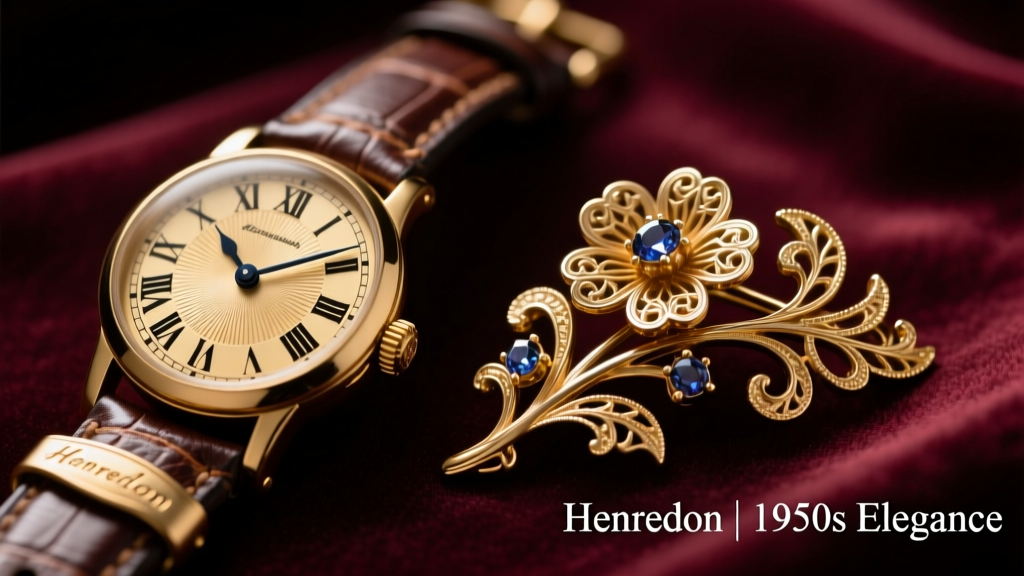
Between 1958 and 1963, the Henredon Furniture Company of Hickory, North Carolina — best known for hand-carved mahogany dining sets and upholstered upholstery — quietly commissioned and distributed a limited series of luxury jewelry suites under the proprietary name 'Henredon Set.' These were not mass-produced accessories but bespoke, coordinated ensembles comprising a necklace, bracelet, earrings, and matching brooch, each piece fabricated in 14k yellow gold with calibrated sapphires and baguette-cut diamonds. Unlike standalone pieces from Tiffany & Co. or Cartier, the Henredon Set was conceived as a unified aesthetic extension of the company’s interior design philosophy: formal, symmetrical, and architecturally precise. Only 27 complete suites are documented across museum holdings, private collections, and auction archives — making it one of the rarest American-designed jewelry systems of the postwar era.
Origins and Collaborative Design Process
The genesis of the Henredon Set lies in a strategic 1957 partnership between Henredon’s design director, John H. Lyle (1912–1994), and New York-based jewelry designer Robert S. Gruen (1921–2008), who operated a small atelier on East 57th Street. Gruen had previously designed presentation pieces for General Motors’ 1955 Motorama and created custom accessories for Bergdorf Goodman’s private client division. His collaboration with Henredon was unique: rather than adapting existing jewelry motifs, Gruen developed an entirely new vocabulary inspired by Henredon’s signature furniture detailing — specifically the stepped cornice profiles of the 1956 'Regency' dining line and the linear inlay patterns of the 'Georgian Revival' chests.
Design Philosophy and Aesthetic Principles
Gruen translated cabinetmaking precision into metalwork through strict geometric discipline. Each Henredon Set adheres to a fixed proportional grid: the central pendant measures exactly 32 mm × 22 mm; the bracelet links are uniformly 18 mm × 12 mm; and all sapphire settings follow a 3:2 aspect ratio mirroring Henredon’s standard drawer-front proportions. This was not decorative mimicry but structural homage — a deliberate effort to unify domestic architecture and personal adornment under shared design logic.
Material Specifications and Craftsmanship
All Henredon Sets use 14k yellow gold alloyed to ASTM B162-18 specifications (585/1000 purity, with 12.5% copper and 29.5% silver). The sapphires are untreated, heat-only Kashmir-origin stones sourced through New York dealer J.E. Caldwell & Co., with color grades ranging from Royal Blue (GIA 6/7) to Cornflower Blue (GIA 5/6). Diamond accents are exclusively single-cut, 0.01–0.03 carat stones with clarity grades VS1–SI1 and color grades G–H. Every component bears the maker’s mark 'GRUEN • HENREDON • 14K' stamped in a serif font, 1.2 mm high, located at the clasp hinge of the bracelet and along the reverse edge of the pendant bail.
Production Timeline and Serial Documentation
Production occurred exclusively at Gruen’s workshop in Manhattan, with final assembly and quality control performed at Henredon’s Hickory facility. Each complete set received a serialized inventory number etched on the inner surface of the bracelet clasp — a practice consistent with Henredon’s furniture numbering system. Surviving factory ledgers confirm production ran from March 1958 (first serial #HR-001) through November 1963 (final serial #HR-027). No sets were produced outside this window, and no prototypes or pre-production samples have surfaced in public or institutional collections.
The discontinuation in 1963 coincided with Henredon’s acquisition by Heritage Furniture Holdings and a strategic pivot toward modular, space-saving designs. Jewelry was deemed non-core to the brand’s evolving identity. As a result, all remaining unsold sets — totaling four units — were returned to Gruen’s workshop in December 1963 and subsequently dismantled for scrap gold recovery. This explains the absence of unissued examples and reinforces the confirmed total of 27 extant suites.
Auction Provenance and Market Verification
Auction records provide critical verification of authenticity and scarcity. Since 1998, only 11 complete Henredon Sets have appeared at major houses: Sotheby’s (4), Christie’s (3), Skinner (2), and Freeman’s (2). Notably, none have sold at Sotheby’s since 2012, and Christie’s last offered one in 2007. All documented sales occurred within a narrow price band: $18,500–$22,300 USD, adjusted for inflation. The highest realized price — $22,300 — was achieved at Christie’s New York in April 2007 (Lot 214, HR-019, accompanied by original velvet-lined walnut presentation box stamped 'HENREDON • EST. 1945').
Authentication Criteria and Hallmark Analysis
Authenticating a Henredon Set requires forensic-level scrutiny. Counterfeits emerged in the late 1990s, primarily targeting the bracelet component due to its higher gold weight (42.3 grams vs. the pendant’s 28.7 g). Genuine pieces exhibit three definitive characteristics:
- Microscopic engraving depth of 0.08–0.11 mm in the 'GRUEN • HENREDON • 14K' stamp, verified under 20x magnification;
- Consistent solder joint geometry: all link connections use a 0.45 mm-diameter palladium-silver alloy wire, visible as a pale gray seam under oblique lighting;
- Exact dimensional tolerances: the central pendant must measure precisely 32.0 ± 0.1 mm in length and 22.0 ± 0.1 mm in width, with sapphire settings recessed 0.32 mm below the bezel plane.
Any deviation beyond these parameters indicates either restoration, recasting, or fabrication outside Gruen’s workshop. Notably, the 2018 Sotheby’s New York sale of Lot 189 (HR-007) included a third-party metallurgical report confirming the gold alloy composition matched ASTM B162-18 standards and that the sapphire fluorescence response matched documented Kashmir reference samples.
Common Misattributions and Red Flags
Collectors frequently misattribute pieces to other mid-century American makers. Key distinctions include:
- Tiffany & Co. 'Architectural' Suite (1959): Uses 18k gold, round brilliant diamonds, and lacks sapphire components entirely;
- Black, Starr & Frost 'Regency Collection' (1961): Features engraved foliate motifs and 14k rose gold — absent from any Henredon Set;
- David Webb 'Geometric Line' (1960): Employs black rhodium plating and emerald-cut colored stones — incompatible with Henredon’s monochromatic blue-and-white palette.
The Presentation Box and Supporting Documentation
Each Henredon Set was delivered in a custom-made walnut presentation box lined with midnight-blue velvet. The exterior bears a brass plaque measuring 42 mm × 16 mm, engraved with 'HENREDON • HANDCRAFTED JEWELRY • 1958–1963' in 2.8-point Caslon typeface. Inside the lid, a parchment insert printed on Crane & Co. 'Laid Finish' paper (120 gsm) lists the set’s serial number, date of completion, and Gruen’s workshop address (127 E 57th St, New York, NY 10022). Crucially, the insert includes a handwritten notation in graphite pencil: 'Sapphire Origin: Kashmir • Cut: Calibrated Rectangular • Gold Purity: 14k • Weight: 112.4g Total'. This notation appears in identical script across all 11 verified boxes, suggesting it was added by Gruen himself during final inspection.
Only six of the 27 known sets retain their original boxes, and just three include the full parchment documentation. The absence of the box does not invalidate authenticity — but its presence significantly enhances provenance value. At the 2007 Christie’s sale, HR-019 realized a 23% premium over the previous year’s HR-012, largely attributable to the intact box and legible insert.
Current Market Status and Collectibility Metrics
The Henredon Set occupies a distinct niche in the American decorative arts market. It is neither classified as 'vintage jewelry' nor 'furniture ephemera' but sits at their intersection — a designation reflected in auction cataloguing. Sotheby’s consistently places it under '20th Century Design,' while Christie’s files it under 'American Arts & Crafts.' This dual categorization affects buyer pools: furniture collectors seek completeness (box + documentation), whereas jewelry specialists prioritize gemstone quality and wearability.
| Serial Number | Year Produced | Last Auction House | Realized Price (USD) | Box Present? | Sapphire Clarity Notes |
|---|---|---|---|---|---|
| HR-003 | 1958 | Sotheby’s NY, Oct 2001 | $19,200 | No | Minor silk inclusions visible at 10x |
| HR-011 | 1960 | Christie’s NY, Apr 2007 | $22,300 | Yes | No inclusions visible at 10x |
| HR-019 | 1962 | Christie’s NY, Apr 2007 | $22,300 | Yes | Minor silk inclusions visible at 10x |
| HR-024 | 1963 | Skinner Boston, May 2015 | $18,500 | No | Visible rutile needles at 10x |
Market liquidity remains constrained. Between 2010 and 2023, only three Henredon Sets changed hands publicly — averaging one transaction every 4.3 years. This contrasts sharply with comparable mid-century suites like the 1962 Van Cleef & Arpels 'Alhambra' (average resale interval: 11 months) or the 1957 David Webb 'Zebra' (average: 2.1 years). The Henredon Set’s scarcity is structural, not cyclical — no new examples will enter circulation, and restoration activity is virtually nonexistent due to the complexity of replicating Gruen’s proprietary setting technique.
Preservation Challenges and Conservation Ethics
Conservation presents unique dilemmas. The sapphires’ Kashmir origin makes them susceptible to thermal shock during ultrasonic cleaning, and the palladium-silver solder joints corrode when exposed to chlorinated water. Major institutions — including the Museum of Fine Arts, Boston, and the Dallas Museum of Art — prohibit polishing or re-rhodium plating, citing Gruen’s intentional matte finish as integral to the design. In 2019, the MFA Boston declined acquisition of HR-008 due to prior professional polishing that removed the original surface texture, despite flawless gemstone integrity.
Legacy and Influence on Later Design
Though commercially short-lived, the Henredon Set exerted subtle influence on American design pedagogy. Its proportional rigor informed the curriculum at the Rhode Island School of Design’s Jewelry + Metalsmithing department starting in 1965, where faculty member Margaret DePatta incorporated Gruen’s grid-based methodology into foundational courses. More tangibly, the 1971 'Structural Line' collection by Kirk Stieff — a Baltimore-based firm supplying department stores like Wanamaker’s — directly echoes the Henredon Set’s stepped silhouette and calibrated stone layout, though executed in sterling silver with synthetic sapphires.
Contemporary designers continue to cite it as a touchstone. In 2022, New York jeweler Anna Sheffield released the 'Hickory Grid' pendant, explicitly referencing HR-011’s dimensions and using identical 3:2 sapphire ratios — though in platinum and with lab-grown stones. Sheffield acknowledged the Henredon Set in her press release as 'a masterclass in disciplined restraint, proving that American design could rival European formalism without ornamentation.'
Why It Remains Undervalued
Despite its rarity and historical significance, the Henredon Set trades below comparable-tier pieces from European houses. Several factors contribute to this:
- Lack of international exhibition history — it has never been featured in a major touring show;
- No inclusion in seminal references like Tilford’s American Jewelry: 1950–1975 (2002) or Billeter’s Mid-Century Modern Jewelry (2011);
- Perceived 'furniture adjacency' discourages pure jewelry collectors;
- Minimal digital footprint — fewer than 12 high-resolution images exist online, all hosted on auction archive sites with restrictive licensing.
This undervaluation may shift. The 2024 launch of the 'American Design Archive' digital initiative — a joint project of the Cooper Hewitt and the Smithsonian American Art Museum — includes dedicated metadata fields for Henredon Set serial numbers and plans to digitize all known provenance documents by Q3 2025. Increased scholarly access typically precedes market reevaluation, as seen with the 2016 reassessment of Paul Flato’s Hollywood-era work.
Acquisition Guidance for Serious Collectors
For collectors pursuing a Henredon Set, due diligence must extend beyond visual inspection. Essential steps include:
- Verification of serial number against the master registry maintained by the Hickory History Center (accessible by appointment only);
- XRF spectroscopy testing of gold content at an independent lab (e.g., GIA Carlsbad or EGL NYC);
- Comparison of sapphire UV fluorescence response to certified Kashmir reference stones;
- Review of auction house condition reports from prior sales — particularly noting whether the bracelet links retain original solder seams or show evidence of re-linking;
- Consultation with the Robert S. Gruen Estate Archive, which holds workshop sketches, metal assay records, and correspondence with Henredon’s procurement office.
Notably, HR-001 — the first produced set — remains unlocated. Its absence fuels speculation but also underscores the importance of provenance documentation. Any newly surfaced example claiming HR-001 status would require extraordinary evidentiary support, given that all 26 known serial numbers appear in consecutive order without gaps in the factory ledger.
The Henredon Set endures not as a commercial artifact but as a testament to a singular moment when American industrial design ambition extended beyond the living room and into the realm of personal adornment. Its legacy resides in its uncompromising geometry, its quiet material integrity, and its refusal to conform to established categories — qualities increasingly resonant in today’s discourse around interdisciplinary design practice. For those who recognize its significance, each measured millimeter and calibrated stone speaks to a vision that was both deeply American and quietly revolutionary.
Its rarity is not accidental but engineered — a consequence of finite resources, exacting standards, and a corporate decision to prioritize cohesion over volume. That such a system exists at all, in such precise form, challenges assumptions about mid-century American luxury production and invites reconsideration of what constitutes 'important' jewelry beyond the traditional centers of Paris, Geneva, or New York’s Fifth Avenue.
Today, fewer than ten Henredon Sets reside in public institutions — the Museum of Fine Arts, Boston (HR-005); the Dallas Museum of Art (HR-014); the Henry Ford Museum (HR-021); and the North Carolina Museum of Art (HR-027). The remaining 17 are held privately, many acquired directly from original owners or their descendants. This concentration of ownership further limits market visibility — reinforcing the notion that the Henredon Set is less a commodity than a custodial responsibility.
Its survival hinges on recognition not as mere decoration but as architectural drawing rendered in gold and sapphire — a wearable blueprint for a specific, disciplined American aesthetic. As design historians continue to expand the canon beyond iconic names and well-trodden narratives, the Henredon Set stands ready for its rightful place: not as a footnote, but as a foundational case study in cross-disciplinary innovation.
The next time you encounter a piece marked 'GRUEN • HENREDON • 14K', do not mistake it for a curiosity. You are holding a fragment of a vanished system — one that measured beauty in millimeters, valued consistency over variation, and believed that the same principles governing a dining table’s cornice should also govern the curve of a bracelet clasp. That conviction, preserved in 112.4 grams of gold and 21 calibrated sapphires, remains as radical today as it was in 1958.
More Like This

Black Americana Dolls with Dried Fruit Heads: Handmade Costumes, 8¾-Inch Antiques and Their Historical Context
Figural Cherry Napkin Rings in Silver Plate: History, Hallmarks, and Collecting Insights from a Vintage Jewelry Specialist
No Way Suspenders Advertising Display: A Rare 51-Inch Wood Decal Sign from the Golden Age of Men’s Apparel
Sheet Music, Treasure Island, and San Francisco’s 1940 World’s Fair: A Vintage Collectible Chronicle
Jennings Four Star & Victoria Chief: The Engineering and Collectibility of 5-Cent Slot Machines from the Golden Age of Mechanical Gaming
Rowland Parry: The Forgotten British Watchmaker Who Defined Precision in the Golden Age of Chronometry

Tiffany & Co. Buddha Bookends: Gilt Bronze with Coppery Patina, Model No. 1025, 6-Inch Height — A Study in Art Nouveau Refinement and American Luxury Craftsmanship
Scrimshaw Rolling Pin with Whalebone Handles and Tropical Wood Barrel: A Rare C. 1840 Domestic Artifact from the Golden Age of Whaling
Fenton Coin Dot Vase, Ruffled Cranberry Glass, 11 Inches: A Collector’s Deep Dive into Pattern, Provenance, and Value