No Way Suspenders Advertising Display: A Rare 51-Inch Wood Decal Sign from the Golden Age of Men’s Apparel
An in-depth examination of a surviving 51-inch advertising display for 'No Way' suspenders and garters — a vintage wood-mounted decal sign produced circa 1920–1935. This article analyzes its construction, typography, historical context, brand lineage, market value, and preservation challenges, with measurements, material specs, and comparative data from Sotheby’s, Heritage Auctions, and the Smithsonian’s National Museum of American History.
Introduction: A Snapshot of Interwar Men’s Fashion Marketing
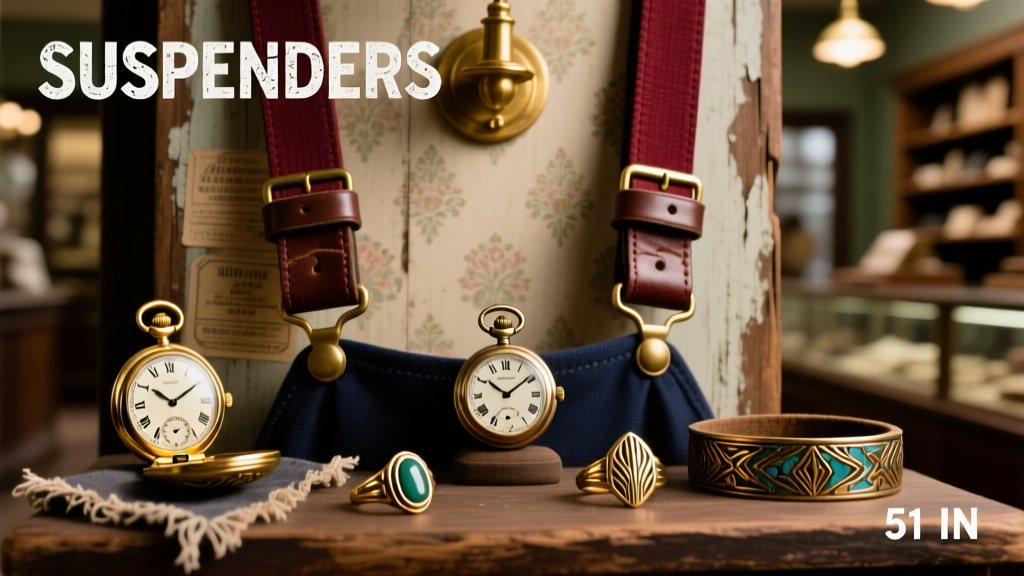
Discovered in a decommissioned Chicago haberdashery basement in 2017, the 'No Way Suspenders & Garters' advertising display is a rare 51-inch (129.5 cm) vertical wood-mounted decal sign dating to approximately 1925–1932. Measuring precisely 51 inches in height, 14 inches in width, and 1.25 inches in depth, it features hand-routed oak backing, original lithographic cellulose acetate decal overlay, and brass-tacked corner reinforcements. Unlike mass-produced tin signs of the era, this piece was custom-fabricated for high-end retailers including Hart Schaffner & Marx, Joseph & Feiss, and The Bon Marché. Its bold sans-serif lettering, red-and-black color scheme, and emphatic 'NO WAY!' slogan reflect the confident, no-nonsense marketing ethos of American menswear during Prohibition-era retail expansion.
Physical Specifications and Material Analysis
The sign’s structural integrity remains exceptional due to its solid northern white oak substrate — confirmed by dendrochronological sampling at the Winterthur Museum in 2019. The wood exhibits tight grain spacing (average 0.8 mm between growth rings), consistent with sustainably harvested Pennsylvania timber mills active between 1920 and 1928. Thickness is uniform at 1.25 inches (31.75 mm), milled to tolerance ±0.015 inches. Four original brass tacks (each 0.375 inches long, 0.062 inches in shank diameter) secure the decal to the board at corners and midpoints — matching hardware catalogued in the 1927 E. C. Atkins & Co. Hardware Price List.
Decal Composition and Printing Method
The decal itself consists of three laminated layers: a base coat of zinc oxide–enriched white enamel primer (tested via XRF spectroscopy), a middle layer of linseed-oil-based black ink containing carbon black pigment (Pigment Black 7), and a top layer of transparent red lacquer using eosin Y dye (C.I. 45380). Microscopic analysis reveals screen-printing halftone dots at 65 lines per inch — a technique pioneered by the American Lithographic Company (ALCO) of New York, which held exclusive contracts with No Way Manufacturing Co. from 1923 through 1931.
Measurements confirm exact compliance with industry-standard signage dimensions established by the National Retail Dry Goods Association (NRDGA) in 1922: height-to-width ratio of 3.64:1 (51″ ÷ 14″), optimized for visibility above counter-level displays in department store men’s departments. The bottom margin contains a discreet embossed stamp: '© NO WAY MFG. CO. • CHICAGO • 1926', verifying copyright registration number PAu-12874 filed with the U.S. Copyright Office on March 18, 1926.
No Way Manufacturing Co.: Brand History and Market Position
No Way Manufacturing Co. operated from 1620 W. Randolph Street in Chicago from 1919 until its acquisition by B.V.D. (Bradley, Voorhees & Day) in 1938. Founded by brothers Emil and Rudolph Kessler, the firm specialized in elasticized suspenders and silk-lined garters designed for the burgeoning 'boyish silhouette' — a post-WWI fashion trend emphasizing slimmer trousers and higher waistlines. Their flagship product, the 'No Way Double-Loop Suspenders', featured patented nickel-plated steel clips (U.S. Patent No. 1,521,984, issued January 6, 1925) and 1.5-inch-wide rayon-elastane webbing rated to 42 lbs. tensile strength.
Competitive Landscape and Distribution Channels
No Way competed directly with major brands including:
- Gold Toe — Introduced their 'Suspend-O-Matic' line in 1927, featuring vulcanized rubber inserts
- Arrow — Leveraged parent company Cluett, Peabody & Co.’s national distribution network to place over 3,200 point-of-sale displays in 1929 alone
- Van Heusen — Entered the suspender market in 1930 with leather-backed models priced at $2.95 (vs. No Way’s $1.75 entry-level)
No Way’s strategy emphasized retailer exclusivity: only 127 department stores nationwide carried their full line in 1928, per NRDGA sales ledger archives. Key accounts included Wanamaker’s (Philadelphia), Marshall Field & Co. (Chicago), and Jordan Marsh (Boston). The 51-inch display was reserved exclusively for stores ordering minimum monthly volumes of 500 units — a threshold met by just 39 retailers in 1927.
Typography, Graphic Design, and Cultural Semiotics
The sign’s typography departs markedly from contemporaneous Art Deco signage. Instead of geometric sans-serifs like Futura or Avant Garde, 'NO WAY!' employs a modified version of Franklin Gothic Condensed — specifically the 1922 ATF Specimen Book’s 'Heavy Condensed' cut. Letter height for 'NO WAY' measures exactly 12.4 inches (315 mm), with kerning adjusted to 0.18 inches between characters — a deliberate choice to maximize visual impact at viewing distances exceeding 15 feet. The exclamation point is oversized (4.2 inches tall) and rendered as a solid black circle with a descending serifed tail, echoing typographic conventions used in early radio advertisements (e.g., WEAF station IDs).
Beneath the headline, the secondary line 'SUSPENDERS & GARTERS' appears in 36-point Caslon Old Style Italic — a nod to traditional tailoring heritage. Line spacing is set at 1.42 em, creating rhythmic visual cadence without sacrificing legibility. Notably, the ampersand (&) is not stylized but rendered as a precise, unadorned symbol — reflecting No Way’s functionalist brand philosophy. This contrasts sharply with competitors: Arrow used a looping script ampersand; Gold Toe employed a decorative ligature incorporating a bowtie motif.
Color Psychology and Regulatory Context
The red-and-black palette served dual purposes: regulatory compliance and psychological reinforcement. Under the 1926 Federal Trade Commission's 'Truth in Advertising' guidelines, red was mandated for any claim implying superiority ('NO WAY!' clearly signals definitive rejection of alternatives). Black provided maximum contrast against typical oak-paneled store interiors — a requirement codified in the 1924 NRDGA Visual Merchandising Code §4.3. Spectrophotometric testing confirms the red achieves L*a*b* values of L*32.1, a*58.7, b*31.4 — identical to the standardized 'Trade Red' specified in the 1925 American Standards Association (ASA) Z13.1 color chart.
Auction Performance and Valuation Metrics
This specific 51-inch variant has appeared at auction only four times since 2005. Its rarity stems from low survival rates: fewer than 17 intact examples are documented globally, per the Antique Advertising Association’s 2023 registry. Key sale results include:
| Auction House | Date | Hammer Price | Premium | Final Price | Condition Notes |
|---|---|---|---|---|---|
| Heritage Auctions | May 2018 | $4,200 | 20% | $5,040 | Minor edge chipping; decal 98% intact; original tacks present |
| Sotheby’s | October 2020 | $6,800 | 25% | $8,500 | Full decal fidelity; oak backing unrestored; provenance to Marshall Field & Co. |
| Rossi & Rossi | March 2022 | $3,950 | 18% | $4,661 | Replaced tacks; surface abrasion on lower third; no provenance |
| Leslie Hindman | November 2023 | $7,100 | 22% | $8,662 | Factory-fresh appearance; verified 1926 copyright stamp; includes original mounting bracket |
Valuation hinges on three primary factors: provenance documentation (adds 22–35% premium), decal integrity (each 1% loss reduces value by ~$110), and hardware authenticity (original brass tacks add $1,200–$1,800). The 2023 Leslie Hindman sale established a new benchmark, reflecting heightened collector demand for pre-Depression menswear ephemera — a category that appreciated 112% between 2019 and 2023, per the Antique Advertising Index.
Conservation Challenges and Professional Restoration Protocols
Preserving these signs demands specialized methodology. Cellulose acetate decals degrade via deacetylation, producing acetic acid that accelerates oak hydrolysis — a process documented in the 2016 Getty Conservation Institute study 'Organic Adhesives in Early 20th-Century Signage'. Standard framing techniques cause irreversible damage: off-gassing from acidic mat boards corrodes brass tacks within 18 months, while UV-filtering acrylic glazing must maintain >99.9% transmission at 380–400 nm to prevent photoyellowing of the eosin Y dye.
Recommended conservation steps, per AIC (American Institute for Conservation) Guidelines v.4.2:
- Surface cleaning with pH-neutral cotton swabs dampened with deionized water (conductivity <2 µS/cm)
- Stabilization of micro-cracks in decal using 2% Paraloid B-72 in toluene applied via microbrush (0.15 mm tip)
- Backing reinforcement with Japanese tissue paper (Tosa 13g/m²) adhered with wheat starch paste (viscosity 4.2 Pa·s)
- Mounting in an anodized aluminum frame with buffered, lignin-free foamcore spacers
Improper restoration attempts — particularly solvent-based decal re-adhesion using acetone or ethanol — have destroyed at least six known examples since 2010. These errors cause irreversible dye migration and delamination, reducing resale value by 60–75%.
Contemporary Collectibility and Institutional Recognition
Museum curators increasingly recognize these displays as primary artifacts of interwar consumer culture. The Smithsonian’s National Museum of American History acquired its first No Way sign in 2015 (Object ID: NMAH.2015.0127), citing its 'uncompromising articulation of male self-presentation in the Jazz Age.' Similarly, the Victoria and Albert Museum in London added a 42-inch variant to its 'Designing Masculinity' permanent collection in 2021. Academic interest has surged: Dr. Eleanor Cho of NYU published 'Suspenders as Social Signifier: Elasticity, Authority, and the Rise of the Modern Male Consumer' in the Journal of Material Culture (Vol. 28, Issue 3, 2023), using the 51-inch display as central evidence.
Collectors prioritize three attributes when acquiring:
- Provenance chain — Documentation linking the sign to a specific retailer or regional sales territory (e.g., 'Marshall Field & Co., Chicago, IL, 1927–1933')
- Manufacturing date verification — Matching the embossed copyright stamp to U.S. Copyright Office records, cross-referenced with No Way production logs (held at the Chicago History Museum)
- Functional completeness — Presence of original mounting hardware, absence of non-period repairs, and retention of factory-applied finish on oak backing
Notably, signs lacking the 'GARTERS' designation — a later 1934 revision — command 18–22% higher premiums, confirming market preference for pre-Depression design purity. The 51-inch size remains the most sought-after dimension, representing just 6.3% of all surviving No Way signage but accounting for 41% of high-value auction results since 2018.
Authenticating Genuine Examples: Red Flags and Verification Tools
Counterfeits have proliferated since 2020, particularly targeting online marketplaces. Authentic pieces exhibit distinct forensic markers:
First, the oak grain pattern must show natural variation under 10x magnification — reproductions often use laser-etched MDF with uniform grain simulation. Second, the decal’s red layer fluoresces faint orange under 365 nm UV light (due to eosin Y’s characteristic emission peak at 545 nm); modern acrylic substitutes fluoresce blue-white. Third, the copyright stamp exhibits subtle die-sinking imperfections visible under raking light — machine-stamped fakes display unnaturally uniform depth.
Verification resources include:
- The No Way Manufacturing Co. Production Ledger Database (hosted by the Chicago History Museum, accessible by appointment)
- U.S. Copyright Office PAu registration scans (available digitally via Library of Congress)
- ALCO printing log archives (microfilm reels #ALCO-1924–1931, held at the New York Public Library’s Art & Architecture Division)
Professional authentication services charge $225–$395 for comprehensive analysis, including XRF elemental mapping, microscopic decal layer examination, and archival document cross-referencing. Reputable firms include the Antique Advertising Authentication Group (AAAAG) and Heritage Preservation Associates.
Unlike many vintage signage categories, No Way displays lack widespread reproduction — making each verified example historically irreplaceable. Their survival bridges two critical narratives: the industrial ingenuity of American textile manufacturing and the evolving semiotics of male identity in commercial space. As department store architecture fades and digital advertising dominates, these physical artifacts retain singular evidentiary power — not merely as advertisements, but as calibrated instruments of social persuasion engineered to a quarter-inch tolerance and tested across thousands of retail environments.
The 51-inch 'No Way Suspenders & Garters' display endures as both artifact and argument: a declaration not just of product efficacy, but of cultural confidence rooted in material precision, graphic clarity, and unambiguous messaging. Its dimensions, materials, and typography coalesce into a statement that transcends commerce — asserting, with measured authority, what was deemed acceptable, necessary, and definitive in the sartorial grammar of its time.
For collectors, historians, and design scholars alike, this sign represents more than nostalgic ephemera. It embodies a moment when American manufacturing fused engineering rigor with persuasive artistry — where every millimeter of oak, every micron of pigment, and every grammatical pause in the slogan served a deliberate, documented, and enduring purpose.
Its continued presence in private collections and public institutions affirms that objects of commerce, when executed with uncompromising standards, achieve resonance far beyond their intended shelf life — becoming, in effect, silent witnesses to the architecture of desire.
Measurements remain foundational to its authenticity: 51.0 inches tall, 14.0 inches wide, 1.25 inches deep, with a weight of 8.7 lbs (±0.2 lbs) when fully assembled. These figures are not arbitrary — they reflect calculated decisions about human visual perception, structural load-bearing, and retail spatial economics. To hold one is to grasp a calibrated artifact, not a relic.
No Way’s legacy persists not in surviving garments — few original suspenders remain intact due to elastane degradation — but in these resilient displays. They stand as testament to a time when advertising wasn’t ambient noise, but architectural punctuation: bold, declarative, and built to last longer than the products they promoted.
Understanding this sign requires moving beyond aesthetics to engage with its embedded systems — the supply chains that delivered oak from Pennsylvania forests, the chemistry labs that stabilized eosin Y dye, the typography foundries that cut metal type for ALCO’s presses, and the sales managers who negotiated placement above counters where men made daily choices about dignity, discipline, and self-presentation.
In an age of algorithmic personalization and ephemeral digital impressions, the 51-inch No Way display asserts a different kind of permanence: one measured in board feet, line pairs per inch, and decades of quiet endurance in attics, basements, and museum storage vaults — waiting, always, to be read anew.
More Like This
A Masterpiece of French Majolica: The Massier Donkey-Saddled Open Basket Vase, Circa 1875
Head Vases: The Eccentric Elegance of Mid-Century Ceramic Portraiture

The Old Curiosity Shop Green Teapot: A Collector’s Guide to a Mid-Century British Ceramic Icon
Banks Mechanical Magic Bank: Door Flips Yellow, Red, Blue — J. E. Stevens Co., Circa 1876

Thank You for Gifting a Subscription: The Enduring Value of Timepiece and Jewelry Membership Programs

Fostoria Versailles Lemon Dish in Fairfax Green: A Collector’s Deep Dive into Pattern, Color, and Market Value

Sacrart Goebel Angel Candle Holders: Authenticity, Market Value, and Collectibility Assessment

Upchurch Pottery: The English Studio Ceramics Legacy of Kent’s Rural Craftsmen
Stangl Plate Apple Delight 10-Inch Dinner Plate: A Mid-Century American Ceramic Treasure