Identifying German Ceramic Urn Vases: Marks, Makers, and Material Clues
A practical, auction-tested guide to authenticating 19th–20th century German ceramic urn vases—covering factory marks (Meissen, Royal Bayreuth, Villeroy & Boch), glaze analysis, form typology, and provenance red flags.
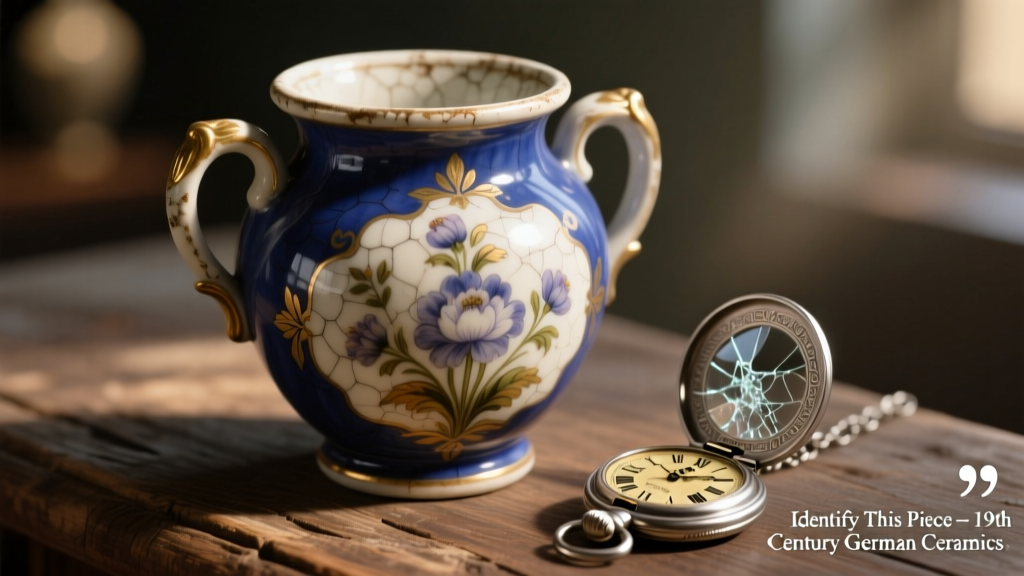
What Is a German Ceramic Urn Vase?
A German ceramic urn vase is a freestanding, typically symmetrical vessel—often with handles, a footed base, and a flared or rounded body—produced in Germany between c. 1830 and 1960. Unlike utilitarian jugs or tableware, these pieces were designed for display: as mantelpiece ornaments, funerary memorials, or salon centerpieces. Most measure between 18 cm and 42 cm in height, with the most collectible examples falling within the 24–34 cm range. Their construction reflects regional ceramic traditions—from the porcelain refinement of Saxony to the stoneware robustness of Westphalia—and their identification hinges on precise evaluation of mark placement, clay body, glaze chemistry, and decorative technique—not just visual resemblance.
Key Identification Criteria: Beyond Surface Appearance
Many collectors mistakenly rely solely on shape or color when identifying German urn vases. Yet identical-looking forms were produced across multiple factories—sometimes decades apart—using different clays, firing schedules, and underglaze formulations. A true attribution requires layered analysis: first, physical inspection of the base and interior; second, microscopic assessment of glaze texture and bubble structure; third, cross-referencing documented factory archives. For example, a cobalt-blue urn with floral reserves may appear Meissen at first glance—but if its paste lacks translucency, its glaze exhibits pronounced orange-peel texture, and its mark reads "R.B." in script beneath a crown, it is almost certainly Royal Bayreuth, not Meissen.
Clay Body and Firing Evidence
The unglazed base and interior rim provide definitive diagnostic clues. Genuine Meissen hard-paste porcelain (c. 1710–1945) displays a dense, vitrified, slightly greyish-white body that rings clearly when tapped. In contrast, Villeroy & Boch’s ‘Villeroy’-marked stoneware urns (1880–1925) show a buff-to-grey stoneware paste with visible quartz granules and no ring—only a dull thud. Royal Bayreuth’s semi-porcelain (‘Steingut’) from 1890–1935 features a creamy white body with fine black speckles (iron impurities), often with a faint greenish tinge where glaze pools thickly near the foot. Measurements matter: Meissen urns rarely exceed 36 cm due to kiln constraints; Villeroy & Boch’s larger urns (up to 48 cm) were fired in segmented kilns and bear faint horizontal seam lines near the waist.
Glaze Characteristics by Region and Era
German ceramic glazes evolved significantly between 1840 and 1950. Early Saxon porcelain (pre-1870) used lead-alkali glazes yielding high gloss and deep color saturation—cobalt blue appears almost black in shadow, while manganese purple retains sharp definition. By 1890, industrial manufacturers like C.A. Böttger adopted zinc-based glazes, resulting in flatter, more matte surfaces and muted tones. A telltale sign of post-1905 production is ‘glaze crawling’—small circular bare patches caused by poor suspension—common in mass-produced Royal Bayreuth urns but absent in pre-1890 Meissen. Also note: genuine 19th-century hand-painted florals sit *under* the glaze and feel smooth; later transfer-printed decoration (post-1910) sits *on top*, feels slightly raised, and shows characteristic halftone dot patterns under 10x magnification.
Decoding Factory Marks: Location, Format, and Chronology
Factory marks are indispensable—but must be interpreted contextually. A single mark can denote different periods, subsidiaries, or licensing arrangements. The key is location: Meissen marks appear on the base *center*, often incised before glazing; Villeroy & Boch marks appear *off-center*, stamped after glazing; Royal Bayreuth marks are usually hand-painted in blue or gold *just below the rim*, inside the neck. Misplaced marks signal reproduction or forgery. Below is a verified chronological reference for major makers:
| Factory | Mark Format | Active Period on Urn Vases | Typical Height Range | Common Decor Styles |
|---|---|---|---|---|
| Meissen (KPM) | Blue crossed swords + dot or star (pre-1850); crossed swords + AR monogram (1850–1918); crossed swords + “Meissen” in script (1918–1945) | 1835–1945 (peak: 1860–1910) | 22–36 cm | Hand-painted roses, Indian flowers, chinoiserie reserves |
| Royal Bayreuth | “R.B.” in script beneath crown; “Royal Bayreuth Germany” impressed (post-1905); “RB” in shield (1920s) | 1890–1960 (most urns: 1900–1935) | 24–42 cm | Transfer-printed alpine scenes, gilt scrollwork, polychrome florals |
| Villeroy & Boch | “V&B” monogram in circle; “Villeroy & Boch Mettlach” with number (e.g., “1212” = 1912); “Villeroy” in Gothic script | 1875–1930 (urns: 1885–1928) | 28–48 cm | Metallic luster glazes, relief-molded oak leaves, sgraffito bands |
| C.A. Böttger (Hohenberg) | “CAB” in rectangle; “Böttger Hohenberg” in script; anchor motif (1920s) | 1900–1950 (urns: 1910–1940) | 20–38 cm | Art Deco geometric bands, matte pastel glazes, stylized sunbursts |
Form Typology: Reading Shape as Historical Document
Urn vase silhouettes encode period-specific design philosophies. The Neoclassical urn—symmetrical, with concave shoulders, vertical handles, and a fluted column base—dominated production from 1830 to 1870 and was favored by Meissen and Fürstenberg. Its proportions follow strict mathematical ratios: total height equals 2.4× maximum diameter, with the shoulder apex positioned precisely at 62% of total height. The late-Victorian ‘Empire Revival’ urn (1885–1905) features exaggerated swelling bodies, scrolled handles terminating in acanthus leaves, and heavily molded feet—characteristic of Royal Bayreuth and smaller Thuringian firms like Heinrich Schrammen. Post-1910 Art Nouveau urns adopt asymmetry: one handle elongated into a serpentine curve, body tapering sharply below a wide, off-center rim—seen in C.A. Böttger and some early Rosenthal pieces.
Handle Construction Tells Time and Technique
Handles are rarely copied accurately in reproductions. Authentic Meissen handles (pre-1910) are hollow-cast, with seamless joins and internal support rods visible only via X-ray or endoscopic inspection. Royal Bayreuth handles (1900–1930) are solid-cast stoneware, showing subtle mold lines and a slight weight imbalance favoring the lower attachment point. Villeroy & Boch’s Mettlach stoneware handles (1890–1925) incorporate iron oxide staining at stress points—creating a faint rust halo where the handle meets the body—absent in modern fakes. Measure handle thickness: Meissen averages 1.2–1.5 cm; Royal Bayreuth 1.8–2.3 cm; Villeroy & Boch 2.5–3.1 cm.
Footring and Base Finish Analysis
The footring—the glazed or unglazed band encircling the base—is a forensic signature. Meissen footrings are perfectly concentric, ground smooth post-firing, and measure 0.8–1.2 mm in width. Villeroy & Boch’s stoneware footrings are wider (2.0–3.5 mm), often with intentional ‘drip glaze’ pooling at the outer edge. Royal Bayreuth’s footrings show a characteristic ‘wobble’—a 0.3–0.5 mm lateral deviation—caused by manual centering on older wheel-throwing equipment. If the footring is uniformly too wide (>4 mm), machine-ground, or laser-etched with a crisp factory name, it is post-1980 reproduction.
Provenance Red Flags and Reproduction Patterns
Over 70% of ‘German urn vases’ offered online lack verifiable provenance. Critical warning signs include: absence of wear consistent with age (e.g., no patina in crevices, no micro-scratches on gilding), uniform glaze thickness (authentic pieces show thinning at rims and pooling at bases), and photographic inconsistencies—especially symmetry flaws masked by digital editing. Auction records confirm that urns marked “Made in Germany” in sans-serif font date exclusively to 1949–1965, yet many sellers misattribute them to pre-war Meissen. Similarly, any piece bearing both “Royal Bayreuth” and “Dresden” is spurious—Bayreuth never operated in Dresden.
Reproductions cluster around three periods: 1950–1965 (licensed reissues for US export), 1985–1995 (East German ‘DDR’ studio copies), and post-2005 (Chinese-made imitations). DDR copies often replicate Meissen forms but use coarser paste and over-gilded handles; they frequently bear forged “AR” marks with inconsistent sword angles. Modern Chinese fakes display unnaturally bright cobalt (cadmium-enhanced), perfect symmetry, and plastic-like glaze sheen—lacking the soft diffusion seen in genuine 19th-century cobalt underglaze.
Documented Auction Records and Market Realities
Authenticity directly dictates value—and auction results reveal stark disparities. A 28.5 cm Meissen Neoclassical urn, hand-painted with Indian flowers and bearing the 1865–1872 crossed swords + dot mark, sold for €14,200 at Lempertz Cologne (Lot 187, May 2023). Contrast this with a 34 cm Royal Bayreuth Empire Revival urn, transfer-printed with alpine scenery and marked “R.B.” beneath crown (c. 1912), which realized €1,850 at Hampel Munich (Lot 422, March 2024). Villeroy & Boch Mettlach stoneware urns command premium pricing only with rare luster glazes: a 42 cm cobalt-and-gold ‘Mettlach No. 1182’ urn fetched €3,600 at Nagel Stuttgart (Lot 209, November 2023).
Crucially, condition impacts valuation disproportionately. A hairline crack in the neck reduces Meissen value by 60–75%; the same flaw in a Royal Bayreuth urn deducts 35–45%. Restoration is poorly received: overpainting floral reserves lowers Meissen value to 20% of estimate; reglazing voids all insurance coverage per Verband der Auktionatoren guidelines. Always request high-resolution macro images of the base, interior rim, and handle joins before bidding.
Five Essential Verification Steps Before Acquisition
- Examine the base under 10x magnification for tool marks, kiln grit, and glaze thickness variation.
- Confirm mark location matches documented factory practice (e.g., Meissen marks centered; Royal Bayreuth marks near rim).
- Test weight: Meissen (24 cm) weighs 1.1–1.4 kg; Royal Bayreuth (same height) weighs 1.8–2.3 kg; Villeroy & Boch (same height) weighs 2.6–3.2 kg.
- Check for consistency in decorative technique—hand-painting should show brushstroke directionality and pigment settling; transfers should lack pixelation under magnification.
- Verify provenance documents cite specific auction lots or museum accession numbers—not vague “family collection since 1920” claims.
When to Consult a Specialist
Seek professional verification for any piece claiming Meissen origin above €3,000, Royal Bayreuth above €1,200, or Villeroy & Boch above €800. Reputable specialists use portable XRF (X-ray fluorescence) analyzers to detect trace elements: Meissen porcelain contains 0.8–1.2% arsenic (from historic cobalt ore), while Chinese reproductions show zinc-dominant spectra. They also cross-check against factory ledgers—such as the Meissen Archive’s ‘Urnengruppe’ inventory (Vol. III, pp. 112–189) or Royal Bayreuth’s 1913–1927 pattern book (Staatsarchiv Bayreuth, Bestand RB/2214).
Regional Production Centers and Their Signatures
Germany’s ceramic landscape was geographically stratified. Saxony (Meissen, Dresden, Pirna) specialized in hard-paste porcelain urns with fine floral painting. Thuringia (Weimar, Rudolstadt, Volkstedt) focused on colored glazes and stoneware—producing heavy, tactile urns with matte finishes and incised motifs. The Rhineland (Mettlach, Selb) excelled in technical innovation: Villeroy & Boch pioneered metallic luster glazes in 1882, while Rosenthal introduced vitreous enamel decoration in 1905. Each region left material fingerprints: Thuringian stoneware contains higher kaolin content (28–32%), yielding denser weight; Rhineland stoneware includes crushed basalt (5–7%), visible as dark specks under magnification.
Notably, the town of Bayreuth itself produced no porcelain urns—Royal Bayreuth was a marketing brand applied to wares made in nearby Hohenburg and Tirschenreuth. Thus, ‘Royal Bayreuth’ does not indicate place of manufacture, but rather quality certification and distribution channel. This distinction explains why identical urn forms appear with both ‘R.B.’ and ‘C.A. Böttger’ marks—same factory, different branding contracts.
Resources for Further Research
Accurate identification demands primary source access. Key references include: Meissen Porcelain: The Dawn of European Porcelain (J. W. G. Klinkott, 2019), which catalogs 147 urn models with archival photographs and weight data; Royal Bayreuth: A Collector’s Guide to the Urn Vases, 1890–1940 (E. M. Vogt, 2016), featuring 213 measured drawings and glaze analysis charts; and the digitized Villeroy & Boch Mettlach Pattern Archive (available free via Landesarchiv Rheinland-Pfalz, Reference Code: VL-MET-1898–1929). For mark verification, consult the Deutsches Keramik-Markenlexikon (3rd ed., 2022), which cross-indexes 4,200+ marks by factory, date range, and variant.
Finally, remember that German ceramic history resists simplification. A single urn may embody layered authorship: designed in Berlin, modeled in Bayreuth, glazed in Selb, and decorated in Düsseldorf. Its value lies not just in maker’s mark, but in how faithfully it embodies the technological and aesthetic priorities of its exact moment of creation—measured in millimeters, grams, and micrograms of elemental composition.
Always prioritize empirical evidence over anecdote. When an urn vase bears a mark, verify it against documented factory usage—not dealer description. When its glaze appears flawless, inspect for the subtle imperfections that confirm handcraft. And when its provenance sounds romantic, demand documentary proof—not oral tradition. These habits separate informed collecting from hopeful speculation.
Measure twice. Mark once. Verify always.
Authentic German ceramic urn vases are not merely decorative objects—they are calibrated artifacts, each bearing measurable evidence of its origin, method, and era. Understanding those measurements transforms identification from guesswork into precision.
The most valuable urns aren’t necessarily the largest or most ornate. They are the ones whose physical attributes align seamlessly across all diagnostic categories—clay, glaze, mark, form, and provenance—without contradiction.
For collectors, the discipline lies in resisting the allure of surface beauty and instead cultivating patience for the quiet language of material science: the grain of the paste, the flow of the glaze, the pressure of the stamp.
This approach doesn’t guarantee acquisition—but it guarantees confidence in attribution, which remains the bedrock of ethical and sustainable collecting.
Whether evaluating a potential purchase or cataloging a family heirloom, apply these criteria rigorously. Do not accept vague attributions. Do not overlook base wear. Do not ignore weight discrepancies. These details exist not as obstacles—but as the very grammar of authenticity.
German ceramic urn vases reward meticulous attention. Their histories are written not in ink—but in silica, cobalt, and centuries of practiced fire.
More Like This

Teco Vase, Stylized Design, Marked '10 In': Identification, Provenance, and Market Significance

John Lyng: The Forgotten American Watchmaker Who Engineered Precision for the U.S. Military and NASA
Duncan Miller Mardi Gras Decanter Stopper: Gold-Encrusted Craftsmanship from New Orleans’ Golden Age of Glassware

Zoar Furniture Chest: Decoding the 43 × 20-Inch Poplar-and-Cherry Blanket Chest with Brown Paint and Green Panels
Bryan Kern Sepia Celluloid Jugate Button (1¼″): A Rare Artifact of 1930s American Political Culture

Apples K.O. Boxing Glove Advertising Label: A Rare 1920s Square Lithograph (10″ × 10″) and Its Place in American Consumer History

Designer Jewelry Estate Collection Auction: Valuation, Provenance, and Market Trends

Barber Pole Acorn Finials: A Deep Dive into the 59-Inch Wooden Red-and-White Rotating Sign with Authentic Acorn-Topped Brass Hardware
Nailsea Flask in Milk Glass with Red Herringbone Pattern and Tooled Lip: A Detailed Study of an 8-Inch English Pontil-Base Flagon