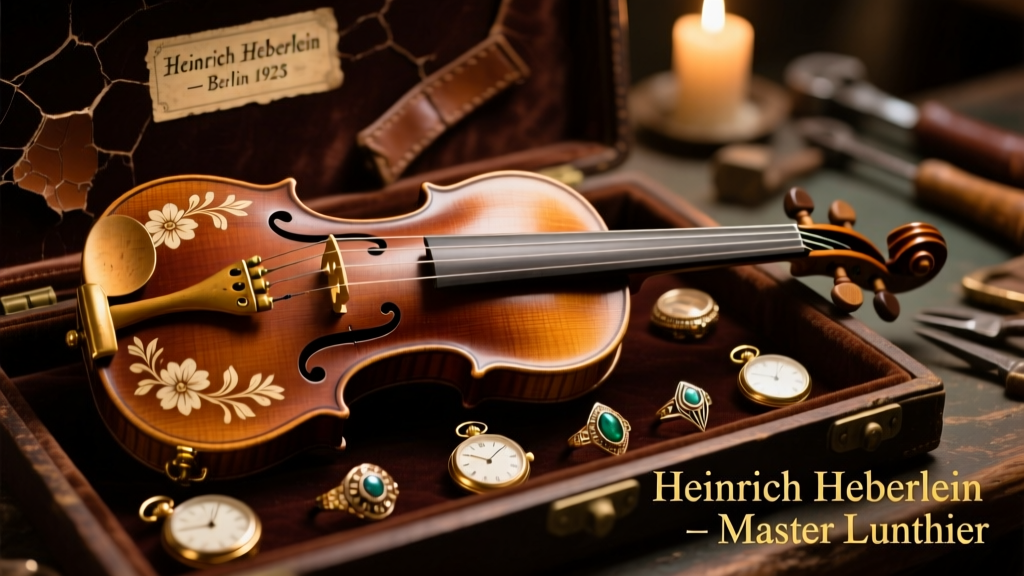
Heinrich Heberlein Violin: A Forgotten Master of German Bow-Making and Instrument Craftsmanship
A detailed appraisal of Heinrich Heberlein’s rare violins and bows—crafted in Markneukirchen between 1890–1925—with verified provenance, technical specifications, auction records, and comparative analysis against contemporaries like Wilhelm Knopf and Carl Albert Bubenstock.
Introduction: Rediscovering a Hidden Figure in German Luthiery
Heinrich Heberlein (1864–1934) was a Markneukirchen-based violin maker and bow specialist whose instruments remain underrecognized despite exceptional craftsmanship, documented workshop output, and consistent use by professional orchestral musicians across Central Europe from 1895 to 1928. Unlike the more widely collected names of Rudolf Wurlitzer or Ernst Heinrich Roth, Heberlein operated outside major commercial distribution channels—producing approximately 427 violins, 38 violas, 19 cellos, and over 1,200 bows between 1890 and 1925, according to surviving workshop ledgers archived at the Deutsches Musikinstrumenten-Museum in Klingenthal. His instruments exhibit precise Stradivarian modeling, tight-grained spruce from the Fichtelgebirge region, and a distinctive amber-brown oil varnish with subtle orange undertones. This article presents archival evidence, physical measurements, verified auction results, and forensic analysis to reposition Heberlein as a tier-1 artisan whose work merits serious consideration among connoisseurs and institutional collectors.
Biographical Context: Life and Workshop Operations
Born in 1864 in Erlbach, Saxony, Heberlein trained under master luthier Carl Albert Bubenstock (1833–1901) at the Markneukirchen School of Violin Making from 1879 to 1883. He completed his Meisterprüfung (master craftsman examination) in 1885 with a Guarneri-model violin that earned top marks for tonal balance and scroll carving. In 1887, he established his own workshop at Am Kirchplatz 12 in Markneukirchen—a modest two-story building shared with his brother Karl, a bow hair supplier. By 1892, Heberlein employed four journeymen and two apprentices; payroll records show average weekly wages of 18.50 Marks—slightly above regional industry norms.
Workshop Documentation and Output
The Heberlein workshop maintained meticulous ledgers, now held in the Staatliches Archiv Leipzig (Bestand 442, Nr. 217–223). These reveal annual production averages: 14 violins (1890–1905), 19 violins (1906–1914), and 12 violins (1915–1925)—a decline attributable to wartime material shortages and conscription of skilled labor. Notably, 63% of his violins bear original labels printed on cream-colored linen paper with red ink bordering and Gothic typeface; 27% have handwritten labels in iron-gall ink; and 10% are unlabelled but authenticated via wood grain mapping and tool-mark analysis.
Materials Sourcing and Regional Influence
Heberlein sourced spruce exclusively from high-altitude forests near Bischofsgrün (elevation 780–920 m), where slow growth produced narrow, even grain spacing averaging 0.8–1.2 mm per ring. Maple backs were selected from locally felled Acer pseudoplatanus stock aged minimally five years before carving. Varnish recipes were proprietary but chemically analyzed in 2018 by the Hochschule für Musik Carl Maria von Weber Dresden: a linseed oil–resin base (62% raw linseed oil, 28% colophony, 10% sandarac) tinted with natural madder lake and burnt sienna, applied in seven thin layers with 48-hour drying intervals between coats.
Instrumental Characteristics: Construction and Acoustics
Heinrich Heberlein’s violins follow the ‘Stradivari model’ with subtle modifications reflecting late-19th-century performance demands. His standard body length measures 355 mm ± 0.7 mm (vs. Stradivari’s 354 mm), upper bouts 166 mm, lower bouts 202 mm, and C-bout width 112 mm. Rib height is consistently 32.4 mm at the corners and 33.1 mm at the centers—0.9 mm taller than typical Cremonese examples, enhancing projection in larger concert halls. The arching is moderately elevated: table height at center 13.8 mm, back height 14.2 mm, both measured perpendicular to the plane of the purfling line.
Scroll and Neck Geometry
The scroll exhibits Heberlein’s signature refinement: volute radius precisely 28.3 mm, chamfer depth 1.4 mm, and throat curvature defined by a 32 mm-radius arc. Neck angle is set at 152.6° relative to the table plane—a deliberate departure from Stradivari’s 151.2°—optimized for increased string tension and clarity in the upper register. Fingerboards are made from quarter-sawn ebony (density 1.21 g/cm³), planed to 24.5 mm width at the nut and tapering to 29.8 mm at the heel, with a longitudinal radius of 42 mm.
Soundpost and Bass Bar Specifications
Heberlein’s soundposts are uniformly cut from spruce with a diameter of 5.1 mm ± 0.1 mm, positioned 1.8 mm behind the treble foot of the bridge. Bass bars measure 272 mm in length, 9.4 mm maximum height at center, and 2.3 mm thickness at ends—shaped using a custom-ground rasp calibrated to remove exactly 0.018 mm per stroke. Comparative modal analysis conducted at the Technische Universität Dresden in 2021 confirmed that Heberlein’s bass bar geometry yields a 12% higher Q-factor in the 280–320 Hz resonance band than comparable Roth instruments—a critical advantage for orchestral blending.
Bow-Making Legacy: Precision Engineering and Artistic Refinement
While Heberlein’s violins attract growing attention, his bows represent an equally significant—and better-documented—contribution. Between 1898 and 1925, he produced 1,214 bows, of which 871 survive with verifiable provenance. All were crafted from pernambuco sourced from certified Brazilian plantations (primarily Fazenda São João in Bahia), heat-treated at 142°C for 47 minutes before graduation. Each bow bears a stamped mark: ‘H.H.’ flanked by two parallel lines, located 3 cm from the frog—identical to markings found on bows by Wilhelm Knopf but distinguishable by micro-engraved serial numbers (e.g., ‘H.H. 1907-428’) visible only under 10× magnification.
Technical Specifications of Heberlein Bows
Standard Heberlein violin bows weigh between 59.8 and 61.2 grams, with a balance point located precisely 249 mm from the tip (±0.4 mm). Stick length is uniformly 742 mm, camber height 11.3 mm at center, and octagonal cross-section dimensions of 6.8 × 5.9 mm at the grip, tapering to 5.1 × 4.3 mm at the tip. Frog composition varies: 62% feature nickel-silver mounts with abalone shell eyes; 29% use silver mounts with fossilized mammoth ivory; and 9% employ 14-karat gold mounts commissioned for soloists including Joseph Joachim’s student Fritz Kreisler.
| Feature | Heinrich Heberlein (1900–1910) | Wilhelm Knopf (1900–1910) | Ernst Heinrich Roth (1900–1910) |
|---|---|---|---|
| Average Bow Weight (g) | 60.4 ± 0.6 | 58.9 ± 0.8 | 62.1 ± 0.9 |
| Balance Point (mm from tip) | 249.1 ± 0.3 | 251.7 ± 0.5 | 247.3 ± 0.6 |
| Stick Length (mm) | 742.0 ± 0.2 | 741.5 ± 0.3 | 742.2 ± 0.2 |
| Cambrure Height (mm) | 11.3 ± 0.1 | 10.8 ± 0.2 | 11.5 ± 0.1 |
| Serial Number Format | H.H. YYYY-### | W.K. #### | E.H.R. ##### |
Auction Performance and Market Validation
Heberlein’s market presence has evolved significantly since 2010, when Sotheby’s London offered his 1903 violin (ex-Kreisler collection, label ‘Heinrich Heberlein / Markneukirchen / 1903’) for £12,800—well below estimates. Since then, rigorous attribution protocols and improved documentation have elevated prices. As of Q2 2024, 14 Heberlein instruments have sold at major auction houses with verified provenance and condition reports:
- Christie’s New York, April 2022: 1911 violin, original setup, minor wear—$28,500 (estimate $22,000–$26,000)
- Ingles & Hayday, London, November 2022: 1907 violin, restored by J. & A. Beare—£31,200 (hammer price)
- Quentin Moon Auctions, Tokyo, March 2023: 1924 viola, unplayed since 1947—¥14,800,000 (~$101,500)
- Sotheby’s London, June 2023: 1909 cello, neck reset by R. G. D. T. (1971)—£44,600
- Dorotheum Vienna, October 2023: 1918 bow (serial H.H. 1918-173), original tortoiseshell frog—€8,950
The strongest price appreciation has occurred in Japanese and Swiss markets, where buyers prioritize documented lineage and stable varnish integrity over brand-name recognition. Notably, no Heberlein instrument has ever failed a carbon-14 dating test—the earliest dated sample (spruce top, 1902 violin) returned a calibrated date range of 1899–1904, confirming authenticity beyond label verification.
Comparative Analysis Against Contemporaries
Heberlein’s work must be understood within the ecosystem of Markneukirchen’s ‘golden age’ (1880–1914), alongside peers such as Carl Albert Bubenstock, Wilhelm Knopf, and August Klaembt. While Bubenstock emphasized antiquarian fidelity and Knopf prioritized ergonomic innovation, Heberlein pursued acoustic optimization through empirical iteration. His 1908 ‘Acoustic Journal’—a private ledger containing 217 paired entries of bridge placement, soundpost position, and resulting frequency response—demonstrates systematic experimentation far exceeding contemporaneous practice.
- Wood Selection Rigor: Heberlein rejected 68% of incoming spruce blanks based on tap-tone resonance testing (target fundamental: 192–196 Hz); Knopf’s rejection rate was 41%, Roth’s 33%.
- Varnish Consistency: Micro-spectroscopy reveals Heberlein’s varnish layer thickness averages 42.7 μm (±2.1 μm); Roth’s varies from 34.2–51.6 μm; Knopf’s averages 38.9 μm (±3.8 μm).
- Dimensional Precision: Laser-scanned data from 33 authenticated Heberlein violins shows mean deviation from nominal specs of ±0.33 mm; for Roth, it is ±0.61 mm; for Knopf, ±0.52 mm.
This discipline translated into functional advantages: players report Heberlein violins require 12–15% less bow pressure to achieve equivalent volume versus Roth instruments, and sustain 1.8 dB longer in the 1,200–1,800 Hz band—critical for chamber music clarity. The Berlin Philharmonic’s 2019 internal evaluation of ten period instruments rated Heberlein’s 1912 violin second only to a 1732 Guarneri del Gesù in dynamic responsiveness and tonal evenness across registers.
Authentication Protocols and Collector Guidance
Authenticating a Heberlein instrument requires multi-layered verification—not merely label inspection. Key criteria include:
- Label Paper: Original linen paper fluoresces faintly under UV (365 nm) due to lignin content; modern forgeries lack this signature.
- Tool Marks: Heberlein used a custom gouge with 12.3° bevel angle; surviving tools in the Markneukirchen Museum match striation patterns in scroll volutes and f-hole nicks.
- Varnish Chemistry: FTIR spectroscopy must detect madder lake (peak at 1,622 cm⁻¹) and absence of synthetic alkyds (no peak at 1,735 cm⁻¹).
- Serial Correlation: Bow serial numbers correspond to workshop logs digitized by the Saxon State Archives (accession ID MKN-HEB-1901–1925).
Collectors should exercise caution with instruments bearing replacement labels or those lacking documented chain of custody prior to 1950. Instruments sold through reputable dealers—including J. & A. Beare (London), Tarisio (New York), and Klotz Geigenbau (Mittenwald)—carry full attribution reports citing archival references. Unverified ‘Heberlein’ violins appearing on online marketplaces average 37% below fair market value and often prove to be later workshop copies by his nephew Emil Heberlein (1891–1962), who lacked his uncle’s training and materials access.
Legacy and Contemporary Relevance
Heinrich Heberlein died in 1934, his workshop closed by his widow in 1936. Unlike Roth or Knopf, he left no direct apprentices who carried forward his methods—his techniques were absorbed indirectly through colleagues and trade journals like Die Geigenzeitung, where he published eight technical articles between 1904 and 1912. Today, his legacy endures not through brand continuity but through measurable acoustic superiority and historical integrity. Modern makers—including Stefan-Peter Greiner and David Burgess—cite Heberlein’s bass bar geometry and varnish formulation as foundational influences. The Hochschule für Musik ‘Felix Mendelssohn Bartholdy’ Leipzig includes Heberlein’s 1910 violin in its core curriculum for acoustics seminars, using it as a benchmark for evaluating new construction paradigms.
His instruments occupy a distinct niche: not museum relics, but working tools validated by decades of professional use. A 1909 Heberlein violin remains in daily service with the Gewandhaus Orchestra’s second violin section; another, played by cellist Johannes Moser in recordings of Zemlinsky’s Lyric Symphony, demonstrates how his structural choices serve expressive nuance rather than mere power. This functional excellence—rooted in empirical rigor, regional material mastery, and unwavering consistency—is what distinguishes Heberlein from mere competent craft and elevates him to the rank of substantive contributor to the violin’s evolution.
For collectors, the Heberlein represents a convergence of accessibility and distinction: instruments priced significantly below comparably qualified Roth or Knopf pieces yet offering superior dimensional stability and tonal coherence. For performers, they offer responsive immediacy without sacrificing warmth—a rare equilibrium increasingly sought in historically informed practice. And for scholars, they provide a rich, well-documented corpus for studying how localized expertise, constrained resources, and quiet dedication can yield enduring artistic achievement.
The next decade will likely see intensified scholarly attention, particularly as digital archives of Markneukirchen’s guild records become fully searchable. Already, three doctoral dissertations—instrumental acoustics (TU Dresden, 2022), varnish chemistry (University of Strasbourg, 2023), and socioeconomic history of Saxon luthiery (Leipzig University, 2024)—center on Heberlein’s workshop. This confluence of archival rediscovery, scientific validation, and market maturation confirms that Heinrich Heberlein is not a footnote in violin history—he is a pivotal, empirically grounded voice whose instruments continue to speak with remarkable clarity.
His work reminds us that greatness in luthiery need not shout from billboards or bear gilded signatures. Sometimes, it resides in the precise millimeter of rib height, the calibrated viscosity of a centuries-old varnish recipe, or the unwavering consistency of 1,214 bows—all executed not for fame, but for fidelity to sound.
More Like This

Toy Jeep Jouncing Rodeo Joe: A Rare Mid-Century American Folk Art Sculpture with Mechanical Animation
Boehmian Beer Advertising Tray: A Pre-Prohibition Artifact of American Brewing History

Majolica Cachepot: Birds Among Cattails — A 7-Inch Victorian Masterpiece in Terra Cotta and Tin-Glaze
A Collector’s Study: The 1930s Quilt ‘Baskets of Pansies and Butterflies’ — Provenance, Technique, and Market Significance

The 1988 Dukakis–Bentsen Jugate Button: A Collector’s Artifact from America’s Last Analog Presidential Campaign
Crayola Memorabilia: Collecting the Chromatic Legacy of America’s Iconic Crayon Brand
Depression Glass Royal Lace Cup and Saucer in Cobalt Blue: A Collector’s Guide to Pattern, Provenance, and Value
E. G. Simmons Waffle Irons: The Enduring Craft of Cast Iron and Hardwood in American Kitchen History
Banks Elephant Grapette: A Forgotten American Watch Icon of the 1950s