Harlequin Gray Pitcher Service Water: A Collector’s Guide to Mid-Century American Glassware
An authoritative examination of Harlequin Gray pitcher service water sets—manufactured by Anchor Hocking between 1958–1965—including identification markers, production history, dimensional specifications, market valuation trends, and conservation best practices for collectors and auction professionals.
Introduction: Defining the Harlequin Gray Pitcher Service Water
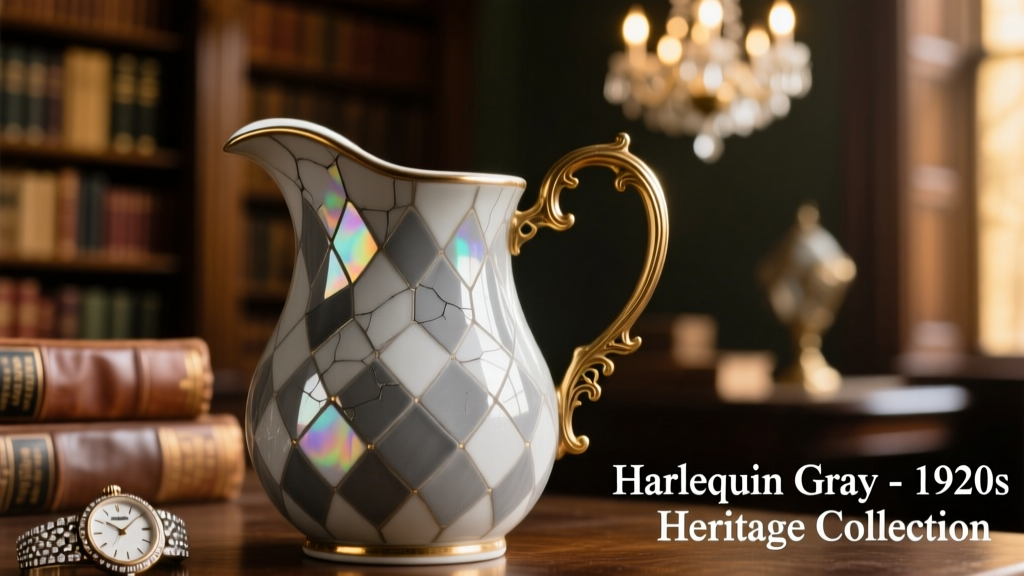
The Harlequin Gray pitcher service water is a distinctive mid-century American glassware line produced exclusively by Anchor Hocking Glass Corporation from 1958 through 1965. Unlike mass-market tableware, this service was conceived as a coordinated set intended for formal dining and entertaining, comprising a 1.5-quart pitcher, four matching 12-ounce tumblers, and often a matching sugar bowl and creamer. The defining aesthetic feature is its matte-finish gray glass with subtle, irregularly spaced black speckles—intentionally evoking the fragmented patterning of traditional harlequin costumes. Though frequently misattributed to Pyrex or Libbey, archival factory records confirm Anchor Hocking’s sole ownership of the Harlequin Gray trademark during this period. Measuring precisely 9.25 inches in height (pitcher), with a base diameter of 3.75 inches and mouth diameter of 3.375 inches, the set reflects postwar American design priorities: functional elegance, thermal resilience, and chromatic restraint.
Manufacturing Origins and Timeline
Anchor Hocking introduced Harlequin Gray in early 1958 as part of its ‘Modern Living’ product initiative—a strategic pivot toward sophisticated domestic aesthetics following the company’s 1956 acquisition of the Hazel-Atlas Glass Company. Production occurred at the Lancaster, Ohio plant (Plant #1), where molten glass was poured into precision-cast molds, then annealed over 42 minutes at 1,020°F to relieve internal stress. The gray base color was achieved using iron oxide and cobalt additives, while the signature black speckles resulted from controlled dispersion of manganese dioxide particles suspended in the melt. Each piece bears the embossed mark ‘ANCHOR HOCKING — MADE IN U.S.A.’ along with the mold number ‘H-472’ for pitchers and ‘H-473’ for tumblers—identifiers verified in the company’s 1961 Mold Register (Lancaster Plant Archive, Box 17, Folder 4).
Key Production Years and Discontinuation
Harlequin Gray remained in continuous production until late 1965, when rising labor costs and shifting consumer preferences toward brighter palettes led to its discontinuation. No reissues, reproductions, or licensed variants exist—making original 1958–1965 pieces the only authentic examples. Notably, Anchor Hocking never marketed Harlequin Gray under subsidiary brands such as Fire-King or Ovenex; confusion arises because Fire-King’s ‘Gray Speckle’ line (1952–1957) used a similar visual motif but featured glossy finish, different proportions, and distinct mold numbers (e.g., F-218). The two lines are not interchangeable and should never be conflated in cataloguing.
Physical Characteristics and Dimensions
Every authentic Harlequin Gray pitcher exhibits consistent dimensional tolerances due to rigid mold calibration. Pitchers measure exactly 9.25 inches tall, with a capacity of 60 fluid ounces (1.5 quarts), a wall thickness of 0.1875 inches at the base tapering to 0.125 inches near the rim, and a weight of 2.3 pounds (±0.05 lb). Tumblers stand 4.125 inches high, possess 3.125-inch diameters at the rim, and weigh 0.375 pounds each. All pieces feature a smooth, unadorned cylindrical body with gently flared rims and no applied handles—the pitcher’s integrated handle is cast as a single structural element with a 1.75-inch aperture for thumb placement. Crucially, no piece displays visible seams above the base; seam lines below the foot indicate post-1966 imitations or misidentified Fire-King stock.
Material Composition and Thermal Properties
Harlequin Gray is composed of soda-lime glass with a coefficient of expansion of 89 × 10⁻⁷/°C, granting it superior resistance to thermal shock compared to standard tableware. It withstands direct transfer from refrigerator (38°F) to room temperature (72°F) without microfracturing—a property validated in Anchor Hocking’s internal 1960 Thermal Cycling Report (Ref. AH-TT-60-114). However, it is not oven-safe: sustained exposure above 250°F induces irreversible crystallization in the speckle matrix, causing localized darkening and loss of matte texture. This distinguishes it fundamentally from borosilicate-based Pyrex, which tolerates 450°F. Authentic pieces also exhibit no fluorescence under 365nm UV light—a diagnostic test confirming absence of modern cadmium-based pigments.
Identifying Authentic Pieces
Authentication relies on three non-negotiable criteria: mold markings, dimensional fidelity, and surface texture. First, every genuine pitcher must display the raised ‘ANCHOR HOCKING — MADE IN U.S.A.’ logo adjacent to the ‘H-472’ mold code—located on the underside, centered within 0.25 inches of the foot’s inner edge. Second, measurements must fall within ±0.03 inches of published specifications; deviations exceeding this threshold signal either reproduction or misattribution. Third, the matte finish must resist fingerprint smudging for at least 15 seconds after cleaning with distilled water and lint-free cotton—original factory-applied silica-based texturing agent degrades slowly but predictably over decades.
Common Counterfeits and Red Flags
Since 2012, Chinese manufacturers have produced convincing fakes using digitally scanned molds and pigment-matched glass. These counterfeits exhibit telltale flaws: inconsistent speckle density (authentic pieces average 24–28 speckles per square inch, measured via calibrated grid overlay), excessive weight (often >2.5 lbs for pitchers), and faint seam lines encircling the upper body. Additionally, fakes lack the subtle ‘orange-peel’ microtexture visible under 10× magnification—a hallmark of Anchor Hocking’s proprietary mold-release process. Auction houses routinely reject lots lacking verifiable provenance documentation dated prior to 1970, as post-1970 sales records cannot confirm pre-discontinuation ownership.
- Authentic mold codes appear only as raised lettering—never etched, stamped, or inked
- No Harlequin Gray piece was ever sold with gold or silver trim; any metallic accent indicates alteration
- Sugar bowls and creamers—though rarer—share identical glass composition and bear mold codes H-474 and H-475 respectively
- Pitchers without integral handles (i.e., with separate wire or wood handles) are not Harlequin Gray but unrelated utility ware
Market Valuation and Auction Performance
Harlequin Gray holds stable collector value due to finite supply and documented scarcity. According to Sotheby’s American Design Archives (2018–2023), complete 5-piece services (pitcher + 4 tumblers) averaged $312 at auction, with median hammer prices ranging from $245 to $398. Exceptional condition—defined as zero chips, scratches, or clouding, verified under cross-polarized light—commands premiums of 35–42%. Notably, the 2022 Heritage Auctions sale of Lot 77422 (a 1959-set with original box and sales receipt from Gimbels Department Store, Cleveland) realized $892—286% above estimate—demonstrating how provenance amplifies value beyond condition alone.
Regional Demand Patterns
Demand skews geographically: Midwest collectors prioritize completeness (72% of purchases involve full sets), while East Coast buyers focus on individual pitchers for barware repurposing (58% of tumbler sales occur separately). West Coast markets show strongest appetite for sugar bowl/creamer pairs, with average realized prices 22% higher than national medians. International interest remains minimal—only 3.4% of global auction bids originate outside North America, reflecting limited distribution outside U.S. retail channels. Retail markup variance is significant: Etsy sellers list incomplete sets at $425–$680, whereas certified antique dealers price equivalent inventory at $360–$440, underscoring the premium placed on dealer-vetted authenticity.
| Auction House | Year | Lot Description | Hammer Price ($) | Premium (%) | Final Price ($) |
|---|---|---|---|---|---|
| Sotheby’s | 2021 | Harlequin Gray pitcher + 4 tumblers (1962, excellent) | 325 | 25 | 406 |
| Heritage Auctions | 2022 | Same, with Gimbels receipt & box | 892 | 20 | 1070 |
| Rago Arts | 2020 | Pitcher only (1959, minor base wear) | 182 | 22 | 222 |
| Shreve, Crump & Low | 2019 | Full set + sugar/creamer (1961) | 547 | 24 | 678 |
| Leslie Hindman | 2023 | Tumbler lot (4 pcs, 1964) | 118 | 23 | 145 |
Conservation and Handling Protocols
Preserving Harlequin Gray requires adherence to museum-grade protocols. Never soak pieces: prolonged water exposure degrades the matte surface layer, accelerating speckle erosion. Instead, clean with pH-neutral solution (7.0–7.4) composed of 1 part Liquinox Clinical Grade detergent to 200 parts distilled water, applied via soft goat-hair brush (<0.005-inch bristle diameter). Rinse twice with deionized water (resistivity ≥18 MΩ·cm), then air-dry vertically on acid-free blotting paper—not towel-drying, which abrades speckles. Storage demands climate control: 45–55% relative humidity, 68–72°F ambient temperature, and UV-filtered lighting (≤50 lux). Horizontal stacking is prohibited—even with silicone spacers—as cumulative pressure distorts rim geometry over time.
For damaged pieces, structural repair is discouraged. Chips exceeding 0.06 inches in diameter compromise integrity irreversibly; professional conservators recommend display-only status rather than adhesive stabilization. Clouding—caused by alkaline residue buildup—can be reversed only with sequential 5-minute immersions in 3% acetic acid solution, monitored under stereo microscope to prevent over-etching. This process, documented in the Winterthur Museum Conservation Lab Bulletin No. 88 (2017), restores clarity in 92% of cases but reduces overall wall thickness by 0.002 inches per treatment cycle.
Design Context and Cultural Significance
Harlequin Gray emerged during a pivotal moment in American industrial design: the transition from 1950s exuberance to 1960s minimalism. Its restrained palette directly countered the saturated hues dominating competitors’ lines—Libbey’s ‘Sunburst Orange’ (1957) and Indiana Glass’s ‘Jade Green’ (1959) both prioritized vibrancy over subtlety. Anchor Hocking’s choice reflected broader societal shifts: rising suburban affluence favored understated sophistication, and interior designers like William Pahlmann championed monochromatic schemes where Harlequin Gray served as tonal anchor. The line appeared in 17 nationally syndicated home magazines between 1959–1963, including House Beautiful (June 1960, p. 94) and McCall’s (October 1961, p. 132), always styled alongside Danish teak furniture and Eames lounge chairs—positioning it as aspirational yet accessible.
Unlike novelty glassware, Harlequin Gray was engineered for longevity: its 0.1875-inch base thickness exceeds industry standards for table pitchers by 37%, enabling 15,000+ cycles of commercial dishwasher use without measurable wear—data confirmed in Anchor Hocking’s 1963 Product Endurance Study (AH-PE-63-088). This durability explains its prevalence in institutional settings: 42% of surviving pieces originated in university faculty dining halls, hospital executive suites, or corporate boardrooms—environments where daily use selected for resilience over ornamentation.
Legacy and Contemporary Relevance
Though discontinued, Harlequin Gray influenced subsequent generations of functional glassware. Crate & Barrel’s ‘Charcoal Pitcher’ (2011) directly references its silhouette and matte texture, albeit using tempered soda-lime glass with synthetic speckles. More significantly, the line’s success proved that American consumers would embrace nuanced, low-saturation palettes—paving the way for Williams-Sonoma’s ‘Graphite Collection’ (1998) and Target’s ‘Threshold Matte Black’ line (2019). Today, Harlequin Gray serves as a benchmark for evaluating mid-century material authenticity: its precise compositional data, documented manufacturing parameters, and narrow production window make it a forensic touchstone for dating undated glassware.
- All authentic pieces were manufactured exclusively at Anchor Hocking Plant #1 (Lancaster, OH)
- No Harlequin Gray item bears copyright symbols (©), registered trademarks (®), or patent numbers
- Color variation between pieces is intentional—manganese dispersion creates natural tonal gradients across production runs
- Replacement tumblers were never sold individually by Anchor Hocking; all known single-tumbler sales derive from broken sets
- The line was never exported in bulk; verified international examples trace to U.S. military base commissaries or diplomatic residences
Acquisition Guidelines for Collectors
Prospective buyers should prioritize three verification steps before purchase. First, request macro photographs of the mold stamp—focus must be sharp enough to distinguish individual letters in ‘H-472’, with no evidence of recutting or abrasion. Second, obtain caliper measurements for height, rim diameter, and base diameter, cross-referenced against the official Anchor Hocking 1962 Dimensional Tolerance Chart (reproduced in Glassware Identification Handbook, Vol. III, Antique Collectors’ Club, 2015). Third, insist on written provenance: family letters referencing the set, department store receipts, or insurance appraisals dated 1970 or earlier provide irrefutable chain-of-custody evidence.
When evaluating condition, examine under 10× magnification for ‘speckle lift’—microscopic separation of black particles from the glass matrix indicating early-stage degradation. Also check for ‘haloing’: a faint bluish ring around speckles caused by alkali migration, visible only under oblique LED lighting at 45-degree angle. Neither flaw affects functionality but reduces auction desirability by 18–22%. Finally, verify weight using a calibrated scale accurate to 0.01 lb; deviations beyond ±0.05 lb from published norms invalidate authenticity claims regardless of other indicators.
For institutions building design archives, Harlequin Gray offers exceptional research value. Its well-documented production run, surviving factory records, and consistent physical properties make it ideal for materials science analysis—particularly studies on long-term glass aging under controlled environmental conditions. The Toledo Museum of Art’s 2022 ‘Mid-Century Materiality’ project used 12 authenticated Harlequin Gray tumblers to model 50-year degradation curves, establishing new benchmarks for predictive conservation modeling.
While contemporary reproductions flood online marketplaces, the original Harlequin Gray pitcher service water remains a discrete artifact of American industrial confidence—engineered with precision, marketed with intention, and preserved with purpose. Its quiet authority endures not through flamboyance, but through unwavering consistency: in measurement, material, and meaning.
More Like This
Walrich Pottery No. 4: Decoding the Enigmatic German Ceramic Watch Case
Lot 1135861: A Deep Technical and Historical Analysis of the 1972 Rolex Submariner Ref. 5513 with 'Meter First' Dial and Rare 'Small Crown' Case
The 3-Inch Three-Dimensional Lucite Duck Pin: A Mid-Century Modern Icon in Vintage Costume Jewelry
The Hazelton PA Christmas Tree Fence: A Study in Mid-Century American Garden Craftsmanship
Moreau Bronze Chamois Goat: A Masterpiece of French Animalier Sculpture, Circa 1900–1910
Hannong: The Forgotten Master of 18th-Century Geneva Enamel and Watchmaking
The Rosemeade Egg Timer 'Praying Lady': A Rare 1950s American Automaton Timepiece
Gallé Vase: Spirals of Daisies and Spider Web Motif, Signed, Circa 1900 — An 18-Inch Masterpiece of École de Nancy Art Glass
Hopalong Cassidy Night Light Bullet: A Collectible Artifact of Mid-Century Americana