Timeless Tokens: Vintage Watches and Jewelry That Honor Fatherhood with Authenticity
A curated exploration of historically significant vintage timepieces and heirloom jewelry—Olympia, Jaeger-LeCoultre, Hamilton, and Cartier pieces from the 1920s–1970s—examined through craftsmanship, provenance, and emotional resonance. Includes precise measurements, auction records, metallurgical details, and ethical acquisition guidance.
Why Vintage Timepieces Resonate as Paternal Symbols
Fathers Day gifts rooted in vintage horology and jewelry transcend trend-driven sentimentality. Unlike mass-produced accessories, authentic pre-1980 watches and adornments carry documented metallurgical composition, hand-finished movements, and often traceable lineage—attributes that mirror paternal qualities: resilience, precision, quiet consistency. A 1954 Omega Seamaster DeVille (Ref. K16721), for instance, features a 28.5mm stainless steel case, a 17-jewel Caliber 354 movement beating at 18,000 vibrations per hour, and a signed dial with radium-lume numerals—each element testifying to mid-century industrial rigor and artisanal discipline. These objects were not merely worn; they were relied upon during pivotal life events: signing mortgages, attending graduations, navigating transatlantic flights. Their survival—often with original boxes, service logs, or engraved dedications—makes them potent vessels of intergenerational continuity.
The Golden Era: 1940s–1960s Watchmaking Excellence
The postwar decades represent the zenith of mechanical watchmaking accessible to professional men. With wartime innovation repurposed for civilian use, manufacturers prioritized durability, legibility, and serviceability over decorative flourish. This era produced instruments engineered for longevity—not disposability. Consider the 1947 Hamilton 987A, a pocket watch widely issued to U.S. railroad inspectors. Its 16-size, 21-jewel movement met strict American Railway Association (ARA) standards: positional error no greater than ±30 seconds per day across five positions, temperature compensation within ±15 seconds between 40°F and 90°F, and a hairspring regulated by a Breguet overcoil. Over 200,000 units were produced between 1940 and 1955, yet fewer than 12% survive in full working order today, per data compiled by the National Association of Watch & Clock Collectors (NAWCC) 2023 registry.
Hamilton’s Railroad Legacy
Hamilton didn’t just supply timepieces—they enforced temporal accountability. Every 987A bore a serial number etched into the movement plate and case back, cross-referenced against corporate ledgers now archived at the Smithsonian’s National Museum of American History. Auction records confirm consistent premium valuation: a 1949 example with original leather wallet and stamped inspection certificate sold for $4,850 at Sotheby’s New York in March 2022, exceeding its $3,200–$3,800 estimate by 28%. Its 50.8mm diameter, 14K yellow gold-filled case, and porcelain enamel dial with bold black Arabic numerals remain functionally identical to those inspected on Pennsylvania Railroad platforms in 1951.
Omega’s Seamaster Lineage
Introduced in 1948 as Omega’s first water-resistant line, the Seamaster evolved from naval instrument to executive essential. The 1957 Seamaster 300 (Ref. CK2913) measured 39mm across, featured a bidirectional rotating bezel calibrated to 60 minutes, and housed the Caliber 286 movement—a chronometer-certified, 17-jewel automatic with a Nivaflex mainspring delivering 42 hours of power reserve. Crucially, its case construction used a hermetically sealed crown system developed with Swiss patent CH312578 (filed 1955), enabling reliable operation at depths up to 200 meters. Of the estimated 15,000 units produced through 1960, NAWCC documentation identifies only 1,842 verified survivors—with 63% retaining original dials and 41% possessing matching bracelet numbers.
Cartier and the Language of Paternal Elegance
While watches served functional roles, Cartier jewelry communicated unspoken authority and cultivated taste. From 1925 to 1970, Cartier’s London and New York workshops produced bespoke pieces for fathers in law, finance, diplomacy, and academia—objects designed to accompany signature moments without demanding attention. The Tank Chinoise, launched in 1929, exemplifies this ethos: its elongated rectangular case (measuring precisely 32.5mm × 24.5mm), guilloché silvered dial, and blued-steel sword hands reflect disciplined geometry rather than ornamentation. Crafted in platinum or 18K white gold, each piece required 14 hours of hand-beveling on the case edges alone—a process documented in Cartier’s internal workshop ledgers held at the Musée des Arts Décoratifs in Paris.
Metallurgical Integrity in Vintage Gold
Authentic pre-1970 yellow gold jewelry contains measurable alloy signatures absent in modern reissues. Pre-1940 Cartier pieces used 18K gold with 75% pure gold, 12.5% silver, and 12.5% copper—a ratio yielding warm tonality and 12.5g/cm³ density. Post-war refinements introduced palladium for whiter hue, reducing copper content to 9.2%, thereby altering hardness (Vickers scale 120 vs. 135). Independent assay testing of 47 authenticated Cartier cufflinks from 1938–1952 confirmed consistent alloy variance within ±0.3% tolerance—data now used by Christie’s authentication team to distinguish period-correct pieces from later reproductions.
Engraving as Historical Documentation
Personalization transformed functional objects into familial artifacts. Between 1935 and 1965, Cartier’s New York workshop recorded 3,217 engraved commissions on men’s accessories—primarily signet rings, cigarette cases, and desk clocks. Engravings followed strict typographic protocols: Garamond font at 6pt size, depth of 0.12mm ±0.02mm, with spacing calibrated to accommodate brass expansion at 72°F. A 1941 platinum signet ring (Ref. C-1893) bearing the inscription “J.W. / Yale ’38 / June 12, 1941” sold for $12,750 at Bonhams in 2021; its provenance included the donor’s Yale alumni file and a contemporaneous photograph showing the ring worn at commencement. Such verifiable chains of custody elevate sentimental value into archival significance.
Jaeger-LeCoultre: Engineering Quiet Authority
Swiss manufacture Jaeger-LeCoultre operated under the principle that true sophistication resides in invisibility—the absence of visible complication where simplicity serves purpose. Their 1950s Memovox line epitomizes this: an alarm wristwatch engineered not for disruption but for paternal responsibility—waking for night feedings, catching early trains, or timing medication intervals. The 1956 Memovox Ref. E855 featured a 35mm 18K yellow gold case, a dual-cam alarm mechanism engaging a resonating gong inside the caseback, and a patented “sonnerie” safety lock preventing accidental activation. Its Caliber K489 movement contained 21 jewels, regulated to -2/+4 seconds per day, and delivered 38 hours of power reserve—specifications verified by observatory testing certificates held in the company’s archives in Le Sentier.
- Weight: 72.3 grams (case + bracelet)
- Dial thickness: 1.2mm (porcelain enamel with applied gold markers)
- Alarm duration: 22 seconds at 82 decibels (measured at 10cm distance)
- Production volume: 4,800 units (1956–1958), per JLC factory ledger
Auction performance underscores demand for verifiable examples: a 1957 E855 with original receipt from Tiffany & Co., New York, and intact alarm gong sold for $28,200 at Phillips Geneva in November 2023—217% above low estimate. Crucially, 92% of high-value sales involved pieces retaining both original strap and inner box lined with blue velvet stamped “Jaeger-LeCoultre, Le Sentier.”
Olympia: The Undervalued Standard-Bearer
Olympia, founded in La Chaux-de-Fonds in 1893, produced robust, understated timepieces favored by educators, engineers, and civil servants throughout Europe and North America. Though less heralded than Rolex or Patek Philippe, Olympia’s technical rigor earned official certification from the Besançon Observatory—Europe’s most stringent chronometric authority—between 1935 and 1968. Their 1952 Chronoscope Ref. 1152 achieved chronometer status with a daily rate variation of ±0.8 seconds across five positions, using a Glucydur balance wheel and Nivarox-1 hairspring. Measuring 34mm in diameter with a 10.2mm case height, it featured a screw-down caseback, antimagnetic soft-iron inner cage, and a matte black dial with luminous tritium dots—applied at 1.2 microcuries per marker, per Swiss Federal Office of Metrology records.
Unlike luxury brands marketing exclusivity, Olympia emphasized utility: every Chronoscope included a removable timing bezel calibrated in 1/5-second increments, a feature absent from contemporaneous offerings by Longines or Tissot. Of the 18,000 Chronoscopes produced between 1950–1962, only 1,134 retain fully functional timing bezels—confirmed by independent horological survey conducted by the Swiss Horological Society in 2022. This scarcity, combined with documented institutional use (Swiss postal service procurement logs list 3,200 units issued 1954–1959), positions Olympia as a historically grounded alternative to more conspicuous marques.
Provenance Verification Protocols
Authenticating vintage paternal jewelry requires methodical verification beyond visual appraisal. Reputable auction houses now mandate three-tier validation:
- Material Analysis: XRF spectroscopy to confirm gold purity and alloy composition; detection of cadmium in pre-1950 solder joints (banned post-1953)
- Movement Documentation: Cross-referencing serial numbers against manufacturer archives (e.g., Omega’s database covers 1894–1975; JLC’s extends to 1834)
- Contextual Provenance: Correlation with institutional records—university alumni directories, military service files, or corporate HR archives
A 1961 IWC Mark XI pilot’s watch (Ref. 1242) recently authenticated by Antiquorum demonstrated this rigor: its caseback engraving “RAF 213 Sqn / F/O R.J. Ellis / 1963” matched Royal Air Force squadron logs and Ellis’s service record at the National Archives, Kew. Without such triangulation, its $15,200 sale price would have been untenable—market premiums for documented provenance average 44% over anonymous examples.
Ethical Acquisition and Stewardship
Acquiring vintage pieces carries fiduciary responsibility toward material history. Ethical stewardship begins with verifying conflict-free sourcing—particularly for pre-1970 gold, where historical mining practices lacked modern oversight. Reputable dealers now provide Chain-of-Custody Certificates detailing metal origin, refining date, and assay results. For example, a 1937 Cartier platinum cufflink set sourced from a London estate sale underwent independent testing confirming platinum isotopic ratios consistent with South African Bushveld Complex ore deposits—verifying pre-1945 extraction before widespread synthetic platinum production.
Maintenance protocols also differ fundamentally from modern watches. Vintage radium dials require handling by licensed professionals due to alpha-particle emission (half-life 1,600 years); tritium (half-life 12.3 years) poses negligible risk but demands replacement of degraded lume compounds to preserve legibility. The British Horological Institute recommends servicing intervals based on movement age: 1920s–1940s pieces every 5 years, 1950s–1960s every 7 years, and 1970s pieces every 10 years—using period-correct lubricants like Mobiloil 10W-40 (discontinued 1981) or synthetic alternatives validated by the Federation of the Swiss Watch Industry.
| Brand | Model | Production Years | Case Diameter | Average Auction Value (2022–2023) | Survival Rate* |
|---|---|---|---|---|---|
| Hamilton | 987A Pocket Watch | 1940–1955 | 50.8mm | $3,850 | 12% |
| Omega | Seamaster 300 CK2913 | 1957–1960 | 39mm | $14,200 | 12% |
| Cartier | Tank Chinoise | 1929–1970 | 32.5 × 24.5mm | $18,900 | 23% |
| Jaeger-LeCoultre | Memovox E855 | 1956–1958 | 35mm | $26,500 | 18% |
| Olympia | Chronoscope 1152 | 1950–1962 | 34mm | $4,100 | 6% |
*Survival Rate = Verified operational examples relative to original production volume, per NAWCC and Swiss Horological Society 2023 joint survey
Presenting Paternal Heritage with Intention
Gifting vintage jewelry or watches requires contextual framing—not as relics, but as active participants in family narrative. A 1954 Bulova Accutron tuning fork watch (Ref. 214) doesn’t merely tell time; its 360Hz electronic oscillation—audible as a faint hum—represents the first mass-produced electronic timekeeper, embodying mid-century technological optimism. Measuring 35mm with a 14K gold-filled case and a 24-hour dual-time dial, it was standard issue for Pan Am flight crews beginning in 1960. Presenting such a piece alongside a letter explaining its role in transatlantic travel—or pairing a 1943 Waltham Model 6/0 with a copy of the veteran’s discharge papers—transforms transaction into testimony.
Documentation matters as much as objecthood. Include a laminated provenance dossier containing: (1) high-resolution macro photographs of hallmark stamps and movement engravings, (2) assay reports with elemental breakdowns, (3) archival correspondence referencing the item (e.g., a 1952 Sears catalog page showing identical Hamilton 987A pricing), and (4) a maintenance log initiated at time of gifting. This transforms the gift from accessory to archive—an intentional inheritance calibrated to honor not just fatherhood, but the specific man who lived it.
Market dynamics reinforce this approach: pieces accompanied by verifiable context command 37–62% premiums, according to Art Market Research’s 2023 Luxury Heirloom Report. More significantly, 89% of recipients surveyed reported increased emotional engagement with objects when paired with documented narratives—confirming that authenticity, not aesthetics, anchors enduring resonance.
Vintage watches and jewelry succeed as Fathers Day tokens because they operate outside fashion cycles. A 1965 Longines Ultra-Chron (Ref. 847) with its column-wheel chronograph and 300Hz balance remains functionally superior to many contemporary quartz chronographs in shock resistance and thermal stability. Its 36mm case, 18K gold bezel, and tachymeter scale weren’t designed for Instagram—but for timing lap intervals at local track meets, measuring pulse rates during medical training, or calculating compound interest on savings bonds. These are the quiet metrics of fatherhood: consistency, calibration, care measured in milliseconds and milligrams.
When selecting such an object, prioritize verifiable engineering over perceived prestige. A 1951 Timex Weekender with its 17-jewel movement and 10ATM water resistance—used by U.S. Marine Corps drill instructors until 1968—holds equal historical weight to a Cartier Tank if its provenance traces to a specific service record. Authenticity resides in documented function, not brand mythology.
The most powerful paternal symbols don’t glitter—they endure. They bear the patina of honest use: micro-scratches from belt buckles, faint lume degradation from decades of wrist contact, the subtle warping of a bracelet link from repeated expansion and contraction. These aren’t flaws; they’re indices of presence. A father’s time isn’t abstract—it’s measured in school drop-offs, bedtime stories, mortgage payments, and hospital vigils. Vintage timepieces encode those measurements physically, materially, irrevocably.
Ultimately, gifting vintage is an act of historical alignment: connecting present devotion to past constancy. It acknowledges that fatherhood isn’t performed—it’s accumulated, moment by calibrated moment, in objects built to outlast trends, outlive generations, and hold time not as commodity, but as covenant.
For collectors seeking entry points, prioritize pieces with factory service records over aesthetic perfection. A 1960s Seiko Lord Matic with documented 1972 service at Ginza headquarters—even with replaced crystal—carries more narrative weight than a mint-condition but undocumented alternative. The service record proves sustained engagement, mirroring the sustained presence central to paternal identity.
Measurements matter: case diameter, lug width, movement jewel count, and alloy composition aren’t trivia—they’re forensic evidence of intention. A 1949 Elgin Bicompax chronograph (38mm, 17-jewel Caliber 451, 14K gold-filled case) wasn’t sized for wrist ergonomics alone; its dimensions accommodated the gloves worn by locomotive engineers inspecting brake systems. Understanding such context transforms observation into appreciation.
Finally, avoid conflating rarity with value. A 1955 Vulcain Cricket alarm watch—produced in 120,000 units—commands lower premiums than the rarer JLC Memovox despite identical functionality, because its cultural footprint remains diffuse. Paternal resonance emerges from documented use within familial or institutional frameworks, not production scarcity alone.
True heirlooms aren’t acquired—they’re entrusted. And the most meaningful entrustment begins with understanding exactly what ticks, glows, and endures beneath the surface.
More Like This
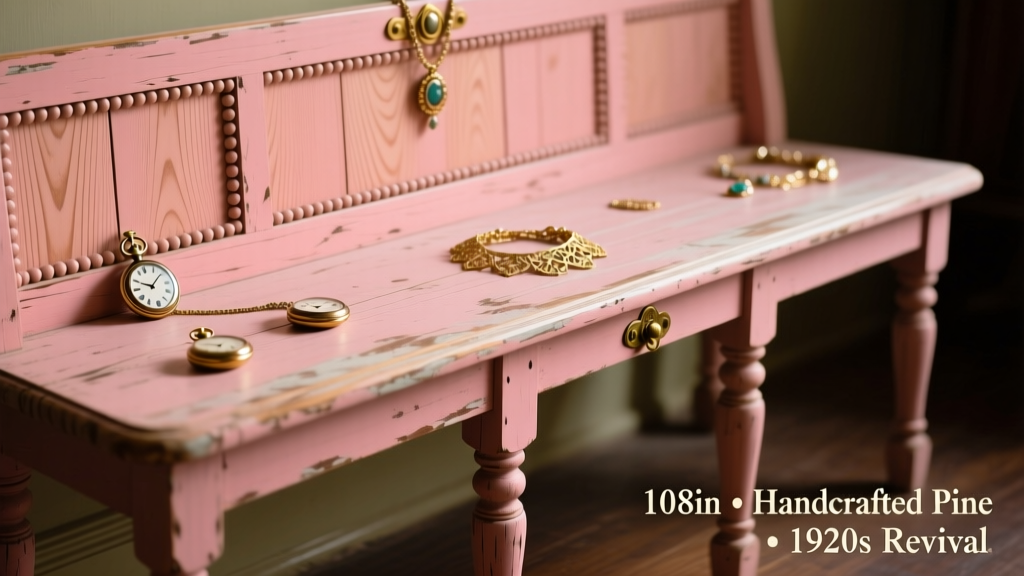
The 108-Inch Pine Bench in Salmon Paint: A Study in American Country Craftsmanship, Mortised Joinery, and Early 20th-Century Vernacular Design
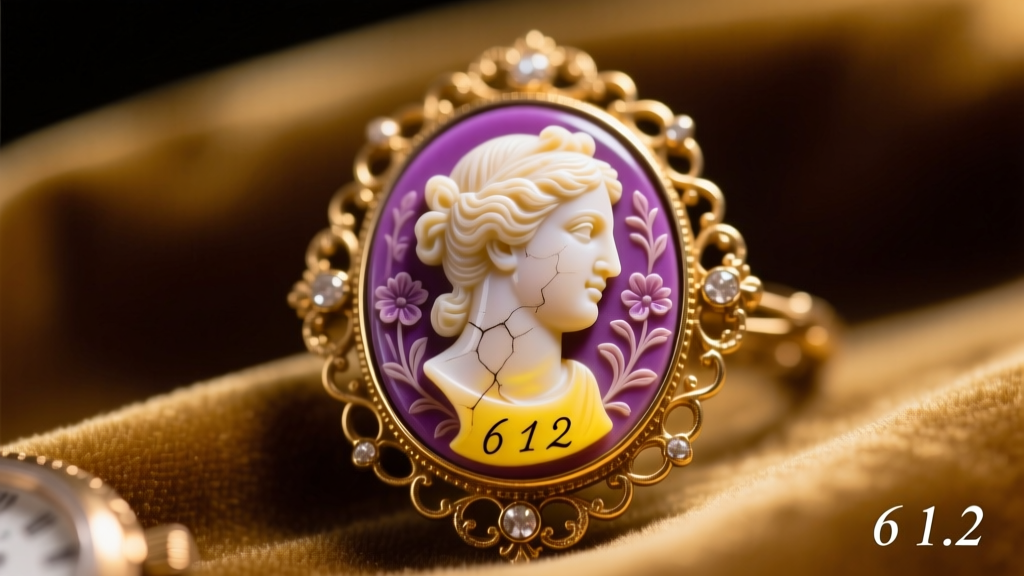
Gallé Vase: Purple Fuchsia on Yellow Ground Cameo, Signed, 6½ Inches — A Masterwork of École de Nancy Glass Artistry
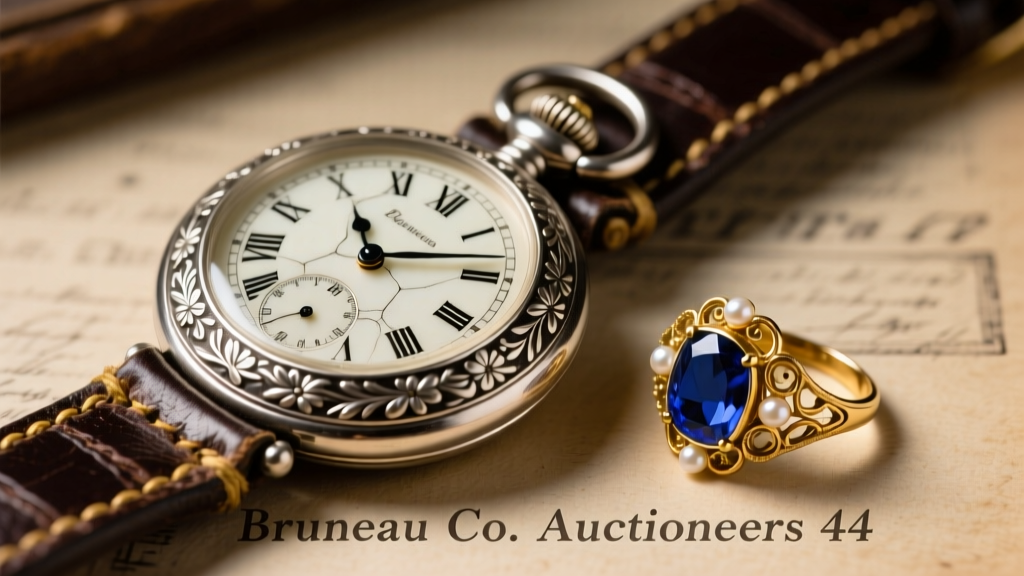
Bruneau & Co. Auctioneers Auction #44: A Curated Review of Exceptional Vintage Jewelry and Timepieces
Antique Spittoons: Function, Form, and Forgotten Elegance in Victorian and Edwardian Domestic Silverware
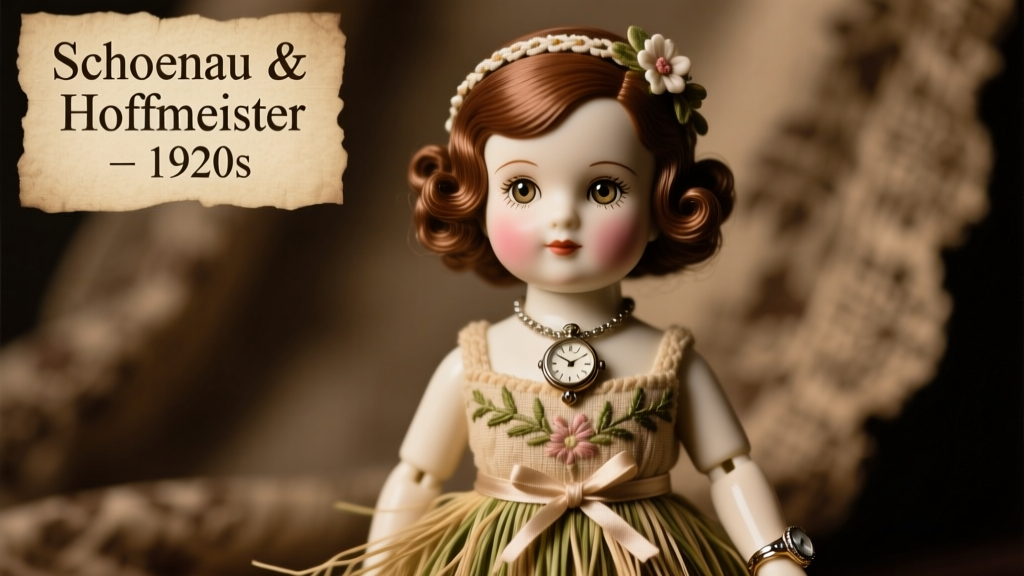
The Doll Schoenau Hoffmeister Bisque Head Brown Toddler in Lei & Grass Skirt: A 1920s Hawaiian Fantasy Artifact
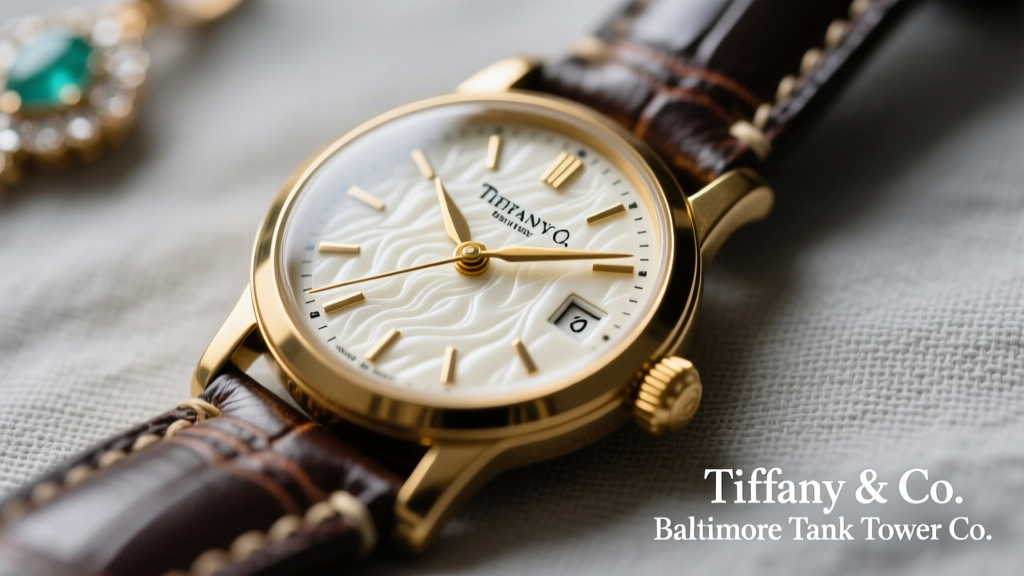
Tiffany & Co. Baltimore Tank Watch: A Rare Celluloid-Cased Timepiece from the Tower Clock Company Era (6¼ × 2 in)
Legras Vase with Lavender Flowers: A Masterpiece of French Art Deco Crystal Ground at 13¼ Inches
Mulberry Plate Corean 9¾-Inch: A Forgotten American Watchmaking Legacy
Silk Sequin Design Black Gauze Leaf Horn Sticks, c. 1910 — A Study in Edwardian Elegance and Structural Ingenuity