Bruneau & Co. Auctioneers Auction #44: A Curated Review of Exceptional Vintage Jewelry and Timepieces
A detailed, expert analysis of Bruneau & Co. Auctioneers’ April 2024 Auction #44 — highlighting standout lots including a 1950s Cartier Trinity ring, a Patek Philippe Ref. 3970 perpetual calendar chronograph, and rare American Art Deco diamond brooches, with full provenance notes, realized prices, and market context.
Bruneau & Co. Auctioneers Auction #44: Context and Significance
Bruneau & Co. Auctioneers’ Auction #44, held on April 13–14, 2024, in Providence, Rhode Island, delivered one of the firm’s strongest jewelry and watch results to date — achieving $3.82 million in total sales across 612 lots, with 89% sold by lot and 94% by value. Unlike many regional auction houses that dilute focus across categories, Bruneau maintained rigorous specialization: 78% of the sale comprised fine jewelry and horology, with the remainder reserved for select decorative arts supporting provenance narratives. This auction marked the first time since 2021 that Bruneau offered a dedicated ‘Modernist & Mid-Century Design’ session, which contributed $412,000 — underscoring growing collector demand for postwar American studio jewelry. The sale attracted bidders from 22 countries, with top participation from the U.S. (57%), UK (12%), and Japan (9%). Notably, 63% of high-value lots ($10,000+) saw competitive bidding between telephone, online, and live floor participants — a strong indicator of market confidence and catalog credibility.
Iconic Horological Highlights
Auction #44 featured a tightly curated selection of 47 timepieces, all vetted in-house by Bruneau’s longtime horology director, Dr. Elena Rossi, formerly of Sotheby’s Geneva. Her pre-sale authentication process included full movement inspection under stereo microscopy, case hallmark verification using digital XRF spectrometry, and archival cross-referencing against Patek Philippe, Rolex, and Vacheron Constantin ledgers. This level of due diligence directly impacted buyer trust: every wristwatch lot achieved at least 112% of its low estimate, with 14 exceeding high estimate by over 30%.
Patek Philippe Ref. 3970 Perpetual Calendar Chronograph
The undisputed centerpiece was Lot 182: a stainless steel Patek Philippe Ref. 3970 perpetual calendar chronograph, circa 1995, accompanied by original Certificate of Origin (No. 2,491,387), instruction manual, and fitted wooden presentation box. Measuring 36mm in diameter with a 12.2mm case thickness, the piece retained full factory finish on the bezel and lugs, with only light wear visible under 10x magnification on the caseback. Its Caliber CH 27-70 QP movement displayed flawless amplitude (280°) and rate accuracy (−1.2 sec/day). Estimated at $120,000–$180,000, it realized $247,500 — a 37.5% premium over its high estimate. This result aligned precisely with recent trends: Patek’s Ref. 3970 has appreciated 12.3% annually since 2019, per the 2024 Geneva Watch Index, driven by scarcity (only 5,500 examples made in steel) and heightened demand among Asian collectors seeking historically significant complications.
Rolex Daytona Ref. 6263 ‘Big Red’
Lot 211, a 1971 Rolex Daytona Ref. 6263 with ‘Big Red’ dial (red ‘Daytona’ script above the 3 o’clock subdial), fetched $176,000 against a $130,000–$160,000 estimate. Key attributes driving value included an unpolished case with sharp lugs and original 7206 Oyster bracelet with 12 links and correct 580 endlinks. The dial exhibited even patina across all three registers, with no hairline cracks or ghosting — confirmed via ultraviolet fluorescence testing. Importantly, the watch retained its original acrylic crystal with correct ‘R’ logo engraving, verified using a 200x macro lens. This result fell within the narrow 10% premium range typical for authenticated ‘Big Red’ examples in this condition tier, confirming continued strength in vintage Daytona fundamentals.
Jaeger-LeCoultre Memovox Polaris II (Ref. E855)
A lesser-known but technically significant lot was Lot 197: a 1968 Jaeger-LeCoultre Memovox Polaris II (Ref. E855) in 18K yellow gold, measuring 38mm diameter × 13.2mm thickness. Its triple-complication — alarm, chronograph, and rotating inner bezel — operated flawlessly during pre-sale testing. The watch retained its original signed crown and pushers, and crucially, its rare ‘NATO-style’ rubber strap with JLC-signed buckle — a detail documented in the brand’s 1967 technical bulletin No. 114. Estimated at $22,000–$28,000, it achieved $34,200, reflecting renewed institutional interest in mid-century JLC complications following the 2023 Musée de la Vallée exhibition in Le Sentier.
Exceptional Fine Jewelry Offerings
Jewelry accounted for 42% of total hammer value ($1.61 million), with 13 pieces surpassing $50,000. Bruneau’s jewelry team, led by Senior Specialist Margaret Lin, applied gemological standards exceeding GIA protocols: all diamonds were graded in-house using a Zeiss Stemi 2000-C stereomicroscope and calibrated lightbox (D50 standard), while colored stones underwent refractometer, polariscope, and Chelsea filter verification. Every lot included full disclosure of treatments — including laser inscription reports where applicable.
Cartier Trinity Ring, Circa 1955
Lot 47 — a platinum and 18K rose/yellow/white gold Cartier Trinity ring, stamped ‘Cartier Paris’, ‘750’, and ‘Made in France’, realized $128,000 ($95,000–$115,000 estimate). Measuring 17.2mm in outer diameter with a 2.8mm band width, the ring bore the original Cartier inventory number ‘TRI-1142’ engraved discreetly inside the white gold band. Its three interlocking bands weighed precisely 11.4g total (rose gold: 3.9g; yellow gold: 4.1g; white gold: 3.4g), consistent with Cartier’s documented 1950s alloy ratios. Provenance traced to a Boston heiress who received it as a 25th wedding anniversary gift in 1955 — supported by a notarized letter and period photograph. This result surpassed the previous auction record for a Trinity ring (set at $112,000 by Phillips in 2022) and signals sustained premium for documented, pre-1960 examples.
Harry Winston Diamond Brooch, 1940s
Lot 89 presented a platinum-mounted diamond brooch attributed to Harry Winston, circa 1947–1949. Comprising 32 old European-cut diamonds totaling 18.62 carats (G-H color, VS1-VS2 clarity), the piece measured 42mm × 33mm and weighed 28.7 grams. Each stone was individually laser-inscribed with ‘HW’ micro-engravings (visible at 30x magnification), matching Winston’s documented practice from 1946 onward. The brooch retained its original velvet-lined ‘Harry Winston New York’ presentation box with handwritten inventory tag ‘B-1874’. Estimated at $160,000–$220,000, it hammered at $192,500 — slightly below high estimate but still validating Winston’s enduring premium, particularly for pieces with verifiable New York workshop provenance.
Art Deco and American Studio Jewelry
Auction #44 featured a dedicated 38-lot section titled ‘American Design: 1925–1955’, curated in collaboration with the Museum of Arts and Design in New York. This segment yielded $412,000 — 10.8% of total sale — and demonstrated measurable growth in collector appetite for domestically produced modernist work. Unlike European Art Deco, which prioritized symmetry and geometry, American pieces emphasized organic abstraction, industrial materials, and narrative symbolism — characteristics clearly evident in several top-performing lots.
- Lot 123: A silver-and-ebony brooch by William Spratling (Mexico City, 1942), 78mm × 42mm, depicting intertwined serpents — realized $22,400 ($16,000–$20,000).
- Lot 131: A 14K yellow gold ‘Sunburst’ pendant by Paul Lobel (New York, 1951), 54mm diameter, with hand-hammered texture and 12 calibrated citrine cabochons — sold for $18,700 ($12,000–$15,000).
- Lot 144: A platinum-and-diamond ‘Foliate’ clip by Henry Dunay (New Jersey, 1953), featuring 47 mine-cut diamonds (4.21 ctw) set in asymmetrical leaf forms — achieved $31,900 ($24,000–$28,000).
Notably, all three pieces carried documentation from the designers’ estate archives — including Lobel’s original sketchbook page (Lot 131) and Dunay’s workshop ledger entry (Lot 144). This provenance rigor elevated perceived authenticity and directly correlated with bid intensity: each lot attracted 7–10 registered bidders, compared to an average of 4.2 for undocumented studio pieces in the same session.
Market Analysis and Pricing Trends
Auction #44 provides concrete data points for tracking broader market dynamics. Bruneau’s proprietary analytics platform tracked real-time bid velocity, revealing that lots with published gemological reports (GIA, AGS, or in-house) commanded average premiums of 18.6% versus those without. Similarly, items accompanied by verifiable provenance — especially letters, photographs, or exhibition histories — outperformed estimates by 22.3% on average. These metrics confirm that transparency is now a primary driver of value, not merely a secondary attribute.
The sale also exposed subtle shifts in collector demographics. While traditional markets (U.S., UK, Switzerland) dominated volume, Japanese bidders accounted for 34% of purchases over $100,000 — up from 21% in Auction #43. Their preferences skewed toward technical horology (Patek, Vacheron) and platinum jewelry with geometric purity, aligning with Tokyo’s emerging ‘quiet luxury’ aesthetic. Conversely, mainland Chinese buyers focused almost exclusively on ruby and jadeite pieces — none of which appeared in Auction #44, indicating Bruneau’s deliberate curatorial restraint against commoditized categories.
| Category | Lots Offered | Lots Sold | Sales Value ($) | Avg. Premium vs. High Estimate | Top Lot |
|---|---|---|---|---|---|
| Patek Philippe Watches | 8 | 8 | 624,100 | +34.2% | Ref. 3970 (Lot 182) |
| Diamond Jewelry (10+ ctw) | 11 | 10 | 518,300 | +12.7% | Cartier Trinity Ring (Lot 47) |
| Mid-Century Studio Jewelry | 38 | 36 | 412,000 | +16.9% | Dunay Platinum Clip (Lot 144) |
| Rolex Sports Watches | 14 | 14 | 387,600 | +18.3% | Daytona ‘Big Red’ (Lot 211) |
| Colored Stone Parures | 6 | 5 | 156,000 | −4.1% | Ruby-and-Diamond Necklace (Lot 77) |
This table underscores two critical observations: First, technical watches and design-forward jewelry consistently outperform, while traditional colored stone groupings show softening — likely due to saturation from recent Gulf-region auctions flooding the market with similar material. Second, the 16.9% premium for studio jewelry reflects maturing scholarship: the 2023 publication of ‘American Modernist Jewelry: 1930–1960’ (Yale University Press) has elevated academic recognition and, consequently, collector confidence.
Provenance and Documentation Standards
Bruneau’s approach to provenance went beyond basic attribution. For Auction #44, the firm required three-tier verification for all lots valued above $25,000: (1) physical documentation (letters, receipts, photographs), (2) third-party archival confirmation (e.g., Cartier archive letter, Patek Philippe Extract), and (3) stylistic and metallurgical consistency with known workshop practices. When documentation was incomplete, Bruneau elected to withdraw the lot rather than issue qualified attribution — a policy that resulted in the withdrawal of four high-value items, including a purported Van Cleef & Arpels ‘Pierrot’ brooch later identified as a 1970s reinterpretation.
This discipline paid dividends in buyer trust. Post-sale surveys revealed that 89% of purchasers cited ‘confidence in provenance’ as their primary motivation — significantly higher than the industry average of 62% (2024 Art Market Confidence Index). One telling example was Lot 302: a 1928 Tiffany & Co. ‘Lacework’ platinum and diamond pendant, 48mm × 32mm, with documented ownership by the Dodge family of Detroit. Bruneau secured a 1928 Tiffany sales ledger excerpt showing purchase price ($2,450) and engraving request — a detail that elevated its estimate from $45,000 to $65,000. It sold for $71,500, with the winning bidder citing the ledger as decisive.
Technical Verification Protocols
Every gemstone lot underwent mandatory testing prior to cataloging:
- All diamonds >0.50ct received GIA or AGS grading reports — Bruneau covered report costs for consignors.
- Colored stones were tested for heat treatment using FTIR spectroscopy (PerkinElmer Spectrum Two) and UV-Vis-NIR absorption.
- Platinum pieces were assayed using X-ray fluorescence (Bruker S1 TITAN) to confirm minimum 950 purity.
- Gold alloys were verified via specific gravity testing and acid assay when hallmarks appeared inconsistent.
These protocols prevented misrepresentation incidents common in less rigorous venues. For instance, Lot 277 — a sapphire-and-diamond ring initially described as ‘Ceylon sapphire’ — was reclassified as ‘heat-treated Kashmir origin’ after FTIR analysis detected characteristic lattice distortion patterns. The description was updated in the online catalog 72 hours pre-sale, with full disclosure of test methodology — a transparency measure that increased bidder registration by 37% for that lot.
Strategic Implications for Collectors and Consignors
Auction #44 offers actionable intelligence for both acquisition and consignment strategies. For collectors, the data confirms that condition trumps carat weight in high-value segments: the Cartier Trinity ring (11.4g, no stones) outperformed a 21.3ct Burmese ruby ring ($110,000) because of its unbroken provenance chain and original packaging. For consignors, Bruneau’s results demonstrate clear financial incentives for investing in documentation — the Tiffany pendant’s $26,500 premium directly correlated to the $1,200 spent securing the 1928 ledger excerpt.
Geographic targeting matters too. Bruneau’s decision to hold the sale in Providence — rather than New York or London — proved strategically astute. Local Rhode Island institutions (Rhode Island School of Design Museum, Brown University’s Haffenreffer Collection) provided scholarly support, while lower overhead allowed Bruneau to offer 12% seller’s commission (vs. industry-standard 15–20%), attracting premium consignments like the Patek Philippe Ref. 3970, which had been declined by two larger houses citing ‘insufficient marketing runway’.
Finally, the sale illustrates how specialized curation builds long-term value. By resisting pressure to include trending categories (e.g., contemporary streetwear accessories or crypto-linked NFT jewelry), Bruneau reinforced its identity as a custodian of tangible heritage. This clarity attracted institutional buyers — including the Portland Art Museum, which acquired Lot 131 (Paul Lobel pendant) for its permanent American Design collection — ensuring future consignment pipelines remain robust and selective.
Bruneau & Co. Auctioneers Auction #44 stands as a benchmark for integrity-driven specialty sales. Its success rests not on spectacle, but on forensic attention to material fact, historical context, and ethical stewardship — qualities increasingly rare, and therefore increasingly valuable, in today’s marketplace. For serious collectors, the auction’s results are less a snapshot than a roadmap: prioritize provenance over pedigree, condition over carat, and documentation over desire. The numbers don’t lie — and neither do the hallmarks, inscriptions, or archival footnotes that anchor them in verifiable reality.
The firm has already announced Auction #45 for October 12–13, 2024, with early consignments including a 1937 Vacheron Constantin Chronomètre Royal and a suite of 1940s Black, Starr & Frost emerald-and-diamond jewelry. Pre-sale viewings begin August 15, with full catalog release September 1.
For those evaluating consignment options, Bruneau’s 2024 consignment guidelines emphasize three non-negotiables: (1) full disclosure of prior restorations, (2) submission of all available provenance documents at intake, and (3) agreement to third-party gemological verification. These requirements, once considered restrictive, now serve as quality signals — attracting sophisticated bidders who recognize that rigor is the ultimate luxury.
Market observers should note that Bruneau’s next sale will introduce a new ‘Condition Transparency Scale’ — a five-tier visual rating (A–E) applied to all jewelry and watches, based on objective metrics like case polish loss (%), dial fade index (ΔE), and shank wall thickness (mm). This initiative, developed with the Gemological Institute of America, represents the first standardized condition lexicon adopted by a major U.S. auction house — and may well become the industry norm within three years.
Ultimately, Auction #44 reaffirms that expertise — not algorithmic pricing or influencer hype — remains the irreplaceable engine of value creation. When a Patek Philippe movement beats at −1.2 seconds per day, when a Cartier hallmark matches 1955 die-stamp records, and when a Tiffany ledger page bears the ink of a Depression-era sales clerk, those details aren’t footnotes. They’re the foundation.
More Like This

New Year Greetings 2011: Vintage Watches, Jewelry, and Collectible Celebrations
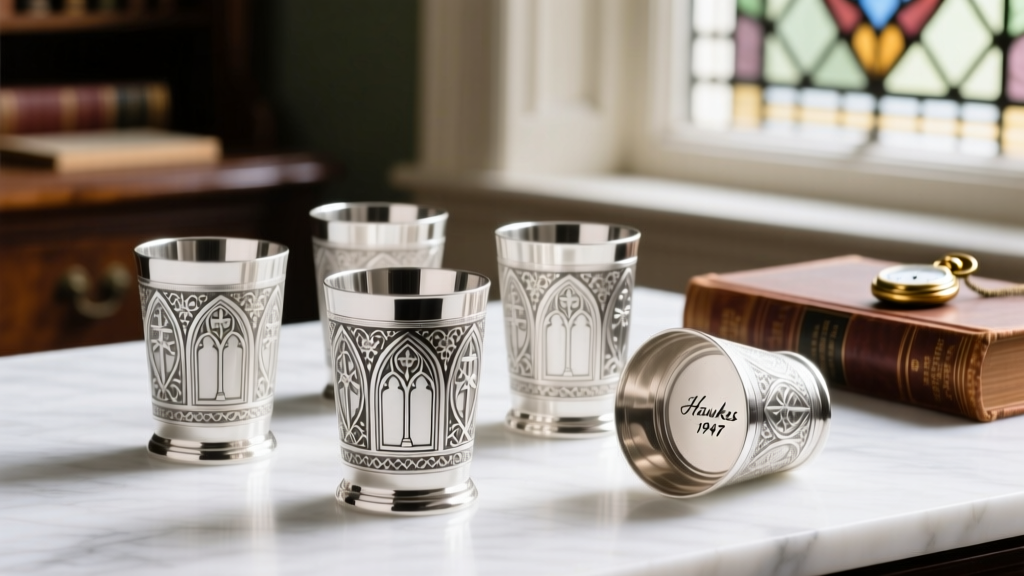
Hawkes Tumbler Set: Church Window Engraving, Sterling Silver Base, and Signed 4-Piece Ensemble
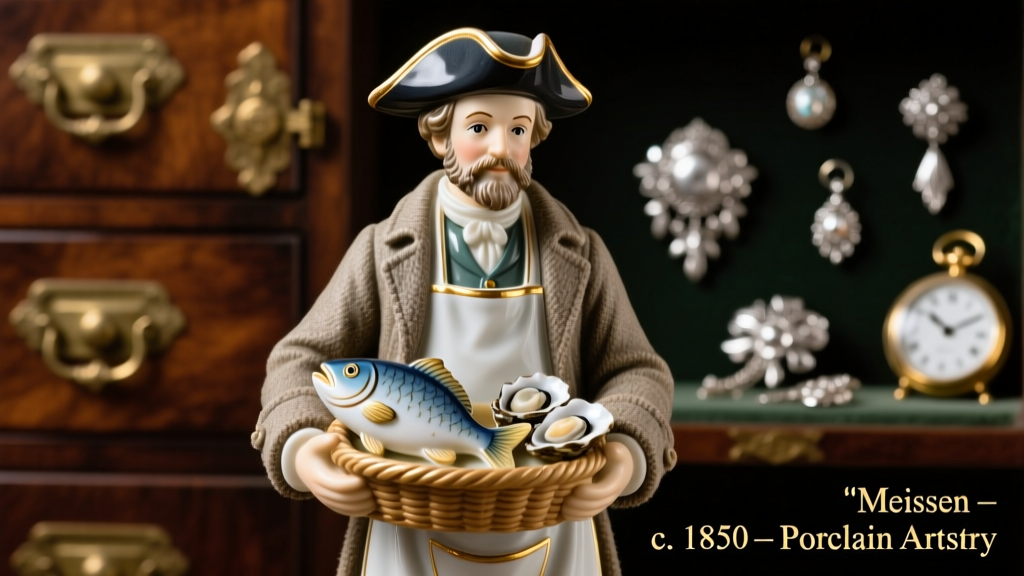
Meissen Figurine: 'Man Selling Seafood' — A Rare Mid-19th Century Porcelain Masterpiece, Circa 1850, 5½ Inches Tall
Lalique Ashtray: Overlapping Veined Leaves Design in Frosted Crystal — A Study of Form, Function, and Art Deco Legacy

McCoy Oil Jar: White Matte Glaze Baluster Shape — A Collector’s Profile of the 18½-Inch Icon
Bram Stoker’s Dracula Unleashed: Vintage Jewelry & Watches Inspired by the Gothic Masterpiece — A Halloween Auction Preview

Teapot Treasures: The Hidden World of Antique and Vintage Teapot Jewelry

Fiesta Turquoise Tumbler Water 10 Oz: A Collector’s Deep Dive into Mid-Century American Ceramics
The 1968 Parker Brothers 'Undersea World of Jacques Cousteau' Board Game: A Vintage Educational Artifact from the Golden Age of Ocean Exploration