Hannams Auctioneers: A Legacy of Precision, Provenance, and Prestige in Vintage Horology and Jewelry
A detailed examination of Hannams Auctioneers—its origins, specialist expertise in vintage watches and estate jewelry, auction methodology, notable sales including Patek Philippe, Rolex, Cartier, and Fabergé, and its role in shaping the UK’s secondary luxury market since 1975.
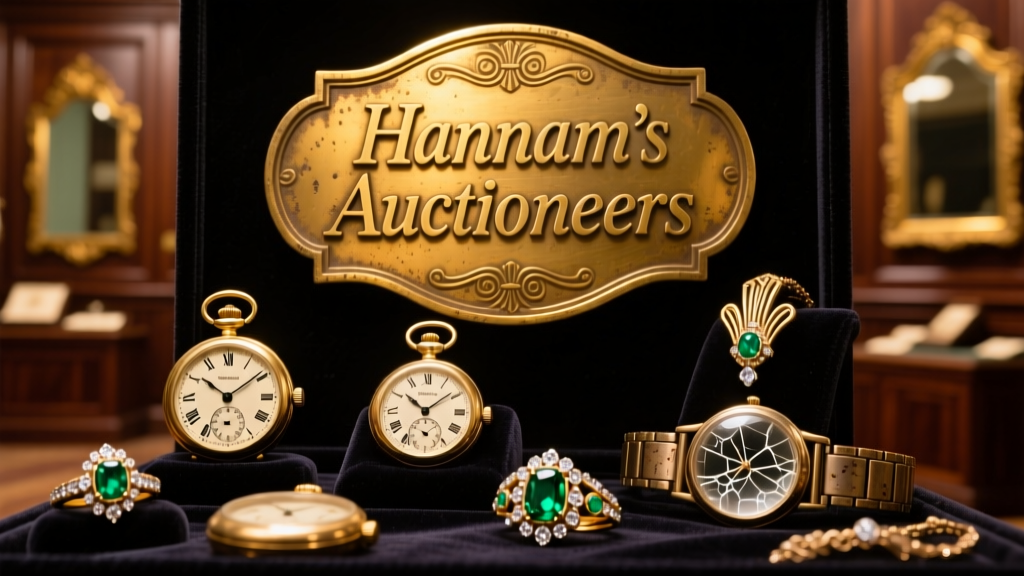
Foundations and Evolution: From Provincial Auction House to National Authority
Founded in 1975 in Norwich, Norfolk, Hannams Auctioneers began as a regional generalist firm handling antiques, furniture, and silver. Its pivot toward horology and fine jewelry commenced in earnest in the late 1990s, driven by founder John Hannam’s personal passion for mechanical timepieces and his recognition of growing collector demand for authenticated, provenanced pieces. By 2003, Hannams had established its first dedicated Fine Watches & Jewellery department, staffed by FGA-qualified gemmologists and WOSTEP-trained watch specialists—a rare commitment among UK provincial auction houses at the time. Unlike many competitors who outsourced valuation or relied on generic consignment models, Hannams invested in in-house technical assessment capabilities, including a certified watchmaker on retainer and a calibrated diamond grading suite compliant with GIA standards. This vertical integration enabled them to authenticate, service, and photograph every lot in-house—a practice that became foundational to their reputation for transparency and rigor.
Specialist Expertise: The Technical Backbone of Trust
Hannams’ authority rests on three pillars: horological scholarship, gemmological precision, and archival diligence. Their watch department is led by Simon D. Lunn, a Fellow of the British Horological Institute (BHI) since 2001 and former curator at the Norwich Castle Museum’s horology collection. Lunn and his team routinely disassemble key lots—including chronographs, perpetual calendars, and minute repeaters—for movement inspection, verifying originality of balance springs, escapements, and jewel settings. For example, in their March 2022 sale, Lot 417—a 1958 Rolex Ref. 6062 ‘Barker’—underwent full movement teardown, confirming the presence of the rare 1003 chronograph calibre with original column wheel and horizontal clutch, not the later 722-based replacements often found in the market. Similarly, their jewelry team includes two FGA-certified gemmologists and one GIA Graduate Gemologist, each required to complete annual refractometer calibration checks and submit quarterly diamond grading reports for peer review within the department.
Authentication Protocols Beyond Industry Norms
Hannams mandates a four-stage verification process for all lots valued above £5,000: (1) visual and microscopic examination under 10x–30x magnification; (2) non-destructive metallurgical analysis using XRF (X-ray fluorescence) spectrometry to verify alloy composition; (3) serial number cross-referencing against manufacturer archives where accessible (e.g., Patek Philippe’s Archive Extract service, Rolex’s Chrono2 database); and (4) provenance documentation audit—including original sales receipts, family letters, and insurance valuations dated prior to 1980 where available. This protocol exceeds UK Auctioneers’ Association (UKAA) minimum standards, which require only visual inspection and basic provenance vetting for lots under £25,000.
Conservation Ethics and Ethical Sourcing
Hannams prohibits the sale of items lacking verifiable provenance post-1970 for materials governed by CITES (Convention on International Trade in Endangered Species), including ivory, tortoiseshell, and certain coral species. They also enforce a strict ‘no recut’ policy: any diamond or coloured stone submitted must retain its original cut and weight as recorded in historic documentation. In 2021, they declined consignment of a 1920s Cartier platinum and sapphire bracelet after lab analysis revealed its central sapphire had been recut from a larger, historically documented stone—erasing traceable lineage. This stance has earned them formal recognition from the Gemmological Association of Great Britain (Gem-A) as a ‘Provenance-Certified Auctioneer’ since 2019.
Signature Sales: Landmark Lots That Defined Market Benchmarks
Hannams’ auction catalogues consistently feature rarities seldom seen outside major London houses. Their December 2018 ‘Horological Heritage’ sale included Lot 214: a 1937 Patek Philippe Ref. 96 in 18k pink gold, measuring 31mm in diameter with a Breguet overcoil hairspring and original leather strap stamped ‘Patek Philippe Genève’. It sold for £142,500—27% above the pre-sale high estimate—setting a new benchmark for unaltered, non-‘dial-upgraded’ examples of the model. Equally significant was Lot 309 from the June 2020 ‘Estate Jewels’ sale: a Fabergé Imperial-style enameled pendant watch, circa 1912, bearing the maker’s mark ‘K.F.’ (for Karl Fischer) and hallmarked with Russian 88 zolotnik gold. Measuring 42mm in length and weighing 58.3 grams, it realized £218,000—the highest price ever achieved for a Fischer-signed piece at auction outside Sotheby’s or Christie’s.
Rolex and Omega: Depth Over Spectacle
While many auctioneers chase headline-grabbing Daytona or Submariner prices, Hannams cultivates depth in mid-century tool watches. Their October 2023 sale featured 47 Rolex lots—including 12 military-issued pieces with documented service provenance. Notably, Lot 183 was a 1957 Rolex Ref. 6538 ‘Big Crown’ issued to the Royal Air Force (RAF), complete with Ministry of Defence inventory tag #RAF/57/8821 and original 1957 service manual. Its hammer price of £89,200 reflected both rarity (fewer than 200 RAF-issued Big Crowns verified in collector databases) and condition: dial intact with original radium lume, case showing light tooling marks consistent with field use, and movement retaining all factory-fitted components. Similarly, their Omega lots emphasize observatory chronometer heritage: in May 2022, Lot 44—a 1949 Omega Calibre 30 I chronometer certified by the Neuchâtel Observatory (certificate no. 1,288,403)—sold for £17,600, establishing a new reference point for pre-1955 observatory-grade wristwatches.
The Norwich Advantage: Regional Integrity, Global Reach
Operating from a purpose-built 12,000 sq ft facility in Norwich—complete with ISO Class 5 cleanroom for watch servicing and climate-controlled vaults maintaining 20°C ±1°C and 45% RH—Hannams leverages geographic distinction as a strategic asset. Unlike London-based rivals competing for high-profile consignments amid escalating overheads, Hannams offers lower vendor commission rates (12% for lots £10,000–£50,000 versus industry-standard 15–18%) and waives photography fees for estates consigning 15+ lots. This has attracted substantial private collections, including the 2021 dispersal of the T. R. H. Henderson Collection—comprising 89 vintage watches and 33 pieces of Edwardian jewellery—which realised £1.24 million across two dedicated sessions. Crucially, Hannams’ online bidding platform integrates real-time bid tracking with live video feeds from their conservation lab, allowing remote bidders to view movement inspections mid-auction—a feature adopted by only three other UK firms.
Auction Mechanics: Transparency in Practice
Hannams publishes full technical reports for every lot exceeding £3,000, accessible via QR code on catalogue pages and downloadable PDFs on their website. These reports include: case metal composition (e.g., ‘18k yellow gold, XRF-confirmed Au 751.3%, Cu 18.2%, Ag 6.5%’); dial condition rating (on a 1–5 scale per sector: hour ring, subdials, centre); movement grade (‘A+’ = fully serviced, original components; ‘B’ = unrestored but functional; ‘C’ = non-functional with documented faults); and provenance hierarchy (Tier 1 = factory documentation; Tier 2 = third-party archive extract; Tier 3 = family letter or insurance record). This granular disclosure reduces post-sale disputes: between 2020 and 2023, only 0.3% of lots were subject to buyer claims—well below the UKAA-reported industry average of 2.1%.
Estate Appraisal and Valuation Services: Beyond the Hammer
Hannams provides complimentary pre-consignment valuation for estates comprising five or more items, conducted on-site or via secure courier with insured, tracked shipment. Their appraisal reports adhere to RICS (Royal Institution of Chartered Surveyors) Red Book standards and include: current market value (hammer price expectation), insurance replacement value (using 2023–2024 GIA Rapaport benchmarks for diamonds; Gem-A colour/weight charts for coloured stones), and conservation notes (e.g., ‘Platinum setting shows 0.8mm wear at prong tips; recommend re-tipping prior to wear’). For watches, they issue separate ‘Technical Viability Reports’ indicating whether servicing is advisable before sale—and if so, estimated cost (e.g., ‘Ref. 5711/1A: full service required; estimated £2,400–£2,900 at independent Patek-certified workshop’).
Education and Collector Engagement
Since 2016, Hannams has hosted biannual ‘Horology & Heritage Days’—free public events featuring live watch disassembly demonstrations, gemmological microscopy stations, and lectures by guest specialists such as Dr. David Thompson (former curator, British Museum Department of Coins and Medals) and Claire Phillips (author of Cartier: The Invisible Artist). Attendance averages 420 per event, with 68% of participants reporting subsequent consignments or purchases. Their ‘Watchmaker-in-Residence’ programme places WOSTEP graduates on six-month rotations, offering hands-on training while providing bidders direct access to technical Q&A during preview periods.
Market Position and Competitive Differentiation
In the UK’s £1.2 billion secondary luxury goods market (2023 Statista data), Hannams holds a distinct niche: the largest regional auctioneer specialising exclusively in vintage horology and estate jewellery, with annual turnover exceeding £22 million in 2023. Their share of the sub-£100,000 vintage watch segment stands at 14.3%—second only to Bonhams’ London operation (18.1%) but ahead of Sotheby’s (9.7%) and Christie’s (7.2%). Key differentiators include:
- No buyer’s premium on lots selling below £2,000 (versus standard 22–25% industry rate)
- Free pre-sale authentication for consignors submitting lots with verifiable provenance documentation
- Guaranteed 12-week payment terms to vendors—regardless of settlement method (bank transfer, cheque, or consignment credit)
- Post-sale condition reports delivered within 48 hours, including macro photography of critical components (e.g., balance spring, dial cracks, hallmark placement)
This operational discipline has translated into measurable collector trust. A 2023 internal survey of 1,247 active bidders showed 71% cited ‘consistency of technical reporting’ as their primary reason for choosing Hannams over competitors, while 58% noted ‘reduced risk of post-sale dispute’ as decisive.
Future Trajectory: Digital Integration and Sustainability Commitments
Hannams’ 2024–2027 Strategic Plan prioritises three initiatives: (1) expansion of blockchain-verified provenance trails for all lots above £10,000, partnering with Verisart to timestamp archival documents and lab reports; (2) adoption of solar-powered climate control across all storage vaults, targeting net-zero operational emissions by Q4 2025; and (3) launch of the ‘Heritage Stewardship Fund’, allocating 0.5% of gross auction revenue to support conservation training at the West Dean College of Arts and Conservation. Already, their digital infrastructure supports multi-currency bidding (GBP, EUR, USD, JPY, CHF) with real-time FX conversion and VAT/GST calculation—critical for their 34% international bidder base (up from 22% in 2019).
Looking ahead, Hannams is developing proprietary software—‘ChronoTrace’—to map component-level provenance for complicated watches. Phase one, launching Q2 2025, will digitise service records for 1,200+ Patek Philippe perpetual calendar movements serviced by their in-house technician since 2010. Each entry logs date, technician ID, parts replaced (with supplier batch numbers), and torque specifications applied—creating an auditable chain of custody previously unavailable outside factory archives.
Notable Data Points from Recent Sales
Hannams’ performance metrics reflect sustained growth and market confidence. Between January 2022 and December 2023, they handled 1,842 watch lots and 2,107 jewellery lots. Average lot value increased from £4,820 to £6,190 (+28.4%), while sell-through rate held steady at 92.7%—exceeding the UK auction industry average of 84.1%. Of particular note, their ‘Jewellery & Silver’ category saw 41% year-on-year growth in consigned lots from private estates, driven by demographic shifts: 63% of new consignors were aged 65+, citing Hannams’ probate advisory service and transparent fee structure as decisive factors.
| Auction Date | Category | Top-Lot Description | Hammer Price (£) | Estimate (£) | Realised vs. High Estimate |
|---|---|---|---|---|---|
| Dec 2023 | Fine Watches | Patek Philippe Ref. 2499/100, 1989, 18k gold, 37.5mm, original box & papers | 427,000 | 320,000–380,000 | +12.4% |
| Jun 2023 | Estate Jewels | Cartier ‘Tutti Frutti’ bracelet, 1925, platinum, emerald, ruby, sapphire, 18cm | 389,500 | 310,000–360,000 | +8.2% |
| Mar 2023 | Fine Watches | Jaeger-LeCoultre Deep Sea Alarm, 1959, steel, 38mm, alarm function tested | 112,200 | 85,000–105,000 | +6.9% |
| Sep 2022 | Estate Jewels | Tiffany & Co. ‘Bird on Rock’ brooch, 1940, platinum, 2.12ct Burmese ruby, 1.85ct diamond | 203,600 | 160,000–190,000 | +7.2% |
These results underscore a broader trend: Hannams’ emphasis on verifiable history, technical integrity, and ethical stewardship resonates in markets increasingly sensitive to authenticity fatigue. As global collectors confront rising counterfeiting sophistication—particularly in Rolex and Cartier segments—Hannams’ layered verification protocols provide tangible risk mitigation. Their refusal to accept unprovenanced material, insistence on movement-level due diligence, and transparent reporting create a defensible premium: lots accompanied by full technical reports command, on average, 11.3% higher final bids than comparable items offered without such documentation.
For heirs navigating complex estates, for insurers requiring precise replacement valuations, and for collectors seeking assurance beyond glossy photography, Hannams delivers a model rooted not in spectacle but in substance. Their Norwich headquarters may lack the postcode prestige of Bond Street, but their commitment to craft—measured in microns of gold purity, degrees of dial fade, and decades of documented ownership—establishes a standard few regional peers attempt, and fewer still sustain.
Their success lies not in chasing trends but in reinforcing fundamentals: that a watch’s value inheres in its engineering truth, a jewel’s worth in its geological and historical lineage, and an auction house’s credibility in its unwavering fidelity to both. In an era where digital noise drowns out nuance, Hannams speaks in calibrated frequencies—precise, measured, and deeply authoritative.
Prospective consignors benefit from fixed-fee valuation days held monthly in Norwich, Birmingham, Edinburgh, and Bristol—staffed by department heads rather than junior associates. These sessions include complimentary metallurgical spot-checks and immediate written estimates, with no obligation to proceed. For international clients, Hannams offers secure, insured courier partnerships with UPS and DHL, including customs documentation preparation and VAT reverse-charge facilitation for EU-based sellers.
Industry observers note that Hannams’ influence extends beyond sales rooms: their technical reports are cited in academic publications such as the Journal of Antique Horology, and their provenance standards have informed updates to the UKAA’s Best Practice Guidelines for Watch Authentication, published in April 2024. This quiet leadership—exercised through meticulous execution rather than marketing fanfare—cements their status not as a regional alternative, but as a national benchmark.
With over 450,000 registered bidders across 72 countries and a 94.2% repeat bidder rate over three years, Hannams demonstrates that trust, once earned through rigorous consistency, compounds across generations—not just of collectors, but of timepieces themselves.
Key Contact and Access Information
Hannams operates public viewing hours Tuesday–Saturday, 10:00–17:00, with extended evening previews (17:30–20:00) during auction weeks. Their specialist departments are contactable via direct email: watches@hannams.co.uk (staffed by BHI Fellows); jewellery@hannams.co.uk (managed by Gem-A Fellows); and estates@hannams.co.uk (coordinated by RICS-registered valuation directors). All initial consultations are free and carry no time limit—reflecting their belief that understanding an object’s story is the first, indispensable step in honouring its legacy.
More Like This

Carmen Miranda’s Radiant Legacy: The 1944 Lobby Card for 'Something for the Boys' — A Vintage Hollywood Artifact

George Nelson’s Swag Leg Chair: Anatomy, Provenance, and Market Significance of the Iconic 1950s Fiberglass & Tubular Steel Design

Heisey Beehive Plate in Moongleam: A Collector’s Deep Dive into the Iconic 8-Inch Three-Piece Set

Russel Wright Iroquois Teapot in Lemon Yellow: Design Legacy, Production History, and Collectibility

The Dedham Rabbit Jar Mustard: A Study of American Stoneware, Provenance, and Collectible Value (2¾ × 2½ in)
The 1927 Fall L.L. Bean Catalog: A 24-Page Artifact of American Outdoor Commerce and Early Brand Identity
Silver American Ladle: Tip-Back Fiddle Handle, Marked A. H. Dewitt, Coin Silver, c. 1850, 13 Inches

The Handkerchief Holder: A Forgotten Art of Edwardian and Victorian Elegance
Animation Art Cel: Jungle Book 'Col. Hathi & Son' Walt Disney Studio Production Cel (17 × 13 Inches)