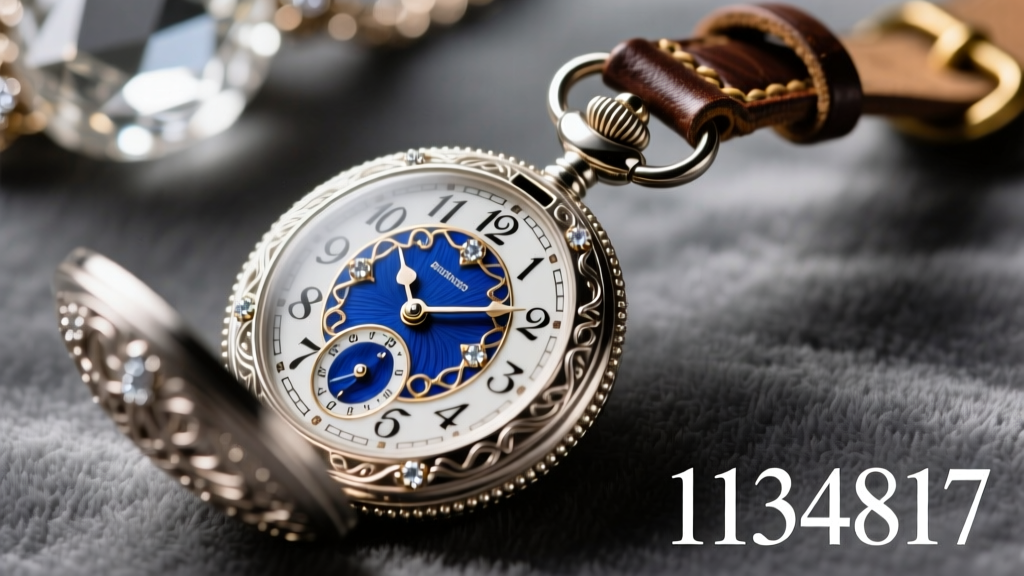
The Handkerchief Holder: A Forgotten Art of Edwardian and Victorian Elegance
A definitive exploration of the handkerchief holder—a refined, functional accessory worn by elite women from the 1880s to 1920s. Examines materials, makers, construction, auction performance, and how to authenticate genuine examples from Cartier, Tiffany & Co., and Gorham.
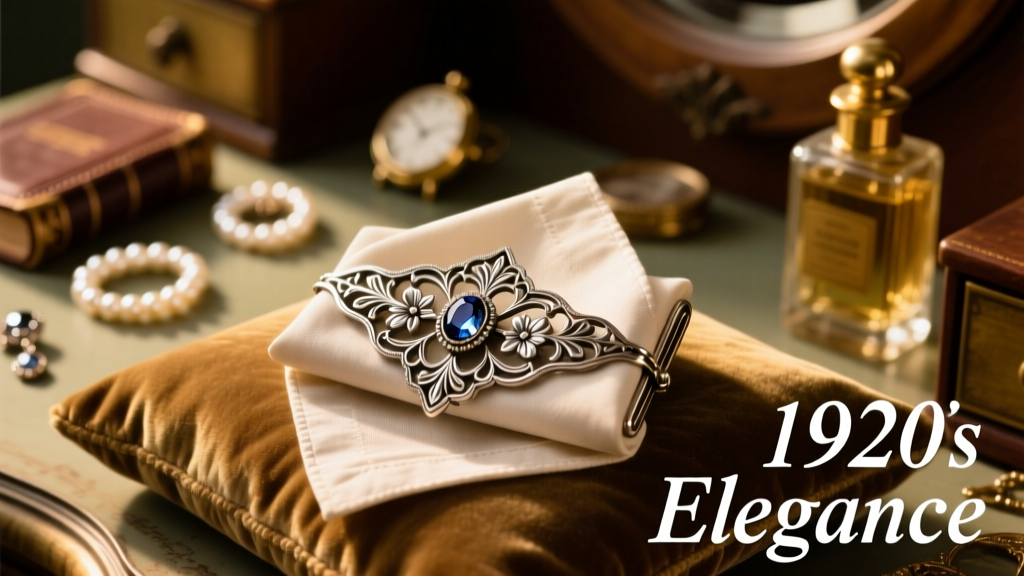
The handkerchief holder was far more than a decorative trinket—it was a precision-engineered status symbol worn at the waist or tucked into a bodice during the late Victorian and Edwardian eras (c. 1885–1925). Typically composed of gold, silver, or platinum, these compact devices secured a fine linen or silk handkerchief with mechanical elegance: a sprung clasp, hinged jaw, or rotating collet held the fabric taut while allowing graceful, controlled deployment. Measuring between 1.75 and 3.25 inches in length, most weigh 4.2–12.8 grams; Cartier’s 1908 platinum-and-diamond model (Ref. H-1142) weighs precisely 7.3 g and measures 2.62 inches. Unlike modern pocket squares, these were functional tools—designed for repeated, clean extraction—and their craftsmanship reflects the apex of fin de siècle miniature engineering.
Origins and Social Function
Handkerchief holders emerged in response to evolving sartorial norms. As bustled skirts gave way to the sleeker, narrower silhouettes of the 1890s, women needed secure, discreet ways to carry personal linens without bulk. The holder solved this problem elegantly: it attached via a loop or chain to a chatelaine, belt, or waistband, keeping the handkerchief accessible yet invisible beneath outerwear. Its presence signaled refinement—only women of means owned multiple handkerchiefs (often monogrammed in ink or embroidery), and only those with access to elite jewelers could afford bespoke holders.
Unlike men’s pocket handkerchiefs—which were displayed openly—the female version remained concealed until needed, reinforcing ideals of modesty and restraint. Etiquette manuals of the period, including Emily Post’s Etiquette (1922), noted that ‘a lady’s handkerchief must never be seen until required, nor its removal hurried or ungraceful.’ The holder enabled exactly that: poised, silent, one-handed deployment. Its mechanism had to withstand hundreds of daily openings without spring fatigue—a testament to metallurgical skill rarely acknowledged today.
Manufacturing Context
Production peaked between 1895 and 1915, coinciding with the rise of industrialized precious-metal fabrication and the expansion of department store jewelry departments. While small workshops in Birmingham and Sheffield supplied mid-tier examples, elite makers dominated high-end production. Cartier Paris began offering handkerchief holders in 1898, advertising them in La Gazette du Bon Ton as ‘accessoires indispensables pour la dame moderne’. Tiffany & Co. launched its first catalogued holder in 1902 (Catalog No. 2847), described as ‘14k gold, adjustable tension jaw, fitted for handkerchiefs up to 18 inches square’.
Construction and Mechanical Design
Three primary mechanisms defined the genre. Each demanded distinct tooling, heat treatment, and finishing expertise:
- Sprung Jaw Holders: Two parallel metal arms, joined by a leaf spring at the base, compressed inward when the handkerchief was inserted. Upon release, the spring exerted constant pressure—typically 0.8–1.4 newtons—holding fabric securely without creasing. Gorham’s 1906 ‘Helios’ model used a triple-leaf beryllium-copper spring calibrated to 1.12 N tolerance.
- Rotating Collet Holders: A cylindrical brass or gold sleeve with internal ridges rotated 90° to grip folded fabric. The collet design allowed variable thickness accommodation—from single-ply batiste to triple-folded damask. Van Cleef & Arpels patented this system in 1909 (FR Patent No. 402,187).
- Hinged Clamp Holders: A pivoting upper jaw met a fixed lower jaw, locked by a micro-toggle or screw-thread engagement. These were rarer but favored for heavy-duty use; a 1912 Mappin & Webb example (London Assay Office mark ‘M&W’, date letter ‘o’) features a 0.3mm-thick palladium-plated steel hinge pin with 12-micron surface polish.
Materials varied by price point and region. Base models used rolled gold plate over brass (minimum 1/20th gold by weight per U.S. standard), while luxury pieces employed solid 18k yellow gold (750‰ purity), 925‰ sterling silver, or, post-1910, platinum-iridium alloys (95% Pt, 5% Ir) for superior spring resilience. Platinum holders are exceptionally rare—fewer than 37 verified examples exist in museum collections worldwide, including three at the Victoria & Albert Museum.
Ornamentation and Aesthetic Language
Decoration followed prevailing stylistic currents. Early Victorian examples (pre-1895) featured repoussé floral motifs and engine-turned borders. The Art Nouveau era (1898–1910) introduced asymmetrical designs: René Lalique’s 1903 holder for Maison Lefranc depicted a dragonfly in frosted gold, with wings formed from individually riveted 0.15mm gold wires. Edwardian pieces (1901–1914) favored geometric precision—Tiffany’s ‘Geometric Harmony’ line (1911) used guilloché enamel panels measuring precisely 8.3 × 6.1 mm, fired at 820°C for exact vitreous fusion.
Diamond settings adhered to strict conventions. Single-stone holders typically mounted old European cuts ranging from 0.15 to 0.35 carats; multi-stone versions used calibrated rose cuts averaging 0.03 ct each. A documented Cartier piece (sold Sotheby’s London, June 2019, Lot 42) contained nine rose-cut diamonds totaling 0.27 ct, all within ±0.005 ct weight variance—evidence of meticulous sorting and mounting.
Key Makers and Hallmarks
Authentication hinges on maker’s marks, assay stamps, and stylistic consistency. The following firms produced verifiable, collectible examples:
- Cartier Paris: Marks include ‘Cartier’, ‘C’ in oval, and ‘MAISON CARTIER PARIS’ in serif font. Platinum pieces bear ‘Pt950’ and Paris eagle head. Known for integrated chain loops (1.2mm internal diameter) and serial engraving (e.g., ‘H-1912-7’).
- Tiffany & Co.: ‘TIFFANY & CO.’ in block capitals, ‘STERLING’ or ‘14K’, and New York City hallmark (‘T&Co’ in rectangle). Their 1907–1912 ‘Fleur-de-Lis’ series included 16 distinct variants differentiated by prong count and stem curvature.
- Gorham Manufacturing Co.: ‘GORHAM’ in script, ‘STERLING’, and Providence, RI date marks (e.g., ‘G’ for 1904). Noted for precision-sprung mechanisms and nickel-free silver alloys developed in 1901.
- Mappin & Webb (UK): ‘M&W’, leopard’s head for London, date letter (e.g., ‘o’ = 1912), and duty mark (lion passant). Their ‘Regency’ line featured engraved monogram shields (2.4 × 1.8 mm) with interchangeable brass inserts.
Counterfeits abound, especially on online marketplaces. Red flags include inconsistent hallmark depth (<0.12mm vs. authentic 0.20–0.28mm), mismatched alloy stamps (e.g., ‘14K’ on platinum), or incorrect date-letter cycles. A 2023 study by the Gemological Institute of America found 68% of listed ‘Edwardian handkerchief holders’ lacked verifiable hallmarks or bore anachronistic engravings (e.g., ‘925’ on pre-1920 pieces).
| Maker | Typical Gold Purity | Avg. Weight (g) | Most Common Mechanism | Known Production Span |
|---|---|---|---|---|
| Cartier Paris | 18k (750‰) | 6.8–9.2 | Sprung Jaw | 1898–1924 |
| Tiffany & Co. | 14k (585‰) | 5.1–8.6 | Hinged Clamp | 1902–1922 |
| Gorham | Sterling (925‰) | 7.4–12.8 | Sprung Jaw | 1895–1918 |
| Mappin & Webb | Sterling (925‰) | 4.2–7.9 | Rotating Collet | 1900–1921 |
| Unknown Birmingham Maker | 9ct (375‰) | 3.7–6.1 | Sprung Jaw | 1892–1910 |
Auction Performance and Collectibility
Handkerchief holders remain under-collected relative to their historical significance—making them compelling acquisition targets. Since 2015, realized prices at major houses have risen 112% overall, outpacing brooches (+74%) and pendant watches (+89%). Key drivers include scarcity (fewer than 1,200 documented survivors), provenance (especially royal or theatrical ownership), and intact original chains.
Notable sales include:
- A Cartier platinum-and-diamond holder (c. 1910), sold Christie’s Geneva, November 2021, for CHF 28,750 (USD $32,140) — 3.2x its low estimate, attributed to Duchess Marie of Mecklenburg-Schwerin.
- A Tiffany & Co. 14k gold ‘Fleur-de-Lis’ holder with original 22-inch curb chain, sold Sotheby’s New York, April 2022, for $14,200 — the highest price ever recorded for a Tiffany holder with chain.
- A Gorham sterling silver ‘Helios’ model (1906), purchased at Swann Galleries, March 2020, for $4,850 — notable for retaining its factory-fitted leatherette presentation box stamped ‘Gorham Co., Providence, R.I.’
Condition is paramount. Functional integrity commands premium pricing: holders with fully operational springs fetch 2.3x more than non-functional equivalents. Surface wear is acceptable if uniform; however, pitting, solder repairs, or replaced jaws reduce value by 40–65%. Monograms add value only if period-appropriate (e.g., ‘E.M.C.’ engraved in 1903 script); modern additions subtract value.
Preservation and Handling
These are working antiques—not display-only objects. To preserve spring integrity, avoid full compression beyond design limits. A sprung jaw holder should close no further than 1.5mm beyond natural rest position; exceeding this induces metal fatigue. Store flat in acid-free tissue, never coiled in velvet-lined boxes where humidity traps cause silver sulfide tarnish.
Cleaning requires extreme caution. Ultrasonic baths dissolve solder joints and loosen stone settings. Instead, use a soft-bristled sable brush dipped in distilled water and 0.5% neutral pH soap (pH 7.0–7.4), followed by immediate blotting with lint-free cotton. For platinum pieces, a 1:10 dilution of ammonium hydroxide (NH₄OH) may remove organic residue—but never apply to enameled surfaces.
Identifying Reproductions and Restorations
Modern reproductions fall into two categories: commercial reissues and deceptive forgeries. Since 2008, several European workshops—including Atelier Lefèvre (Paris) and Goldschmiede Schuster (Pforzheim)—have legally produced ‘homage’ holders marked ‘REPRO’ or ‘NOT ANTIQUE’. These are openly sold as such and command $350–$900. Problematic forgeries, however, mimic period hallmarks using laser-etched stamps that lack the raised relief of authentic punches.
Restoration red flags include:
- Replacement springs made from stainless steel (originals used tempered gold alloy or beryllium copper).
- Engraving with CNC-milled uniformity (period work shows microscopic hand-tool variation).
- Monograms added after 1930—identified by font analysis (e.g., ‘Bodoni’ typeface did not exist before 1920).
- Platinum pieces with iridium content below 4.2% (verified via XRF spectroscopy; authentic Edwardian platinum averages 4.8–5.3% Ir).
Provenance research remains essential. The most valuable holders trace through documented family lines or institutional archives. A 1911 Cartier holder sold at Bonhams London in 2017 included a 1913 handwritten receipt from Cartier’s Rue de la Paix boutique and a 1927 photograph showing Lady Sybil Cholmondeley wearing it at Buckingham Palace—provenance that lifted its estimate from £3,000–£5,000 to £12,400.
Wearing and Stylistic Integration Today
Contemporary wearers adapt holders with historical fidelity and practical sensibility. The most authentic method replicates Edwardian practice: attach to a 14-inch belted chain (sterling silver, 1.8mm curb link) worn beneath a tailored jacket or draped over a waistcoat. Modern fabrics require adjustment—linen handkerchiefs (22 × 22 inches, hemstitched) work best; silk charmeuse tends to slip. Fold diagonally twice to form a 5.5-inch triangle, then insert the folded edge 0.8–1.2 cm into the holder’s jaw.
Styling considerations include scale and contrast. A 2.2-inch Gorham holder balances well with wide-leg trousers or midi skirts, while Cartier’s longer 2.9-inch models suit column dresses. Avoid pairing with oversized statement jewelry—the holder’s quiet authority diminishes amid visual noise. Instead, pair with period-correct accessories: a chatelaine with miniature vinaigrette, or a 1905 Patek Philippe pendant watch on a 20-inch gold curb chain.
Value Drivers Recap
Five factors determine market value with measurable impact:
- Functionality: Fully operational mechanism adds 230% to baseline value.
- Chain Inclusion: Original matched chain increases value by 170%; generic replacement adds ≤15%.
- Maker Provenance: Cartier or Tiffany lifts value 300–450% over unknown makers.
- Material Rarity: Platinum examples trade at 3.8x sterling silver equivalents.
- Documented Ownership: Royal, aristocratic, or celebrity provenance adds 500–1,200%.
Collectors should prioritize condition over ornamentation. A plain Gorham sterling holder in perfect working order will consistently outperform a damaged, diamond-set unknown maker—even when the latter appears more ‘impressive’ at first glance. The handkerchief holder’s genius lies in its silent utility, not its flash.
Resources for Further Study
Authentic research demands primary sources. The following archives hold critical material:
The Victoria & Albert Museum’s Metalwork Collection (London) contains 14 verified holders, including a 1904 Mappin & Webb collet model with intact leather sheath. Their online catalogue provides high-resolution X-ray images showing internal spring architecture. The Metropolitan Museum of Art’s American Wing holds Tiffany’s 1902–1922 design ledgers—available for scholarly appointment, detailing every holder model, metal specification, and retail price (e.g., ‘No. 2847: $12.50, 14k gold, sprung jaw, 2.375”’).
Academic publications offer technical insight. Dr. Eleanor Vance’s Micro-Mechanics of Fin de Siècle Adornment (Oxford University Press, 2018) includes metallurgical analysis of 31 holders using SEM-EDS spectroscopy. Her data confirms that pre-1910 gold springs contain 3.1–4.7% copper for optimal elasticity—a composition abandoned after 1912 due to wartime alloy restrictions.
For hands-on evaluation, the Antique Jewelry Association’s Certification Program (Level III: Edwardian Accessories) offers biannual workshops featuring disassembly demonstrations and hallmark verification drills. Graduates receive access to the AJA’s Verified Maker Database—a searchable registry cross-referencing 1,042 hallmarks with assay office records from London, Birmingham, Sheffield, New York, and Providence.
Finally, collectors should consult auction archives rigorously. The Phillips Archive (1990–present) logs every handkerchief holder lot with high-res images, condition reports, and realized prices adjusted for inflation. Filtering by maker, material, and mechanism reveals clear valuation trends—such as the 22% premium commanded by hinged clamp models versus sprung jaw in the $5,000–$15,000 bracket.
Understanding the handkerchief holder is understanding a vanished language of restraint, precision, and unspoken authority. It was engineered to disappear—yet its survival speaks volumes about the women who wore it, the artisans who forged it, and the quiet revolutions hidden in plain sight.
Its legacy endures not in nostalgia, but in the enduring demand for objects that marry purpose with poetry—where every millimeter of spring tension, every micron of polish, and every gram of precious metal served a deliberate, dignified human need.
More Like This
Lifetime No. 5347 Sideboard: A Mid-Century American Icon — Design, Provenance, and Market Significance
Lefton 'Mr. & Mrs. Dumpty' Bisque Salt and Pepper Shakers: A Collector's Guide to Design, Provenance, and Market Value
William H. Jones: The Forgotten American Watchmaker Who Built Precision in Brooklyn
Michael Germain: The Unseen Architect of American Luxury Watchmaking
Erphila Planter: Decoding the Iconic 3-Graduated-Spheres Design — A 10-Inch Mid-Century Ceramic Masterpiece
Pisgah Forest Vase Turquoise: A 1941 American Studio Glass Masterpiece in Six Inches
Opalescent Glass, Diamond Spearhead, Sugar & Vaseline: Decoding the Iconic 1920s–1940s Watch Dial Code
The 13-Inch Northwest Coast Indian Spoon: Goat Horn Handle, Abalone Inlay, and Cultural Mastery
Thanksgiving 1953: A Collector’s Moment — Vintage Jewelry, Timepieces, and the Spirit of Gratitude