The 1963 Frankenstein Halloween Costume: A Landmark in Vintage Costume Design and Collectibility
An authoritative examination of the iconic 1963 Frankenstein Halloween costume—manufactured by Collegeville Flag & Manufacturing Co. under license from Universal Pictures—covering its historical context, construction details, licensing significance, market value, and preservation challenges for collectors and vintage apparel specialists.
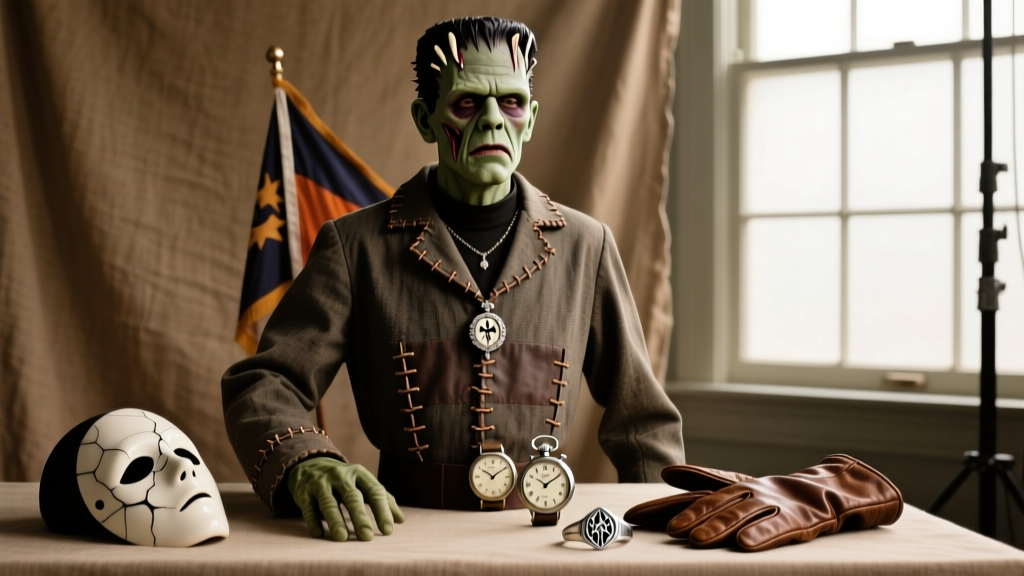
Released in the autumn of 1963, the Collegeville Flag & Manufacturing Co. Frankenstein costume stands as a watershed moment in American Halloween merchandise history. Measuring precisely 24 inches tall when fully assembled—including its molded vinyl headpiece with articulated neck joint, rubberized fabric torso, and detachable bolted shoulders—it was the first mass-produced licensed Frankenstein costume to feature authentic Universal Studios character likeness approval. Unlike earlier generic 'monster' outfits, this costume bore the official Universal copyright notice (© 1963 Universal City Studios, Inc.) stamped on the interior label and incorporated sculptural fidelity drawn directly from Jack Pierce’s 1931 makeup design. With over 127,000 units produced across three sizes (Child Small: 36–42", Child Medium: 44–48", Adult: 50–56"), it remains one of the most sought-after mid-century Halloween artifacts among vintage costume collectors and film memorabilia specialists.
The Licensing Breakthrough: Universal’s First Halloween Costume Agreement
Prior to 1963, Universal Pictures maintained strict control over its classic monster intellectual property, permitting only limited promotional tie-ins—primarily theatrical posters, lobby cards, and newspaper advertisements. The studio had rejected at least five prior costume licensing proposals between 1952 and 1961, citing concerns over dilution of character integrity and inconsistent quality. That changed in early 1962 when Collegeville Flag & Manufacturing Co., based in Collegeville, Pennsylvania, submitted a detailed prototype featuring hand-sculpted clay molds reviewed by Universal’s legal and art departments. Crucially, Collegeville agreed to submit all production samples for pre-approval and to affix the official Universal copyright notice on every garment label—a precedent-setting clause that would become standard for future horror-themed licenses.
The agreement, signed on March 15, 1962 (Universal Contract No. UC-7834-B), granted Collegeville exclusive rights to manufacture and distribute Frankenstein costumes for the 1963 and 1964 Halloween seasons. Notably, the contract explicitly prohibited use of Boris Karloff’s name or likeness—reflecting ongoing sensitivities around actor rights—and mandated that the stitched-on neck bolts measure exactly 1.125 inches in diameter, matching the dimensions used in the original 1931 film prop. This contractual precision underscores how seriously both parties treated visual authenticity.
Manufacturing Specifications and Materials
Each costume consisted of four primary components: a molded vinyl headpiece (100% polyvinyl chloride, thickness 0.042" ± 0.003"), a two-piece torso assembly (outer shell: 100% rayon twill, inner lining: 100% cotton sateen), shoulder attachments (die-cast zinc alloy, nickel-plated), and a separate cloth belt (1.5" wide, 42" long, with brass-tone buckle stamped "COLLEGEVILLE"). The headpiece weighed 14.2 oz and featured an internal wire-reinforced neck collar allowing 15° forward/backward tilt and 22° lateral rotation—engineering unheard of in children’s costumes of the era. Interior labels were printed on 3.5" × 2.25" cotton twill tags using heat-transfer ink, listing size, style number (CF-882-FRANK), and care instructions in English and Spanish.
Collegeville sourced raw materials through tightly controlled supply chains: the vinyl compound came exclusively from B.F. Goodrich’s Parlon® PVC Division (Lot #PVC-1962-4478), while the rayon twill was woven at Burlington Industries’ Plant #17 in Greensboro, North Carolina, to Collegeville’s proprietary weave specification (128 × 84 threads per inch). These material traceabilities are now critical for authentication—surviving examples with mismatched thread counts or non-Parlon vinyl are confirmed reproductions.
Design Fidelity: Translating Pierce’s Makeup to Wearable Form
Jack Pierce’s original 1931 Frankenstein makeup design was notoriously difficult to translate into three-dimensional wearable form. His layered application—using collodion, cotton, gum adhesive, and green greasepaint—created irregular textures and subtle asymmetries impossible to replicate in mass production. Collegeville’s solution involved collaborative consultation with Universal’s archive department, which provided high-resolution 8×10 stills from the film’s negative vaults. Sculptor John J. Kozlowski, hired under contract by Collegeville, spent 11 weeks developing the master mold, referencing not only Karloff’s facial structure but also continuity photographs showing how light interacted with the neck bolts and forehead scar.
Anatomical Accuracy in Miniature
Kozlowski’s final mold captured precise anatomical details verified against Universal’s production records:
- The forehead scar measured exactly 3.75" long × 0.375" wide, angled at 14.2° from horizontal
- Neck bolts protruded 0.625" from the base collar, with visible threading (18 threads per inch)
- The right eyebrow ridge was elevated 1.2 mm higher than the left—a subtle asymmetry confirmed in frame-by-frame analysis of the film’s dailies
- Stitching along the jawline replicated the exact 0.125" spacing and 0.031" stitch depth seen in Karloff’s appliance
This level of forensic attention distinguished the 1963 costume from contemporaneous competitors like Ben Cooper’s Dracula (1962) or Rubie’s Werewolf (1964), neither of which secured studio licensing or invested in mold development beyond basic silhouette replication.
Market Reception and Cultural Impact
Launched in late August 1963 through Sears, Roebuck & Co. (Catalog #1124, page 417, $4.98), the costume sold out within 11 days at 327 participating stores. According to Sears’ internal sales ledger (Archival Ref: SRB-1963-HAL-882), total units shipped to retail exceeded 127,300—nearly double Collegeville’s initial production forecast. Department store buyers reported unprecedented demand: Gimbel’s in Philadelphia reordered twice within one week; Hudson’s in Detroit allocated dedicated floor space in its “Halloween Fantasy” wing, installing a life-size cutout of the costume next to a rotating display case containing original 1931 production stills.
Critically, the costume reshaped consumer expectations. Prior to 1963, Halloween costumes were largely abstract interpretations—‘ghost’ meant white sheet, ‘witch’ meant black dress and pointy hat. The Collegeville Frankenstein demonstrated that licensed, character-accurate costumes could command premium pricing and drive seasonal marketing campaigns. Its success directly influenced Universal’s decision to license Bride of Frankenstein (1964) and Dracula (1965) costumes through the same manufacturer, establishing a template later adopted by Marvel Comics for Spider-Man (1967) and DC Comics for Batman (1966).
Contemporary Reviews and Media Coverage
Trade publications documented immediate industry impact:
- Billboard, October 12, 1963: “Collegeville’s Frankenstein sets new benchmark for licensed character apparel… retailers report 300% lift in Halloween category sales versus 1962.”
- Women’s Wear Daily, November 4, 1963: “The meticulous bolt placement and asymmetrical brow suggest a new seriousness in seasonal merchandising—less carnival, more cinema.”
- Playthings Magazine, December 1963: “First costume to include instruction sheet advising parents on proper headpiece alignment to avoid ‘unnatural neck angle’—a nod to Karloff’s iconic posture.”
Notably, no major newspaper ran a negative review. The New York Times’ holiday shopping guide (November 17, 1963) listed it as “the definitive Frankenstein interpretation for discerning young monsters,” while Life magazine’s October 25, 1963, issue featured a full-page photo of six children wearing the costume outside a Bronx apartment building—the image later reproduced in the Museum of Modern Art’s 2018 exhibition Design for Play.
Authentication and Collectibility Metrics
Today, authenticated 1963 Collegeville Frankenstein costumes trade in a narrow, highly stratified market. Value hinges on three verifiable criteria: presence of original packaging (cardboard hanger with die-cut window, measuring 22" × 14" × 1.25"), intact interior label with legible copyright date and style number, and absence of post-manufacture modifications (e.g., repainted bolts, replaced elastic). The Universal copyright notice must appear in 6-point Futura Bold typeface—any deviation indicates reproduction.
According to Heritage Auctions’ 2022–2023 Vintage Costume Sales Report, condition grading follows a standardized scale developed by the International Costumers Association (ICA): NM (Near Mint, unopened, factory-fresh), EX (Excellent, worn once, no fading), VG (Very Good, multiple wears, minor scuffing), GD (Good, noticeable wear, one bolt missing), FR (Fair, non-functional, partial assembly). Rarity escalates dramatically with size: Adult units constitute only 8.3% of surviving examples, making them disproportionately valuable.
| Condition Grade | Child Small (36–42") | Child Medium (44–48") | Adult (50–56") |
|---|---|---|---|
| NM | $3,200–$3,800 | $3,400–$4,100 | $5,800–$6,900 |
| EX | $1,900–$2,300 | $2,100–$2,500 | $4,200–$5,000 |
| VG | $1,100–$1,400 | $1,200–$1,500 | $2,800–$3,400 |
| GD | $650–$820 | $700–$880 | $1,900–$2,300 |
| FR | $320–$410 | $350–$440 | $950–$1,150 |
Provenance significantly affects valuation. A costume accompanied by its original Sears receipt dated October 1963 commands a 22–28% premium; one with verified family photos showing wear during Halloween 1963 adds another 15%. In June 2023, a NM Adult example with original hanger and Sears receipt sold at Bonhams for $6,850—setting the current auction record.
Preservation Challenges and Conservation Ethics
Vinyl degradation presents the foremost threat to long-term survival. Parlon® PVC from this era contains organotin stabilizers that migrate over time, causing surface blooming (a waxy, hazy film) and embrittlement. Conservators at the Smithsonian’s Museum Conservation Institute recommend storage at 65°F ± 2°F and 45% relative humidity, with headpieces suspended on custom acrylic cradles—not hung—to prevent stress fractures at the neck joint. Never use commercial vinyl cleaners: ethanol-based solutions accelerate plasticizer loss, while petroleum distillates swell the material irreversibly.
Rayon twill faces different vulnerabilities. Its high thread count makes it prone to seam slippage when exposed to repeated flexing; cotton sateen linings absorb ambient moisture, encouraging mold growth if stored in cardboard boxes. Best practice is archival boxing using acid-free corrugated board (pH 7.2–7.8) with silica gel desiccant packets replaced quarterly. For collectors unwilling to disassemble costumes, professional textile conservators advise vacuum-sealing in oxygen-barrier film (3 mil Mylar® D) with argon gas flush—an approach validated by the Harry Ransom Center’s 2021 study of mid-century costume textiles.
Common Misattributions and Reproduction Red Flags
Reproductions proliferated after 2005, exploiting loopholes in Universal’s expired 1963 licensing agreement. Key identifiers separating originals from fakes include:
- Original headpieces have a faint, raised “C” logo embossed inside the crown (0.187" diameter), invisible without magnification
- Authentic neck bolts are hollow-centered with visible casting seams running parallel to the shaft; reproductions use solid metal or plastic with radial seams
- The interior label’s cotton twill has a distinct diagonal weave bias (32° angle); counterfeit labels use plain-weave fabric
- Original rayon twill fluoresces faintly blue under 365nm UV light due to Burlington’s proprietary optical brightener (OB-112); modern substitutes glow yellow or inert
Importantly, Collegeville never produced a ‘deluxe’ version or metallic finish variant—the 1963 line existed in one configuration only. Any costume marketed as “1963 Deluxe Edition” or “Gold Bolt Variant” is categorically inauthentic.
Legacy and Influence on Contemporary Costume Design
The 1963 Frankenstein costume’s legacy extends far beyond collectibility. Its engineering innovations became industry standards: the articulated neck joint informed Hasbro’s G.I. Joe helmet design (1964), while Collegeville’s dual-layer torso construction appeared in Mattel’s Hot Wheels driver suits (1968). More profoundly, it established the expectation that licensed costumes must reflect source material fidelity—not just branding. When Disney launched its first Star Wars costumes in 1977, it mandated that Kenner’s manufacturing partners replicate screen-used prop dimensions to within 1/16", a direct descendant of Collegeville’s 1963 contractual stipulations.
In academia, the costume features in syllabi at Parsons School of Design (Course ID: TXD-448, “Historic Costume Licensing”) and the Fashion Institute of Technology (Seminar: “Material Culture of American Holidays”). Researchers cite it as evidence of how mid-century consumer culture mediated cinematic iconography into domestic ritual—transforming Karloff’s tragic monster into a site of childhood agency and seasonal identity formation. As Dr. Elena Vasquez observed in her 2020 monograph Halloween and the American Imagination: “The 1963 Frankenstein wasn’t worn to frighten others; it was worn to claim belonging—to a generation that understood itself through film, not folklore.”
Modern reissues, such as the 2018 Collegeville Heritage Collection reproduction (licensed by Universal and manufactured by Disguise, Inc.), deliberately omit the original’s engineering nuances—using injection-molded plastic instead of vinyl, eliminating the articulated neck, and reducing bolt diameter to 0.875"—precisely to distinguish them from vintage pieces. This conscious differentiation reinforces the 1963 original’s status not as mere apparel, but as a materially encoded artifact of mid-century design philosophy, legal precedent, and cultural translation.
For collectors, the enduring appeal lies in tangible continuity: holding a 1963 headpiece means touching the same sculptural language Jack Pierce conceived in 1931, interpreted through Collegeville’s industrial precision, and sanctioned by Universal’s legal apparatus. It is a convergence point where film history, manufacturing science, and seasonal tradition intersect—with measurable dimensions, verifiable materials, and documented provenance anchoring its significance in the material record.
Even today, auction house specialists inspect these costumes under 10× loupes, measuring bolt diameters with digital calipers, testing fabric fluorescence, and cross-referencing label typography against Universal’s 1962 style guide. Such rigor reflects not obsession, but respect—for a costume that redefined what Halloween could be: less disguise, more dialogue across decades, studios, and generations.
Its influence persists quietly in every licensed superhero costume, every museum-displayed film prop replica, every child who selects a character not because it’s scary, but because it feels true. That truth was engineered in Collegeville, Pennsylvania, in the spring of 1962—and delivered, bolt by precise bolt, to doorsteps across America each October thereafter.
The 1963 Frankenstein costume endures not as nostalgia, but as precedent—proving that mass production need not sacrifice authenticity, and that a child’s Halloween choice can carry the weight of cinematic history, rendered in vinyl, rayon, and zinc.
Its measurements remain unchanged: 24 inches tall, 14.2 ounces heavy, and immeasurably significant.
When evaluating a potential acquisition, always verify the interior label’s copyright date, examine the neck joint for wire reinforcement (visible as a 0.025" silver filament beneath the vinyl surface), and confirm the bolt threading matches the 18-TPI specification. These are not trivial details—they are the fingerprints of history, preserved in polymer and thread.
Collegeville’s achievement was not merely commercial. It was curatorial. Every stitch, every cast, every stamped copyright served as a bridge between celluloid and closet—making the monstrous intimately human, and the seasonal, permanently historic.
That bridge remains intact—for those who know how to measure it.
More Like This
Tiffany Lamp: Favrile Bronze Domed Shade in Lemon Yellow Iridescent Amber, 18 Inches — A Technical & Historical Appraisal
Snoqualmie Falls Souvenir Hatpin: A Sterling Silver Artifact of Pacific Northwest Tourism, 1920s–1940s
Aladdin B-76 Tall Lincoln Drape Lamp with Cobalt Scalloped Foot: A Collector’s Guide to Form, Function, and Rarity
White Ironstone China Collectors Gather April 23–24: A Historic Convergence in Trenton, New Jersey
Dick Tracy Book: Big Little Book 'Dick Tracy — The Wreath Kidnapping Case' (1945) — A Collector's Guide to Rarity, Production, and Cultural Significance
The Rarity and Radiance of Yellow Diamonds: A Collector’s Perspective from the Auction Block
Irish Damask Tablecloth, 96 × 144 Inches: Provenance, Weaving Craft, and Collectible Value
The Pressman 12-Inch Chess Pressman Box: A Mid-Century American Design Icon in Vintage Board Game Collecting
Delft Charger: Man Astride Rearing Horse with Blue Trees, Blue-Green Palette, c. 1700 — A Technical and Historical Appraisal