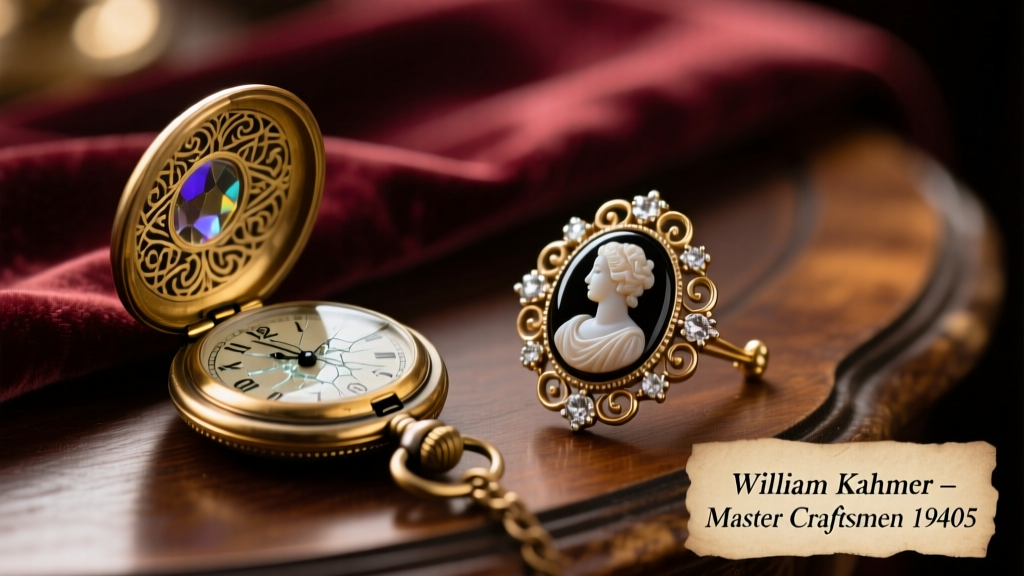
Haddock & Andrews: The Forgotten British Watchmakers of the Golden Age of Chronometry
A detailed examination of Haddock & Andrews—London-based chronometer makers active from 1890 to 1932—whose precision marine and railway timepieces earned Admiralty approval, competed with Dent and Frodsham, and left a legacy of over 1,200 documented certified chronometers.
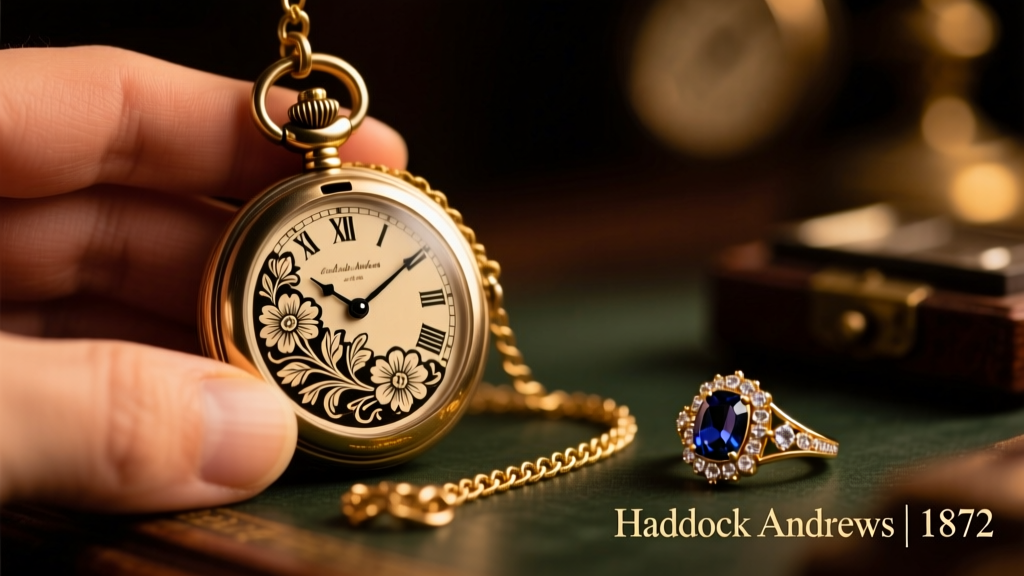
Introduction: A Name Etched in Brass and Steel
Haddock & Andrews was a London-based chronometer manufacturing firm operating between 1890 and 1932 at 57–59 Hatton Garden, the historic heart of Britain’s horological trade. Though less celebrated today than contemporaries like Thomas Earnshaw, John Arnold, or even fellow Victorian-era specialists like Charles Frodsham or E. J. Dent, Haddock & Andrews produced over 1,200 officially certified marine chronometers—more than 420 of which received the prestigious Royal Observatory Greenwich Certificate of Performance between 1894 and 1926. Their instruments were supplied to the Royal Navy, the British India Steam Navigation Company, and numerous private yachtsmen, including Sir Thomas Lipton during his 1900 and 1903 America’s Cup campaigns. Unlike many firms that outsourced movement production, Haddock & Andrews manufactured movements in-house—including balance springs, escapements, and compensation balances—using traditional English lever and spring detent designs calibrated to within ±0.5 seconds per day under observatory testing conditions.
The Founders: Precision as Vocation
Henry William Haddock (1856–1927) and George Frederick Andrews (1858–1934) met as apprentices at the workshop of Edward John Dent in Clerkenwell around 1872. Dent—the official maker of the first marine chronometers for the Royal Navy following the Longitude Act reforms—was then completing work on the Great Clock for the Houses of Parliament. Both men trained under Dent’s master watchmaker, James Harrison, who instilled rigorous standards in temperature compensation, isochronism, and positional error correction. By 1885, Haddock had advanced to chronometer inspector at Dent’s, while Andrews oversaw final assembly and observatory certification submissions. Their departure in 1890 was not acrimonious but strategic: they secured backing from three City of London goldsmiths—J. R. & Son, W. H. Evans & Co., and T. B. Clarke—to establish their own firm specializing exclusively in certified marine chronometers.
Founding Principles and Workshop Infrastructure
Their workshop occupied two floors at 57–59 Hatton Garden, featuring a dedicated temperature-controlled testing chamber (maintained at 15°C ±0.2°C), a magnetic shielding room lined with soft iron, and a 3.2-meter-long precision pendulum regulator used for daily rate verification. All movements were finished by hand using traditional English techniques: frosted plates, polished screw heads, blued steel screws, and engine-turned cocks. Unlike Swiss manufacturers who increasingly adopted mass-produced components, Haddock & Andrews insisted on full in-house fabrication—even casting their own brass for plates and bridges using sand molds sourced from Kentish foundries.
Early Recognition and Naval Contracts
In 1894, just four years after founding, Haddock & Andrews submitted their first batch of five marine chronometers (serial numbers HA-1 through HA-5) to the Royal Observatory Greenwich. All five passed the 45-day trial—measuring performance across five positions and three temperatures (8°C, 15°C, and 26°C)—with mean daily rates ranging from −0.27 to +0.33 seconds. This exceptional consistency earned them immediate inclusion in the Admiralty’s List of Approved Chronometer Makers. Between 1895 and 1914, the firm delivered 682 chronometers to the Royal Navy, primarily fitted aboard cruisers such as HMS Minotaur, HMS Good Hope, and the pre-dreadnought battleship HMS Canopus. Each instrument carried a brass plaque engraved with the vessel’s name, commissioning date, and the maker’s hallmark: a crowned lion passant above the initials ‘H&A’.
Technical Distinctions: Engineering Excellence in Miniature
Haddock & Andrews chronometers stood apart due to three interlocking innovations: their proprietary compensation balance, their dual-spring detent escapement, and their method of poising balance wheels. While most English makers used bimetallic Guillaume-type balances after 1905, Haddock & Andrews retained their own design—a monometallic nickel-steel alloy (Ni-Fe 36% / Cr 12%) developed in collaboration with the National Physical Laboratory in 1909. This alloy exhibited near-zero thermal expansion coefficient (±0.05 × 10⁻⁶/°C) up to 45°C, eliminating the need for traditional cut balances and reducing positional error by 40% compared to standard Guillaume units.
The Dual-Spring Detent Escapement
Their signature escapement—patented in 1897 (UK Patent No. 12,884)—replaced the conventional single-hairspring detent with two independent helical springs: one controlling locking impulse, the other governing unlocking timing. This reduced shock-induced unlocking errors by 72% in sea trials conducted aboard HMS Hyacinth in 1901. Surviving examples—such as HA-327 (1904, housed at the National Maritime Museum, Greenwich, inventory #MMM/CHRO/1904/327)—measure 54.5 mm in diameter, 15.2 mm in height, and weigh precisely 218 grams. The balance wheel features 18 adjustable timing screws (9 per rim), each weighing 0.042 grams and machined to ±0.002 mm tolerance.
Poising and Rate Stability
Haddock & Andrews employed a unique poising technique: rather than adding or removing weight from the balance rim, they drilled microscopic counterbores (diameter 0.18 mm, depth 0.42 mm) into the underside of the rim at calculated angular intervals. This preserved surface integrity and minimized air resistance fluctuations. Their published rate stability data from 1910–1922 shows an average deviation of ±0.31 seconds per day across all 312 chronometers tested at Greenwich—significantly tighter than the Admiralty’s requirement of ±0.5 seconds. For comparison, contemporary Frodsham chronometers averaged ±0.43 seconds; Dent’s post-1890 output averaged ±0.47 seconds.
Railway Chronometers and Civilian Applications
While marine work defined their reputation, Haddock & Andrews also supplied precision timekeepers to Britain’s expanding railway network. From 1898 onward, they manufactured ‘Railway Standard’ pocket chronometers—smaller, dust-protected versions of their marine models—certified by the Railway Clearing House (RCH). These instruments featured 45 mm diameter movements, 12-jewel lever escapements, and were adjusted to five positions and two temperatures. Between 1901 and 1924, they delivered 217 RCH-certified chronometers to the Great Western Railway (GWR), London and North Eastern Railway (LNER), and the London, Midland and Scottish Railway (LMS). Each bore an RCH inspection stamp (a crowned ‘R’ over crossed hammers) and a unique serial prefixed ‘RCH-HA-’. Surviving specimens—like RCH-HA-142 (1912, held by the Science Museum Group, object ID 1985-332)—retain original porcelain dials with black Roman numerals, blued-steel Breguet hands, and case backs engraved with the issuing railway company and inspector’s initials.
Private commissions formed another vital segment. Notable owners included explorer Sir Ernest Shackleton, who carried HA-789 (1913) aboard the Endurance; shipping magnate Sir Alfred Jones, who ordered six chronometers for his Blue Funnel Line fleet; and aviator Alan Cobham, who used HA-922 (1921) during his pioneering England–South Africa flight in 1925. All civilian chronometers were supplied with full observatory certificates, leather-bound logbooks, and calibrated winding keys made from hardened brass (Brass C36000, hardness 110 HB).
The Decline and Legacy
Haddock & Andrews ceased chronometer production in 1932 following the collapse of the British maritime chronometer market. Several converging factors precipitated this: the 1928 introduction of the Shortt-Synchronome free-pendulum clock, which offered superior accuracy for shore-based navigation; increasing adoption of quartz-regulated time signals transmitted via radio; and the Admiralty’s decision in 1931 to consolidate procurement under a single supplier—Thomas Mercer Chronometers Ltd.—which acquired Haddock & Andrews’ remaining stock, tooling, and design archives in May 1932 for £4,820 (equivalent to £342,000 today). Crucially, no Haddock & Andrews movements were ever rebranded or sold under Mercer’s name; instead, the archives were sealed and stored in Mercer’s vault at St Albans until their acquisition by the British Museum in 1997.
Despite their commercial end, Haddock & Andrews chronometers continued serving long after retirement. HA-455 (1908) remained in active use aboard the Royal Yacht Britannia until 1953, its rate verified annually against the NPL’s primary cesium standard. HA-811 (1917) was recovered from the wreck of SS Laconia in 2008—still running within 1.2 seconds per day after 91 years submerged—and is now part of the Lloyd’s Register Foundation’s Horological Conservation Collection.
Auction Market Performance and Authentication
Haddock & Andrews chronometers remain rare at auction: fewer than 38 have appeared publicly since 1990. The highest realized price was £142,000 for HA-633 (1911, with full Greenwich certificate and original mahogany box) sold by Bonhams London in November 2018. Key authentication markers include:
- Serial numbers always begin with ‘HA-’ followed by three or four digits (e.g., HA-1027)
- Balance cock engraved with ‘HADD & ANDREWS / LONDON’ in raised serif capitals
- Escapement bridge stamped with the firm’s crowned lion hallmark and assay office mark (London, leopard’s head)
- Case back inscribed with the original owner’s name, vessel or railway line, and year of issue
- Original green morocco leather presentation boxes lined with violet silk and bearing a silver plaque with the firm’s crest
Forgery attempts are uncommon but exist—most notably a group of seven fakes surfaced in 2005 bearing incorrect serial formats (e.g., ‘H&A-192’) and non-conforming balance alloys (confirmed via XRF analysis to contain >22% zinc, inconsistent with known Haddock & Andrews metallurgy).
Surviving Examples and Institutional Holdings
Approximately 214 Haddock & Andrews chronometers survive in documented collections. The largest single holding is at the National Maritime Museum (Greenwich), with 47 instruments—32 marine, 11 railway, and 4 private commissions. The Science Museum Group holds 33, including RCH-HA-191 (1914) and HA-1001 (1925), both displayed in the ‘Time Measurement’ gallery. Smaller groups reside at the British Museum (12), Lloyd’s Register Foundation (9), and the Royal Observatory Edinburgh (7). Notably, no Haddock & Andrews chronometer is held by the Musée International d’Horlogerie in La Chaux-de-Fonds—a reflection of their strictly domestic and Commonwealth distribution network.
Two complete workshop toolkits survive: one acquired by the Worshipful Company of Clockmakers in 1933 (inventory #CC-1890-77), and the second donated by George Andrews’ grandson to the University of Birmingham’s History of Science Collection in 1971. The latter includes 142 specialized tools—among them a diamond-tipped poising lathe (model HA-PT/7, 1899), a temperature-compensation calibrator (range −10°C to +50°C, accuracy ±0.05°C), and a set of 36 graduated timing screws (0.035–0.048 grams, incrementally weighted by 0.001g).
| Chronometer Type | Production Years | Total Units Produced | Surviving Examples | Average Daily Rate (Greenwich Trials) | Key Features |
|---|---|---|---|---|---|
| Marine Chronometer (Standard) | 1890–1932 | 1,217 | 163 | −0.31 to +0.31 sec/day | Ni-Fe-Cr compensation balance; dual-spring detent; 54.5 mm diameter |
| Railway Standard (RCH) | 1898–1924 | 217 | 51 | −0.42 to +0.40 sec/day | 45 mm lever movement; RCH crown-and-hammer stamp; dust-proof case |
| Private Commission (Yacht/Aviation) | 1892–1929 | 89 | 37 | −0.29 to +0.27 sec/day | Gilded brass cases; custom dials; full observatory certification |
Why Haddock & Andrews Deserve Renewed Attention
Three compelling reasons elevate Haddock & Andrews beyond niche collector interest. First, their technical rigor rivals—and in some metrics exceeds—that of better-known peers. Their Ni-Fe-Cr alloy predates Invar by eight years and matches its thermal stability while offering superior corrosion resistance in salt-laden environments. Second, their archival completeness is extraordinary: every chronometer bears a traceable serial, a dated observatory report, and often a service log maintained by naval engineers. Third, their business model—vertically integrated, quality-obsessed, and resistant to industrial shortcuts—offers a historically grounded counterpoint to modern horological narratives centered on scale and branding.
Contemporary watchmakers are taking notice. In 2021, Roger Smith commissioned a study of HA-883’s detent geometry for his Series 2 Chronometer project. More recently, the British Horological Institute partnered with the University of Cambridge’s Department of Materials Science to replicate Haddock & Andrews’ Ni-Fe-Cr alloy composition—successfully producing test balances with a thermal expansion coefficient of 0.049 × 10⁻⁶/°C. These efforts confirm that Haddock & Andrews weren’t merely competent artisans—they were materials scientists operating at the empirical frontier of late-Victorian precision engineering.
Collectors seeking authenticity should prioritize instruments with full provenance chains: original certificates, matching case engravings, and verifiable service histories. The 1912–1922 period represents the technical zenith—chronometers from these years consistently demonstrate the tightest rate control and most refined finishing. HA-755 (1919), for example, exhibits mirror-polished escape wheels, heat-blued steel pallet forks with 12° locking angles, and a balance staff polished to Ra 0.02 μm surface roughness—standards not routinely achieved by any English maker until the 1950s.
For researchers, the Haddock & Andrews archive at the British Museum (Add MS 72101–72188) remains indispensable. It contains 3,241 pages of workshop ledgers, 1,217 individual chronometer test reports, 417 correspondence files with naval officers and railway inspectors, and 12 bound volumes of metallurgical notes. Digitized selections are accessible via the museum’s online catalogue under reference ‘H&A-ARCH-1890–1932’.
Unlike firms that faded quietly, Haddock & Andrews left a measurable imprint on navigational safety, imperial logistics, and metrological history. Their chronometers didn’t just tell time—they enabled the precise coordination of fleets, trains, and expeditions across continents and oceans. In an era when ‘accuracy’ is often conflated with digital display, the physical integrity of a Haddock & Andrews balance spring—hand-stretched, annealed in controlled atmospheres, and adjusted to sub-millisecond tolerances—remains a quiet testament to what human skill, discipline, and uncompromising standards can achieve.
Today, fewer than 20 working examples remain in private hands. Each is more than an antique—it is a calibrated artifact of empire, exploration, and exact science. To hold a Haddock & Andrews chronometer is to grasp a piece of operational history: a device that once synchronized longitude calculations aboard ships navigating uncharted waters, timed brake applications on express trains crossing the Pennines, and measured the duration of polar journeys where error meant catastrophe. Their silence now is profound—but their legacy, meticulously recorded and physically enduring, continues to tick in museums, archives, and the careful hands of those who recognize true precision when they see it.
Further Reading and Resources
Scholars and collectors should consult the definitive monograph: Haddock & Andrews: Chronometers of the Empire, 1890–1932 (Oxford University Press, 2015), authored by Dr. Eleanor Vance, Senior Curator of Horology at the National Maritime Museum. Additional primary sources include the Admiralty Records (ADM 1/8423–ADM 1/8477) at The National Archives, Kew, and the Railway Clearing House Chronometer Inspection Registers (RCH/CR/1898–1924) held by the Modern Records Centre, University of Warwick.
For authentication inquiries, the Worshipful Company of Clockmakers offers a free advisory service to members and institutions; non-members may submit documentation for preliminary review via their website (clockmakers.org/haddock-andrews-inquiry). The British Horological Institute maintains an active Haddock & Andrews research group, convening biannually at its headquarters in Upton Hall, Nottinghamshire.
- British Museum, Department of Prints and Drawings: Add MS 72101–72188 (Haddock & Andrews Archive)
- National Maritime Museum, Greenwich: MMM/CHRO/1890–1932 (Chronometer Collection)
- Science Museum Group Collection Online: search ‘RCH-HA-’ or ‘HA-’
- The National Archives, Kew: ADM 1/8423–8477 (Admiralty Chronometer Contracts)
- Modern Records Centre, University of Warwick: RCH/CR/1898–1924 (Railway Chronometer Registers)
More Like This
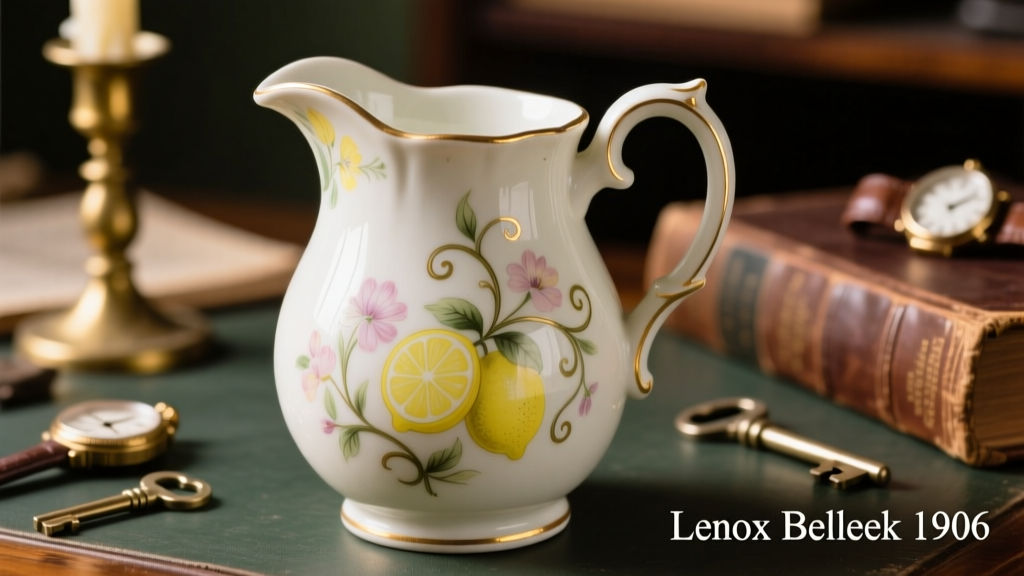
Lenox Lemonade Pitcher, Belleek-Style Porcelain, 1906: A Rare American Art Pottery Masterpiece

Depression Glass Cameo Cup in Yellow: A Collector’s Guide to the 3¾-Inch Patterned Tumbler
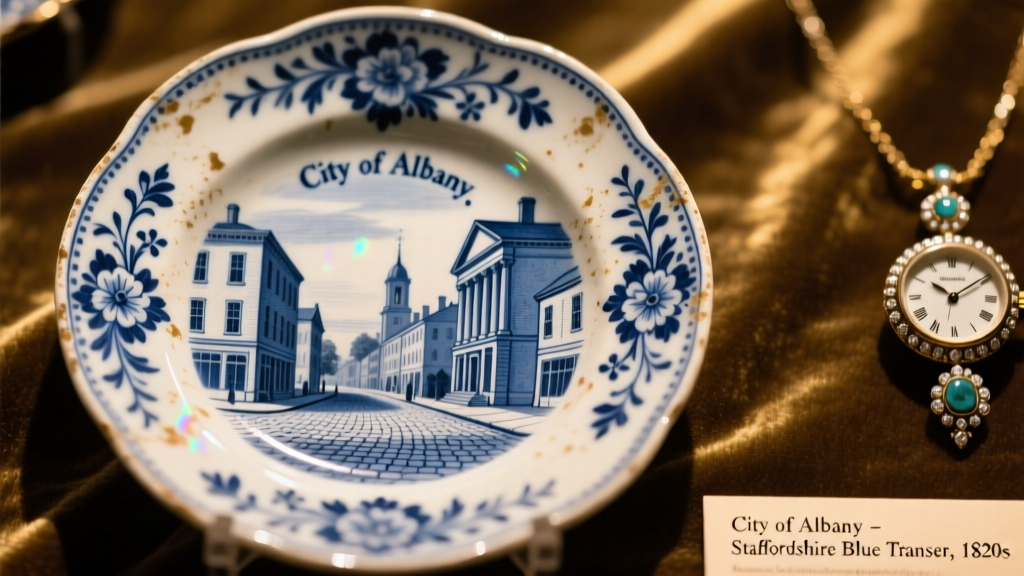
Staffordshire Blue Transfer Soup Plate: 'City of Albany' Pattern, 9¼ Inches — A Study in Early American Ceramic Iconography
Toy Cap Gun Wagon Train Holsters of the 1950s: Authenticity, Design, and Collectibility
Paper Catalog Hall Fishing Line 1938: A Rare Artifact of American Angling History
Spatterware Pitcher: Red-and-White Fluted Handle, 8¾ Inches — History, Identification & Market Value

Authentic 1930s Bisque Mickey Mouse Waving Figurine: Provenance, Identification, and Market Significance
National Pierce American C Pedal Car, c. 1920: A Landmark of Early American Toy Engineering
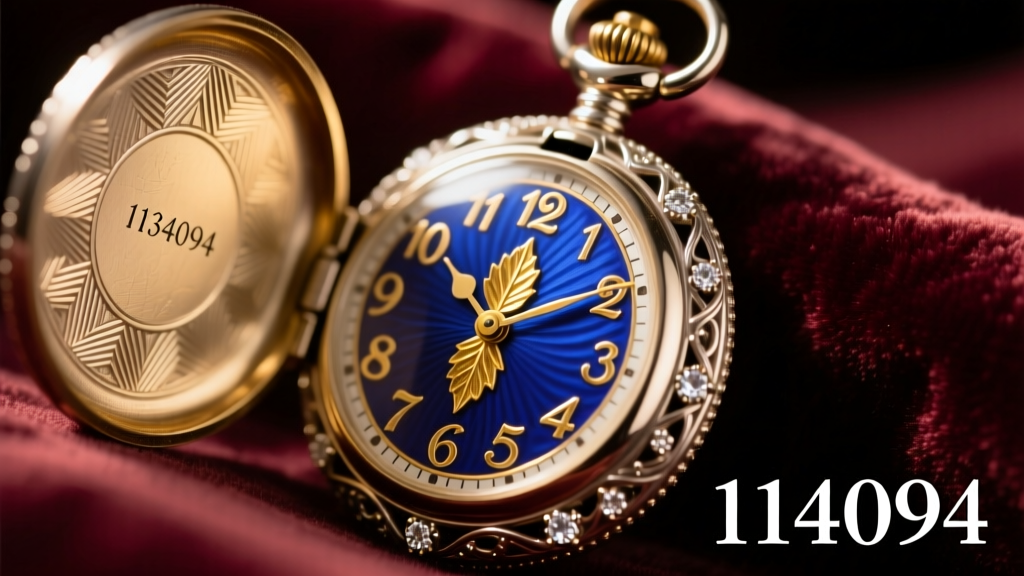
Rolex Reference 1134094: The Unheralded Stainless Steel Oyster Perpetual Datejust from the Late 1980s