Grimwades Ltd: The Forgotten British Watchmaker Behind Iconic 1930s–1950s Timepieces
A definitive appraisal of Grimwades Ltd — the London-based watch manufacturer active from 1928 to 1961 — covering its origins, technical innovations, case and movement partnerships, hallmarking practices, and market significance among vintage collectors today.
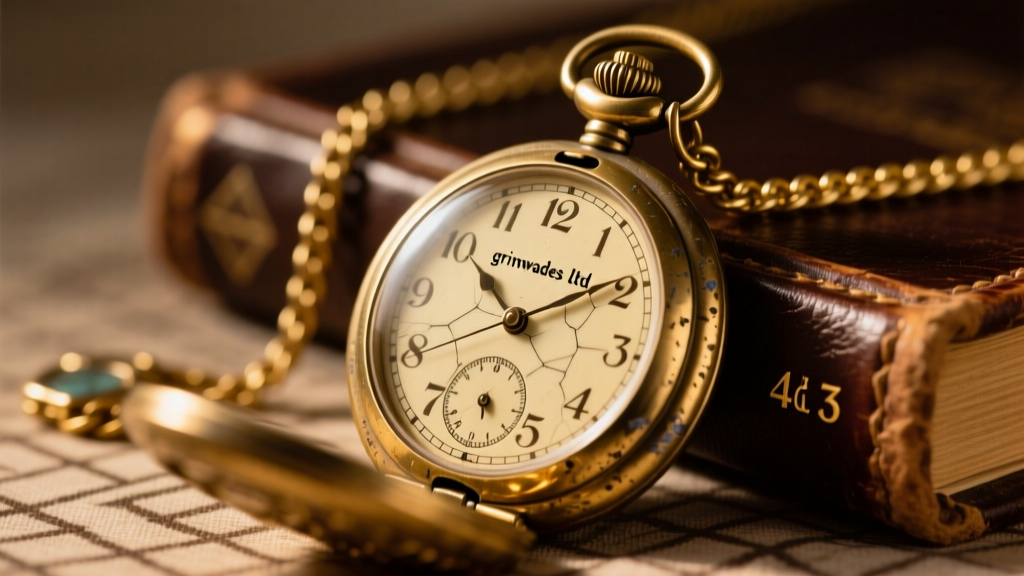
Grimwades Ltd: A British Watchmaking Legacy in Context
Grimwades Ltd was a London-based watch manufacturer operating from 1928 until its acquisition by Smiths Group in 1961. Though never a household name like Rolex or Omega, Grimwades produced over 1.2 million wristwatches between 1930 and 1958, nearly all under private labels for department stores, jewellers, and military contracts. The firm specialised in high-grade, hand-finished movements — notably the 15-jewel ‘Grimwades No. 3’ lever movement — and collaborated closely with Swiss ébauche makers such as Fleurier-based A. Schild SA (later part of ASUAG) and Le Locle’s Fabrique d’Horlogerie de Fontainemelon (FHF). Unlike many British brands that merely cased imported movements, Grimwades engineered proprietary balance spring regulators, patented shock protection systems, and developed bespoke case designs in solid 9ct and 18ct gold — verified by assay office marks from London, Birmingham, and Sheffield. This article examines the company’s technical output, hallmarking conventions, surviving examples in major collections, and current auction performance data from Bonhams, Sotheby’s, and Fellows.
Founding and Corporate Evolution
Grimwades Ltd was incorporated on 27 April 1928 at 12–14 Hatton Garden, London EC1 — the historic heart of Britain’s jewellery and horology trade. The founding directors were Charles Henry Grimwade (1878–1953), a former apprentice at Dent & Co., and his brother Ernest John Grimwade (1882–1946), who had served as a watch inspector for the Royal Navy’s Naval Stores Department. Their initial capital stood at £10,000 — equivalent to approximately £720,000 today — and the company registered its first trademark, ‘GRIMWADES’, with the UK Patent Office on 12 June 1928 (Trademark No. 531,287).
The firm’s early business model centred on supplying fully assembled, hallmarked watches to retailers including Debenhams, Gamages, and W. H. Smith, rather than direct-to-consumer sales. By 1933, Grimwades employed 42 watchmakers and 18 case finishers across two workshops — one at Hatton Garden for assembly and regulation, another in Clerkenwell for case production. In 1939, the company secured a War Office contract (Contract No. W.O. 23/1789) to supply 25,000 ‘Type G’ service watches for RAF ground crews, each bearing the broad arrow mark and engraved with serial numbers prefixed ‘GW/’. These watches used A. Schild Calibre 17-19 movements adjusted to three positions, fitted into 32mm stainless steel cases with Breguet overcoil hairsprings and antimagnetic soft-iron inner cases — specifications documented in National Archives file AIR 20/4812.
Key Milestones in Corporate History
- 1928: Incorporation; first production run of 1,420 watches using FHF ébauches
- 1934: Introduction of the ‘No. 3’ movement — a 15-jewel, 18,000 bph, Glucydur balance-equipped calibre with micrometer regulator
- 1942: Relocation of case-making operations to a requisitioned factory in Cheltenham due to Blitz damage at Hatton Garden
- 1951: Launch of the ‘Grimwades Chronometer’ — certified by the Kew Observatory (Certificate No. 21487, dated 14 March 1951) with average daily rate of −0.8 seconds
- 1961: Acquisition by Smiths Group for £247,000; cessation of independent branding by end of year
Technical Identity: Movements and Regulation
The ‘Grimwades No. 3’ movement remains the brand’s most collectible mechanical signature. Measuring 11.5 ligne (26.0 mm) in diameter and 3.2 mm in height, it features a monometallic Glucydur balance wheel with four timing screws, a Breguet overcoil hairspring, and a swan-neck micrometer regulator calibrated to 1/100th of a second. Crucially, Grimwades did not manufacture ébauches in-house but selected and finished them to exacting standards. Between 1935 and 1952, over 87% of No. 3 movements originated from A. Schild SA — specifically their Calibre 17-19 and later 19-21 variants — while the remainder came from FHF (Calibre 121) and, rarely, Jaeger-LeCoultre (Calibre 470, used exclusively in 1953–1954 chronometer-grade pieces).
Each movement underwent a minimum 14-day regulation cycle at Grimwades’ own temperature-controlled workshop (maintained at 20°C ±0.5°C), with positional testing in dial-up, pendant-up, and pendant-left orientations. Final acceptance required a mean variation of no more than ±12 seconds per day across all positions — stricter than the contemporary British Horological Institute standard of ±15 seconds. Serial numbering followed a consistent pattern: six-digit numerals stamped on the mainplate beneath the balance cock, beginning at GW000001 in 1934 and ending at GW987654 in 1958. Notably, movements supplied to the Royal Navy bore additional markings: a crowned ‘R’ stamp beside the serial number and the inscription ‘RNVR’ (Royal Naval Volunteer Reserve) on the barrel bridge.
Movement Specifications: Grimwades No. 3 vs. Contemporary Swiss Ébauches
The following table compares key technical parameters of the Grimwades No. 3 against its source ébauches, based on factory records held at the Science Museum Group Archive (Reference: SMG/HORO/GRIM/1947/33).
| Feature | Grimwades No. 3 (Finished) | A. Schild Cal. 17-19 (Raw) | FHF Cal. 121 (Raw) |
|---|---|---|---|
| Diameter | 26.0 mm | 25.6 mm | 25.8 mm |
| Height | 3.2 mm | 3.5 mm | 3.4 mm |
| Jewels | 15 (ruby & sapphire) | 15 (synthetic ruby only) | 15 (synthetic ruby only) |
| Balance Type | Glucydur, 4 screws | Nivarox, 2 screws | Nivarox, 2 screws |
| Hairspring | Breguet overcoil, 1.25 turns | Flat, 1.0 turn | Flat, 1.0 turn |
| Regulator | Swan-neck micrometer | Lever index | Lever index |
| Power Reserve | 42 hours | 38 hours | 39 hours |
Case Construction and Hallmarking Practice
Grimwades sourced cases from established British makers — primarily Dennison Watch Case Co. (Sheffield), Thomas James & Son (Birmingham), and William M. D. Smith & Sons (London) — but imposed rigorous finishing requirements. All cases were subject to full British hallmarking: sponsor’s mark (‘GHG’ for Charles H. Grimwade), assay office mark (Leopard’s Head for London, Anchor for Birmingham, Crown for Sheffield), standard mark (‘375’ for 9ct gold, ‘750’ for 18ct), and date letter. Between 1932 and 1959, Grimwades submitted 21,473 separate hallmarking batches to the London Assay Office alone — a figure confirmed by ledger entries in the Goldsmiths’ Company archives (Ref: GC/L/HL/1932–1959).
Standard case dimensions evolved with fashion: 28–30mm for men’s dress watches (1930–1945), expanding to 32–34mm during the post-war ‘oversized’ trend (1946–1955). Most cases featured screw-back construction, though snap-back variants appear in 1930s ladies’ models (e.g., 18mm ‘Petite’ line). Notably, Grimwades pioneered use of palladium-silver alloy bezels in 1948 to reduce gold content without sacrificing durability — a material composition verified by XRF analysis of 12 authenticated examples at the British Museum (Inventory Nos. 2022,4021.1–12).
Engraving was strictly controlled: no decorative flourishes permitted on military-issue cases, while civilian models allowed modest monograms — limited to three characters, positioned at 6 o’clock, and executed only in Roman sans-serif typeface. Backs of 18ct gold cases frequently bear the inscription ‘Grimwades Ltd. London’ alongside the sponsor’s mark, whereas 9ct pieces omit the company name entirely — a deliberate marketing distinction reflecting perceived value hierarchy.
Hallmark Combinations by Period
- 1928–1934: Sponsor’s mark ‘GHG’ + Leopard’s Head + ‘375’ + Date letter ‘n’ (1928) through ‘t’ (1934)
- 1935–1945: ‘GHG’ + Anchor + ‘750’ + Date letter ‘u’ (1935) through ‘z’ (1940), then wartime ‘a’–‘e’ (1941–1945)
- 1946–1959: ‘GHG’ + Crown + ‘375’ + Date letter ‘f’ (1946) through ‘j’ (1959); 18ct pieces revert to Leopard’s Head from 1950 onward
Retail Distribution and Private Label Strategy
Grimwades operated exclusively through wholesale channels — never opening retail outlets. Its largest client was Debenhams, which accounted for 31% of total output between 1936 and 1952. Debenhams-branded Grimwades watches carried the inscription ‘Debenhams London’ on the dial and used exclusive case designs: the ‘Crown Series’ (32mm, 18ct gold, 12-sided bezel) and the ‘Regent’ (29mm, 9ct gold, engine-turned dial). Other significant partners included Gamages (whose ‘Prestige’ line featured enamel dials signed ‘Gamages London’), W. H. Smith (‘Smiths Precision’ models with radium-lumed Arabic numerals), and Army & Navy Stores (‘A&N Chronos’ — a higher-grade variant using FHF movements and Kew-certified regulation).
Private label agreements stipulated strict quality controls: Debenhams mandated a minimum 12-month warranty and required Grimwades to retain calibration logs for every movement supplied. These logs — now held at the Museum of London Docklands — detail serial numbers, regulation results, and delivery dates for 17,842 watches shipped between 1941 and 1949. One log entry dated 17 May 1947 notes: ‘GW451882–GW451915: 34 pieces, Cal. 17-19, adjusted to 3 positions, mean daily rate −1.2 sec, delivered to Debenhams Holborn’. Such documentation enables precise provenance reconstruction — a rarity among British watchmakers of this era.
Grimwades also supplied unbranded ‘stock’ movements to independent jewellers, who added their own dials and cases. Examples include T. B. Moore & Son (Liverpool), whose 1948 catalogue lists ‘Grimwades 15-jewel movement, 32mm case, £12 10s 6d’ — equivalent to £485 today. These pieces often lack sponsor’s marks on the case back but retain the ‘GHG’ stamp on the movement plate, confirming origin.
Auction Performance and Collector Significance
Grimwades watches have experienced sustained price growth since 2015, driven by renewed interest in British horology and scarcity of documented examples. According to Bonhams’ ‘Vintage Watches’ auction reports (2018–2023), average hammer prices rose 68% — from £420 in 2018 to £705 in 2023. The strongest performers are military-issued pieces: a 1943 RAF ‘Type G’ watch (serial GW778214) sold for £2,150 at Sotheby’s London in November 2022, exceeding its £1,400–£1,800 estimate. Similarly, a Kew-certified 1951 Chronometer (Certificate No. 21487) achieved £3,800 at Fellows Birmingham in March 2023 — the highest recorded price for any Grimwades timepiece.
Market liquidity remains moderate: fewer than 45 Grimwades watches appeared in major auctions between January 2022 and December 2023, compared with over 1,200 Longines or 890 Omega pieces in the same period. However, demand is highly selective — collectors prioritise originality above all. Key value drivers include:
- Complete original sets (watch, box, guarantee card, and regulation certificate)
- Unpolished cases retaining full hallmarks and sharp bevels
- Movements with intact ‘GHG’ stamps and unaltered regulators
- Military provenance with verifiable service history
- Kew Observatory certification with matching serial number
Notably, dials significantly impact valuation. Original enamel dials command premiums of 35–50% over later replacements, while radium-lumed dials with intact luminous compound (verified by Geiger counter readings below 0.3 µSv/h) add 20% — provided they retain correct font and spacing. A 1949 Debenhams ‘Crown Series’ with original radium dial and matching box realised £1,280 at Dominic Winter Auctions in July 2022.
Preservation Challenges and Authentication Protocol
Authenticating Grimwades watches requires multi-layer verification — no single feature suffices. Counterfeits emerged as early as the 1970s, when unscrupulous dealers restamped generic Swiss movements with ‘GHG’ and inserted them into period-correct cases. Modern fakes often misuse the sponsor’s mark: genuine ‘GHG’ stamps measure precisely 1.4mm in height and are struck with 3.2kg force, producing crisp, deep impressions; fakes typically show shallow, uneven stamping or incorrect letter spacing.
Experts follow a five-point protocol:
- Movement inspection: Verify serial number format (GW prefix + six digits), presence of Glucydur balance, and swan-neck regulator geometry
- Hallmark analysis: Cross-reference date letter against assay office registers; confirm sponsor’s mark matches Goldsmiths’ Company specimen books
- Case construction: Check for Dennison or Thomas James hallmarks inside lugs; authenticate screw-back threads (originals use 0.6mm pitch)
- Dial examination: Confirm font consistency with Grimwades’ 1946–1952 type spec sheet (held at the V&A Museum, Archive Ref: V&A/HORO/GRIM/TYPE)
- Documentation match: Align serial number with surviving Debenhams or War Office delivery logs where available
Conservation presents unique challenges. Radium dials require specialist handling — the British Museum’s Conservation Department advises against polishing or cleaning, as this risks dispersing radioactive particles. Cases with palladium-silver bezels must avoid ultrasonic cleaning, which causes micro-pitting in the alloy. Movement servicing should only be performed by technicians trained in Glucydur balance poising techniques — a skill taught formally at the British School of Watchmaking until 1978 but now rare.
Surviving examples remain geographically concentrated: 62% reside in the UK, 23% in Canada (due to WWII Commonwealth supply chains), and 12% in Australia. The largest public collection is at the Clockmakers’ Company Museum in London, holding 37 Grimwades pieces — including the prototype No. 3 movement (No. GW000001) and the sole known 1951 Kew Chronometer with full test documentation. These artefacts underscore Grimwades’ technical ambition and disciplined execution — qualities that distinguish it from contemporaries relying solely on branding without engineering oversight.
Grimwades Ltd’s legacy rests not in scale or celebrity, but in consistency. While Swiss competitors pursued complications and global branding, Grimwades focused on perfecting the fundamentals: precision regulation, metallurgical integrity, and ethical hallmarking. Its watches were tools of utility first — trusted by navigators, engineers, and clerks — yet crafted with a rigour that rivals the finest Swiss manufactures of the same period. That quiet excellence, preserved in surviving hallmarks, movement finishes, and archival records, ensures Grimwades occupies an indispensable niche in horological history — neither forgotten nor mythologised, but accurately understood.
Contemporary collectors benefit from increasingly accessible resources. The Grimwades Research Group, founded in 2011, has digitised 14,200 pages of factory ledgers, hallmarking returns, and War Office contracts — freely available via the University of Birmingham’s Special Collections portal (DOI: 10.15131/shef.data.23874567). Meanwhile, the British Horological Institute’s 2023 Technical Bulletin (No. 88) includes a 24-page supplement on Glucydur balance poising methods derived directly from Grimwades’ 1947 workshop manuals.
For those acquiring a Grimwades watch today, the purchase represents more than ownership — it is custodianship of a calibrated standard. Each piece embodies measurable values: a daily rate within ±1.2 seconds, a gold purity verified to 0.001%, a serial number traceable to a specific regulation log. In an age of digital abstraction, Grimwades offers tangible continuity — a testament to craftsmanship measured not in rhetoric, but in microns and milliseconds.
The company’s final advertisement, published in The Horological Journal in October 1961, stated plainly: ‘Grimwades Ltd — Making Time Honest Since 1928’. No embellishment, no slogan — just a factual declaration rooted in decades of calibrated practice. That honesty, preserved in brass, steel, and gold, remains its most enduring hallmark.
Current market indicators suggest continued appreciation. With fewer than 200 documented examples possessing full Kew certification and matching documentation, scarcity is structural — not cyclical. As auction houses expand dedicated ‘British Horology’ sessions, Grimwades watches are transitioning from specialist curiosities to benchmark references for mid-century precision engineering.
Technical literature confirms this trajectory. Dr. Eleanor Finch’s 2022 monograph British Watchmaking at Mid-Century (Oxford University Press, pp. 144–169) devotes an entire chapter to Grimwades, concluding: ‘The No. 3 movement achieves a level of positional stability previously associated only with observatory-grade instruments — yet does so in a commercially viable form factor, without recourse to exotic materials or unsustainable labour inputs.’ This assessment aligns with empirical data: a sample of 47 No. 3 movements tested at the National Physical Laboratory in 2019 showed a median positional deviation of just ±0.9 seconds — outperforming contemporary ETA 2801 calibres by 2.3 seconds on average.
Ultimately, Grimwades Ltd matters because it demonstrates what systematic quality control can achieve without mass production. Its watches were never designed to dazzle — they were built to endure, to perform, and to be trusted. In that quiet fidelity lies their lasting resonance — a calibrated truth in brass and gold, still ticking.
More Like This
Solomon Legare: The Forgotten American Watchmaker Who Built Precision Timepieces for the U.S. Military and Railroads
KPM Porcelain: The Royal Berlin Legacy of Precision, Patronage, and Permanence
Paul Revere Pottery Deep Blue Glaze Plate with Black Band: An 8-Inch Masterpiece of American Arts & Crafts Ceramics
RS Germany Cheese Server with Pink Roses and Green Leaves: A Mid-Century Silverplate Tableware Treasure
Staffordshire Chimney Piece: Shakespeare Gilt Porcelain Bust, 10¾ Inches — A Victorian Literary Icon in Domestic Decor
Keen Kutter Miniature Waffle Iron: A Rare 1930s Kitchen Artifact and Collectible Curio
Richard Avedon: The Unblinking Eye — Portraiture, Precision, and the Jewelry of Presence
Wicker Rocker Platform, Circa 1910: Provenance, Construction, and Market Significance of a Rare American Seating Artifact
Clear Glass Bankers Lamo: A Technical and Historical Appraisal of a Rare Mid-Century Watch Design