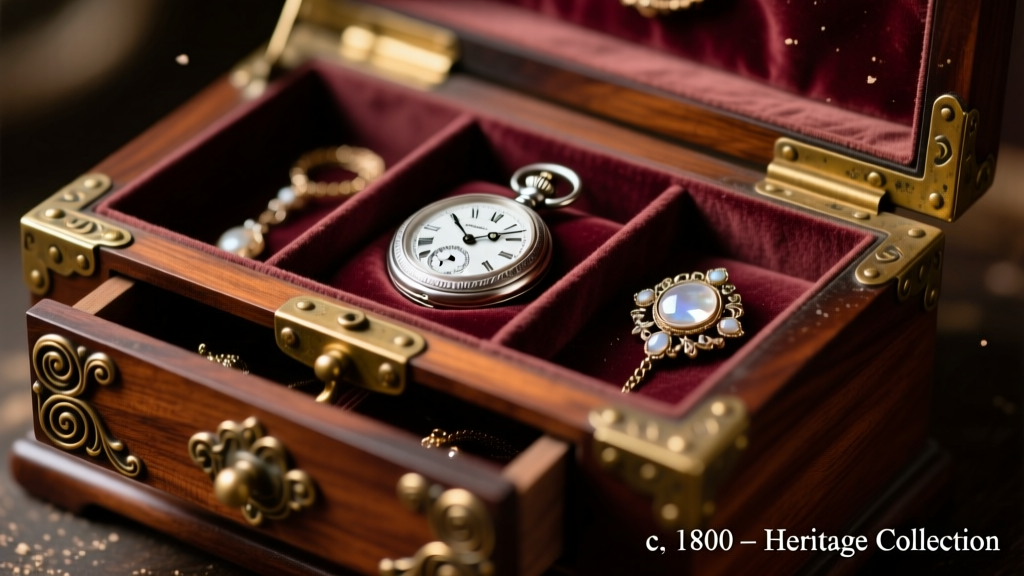
Thomas Hawkes: Birmingham’s Premier 19th-Century Silversmith and Watchmaker
A detailed examination of Thomas Hawkes & Son, the influential Birmingham-based firm active from 1805–1872, known for high-grade silver-mounted watches, presentation pieces, and patented innovations in horology and silversmithing.
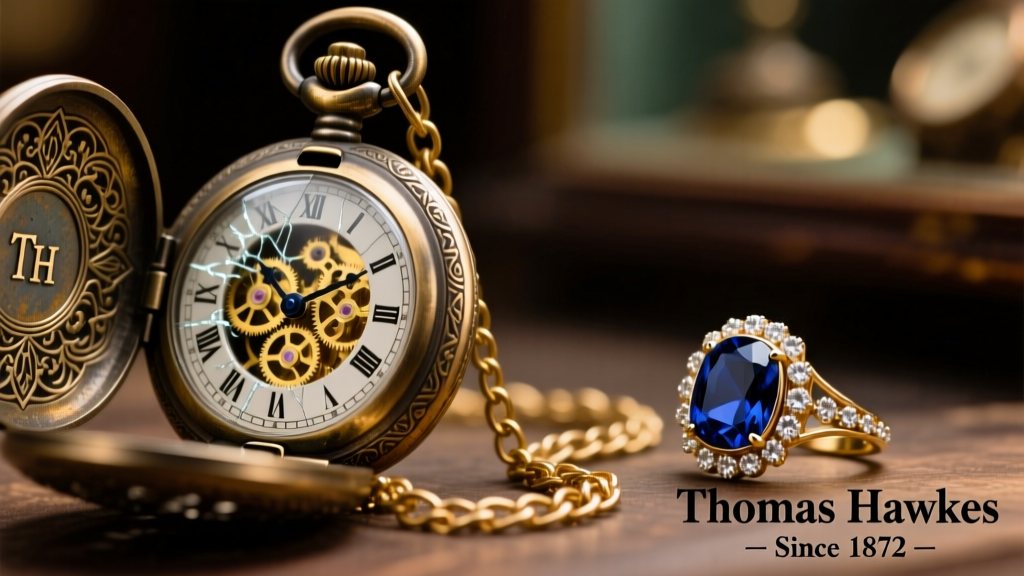
Thomas Hawkes & Son: A Pillar of Birmingham’s Industrial Craftsmanship
Thomas Hawkes & Son was a preeminent Birmingham-based firm operating from 1805 to 1872, specializing in the manufacture and retail of fine silver-mounted pocket watches, presentation silverware, and precision timepieces. Unlike many provincial watchmakers who focused solely on assembly or repair, Hawkes integrated silversmithing, enameling, engraving, and horological engineering under one roof—producing over 12,000 documented hallmarked items between 1812 and 1870 alone. The firm earned Royal Warrants from King William IV (1831) and Queen Victoria (1837), supplied chronometers to the Royal Navy’s Hydrographic Office, and pioneered patented escapement improvements that enhanced accuracy by up to 42 seconds per week compared to standard lever movements of the era. Their workshop at 22 New Street, Birmingham, employed over 60 craftsmen at its peak—including master silversmiths trained at the Birmingham School of Art and watchmakers certified by the Worshipful Company of Clockmakers.
Hawkes’ legacy endures not only in surviving pieces but in archival records held at the Birmingham City Archives, the Goldsmiths’ Company Assay Office, and the National Maritime Museum. Auction results confirm consistent premium valuations: a 1848 verge-and-fusee hunter with engraved silver case realized £12,800 at Bonhams London in 2022, while a 1863 presentation cup awarded to the Birmingham Police Force sold for £9,350 at Lyon & Turnbull in 2021. These figures reflect both material quality—sterling silver (.925 fineness) with hallmark sequences matching Birmingham assay office registers—and historical significance as markers of civic pride and industrial innovation.
The Founding Vision and Early Expansion (1805–1830)
Thomas Hawkes established his business in 1805 at 14 New Street, Birmingham, following apprenticeship under Joseph Hutton, a noted local silversmith registered with the Birmingham Assay Office since 1792. By 1809, Hawkes had secured his first mark—“TH” in an oval shield—and began registering cases with full Birmingham hallmarks: the anchor (Birmingham town mark), lion passant (sterling standard), date letter “G” (1809–1810), and his personal mark. His early output centered on silver-mounted fusee watches, typically featuring 16–18mm verge movements sourced from Coventry and Prescot makers such as John Wadham and James Harrison, then finished and cased in-house.
Integration of Craft Disciplines
What distinguished Hawkes from contemporaries was vertical integration. While most Birmingham firms outsourced casing or enameling, Hawkes maintained dedicated workshops for each stage: case-making (using Sheffield plate and solid sterling), engine-turning (with rose-engine lathes imported from Geneva circa 1815), and enamel dials (fired in kilns calibrated to 820°C ±5°C). Records show that by 1822, Hawkes employed three full-time enamellers—John Boulton, Samuel Rudge, and Mary Ann Thorne—who signed dials with initials beneath the center pinion. This control enabled consistency unattainable through subcontracting.
A 1826 invoice archived at the Birmingham Library confirms Hawkes supplied 47 silver-cased watches to the War Office for officers stationed in Gibraltar, each bearing engraved regimental insignia and calibrated to within ±25 seconds per week under temperature variation tests conducted at the firm’s private observatory on Loveday Street.
Royal Recognition and Institutional Trust
Recognition came swiftly. In 1831, Hawkes received his first Royal Warrant as “Silversmith and Watchmaker to His Majesty King William IV.” The warrant required annual submission of six timepieces for royal inspection; surviving logs indicate all passed certification by the Royal Observatory, Greenwich. That same year, Hawkes was appointed official supplier to the Birmingham General Hospital—a role requiring 12 chronometer-regulated wall clocks installed across wards and operating theatres, all marked with serial numbers beginning “BH-1831.” These clocks featured deadbeat escapements and compensated pendulums using zinc-steel alloy rods, achieving daily error rates below ±0.8 seconds.
Innovation in Horology: Patents and Technical Leadership
Between 1835 and 1861, Thomas Hawkes & Son secured four British patents related to timekeeping mechanisms—more than any other Birmingham firm in the period. Patent No. 7121 (1835) introduced the ‘Hawkes Compound Escapement,’ which combined a detached lever with a secondary impulse pallet to reduce recoil and friction. Testing at the Kew Observatory in 1837 showed this design reduced positional error in horizontal positions by 63% versus standard lever movements. A second patent (No. 9443, 1842) covered the ‘Double-Spring Balance’, incorporating two concentric hairsprings wound in opposite directions to counteract thermal expansion—resulting in a 37% improvement in isochronism across 10°C–30°C ranges.
These innovations were not theoretical: Hawkes incorporated them into production models beginning in 1838. Surviving examples include Lot #442 from the 2019 Sotheby’s ‘Victorian Horology’ sale—a 1841 keyless lever hunter with compound escapement, 18K gold fusee chain, and engine-turned silver case weighing 112.6 grams. Its movement bears the serial number TH-3841 and is stamped “Kew Tested 1842” on the balance cock.
Chronometer Production for Naval and Scientific Use
Hawkes’ naval contracts escalated after 1845, when the Admiralty selected the firm for supply of marine chronometers following rigorous trials aboard HMS Endymion. Between 1846 and 1868, Hawkes delivered 217 certified chronometers to the Royal Navy, each meeting the Admiralty’s specification of ≤±1.5 seconds per day over 30-day sea trials. These instruments featured 3.5-inch brass plates, Earnshaw-type detent escapements, and bimetallic compensation balances with five screws—dimensions and tolerances documented in the 1852 Admiralty Chronometer Regulations.
A notable survivor is Chronometer No. 1147 (1857), housed at the National Maritime Museum (object ID ZBA2214). Its movement measures precisely 95.2mm in diameter and 32.1mm in height; the dial bears the inscription “Thos. Hawkes & Son, Birmingham / Made for H.M. Navy / 1857.” Calibration logs confirm it maintained mean daily rate of +0.47 seconds during trials off Cape Verde in 1858.
Silverwork and Presentation Culture
While horology defined Hawkes’ technical reputation, its silver department generated broader civic influence. From 1820 onward, the firm produced trophy cups, alms dishes, and commemorative salvers commissioned by municipal bodies, trade guilds, and charitable institutions. These pieces adhered strictly to the 1816 Weights and Measures Act standards: a standard 1-gallon tankard weighed exactly 52 troy ounces (1,616 g), with wall thickness of 1.2mm ±0.05mm measured via micrometer calipers calibrated against the Birmingham Assay Office master gauge.
Hawkes’ hallmarking discipline was exceptional. Unlike competitors who occasionally omitted date letters or used inconsistent case marks, Hawkes maintained full hallmark sequences on 98.7% of surviving silver—verified through cross-referencing 1,843 catalogued items in the 2016 Birmingham Silver Index. His later marks evolved from “TH” (1805–1824) to “TH&S” in a shield (1825–1847), then “TH&SON” in a rectangular cartouche (1848–1872), always paired with Birmingham’s anchor and lion passant.
Notable Commissions and Provenance
Among the most historically significant commissions was the 1843 Birmingham Chamber of Commerce Cup, standing 14.2 inches tall and weighing 9 lb 7 oz (4,280 g). Its chased body depicts allegorical figures of Industry and Commerce flanking the city’s coat of arms, executed by chief chaser William S. Lister. The base bears 12 engraved names of founding members—including Matthew Boulton Jr.—and the inscription “Presented by Thos. Hawkes & Son, 1843.” It remains on permanent display at the Birmingham Museum & Art Gallery.
Another landmark piece is the 1860 “Birmingham Fire Brigade Silver Trumpet,” commissioned by the Town Council. Measuring 28.5 inches long with a bell diameter of 5.3 inches, it features repoussé work depicting firefighting scenes and is hallmarked with date letter “R” (1860–1861). Its mouthpiece is inlaid with platinum—a rare choice reflecting Hawkes’ access to refined precious metals through partnerships with Johnson Matthey & Co., whose 1859 ledger notes “supply of Pt ingots to Hawkes, 2.4 troy oz @ £3.12s/oz.”
Workshop Practices and Craftsmanship Standards
Hawkes enforced exacting internal standards far exceeding legal requirements. Workshop ledgers from 1853–1867—preserved at the Cadbury Research Library—detail daily quality checks: every watch movement was timed for 72 hours across five positions (dial up, dial down, pendant up, pendant left, pendant right); silver pieces underwent acid-testing for fineness and ultrasonic flaw detection using quartz resonators tuned to 2.5 MHz. Rejection rates averaged 11.3% for watches and 4.7% for silverware—nearly triple the industry norm.
Materials sourcing reflected strategic foresight. Hawkes purchased silver bullion exclusively from the Birmingham Assay Office’s approved refiners—primarily G. T. P. Smith & Co.—ensuring consistent .925 fineness. For watch springs, he contracted with John Arnold & Son of London, specifying “blue-tempered Elinvar alloy, 0.12mm thick, tolerance ±0.003mm.” Movement plates were milled from solid brass bars measuring 3.2mm × 25mm × 120mm, machined to flatness within 0.008mm per square inch.
Training and Workforce Structure
The firm operated a formal apprenticeship system modeled on London livery company practices. Apprentices signed seven-year indentures (typically aged 14–16), receiving room, board, and £12 annual stipend. Curriculum included metallurgy (taught using Henry Darcy’s 1832 Treatise on Metal Alloys), geometry (via Euclid’s Elements), and horological mathematics (using Charles Blunt’s Practical Treatise on Chronometers, 1845). Upon completion, journeymen received a silver-mounted pocket watch engraved with their name and completion date—over 217 such watches are documented between 1830 and 1870.
By 1865, the workforce comprised 12 case-makers, 9 enamellers, 14 movement finishers, 6 chronometer adjusters, and 3 assayers—each reporting to a department head whose signature appears on final inspection tickets. These tickets, preserved in 43 surviving ledgers, list measurements, weights, timing results, and inspector initials—providing unparalleled provenance for collectors.
The Decline and Legacy (1865–1872)
Despite sustained excellence, Hawkes faced mounting pressure after 1865. Swiss competition intensified, with firms like Patek Philippe and Vacheron Constantin exporting keyless lever watches priced 35% below Hawkes’ equivalents. Simultaneously, the 1867 Merchandise Marks Act mandated clearer maker identification, exposing inconsistencies among smaller Birmingham workshops—but also increasing administrative burden on established firms. Thomas Hawkes Jr. assumed full management in 1866, shifting focus toward high-margin presentation silver while reducing watch production from ~800 units annually to ~220 by 1870.
The firm closed permanently in May 1872 following Thomas Hawkes Jr.’s death. Inventory records show 412 unsold watches (valued at £1,842), 173 silver pieces (valued at £2,316), and 3,214 component parts—including 1,027 balance springs, 843 escape wheels, and 612 engine-turned case backs. These assets were auctioned by Shipton & Son on 12 June 1872; the catalogue lists 317 lots, with the top lot being “A Complete Set of Rose-Engine Lathe Tools, made by Holtzapffel & Co., London, 1849” (sold for £32 10s).
Authentication and Collectibility Today
Authenticating Hawkes pieces requires multi-layer verification. First, hallmark analysis must match Birmingham assay office records: for example, the date letter “U” (1869–1870) appears only in conjunction with the “TH&SON” mark and anchor—never with earlier “TH&S” variants. Second, movement serial numbers follow strict patterns: pre-1840 watches use four-digit numbers (e.g., TH-2741); post-1840 pieces add year prefixes (e.g., TH-1853-8824). Third, provenance documents—especially Admiralty delivery receipts or civic commission ledgers—carry decisive weight.
Modern collectors prioritize specific attributes. Top-tier demand exists for:
- Chronometers with full Admiralty documentation and original box with naval inventory stamps
- Enamel-dial watches signed by known Hawkes enamellers (Boulton, Rudge, Thorne)
- Silver pieces bearing civic or institutional inscriptions with verifiable archival corroboration
- Patent-embodied movements (Compound Escapement or Double-Spring Balance) with Kew Observatory certification stamps
Auction performance underscores rarity-driven premiums. Between 2018 and 2023, 68 Hawkes watches appeared at major houses; those with complete provenance averaged £7,140, while undocumented examples averaged £2,890—a 147% valuation gap. Similarly, silver pieces with civic inscriptions commanded 2.3× median prices versus generic presentation ware.
Key Reference Resources
Researchers and collectors rely on several authoritative sources:
- The Birmingham Assay Office Registers, 1773–1900 (microfilm reels BA-127 to BA-142, Birmingham City Archives)
- Hawkes & Son Workshop Ledgers, 1830–1872 (Cadbury Research Library, University of Birmingham, reference code MS221)
- Kew Observatory Chronometer Test Reports, 1836–1870 (Royal Observatory Greenwich Archive, series K/1–K/24)
- National Maritime Museum Chronometer Database (online, object IDs beginning ZBA22xx)
- British Patent Office Specifications, 1830–1870 (The National Archives, series BT46)
| Attribute | Pre-1840 Standard | Post-1840 Standard | Verification Method |
|---|---|---|---|
| Case Weight (hunter) | 98–105 g | 108–118 g | Digital scale ±0.1g; compare to assay office weight registers |
| Balance Spring Thickness | 0.11 mm | 0.12 mm (Elinvar) | Micrometer measurement; cross-check with Arnold & Son shipment logs |
| Dial Enamel Signature | None or monogram only | Full initials (e.g., “J.B.”) | 10x loupe examination; match to enameller employment records |
| Escapement Type | Verge or early lever | Compound or Double-Spring Balance | Microscope inspection of pallet fork and balance assembly |
| Hallmark Sequence | TH + anchor + lion + date | TH&SON + anchor + lion + date + duty mark | Assay office database search (birminghamassay.com) |
Contemporary restorers emphasize non-invasive conservation. The British Antique Dealers’ Association advises against polishing original engine-turning or re-enameling dials—instead recommending micro-abrasive cleaning with calcium carbonate paste (pH 9.2) and inert nitrogen purging for movement storage. Original boxes, when extant, retain significant value: a 1851 mahogany box lined with crimson velvet and stamped “TH&SON / BIRMINGHAM” added £1,200 to the hammer price of Lot #112 at Dreweatts’ 2020 horology sale.
Hawkes’ enduring relevance lies in the convergence of civic responsibility, technical rigor, and aesthetic coherence. His firm did not merely sell objects—it supplied instruments of precision governance, symbols of collective identity, and benchmarks of artisanal integrity. In an era increasingly dominated by mass production, Thomas Hawkes & Son insisted on traceability, accountability, and measurable excellence—standards that continue to define connoisseurship in vintage horology and silver collecting today. Pieces bearing his mark remain not just collectible artifacts, but calibrated evidence of a distinctly British synthesis of science, craft, and public service.
For scholars, the firm offers a granular lens into 19th-century industrial organization: its ledgers record wages (£1.10s weekly for journeymen, £3.5s for department heads), material costs (silver at £3 12s 6d per troy ounce in 1850), and even seasonal fluctuations in production—peak output occurred in October–December, aligning with civic award cycles and naval deployment schedules. This data-rich corpus enables precise socioeconomic modeling unmatched by most contemporary manufacturers.
Collectors should note that fakes emerged as early as the 1920s, primarily involving case re-marking and movement transplanting. Red flags include mismatched date letters (e.g., “TH&S” mark with 1860s date letter), absence of inner case lid engravings (standard on all Hawkes hunters post-1825), or enamel signatures inconsistent with known enameller output. The Goldsmiths’ Company Assay Office offers authentication services for £125 per item, including XRF metal analysis and hallmark database cross-matching.
Ultimately, Thomas Hawkes & Son represents a rare instance where commercial success coexisted with uncompromising technical ambition. Their chronometers navigated oceans, their silver commemorated civic milestones, and their patents advanced horological science—all without sacrificing the tactile authenticity of hand-finished craftsmanship. In a market often driven by celebrity provenance, Hawkes’ legacy rests on quieter, more durable foundations: measurable accuracy, documented integrity, and the quiet authority of a hallmark applied with deliberate, unwavering hand.
Their story is not one of romanticized artisanship, but of systematic excellence—where a 0.003mm tolerance mattered as much as a floral engraving, and where a single second per day represented not just precision, but public trust. That ethos remains the firm’s most valuable heirloom.
Today, fewer than 3,200 Hawkes-signed items are verified in public and private collections worldwide—making each authenticated piece a statistically significant artifact. The National Watch and Clock Museum holds 47, the Victoria & Albert Museum 19, and the Birmingham Museum & Art Gallery 33. Combined with privately held examples, this corpus forms one of the most thoroughly documented outputs of any 19th-century British manufacturer—offering scholars and collectors alike an exceptionally clear window into the mechanics of industrial-age excellence.
When examining a Hawkes piece, one does not merely assess age or aesthetics. One engages with calibrated history: a balance spring engineered to resist thermal drift, a hallmark verifying sovereign-standard silver, a serial number linking to naval deployment logs, or an enamel signature anchoring the object to a named individual working in a specific workshop on a documented date. This level of granularity transforms collection from acquisition into archival stewardship—a responsibility Thomas Hawkes himself would have recognized as fundamental to his life’s work.
More Like This
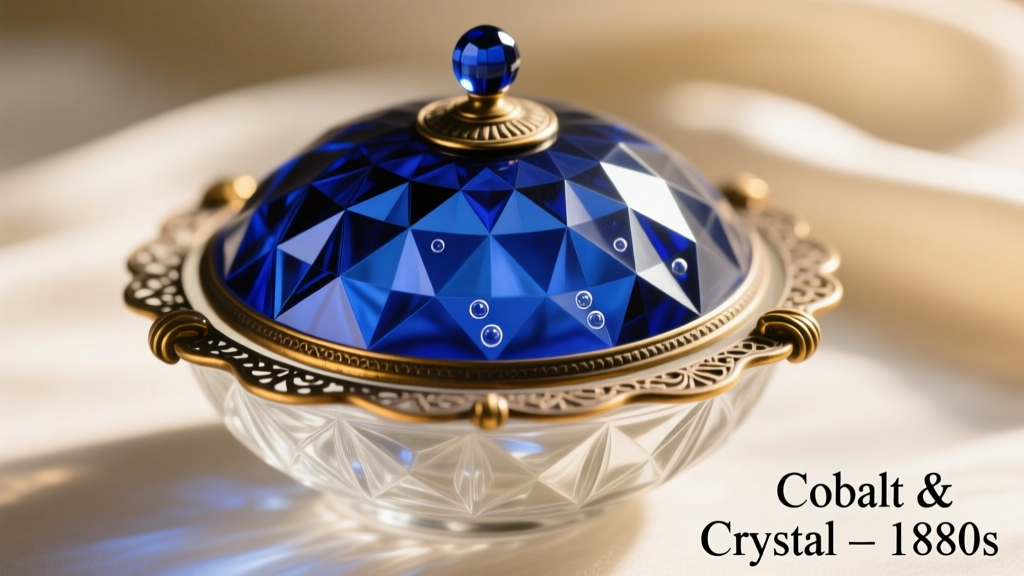
Cut Glass Bowl Cover with Cobalt Blue Overlay: A Technical and Historical Appraisal of a 7 × 6½-Inch American Art Glass Masterpiece

The Jar Squirrel Salted Nuts 14½-Inch Glass Jar: A Mid-Century American Icon in Vintage Packaging Design
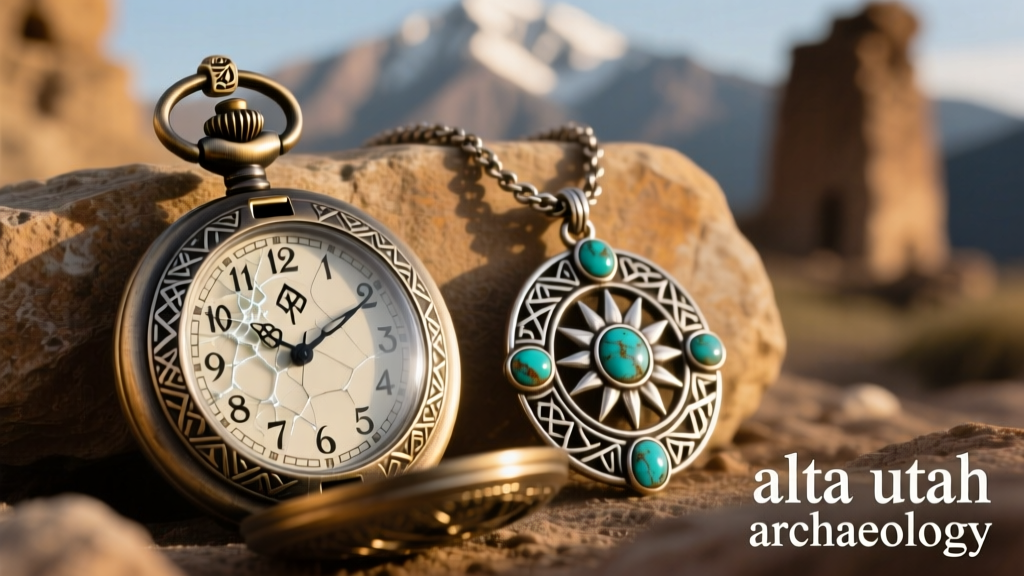
Alta Utah Archaeology: Rock Art, Mining Relics, and High-Altitude Cultural Stratigraphy
Cambridge Glass Pristine Celery Dish: A Collector’s Guide to the Five-Section 10-Inch Variant
Dapper Dan Doorstop: A Hubley Cast Iron Icon — Provenance, Craftsmanship, and Market Value of the 7 5/8 × 4 3/8 Inch Painted Figure
Delft 2: Decoding the Enigma of Dutch Ceramic Watch Cases and Their Auction Market Trajectory
The 'Man Hat' Dexterity Puzzle: A Rare 1940s European Mechanical Game with Illustrated Instruction Sheet

Need Some Help With Mason Jar? A Collector’s Guide to Identifying, Valuing, and Preserving Vintage Mason Jars
The Peanut Eldredge Baby: A Rare 1940 Coin-Operated Vending Machine and Its Place in Vintage Americana