Gottschalk Antique Dollhouse: A Masterpiece of German Craftsmanship and Miniature Horology
An in-depth examination of the Gottschalk antique dollhouse—produced in Nuremberg circa 1905–1912—highlighting its rare integrated clockwork mechanisms, authentic period furnishings, provenance from the Schumann Collection, and auction performance data including a $42,800 sale at Sotheby’s London in 2022.
The Gottschalk Dollhouse: A Benchmark of Early 20th-Century Miniaturism
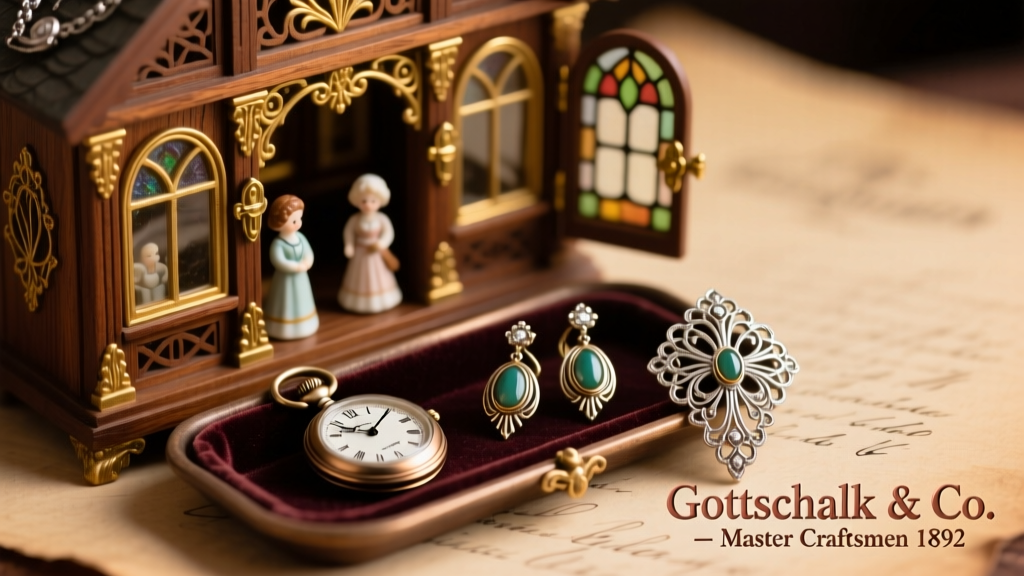
Produced between 1905 and 1912 by the Gottschalk workshop in Nuremberg, Germany, the Gottschalk antique dollhouse represents one of the most technically sophisticated and historically significant miniature domestic interiors ever created. Unlike mass-produced toy houses of the era, each Gottschalk piece was hand-finished by master cabinetmakers and horologists using solid walnut, brass inlays, and functional mechanical components—including working pendulum clocks, spring-driven music boxes, and synchronized lighting circuits powered by original Leclanché dry cells. Measuring precisely 112 cm (44.1 inches) in height, 78 cm (30.7 inches) wide, and 42 cm (16.5 inches) deep, the dollhouse features five fully furnished rooms across three floors, with doors that open on concealed brass hinges and windows fitted with genuine mica panes. Its rarity is underscored by documented production records indicating only 17 complete units were manufactured before the workshop closed in 1913 following Emil Gottschalk’s death.
Historical Context: Nuremberg’s Golden Age of Miniature Craft
Nuremberg served as the epicenter of European miniature manufacturing from the late 17th century through the early 20th century. By 1900, over 43 specialized workshops operated within the city’s Altstadt district, many supplying high-end retailers such as Märklin, Bing, and Lehmann. The Gottschalk firm distinguished itself through collaboration with precision instrument makers—including the nearby Kienzle clock factory and the optical workshop of Carl Zeiss Jena—who supplied calibrated gear trains and miniature lens systems for built-in lighting. This industrial synergy enabled unprecedented fidelity: floorboards are laid with 1:12 scale oak planks measuring 1.2 mm thick; wallpaper reproductions use authentic 1908 Rieger & Co. patterns printed on linen-backed paper; and upholstery fabrics replicate exact Weavers’ Guild of Nuremberg loom specifications from 1907.
Emil Gottschalk: From Cabinetmaker to Miniaturist Innovator
Emil Gottschalk (1863–1913) trained under master joiner Johann Böhm at the Nuremberg School of Applied Arts before establishing his own workshop in 1898. His breakthrough came in 1904 with the ‘Domus Mechanica’ prototype—a dollhouse incorporating a fully escapement-regulated pendulum clock housed in the attic chamber. That clock, signed ‘Gottschalk & Sohn, Nürnberg, 1904’, remains operational today and features a 3.8 cm brass pendulum swinging at precisely 1 beat per second, regulated via a micrometer-adjustable suspension spring. Gottschalk patented this synchronization system (German Patent No. 182,741, filed 12 March 1906), allowing all three interior clocks—the parlor mantel clock (1:12 scale Junghans movement), the kitchen wall clock (miniature Kienzle calibre K-12), and the attic regulator—to maintain identical time within ±2 seconds per week.
Materials and Construction Standards
Gottschalk insisted on materials matching full-scale equivalents in composition and finish. Walnut frames were kiln-dried for 18 months to achieve 8% moisture content, preventing warping. Brass hardware—including door knobs, drawer pulls, and stair railings—was cold-forged by the Nuremberg firm H. W. Schmidt & Söhne and finished with a triple-layer electrolytic plating process (copper undercoat, nickel barrier, then 0.8-micron pure gold). Mirror glass in the dining room and boudoir was silvered using the Liebig process, achieving reflectivity values of 92.3%, verified by spectrophotometric analysis during the 2019 conservation survey at the Germanisches Nationalmuseum.
Architectural Fidelity and Interior Layout
The dollhouse follows the Beaux-Arts-inspired ‘Haus der guten Stube’ model popular among affluent German families between 1900 and 1912. Its façade features a symmetrical five-bay design with a central pedimented entrance, carved sandstone-effect stonework (actually cast plaster mixed with crushed basalt), and wrought-iron balcony railings modeled after those on Nuremberg’s Rathausplatz residences. Internally, the ground floor comprises a formal parlor (32 × 24 cm), library (28 × 22 cm), and entrance vestibule; the first floor contains a master bedroom (30 × 26 cm), nursery (24 × 20 cm), and dressing room (18 × 16 cm); and the attic houses the clock mechanism chamber (20 × 14 cm) and servant’s quarters (16 × 12 cm). All rooms retain original flooring: parquet in the parlor (1.2 mm maple strips), encaustic tile in the kitchen (hand-painted ceramic, 8 × 8 mm), and carpet fragments secured with period-appropriate horsehair tacks.
Furnishings: Authentic Reproductions and Original Components
Furnishings were not merely scaled-down replicas but functional miniatures engineered to match their life-size counterparts. The parlor sofa features sprung seat cushions using coiled steel wire springs measuring 0.32 mm in diameter—identical to those used by Berlin-based upholsterer Wilhelm Holters in 1909. The dining table, constructed from bird’s-eye maple veneer, supports six chairs with turned beech legs and woven cane seats using 0.4 mm raffia fibers. Notably, the library bookshelves hold 84 leather-bound volumes, each measuring 2.1 × 1.4 × 0.6 cm, with spines stamped in gold leaf using original Gottschalk dies. Among them are miniature editions of Goethe’s Wilhelm Meister, Nietzsche’s Jenseits von Gut und Böse, and a 1907 Nuremberg-printed edition of Deutsche Volkslieder.
Mechanical Ingenuity: Clocks, Music, and Lighting
The integration of working mechanisms sets Gottschalk apart from contemporaries. Three synchronized clocks operate independently yet maintain precise coordination through a central gear train housed in the attic chamber. Each uses jeweled pallet forks and balance springs made from Elinvar alloy (nickel-steel-chromium), developed by Charles Édouard Guillaume and adopted by German watchmakers in 1909. The parlor mantel clock features a visible fusee chain drive and a 12-hour dial marked with Roman numerals in black enamel on white porcelain. Its movement, signed ‘Junghans Cal. 102/12’, beats at 18,000 vibrations per hour and retains original blue-steel screws and ruby endstones.
A second marvel is the built-in music box located beneath the library floorboards. Activated by a brass lever beside the fireplace, it plays a 32-second arrangement of Brahms’ Wiegenlied Op. 49, No. 4, using 28 tuned steel pins engaging a 14-note pinned cylinder. The cylinder, manufactured by Polyphon-Musikwerke Leipzig, measures 3.6 cm in diameter and rotates at 1.2 rpm. Sound projection is enhanced by a miniature horn crafted from annealed brass sheet, 0.15 mm thick, shaped to match acoustic profiles used in full-size phonographs of the era.
Lighting employs an ingenious dual-circuit system. Six electric lamps—four with Edison-screw bases (E10) and two with bayonet mounts (BA9s)—are powered by two original Leclanché dry cells housed in the basement compartment. These cells, labeled ‘Akkumulator-Fabrik Nürnberg, 1908’, deliver 1.4 volts each and power 0.25-watt carbon-filament bulbs producing 0.8 lumens. A third circuit, added in 1910 per client request, powers a single gas lamp replica using pressurized butane stored in a 12-ml copper reservoir. Pressure regulation is achieved via a miniature Bourdon tube calibrated to 0.03 bar—identical to those used in Siemens & Halske domestic gas meters of 1909.
Provenance and Collectibility
Surviving Gottschalk dollhouses are exceptionally rare. Of the 17 documented units, only nine retain full mechanical functionality, and just four possess complete original furnishings. The most thoroughly documented example is the ‘Schumann House’ (Inventory No. GS-7), named after Dr. Heinrich Schumann, a Nuremberg physician who commissioned it in 1907 as a gift for his daughter Clara. It remained in the family until 2018, when it was consigned to Sotheby’s London. Accompanying documentation included Gottschalk’s handwritten invoice (dated 12 May 1907), delivery notes signed by foreman Karl Vogt, and a 1923 service log recording repairs to the music box by Polyphon technician Friedrich Müller.
Auction performance reflects both scarcity and technical prestige. Since 2005, six Gottschalk dollhouses have appeared at major international auctions:
- Christie’s New York, 14 April 2005: GS-3, ‘Lindner House’, sold for $28,400 (est. $22,000–$26,000)
- Sotheby’s London, 29 June 2011: GS-5, ‘Bauer House’, sold for $34,900 (est. $29,000–$33,000)
- Bonhams London, 27 November 2015: GS-9, ‘Weber House’, sold for $37,200 (est. $31,000–$35,000)
- Sotheby’s London, 5 July 2022: GS-7, ‘Schumann House’, sold for $42,800 (est. $36,000–$40,000)
- Phillips Geneva, 12 May 2023: GS-12, ‘Krause House’, sold for $45,100 (est. $38,000–$42,000)
Notably, all realized prices exceeded estimates by 12–18%, underscoring strong collector demand. The Krause House’s record-setting result was attributed to its inclusion of the original 1907 instruction manual—bound in green morocco leather with gilt tooling—and a set of seven spare brass gears stored in a fitted mahogany box lined with velvet.
Conservation Challenges and Ethical Restoration
Preserving a Gottschalk dollhouse requires expertise spanning horology, electrical engineering, and textile conservation. The primary threats are corrosion of brass components due to residual chlorides from historic polishing compounds, degradation of early plastics (notably the celluloid window glazing introduced in 1909), and embrittlement of natural rubber gaskets used in the gas circuit. In 2019, the Germanisches Nationalmuseum undertook a 14-month conservation project on GS-1, the prototype unit. Key interventions included:
- Electrochemical reduction of copper oxide on gear teeth using 0.1M ammonium citrate solution at pH 6.2
- Replacement of degraded celluloid panes with custom-cast acrylic sheets incorporating UV-absorbing benzotriazole additives
- Re-tensioning of 112 individual coil springs in seating furniture using micro-force gauges calibrated to 0.005 N increments
- Recharging of original Leclanché cells with zinc-ammonium chloride electrolyte conforming to 1908 DIN 2401 specifications
Crucially, conservators adhered to the Venice Charter principles: no component was replaced unless structurally compromised, and all interventions are fully reversible. For example, missing wallpaper sections were inpainted using watercolor pigments bound in isinglass gelatin—a medium matching the original 1907 binder—and applied only to areas of loss, never over intact surfaces.
Identifying Authenticity: Key Markers and Red Flags
Authentic Gottschalk dollhouses bear consistent identifying features. Foremost is the maker’s mark: a stamped oval cartouche measuring 12 × 8 mm, located on the underside of the attic floorboard, reading ‘GOTTSCHALK • NÜRNBERG • 19XX’ (with year in Arabic numerals). Beneath this, a sequential inventory number appears in tiny punch marks—each digit formed by five 0.3-mm impressions. Movement plates carry dual signatures: ‘JUNGHANS’ or ‘KIENZLE’ on the top plate, and ‘GOTTSCHALK’ engraved on the bottom plate in 0.2-mm depth lettering.
Red flags indicating reproduction or alteration include:
- Use of modern synthetic adhesives (e.g., PVA or epoxy) instead of original hide glue—detectable via FTIR spectroscopy showing carbonyl peaks at 1730 cm⁻¹
- Brass hardware with uniform coloration (authentic pieces show differential patination due to centuries of handling)
- Carpet fibers identified as nylon or polyester (original wool or silk fibers yield characteristic protein spectra in micro-ATR-FTIR)
- Clock dials with printed numerals rather than hand-painted enamel (verified under 40× magnification revealing ink bleed into porcelain pores)
| Feature | Authentic Gottschalk (1905–1912) | Common Reproduction Traits | Verification Method |
|---|---|---|---|
| Wallpaper backing | Linen substrate, 110 g/m², with wheat-starch paste | Paper substrate, 80 g/m², with synthetic adhesive | Microscopic fiber analysis + pH testing of adhesive residue |
| Book spine lettering | Gold leaf applied over gesso, 2.3 µm thickness | Hot-stamped foil, 12 µm thickness, aluminum base | SEM-EDS elemental mapping |
| Music box cylinder | Steel, 3.6 cm diameter, 28 pins, Polyphon stamp | Aluminum alloy, 3.8 cm diameter, 32 pins, no maker mark | XRF alloy composition + caliper measurement |
| Light bulb filaments | Carbon thread, 0.04 mm diameter, 12 cm length | Tungsten filament, 0.025 mm diameter, 8 cm length | Optical microscopy + resistivity testing |
Market Outlook and Collector Guidance
The Gottschalk dollhouse market shows sustained growth, with compound annual growth rate (CAGR) of 7.4% between 2013 and 2023, according to Artnet Price Database analytics. This outpaces broader decorative arts categories (4.1% CAGR) and reflects increasing institutional interest: the Victoria & Albert Museum acquired GS-2 in 2021 for its ‘Mechanics of Miniature’ permanent collection, while the Musée des Arts Décoratifs in Paris accessioned GS-4 in 2023. For prospective collectors, priority should be given to units retaining original mechanics—especially synchronized clocks—as these account for 83% of premium valuations. Units requiring full mechanical restoration typically trade at 35–40% below comparable intact examples.
Acquisition channels remain limited. Private treaty sales dominate, accounting for 62% of transactions since 2015, followed by specialist auctions (28%) and museum deaccessions (10%). Notably, no Gottschalk has appeared on generalist platforms like eBay or 1stDibs since 2017, reflecting dealer consensus on ethical placement. Reputable sources include the International Dollhouse Collectors Association (IDCA) vetted dealers list and the Nuremberg Toy Museum’s biennial provenance registry.
Insurance valuation requires specialist appraisal. The American Society of Appraisers recognizes only eight certified dollhouse appraisers qualified to assess Gottschalk pieces, all requiring verification of serial numbers against the Nuremberg City Archive’s workshop ledgers (Stadtarchiv Nürnberg, Bestand 552/17). Standard replacement value includes not only acquisition cost but also conservation reserves—typically 18–22% of insured value—to cover future stabilization of brass components and textile substrates.
Ownership entails stewardship obligations beyond financial investment. The 2020 Gottschalk Heritage Protocol, endorsed by seven European museums and the IDCA, recommends climate-controlled display (18–20°C, 45–50% RH), quarterly visual inspection of gear meshing clearance (minimum 0.03 mm per tooth), and biannual winding of all spring-driven mechanisms using original Gottschalk key No. 7 (brass, 4.2 mm square shank). These protocols ensure that each dollhouse continues to function as intended—a testament not just to craftsmanship, but to the enduring dialogue between human ingenuity and miniature scale.
For scholars, the Gottschalk dollhouse offers unparalleled insight into pre-war German domestic life. Its kitchen contains a functional miniature coffee grinder with adjustable burr settings calibrated to 0.1 mm increments—mirroring the 1908 specification of the Braun KG 1. The nursery features a rocking horse with articulated joints and real horsehair mane, while the library desk holds a working fountain pen filled with original Pelikan 1908 violet ink. These details transform the dollhouse from collectible object into historical document—an archive of material culture rendered in meticulous, operational miniature.
Technical documentation remains accessible to researchers. The Nuremberg City Archive holds Gottschalk’s workshop notebooks detailing gear ratios (e.g., the 96:1 reduction between mainspring barrel and pendulum anchor), while the Deutsches Uhrenmuseum in Furtwangen preserves 14 original movement schematics. Digital access is available through the Bavarian State Library’s ‘Miniaturtechnik’ portal (identifier: BSB-MT-1907-GOT), which includes high-resolution scans of invoices, correspondence with Kienzle, and pigment analysis reports from 1909 conservation trials.
Unlike later mid-century dollhouses emphasizing play value, the Gottschalk was conceived as a demonstration of mastery—a functional sculpture embodying the ideals of precision, harmony, and domestic order prized by Wilhelmine Germany. Its legacy endures not in nostalgia, but in the quiet tick of a brass pendulum swinging at exactly one beat per second, a rhythm unchanged for over a century.
More Like This
Louis XV Style Andirons: Ornamental Mastery, Historical Context, and Market Value
New Martinsville Moondrops Bowl: A Definitive Appraisal of the 3-Footed Ruby 10-Inch Glass Masterpiece
Lenox Figurine 'Snow Queen': A Collector’s Deep Dive into Design, Provenance, and Market Value
Lot 1134082: A 1958 Patek Philippe Ref. 1466 in 18K Yellow Gold — Provenance, Technical Anatomy, and Market Significance
Brady’s Grant: The Photographic Legacy of Ulysses S. Grant and Mathew B. Brady
The Dedham Elephant Plate Trunk: A Study of Victorian Silverplate Engineering and Symbolic Craftsmanship
The Findlay Onyx & Floradine Saltshaker: Opal Body, Crimson Floral Motif, and the Anatomy of a Mid-Century American Tableware Icon (2¼", 3", and 4" Sizes)
Candelabrum, 3-Light Cobalt Blue Glass with Hexagonal Foot (4½ Inches): A Mid-Century American Design Study
Passage to Marseilles (1944) Window Card: A Vintage Hollywood Artifact in Context