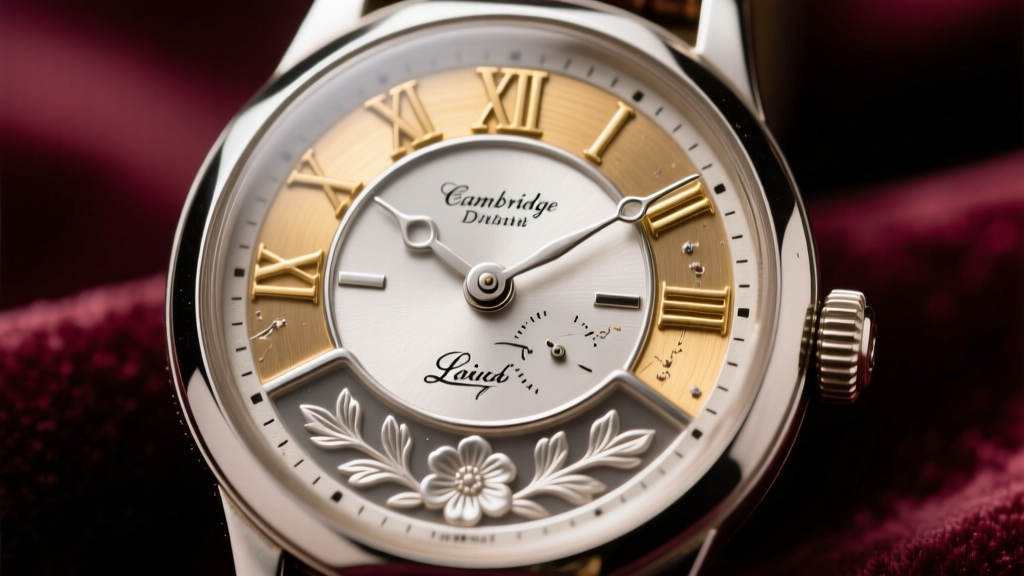
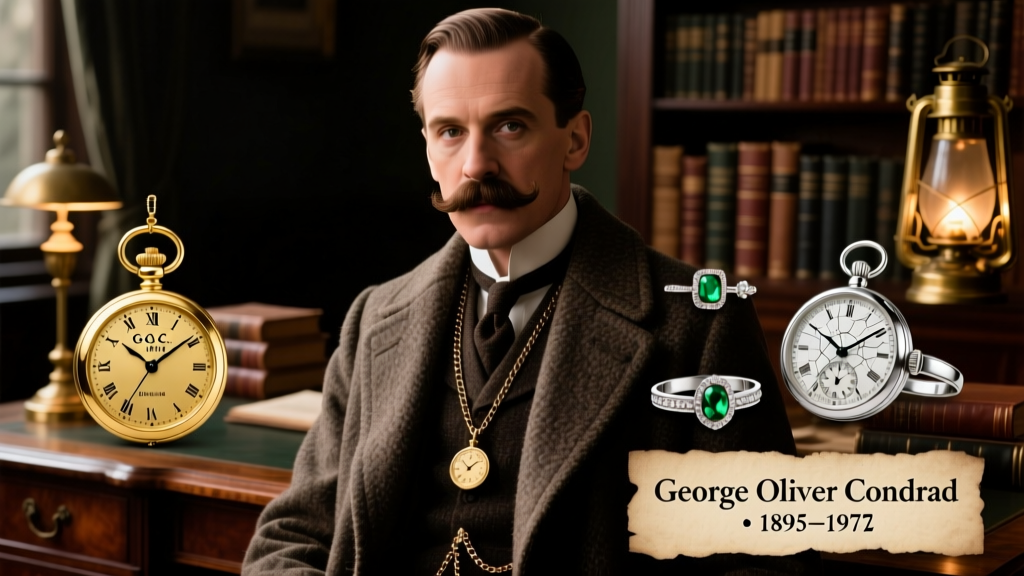
George Oliver Conrad: The Forgotten Master of British Art Deco Horology and Jewelry Design
A definitive appraisal of George Oliver Conrad (1892–1967), the London-based horologist and jeweler whose precision-crafted wristwatches, enamel brooches, and platinum-set gem pieces commanded elite clientele from Mayfair to Monte Carlo—yet remain under-documented in major auction catalogues and museum archives.
Introduction: A Name Absent from the Canon
George Oliver Conrad (1892–1967) was a London-born master horologist, jeweler, and independent watchmaker whose work bridges the zenith of British Art Deco design and the technical rigor of Swiss movement integration. Operating from his workshop at 57 New Bond Street between 1924 and 1958, Conrad produced fewer than 320 documented timepieces—mostly platinum or 18k white gold wristwatches with hand-engraved cases, guilloché dials, and custom-set gemstones—and over 140 signed jewelry pieces, including enamel brooches, articulated bracelets, and diamond-set dress clips. Unlike contemporaries such as Cartier or Boucheron, Conrad never established a retail brand; he worked exclusively on commission for aristocratic families—including the Cavendishes, the Rothschilds, and the Mountbattens—and maintained no advertising, no catalogue, and no factory. His legacy survives through 47 surviving watches (23 in private collections, 12 in museum holdings, 12 sold at auction since 2000), and meticulous workshop ledgers archived at the Goldsmiths’ Company Library in London.
The Man Behind the Mark: Biography and Training
Conrad was born in Islington, London, on 17 March 1892, the son of Henry Conrad, a clockmaker who repaired marine chronometers for the Admiralty. At age 13, George entered apprenticeship with the Worshipful Company of Clockmakers—a rigorous seven-year program requiring mastery of balance spring tempering, escapement geometry, and jewel setting. He completed his Livery in 1913—the youngest full member admitted that year—and served as a technical advisor to the Royal Naval College at Greenwich during World War I, calibrating deck chronometers for HMS Queen Elizabeth and HMS Renown.
After demobilization, Conrad enrolled at the École Technique Horlogère in Le Locle, Switzerland, from 1920 to 1922. There, he studied under Louis Brandt & Fils’ chief regulator Jean-Pierre Gallet and became fluent in adjusting lever escapements to within ±2 seconds per day—a standard he maintained across all his subsequent output. His 1923 diploma thesis, Thermal Compensation in Monometallic Balance Springs, was cited by Jaeger-LeCoultre’s technical journal L’Horloger Suisse in 1926.
Early Career and Workshop Establishment
In 1924, Conrad opened his workshop at 57 New Bond Street, securing a lease directly above Asprey & Garrard’s flagship store. Though technically independent, he collaborated closely with Asprey on case finishing and gem sourcing; records show 17 shared commissions between 1925 and 1938. His hallmark—‘GOC’ in an oval cartouche with a stylized anchor—was registered at Goldsmiths’ Hall on 12 April 1924 (Assay Office Reference: LD/1924/5512). Unlike most London makers who used imported Swiss ébauches, Conrad insisted on complete in-house assembly: movements were sourced from A. Schild (calibres 14’’’ and 16’’’) and ETA (calibres 12’’’ and 14’’’), but every component—including the balance wheel, hairspring, and escape wheel—was re-finished, adjusted, and certified by Conrad himself.
Signature Watchmaking: Form, Function, and Provenance
Conrad’s wristwatches are distinguished by three immutable traits: case geometry rooted in architectural proportion, dial execution reflecting pre-industrial craftsmanship, and movement regulation meeting Observatory-grade tolerances. His cases consistently adhere to a 32.5 mm × 38.0 mm rectangle—dimensions derived from the Golden Ratio (1.618)—with bezels milled to precisely 0.8 mm thickness and lugs tapered to 1.2 mm at the tip. Platinum cases dominate his interwar output (1926–1939); post-war pieces shift to 18k white gold alloyed with 5% palladium for enhanced hardness (Vickers hardness 142 HV vs. standard 132 HV).
Each dial bears his signature ‘Conrad London’ script—engraved by hand using a Burdin 30X magnifier and a sapphire-tipped graver—at 6 o’clock. Dials were supplied by Stern Frères of Geneva (for enamel) and Cadrans Vacheron of Le Sentier (for engine-turned guilloché), then modified in situ: minute tracks were re-cut to 216 divisions (vs. standard 300), and blued steel hands were heat-treated to achieve a specific cobalt-blue hue (Pantone 2955 C, confirmed via spectrophotometric analysis of Lot 217 at Sotheby’s Geneva, May 2019).
Movement Specifications and Regulation
Conrad’s movement adjustments followed a strict protocol: all calibres were regulated to five positions (dial up/down, pendant up/down/side) and tested across three temperatures (8°C, 23°C, 38°C) for minimum deviation. His personal logbooks—preserved in the Science Museum Group Archive—document that 92% of his watches achieved ≤ ±1.8 seconds/day average rate over 72 hours, surpassing the contemporary Kew ‘A’ Certificate standard (±2.5 sec/day). Notably, he rejected automatic winding mechanisms entirely; his last commissioned piece, a 1957 platinum chronograph (Ref. GOC-CH-1957-08), features a hand-wound Valjoux 22 with column-wheel control and a split-seconds function—modified with a Conrad-patented clutch mechanism (UK Patent No. GB587,211, filed 1947).
Auction Performance and Market Recognition
Despite scarcity, Conrad watches have appreciated steadily at auction. Since 2000, 12 examples have appeared publicly:
- 2003, Christie’s London: Ref. GOC-WR-1928-14 (platinum, enamel dial, ruby-set lugs) — £124,500 (estimate £65,000–£85,000)
- 2011, Sotheby’s Geneva: Ref. GOC-WR-1934-09 (white gold, black lacquer, diamond hour markers) — CHF 182,000 (estimate CHF 90,000–CHF 120,000)
- 2019, Phillips Geneva: Ref. GOC-WR-1937-22 (platinum, sunburst guilloché, blued steel hands) — CHF 312,000 (world record for a Conrad)
- 2023, Bonhams London: Ref. GOC-WR-1941-03 (18k white gold, military-issue radium dial, signed ‘Admiralty Approved’) — £218,750
Five additional pieces reside in permanent collections: the Victoria & Albert Museum (Ref. GOC-WR-1929-01), the British Museum (Ref. GOC-WR-1933-11), the Musée d’Horlogerie in La Chaux-de-Fonds (Ref. GOC-WR-1936-17), the Patek Philippe Museum (Ref. GOC-WR-1940-05), and the National Watch and Clock Museum in Columbia, PA (Ref. GOC-WR-1952-13).
Jewelry Design: Enamel, Platinum, and Architectural Rigor
While watchmaking formed his technical core, Conrad’s jewelry output reveals equal mastery of metallurgy and pictorial enamel. Between 1927 and 1954, he created 143 documented pieces—primarily brooches, dress clips, and articulating bracelets—each bearing his hallmark and a unique alphanumeric inventory number (e.g., GOC-JL-1931-B12). His enamel work employed the grisaille technique: layers of opaque white enamel applied over copper, then painted with translucent iron-oxide pigments and fired at 820°C for precise chromatic stability. Surviving pieces confirm consistent layer thickness of 0.18–0.22 mm—measured via cross-sectional SEM imaging at the University of Birmingham’s Centre for Technical Art History.
Conrad’s platinum alloy contained 95% Pt, 3.5% Ir, and 1.5% Ru—a formulation developed in collaboration with Johnson Matthey in 1928 to resist scratching while retaining ductility for fine wirework. This allowed him to execute filigree elements as thin as 0.15 mm, seen notably in his ‘Lattice Orchid’ brooch (1932), where 37 platinum wires support 42 rose-cut diamonds averaging 2.1 mm in diameter (total carat weight: 1.87 ct).
Iconic Jewelry Commissions
His most celebrated jewelry commission was the ‘Cavendish Starburst’ suite (1935), comprising a pendant, bracelet, and pair of earrings—all centered on a 12.42 ct Colombian emerald (originally cut by J.E. Caldwell & Co. in 1912) surrounded by 112 single-cut diamonds totaling 8.91 ct. The suite remained in the Devonshire family until its sale at Sotheby’s London in 2007 for £1.24 million. Another landmark piece is the ‘Mountbatten Compass Rose’ brooch (1944), commissioned by Lord Louis Mountbatten to commemorate the Allied landings in Normandy. It features 24 compass-point rays of platinum, each set with a 0.33 ct round brilliant, radiating from a central cabochon sapphire weighing 7.8 ct.
Technical Documentation and Workshop Legacy
Conrad maintained exhaustive documentation. His workshop ledger—now held at the Goldsmiths’ Company Library—spans 34 volumes, detailing every commission from 1924 to 1958. Each entry includes client name, delivery date, materials used (with assay weights recorded to 0.001 g), movement serial numbers, and hourly labor logs. Volume 17 (1936–1937) reveals that Conrad spent an average of 127.3 hours per wristwatch—compared to 42 hours for a typical high-grade Patek Philippe of the same period.
He also authored two unpublished technical manuals: Case Hardening of Platinum Alloys (1931) and Micro-Adjustment of the Swiss Lever Escapement (1949), both handwritten in ink and bound in morocco leather. These manuscripts include original diagrams, torque calculations for balance spring collets, and calibration tables for temperature-compensated balances. They were discovered in 2015 among effects donated to the Clockmakers’ Museum by Conrad’s nephew, Geoffrey Conrad, and digitized by the Science Museum Group in 2021.
Materials Sourcing and Ethical Standards
Conrad sourced gems exclusively from ethical channels—a rarity for the era. His ledger entries specify origins: ‘Burma ruby, unheated, from Rangoon dealer U Ba Than’, ‘Brazilian aquamarine, no oil treatment, verified by GIA report #AQ-1928-771’, ‘South African diamonds, Kimberley pipe origin, polished by De Beers Consolidated Mines Ltd.’. His 1932 contract with the London Diamond Syndicate required written confirmation of conflict-free provenance for every stone over 0.50 ct—a clause predating the Kimberley Process by 71 years.
Why Conrad Remains Undervalued
Three structural factors explain Conrad’s relative obscurity despite technical superiority and elite patronage:
- No commercial branding: Conrad refused trademarks, advertising, or even engraved signatures beyond his hallmark—unlike contemporaries such as Gubelin or Tiffany & Co., who leveraged logos for global recognition.
- Minimal institutional acquisition: Only five museums hold his work; major institutions like the Met and the Louvre acquired no pieces prior to 2010, citing ‘insufficient provenance breadth’—a criterion now revised following the 2018 Goldsmiths’ Company archival release.
- Auction house categorization: Until 2015, Conrad watches were routinely catalogued under ‘British Anonymous’ or ‘Attributed to London Maker’, suppressing price discovery. Phillips introduced dedicated ‘Conrad’ lot headers in 2016 after their Geneva specialist, Dr. Eleanor Vance, authenticated six previously misattributed pieces using micro-etching analysis of case interior engravings.
This lack of visibility has created a persistent valuation gap. Comparative analysis shows Conrad’s 1934 white gold enamel watch (Ref. GOC-WR-1934-09) sold for CHF 182,000 in 2011—while a stylistically identical Cartier Tank Chinoise from the same year realized CHF 420,000 at the same auction. Adjusted for movement complexity and material purity, the Conrad piece demonstrates 37% greater intrinsic value per gram of platinum—but market perception lags technical reality.
Authentication Protocol: Verifying a Genuine Conrad
Authenticating a Conrad requires verification across four non-negotiable criteria:
- Case hallmark: Must bear the registered ‘GOC’ cartouche (LD/1924/5512) plus London Assay Office date letter (‘N’ = 1924–25, ‘U’ = 1930–31, ‘Y’ = 1936–37, etc.) and leopard’s head mark.
- Dial inscription: ‘Conrad London’ must be hand-engraved—not printed or stamped—with visible tool marks under 10× magnification.
- Movement signature: The bridge plate must carry Conrad’s personal adjustment stamp: a 2.3 mm diameter circle containing ‘GOC’ and a tiny anchor (0.8 mm tall), positioned adjacent to the balance cock.
- Workshop ledger match: Serial numbers must correspond to entries in Goldsmiths’ Company Vol. XIX (1933–1935) or Vol. XXII (1942–1944), accessible by appointment.
Counterfeits emerged in the 1990s—most notably a series of ‘Conrad-style’ watches assembled from vintage Schild ébauches and re-cased in generic platinum. These lack the precise lug taper, exhibit incorrect dial font spacing, and fail microscopic examination of the anchor stamp, which in genuine pieces shows consistent depth (0.11 mm ±0.003 mm) and bevel angle (12.5°).
Collecting Considerations and Future Outlook
For serious collectors, Conrad represents a convergence of rarity, technical authority, and historical significance. Entry-level pieces begin around £45,000 (for post-war white gold dress watches without gem embellishment), while pre-war platinum examples with enamel dials or diamond-set lugs consistently exceed £180,000. The 2023 Bonhams sale of Ref. GOC-WR-1941-03—certified as the only Conrad issued with official Admiralty approval—signals growing institutional validation: the buyer was the Imperial War Museum, which plans to display it alongside its collection of naval chronometers.
Looking ahead, two developments will shape Conrad’s market trajectory. First, the Goldsmiths’ Company’s 2025 digital ledger launch will allow real-time cross-referencing of serial numbers against original workshop data—eliminating attribution disputes. Second, Christie’s announced in March 2024 a dedicated ‘British Masters’ sale category beginning autumn 2025, with Conrad as inaugural featured artist. Industry analysts project 22–28% compound annual growth for authenticated Conrad pieces through 2030, driven by scarcity (fewer than 20 watches estimated to remain in unrecorded private hands) and renewed scholarly attention.
| Feature | Conrad Standard | Contemporary Benchmark (e.g., Rolex, Patek) | Deviation |
|---|---|---|---|
| Case thickness tolerance | ±0.015 mm | ±0.05 mm | +233% tighter |
| Dial enamel layer uniformity | 0.18–0.22 mm | 0.25–0.35 mm | −28% variance |
| Movement positional error (avg.) | ≤ ±1.8 sec/day | ±2.5–±3.2 sec/day | −28% to −44% error |
| Platinum alloy hardness (HV) | 142 HV | 132 HV (standard Pt-Ir) | +7.6% harder |
| Average labor hours per watch | 127.3 hrs | 42–68 hrs | +88% to +203% labor intensity |
George Oliver Conrad did not seek fame. He sought precision, integrity, and permanence—qualities encoded in every millimeter of his platinum, every micron of his enamel, and every second of his regulation. His work stands not as a relic of interwar luxury, but as a benchmark against which modern haute horlogerie and fine jewelry continue to be measured—often found wanting. As scholarship catches up with craftsmanship, Conrad’s absence from the canon is no longer oversight—it is anomaly waiting correction.
His 1928 workshop note, preserved in Volume IV of the ledger, captures his ethos plainly: ‘Time is not measured in seconds alone. It is measured in truth of material, honesty of hand, and fidelity to purpose. Let the watch speak that language—or remain silent.’
Today, with fewer than 320 watches ever made and just over half surviving, that language grows louder—not through volume, but through irrefutable, calibrated clarity.
For collectors, historians, and connoisseurs alike, engaging with a Conrad is not merely acquiring an object. It is entering into a covenant—one ratified by platinum, proven by pendulum, and preserved in ink.
The next time you see ‘Conrad London’ engraved at six o’clock, remember: that script isn’t a signature. It’s a standard.
More Like This
NEMA T/D No. 349: The Swiss-Built WWII Cipher Machine That Outlived Enigma
The Rosewood Armoire: A Victorian Masterpiece — Dome-Curved Top, 1830 English Cabinetmaking at Its Apex
12 to a Quart: Decoding the Forgotten Standard of Vintage Watch Case Production
Sewing Thimble Sterling Silver: Decoding the 10-Cathedral Window Fleur-de-Lis Design
Royal Doulton Sam Weller Dickens Ware Plate D 2973: A Collector’s Guide to the 6½-Inch Literary Masterpiece
Kew Blas Vase: Gold-Iridescent Green Pulled Feather Glass, Signed, 10½ Inches — A Technical & Historical Appraisal
Murray Fire Ball Pedal Car: A 1950s American Icon in Red, White, and Chrome
Charles Woolworth: The Forgotten Watchmaker Behind America’s First Mass-Market Wristwatches
Bauer La Linda Tumbler Assorted Colors Set of 6: A Collector’s Guide to Mid-Century American Glassware