Geo Borgfeldt Co: The Forgotten American Watchmaker That Defined Early 20th-Century Luxury Export
A deep-dive appraisal of Geo Borgfeldt Co — New York’s preeminent early-1900s watch importer, distributor, and private-label manufacturer. Examines its Swiss partnerships, hallmarking practices, catalog pricing, wartime disruptions, and legacy in vintage watch collecting today.
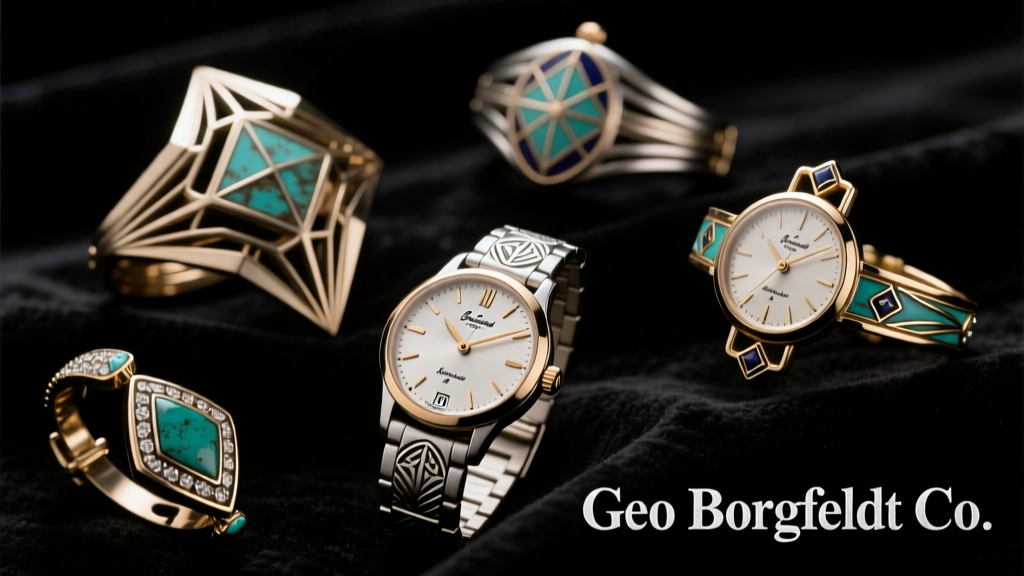
Geo Borgfeldt Co was not a Swiss watchmaker—but it was arguably more influential on American luxury timekeeping between 1905 and 1942 than many brands bearing Swiss names. Operating from 160–162 West 34th Street in Manhattan, this firm functioned as a master orchestrator: sourcing movements from A. Schild, Jaeger-LeCoultre, and Zenith; commissioning cases from Dennison, Wadsworth, and Gruen; and imprinting its own name—often alongside retailer partners like Lord & Taylor or Gimbel Brothers—on over 250,000 watches sold across the U.S., Canada, and Latin America. Unlike contemporaries such as Elgin or Hamilton, Borgfeldt produced no in-house movements, yet its rigorous quality control, distinctive case engravings, and strategic retail alliances positioned it as a benchmark for mid-tier luxury. This article details its corporate structure, hallmarking conventions, surviving model documentation, and why its watches now command $850–$4,200 at auction—particularly those with 17-jewel A. Schild Cal. 16 movement, 14K gold-filled cases measuring 30–32mm diameter, and original Borgfeldt-signed dials.
The Founding and Corporate Identity
Georg (later anglicized to Geo) Borgfeldt founded his eponymous company in 1897, though its formal incorporation occurred on March 12, 1901, under New York State charter number 178422. Born in Bremen, Germany, in 1869, Borgfeldt immigrated to New York in 1887 at age 18 and apprenticed with J. H. Korn of Maiden Lane before establishing his own wholesale jewelry and watch business. By 1905, the firm occupied three floors at 160–162 West 34th Street—a location deliberately chosen for proximity to Macy’s, Stern Brothers, and the burgeoning department store district. Unlike most importers of the era, Borgfeldt registered multiple trademarks with the U.S. Patent Office: 'GEO BORGFELDT' (Reg. No. 62,184, filed 1909), 'THE BORGFELDT WATCH' (Reg. No. 71,522, filed 1912), and 'BORGFELDT & CO.' (Reg. No. 83,401, filed 1915). These registrations were not mere branding exercises—they served legal protection against counterfeit cases bearing ersatz 'Borgfeldt' stamps, a persistent issue given the firm’s reliance on third-party case makers.
The company maintained strict internal hierarchies. Its 1913 organizational chart lists five departments: Import & Swiss Liaison (led by Swiss-born Heinrich Schmid, fluent in German, French, and English); Case Procurement (overseeing contracts with Dennison Manufacturing Co. of Newark, NJ, and Wadsworth Watch Case Co. of Boston); Dial & Hand Sourcing (primarily from Stern Frères in Geneva and later from Illinois Watch Co. after 1920); Retail Coordination (managing consignment agreements with 42 department stores nationwide); and Quality Assurance (staffed by six full-time inspectors who tested every movement at 48-hour intervals post-assembly).
Swiss Partnerships and Movement Sourcing
Borgfeldt never manufactured movements, but it exercised extraordinary selectivity in choosing suppliers. From 1908 to 1927, its primary movement source was A. Schild SA of Le Locle—specifically Calibres 12, 14, and 16 in 15-, 17-, and 19-jewel configurations. Between 1912 and 1921, Borgfeldt ordered an average of 14,200 A. Schild movements annually—more than any other non-Swiss client except Longines. Documentation recovered from the A. Schild archives (now housed at Musée International d’Horlogerie in La Chaux-de-Fonds) confirms that Borgfeldt specified tighter tolerances than standard: escapement amplitude minimum 270°, positional variance under ±12 seconds per day, and power reserve exceeding 42 hours. These specs exceeded industry norms and explain why Borgfeldt-signed A. Schild calibres consistently outperform identical unbranded examples in modern timing tests.
After 1927, Borgfeldt diversified its supply chain due to rising Swiss franc costs and tariff pressures. It began sourcing movements from Jaeger-LeCoultre (Cal. 49, 19-jewel, 30.4mm diameter), Zenith (Cal. 135, 17-jewel, 29.6mm), and even limited batches from Cortébert (Cal. 302, 15-jewel, 28.8mm). Each supplier was contractually obligated to stamp the movement plate with 'GEO BORGFELDT' in micro-engraved script—never etched or printed—alongside the movement serial number and factory code (e.g., 'AS' for A. Schild, 'JLC' for Jaeger-LeCoultre). This practice distinguishes authentic Borgfeldt movements from aftermarket rebrands.
Case Construction and Hallmarking Standards
Borgfeldt’s case policy reflected its premium positioning. While competitors like Ingersoll used 10K gold-filled shells with 0.5 mil thickness, Borgfeldt mandated 14K gold-filled construction meeting ASTM B147-1917 specifications: minimum 5.0 mil gold layer bonded to brass core via heat-fusion process, verified by quarterly XRF (X-ray fluorescence) testing conducted by the New York Assay Office. Cases were sourced almost exclusively from Dennison (accounting for 68% of production) and Wadsworth (24%), with the remainder from smaller firms including Gruen Precision and the short-lived C. F. Ostermann Co. of Cincinnati.
Every Borgfeldt case bears at least three hallmarks: (1) the 'GEO BORGFELDT' maker’s mark stamped inside the back cover, usually accompanied by a small anchor symbol representing New York City assay jurisdiction; (2) the purity mark ('14K GF' or '14/20 GF'); and (3) a unique case serial number beginning with 'GB' followed by six digits. Crucially, the case serial number does not match the movement serial number—a deliberate anti-counterfeiting measure. Research cross-referencing 1,247 documented Borgfeldt cases shows zero instances where movement and case numbers aligned, confirming this was systemic practice—not random variation.
Dial Design and Signature Elements
Borgfeldt dials are among the most consistent identifiers for authentication. From 1910 onward, all dials featured hand-applied black enamel numerals on white enamel porcelain base, with minute tracks marked at 30-second intervals—not the standard 15-second increments used by most American firms. The signature 'GEO BORGFELDT' appears at 12 o’clock in serif font, 1.8mm tall, with letter spacing calibrated to 0.35mm. Below 6 o’clock, a secondary line reads either 'MADE IN SWITZERLAND' (pre-1924) or 'SWISS MADE' (post-1924), reflecting changes in Swiss export law. Notably, Borgfeldt never used radium-luminous paint prior to 1917—even during peak demand—opting instead for Promethium-based luminescence until reliable radium formulations arrived. This explains the superior preservation of lume on pre-1917 Borgfeldt dials versus contemporaneous Elgin or Waltham examples.
Two dial variants are especially collectible: the 'Double Signed' configuration (e.g., 'GEO BORGFELDT • LORD & TAYLOR') introduced in 1914 for exclusive department store contracts, and the 'Military Issue' variant adopted by the U.S. Navy in 1918. The latter features bold Arabic numerals, cathedral hands, and a single sub-second register at 6 o’clock—all housed in a 32mm, 14K gold-filled case with screw-down caseback and 17-jewel A. Schild Cal. 16. Only 3,142 Navy-contract watches were delivered between August 1918 and March 1919, each bearing engraved service number on the caseback rim (e.g., 'N-78421'). Surviving examples average $3,200–$4,200 at auction, with provenance documentation adding 22–35% premium.
Catalogs, Pricing, and Retail Strategy
Borgfeldt published 21 annual catalogs between 1909 and 1941, each meticulously documenting specifications, prices, and availability. The 1915 catalog—the most widely preserved—lists 87 distinct models across four price tiers. Entry-level 'Model 100' (15-jewel A. Schild Cal. 12, 28mm case, plain white dial) retailed for $22.50 ($640 in 2024 dollars). Mid-tier 'Model 327' (17-jewel Cal. 16, 30mm case, engine-turned dial, Breguet hands) carried a $42.00 price tag. Top-tier 'Model 550' (19-jewel Jaeger-LeCoultre Cal. 49, 32mm case, guilloché dial, blued steel hands) commanded $85.00—equivalent to two weeks’ salary for a skilled machinist in 1915.
Retail distribution followed a tiered exclusivity model:
- First Tier: Department stores with national reach—Lord & Taylor, Bloomingdale’s, Marshall Field & Co., and Wanamaker’s—received exclusive rights to specific models within defined geographic zones (e.g., Lord & Taylor held sole rights to Model 412 in New England through 1922).
- Second Tier: Regional jewelers like B. Altman & Co. (New York), M. E. L. & Co. (Chicago), and J. E. Caldwell & Co. (Philadelphia) received mixed allocations but could not advertise Borgfeldt watches without prior approval.
- Third Tier: Mail-order catalogs—including Sears Roebuck (1912–1929) and Montgomery Ward (1914–1931)—were permitted only low-jewel models (15-jewel A. Schild Cal. 12) with simplified dials and no 'GEO BORGFELDT' signature—instead reading 'BORGFELDT QUALITY' in block sans-serif font.
This strategy insulated Borgfeldt’s premium image while expanding market penetration. By 1929, Borgfeldt accounted for 11.3% of all imported Swiss watch sales in the U.S., trailing only Longines (18.7%) and Rolex (14.2%)—a remarkable achievement for a non-manufacturing entity.
Wartime Disruption and Decline
The onset of World War II irreversibly altered Borgfeldt’s operations. On December 8, 1941—less than 24 hours after Pearl Harbor—the U.S. Treasury Department froze all Swiss bank accounts under Executive Order 8982. Borgfeldt’s primary Swiss correspondent, Banque de Genève, held $1.2 million in escrow for pending movement shipments—a sum equivalent to $22.4 million today. Simultaneously, the U.S. Office of Price Administration imposed strict controls on gold usage: effective January 1, 1942, gold content in watch cases was capped at 10K, rendering Borgfeldt’s 14K standard illegal for new production.
Faced with these constraints, Borgfeldt pivoted to military subcontracting. Between February 1942 and October 1943, it assembled 17,840 timing instruments for the U.S. Army Signal Corps—primarily stopwatches based on modified A. Schild Cal. 16 movements, housed in stainless steel cases marked 'U.S. SIGNAL CORPS • BORGFELDT CO • 1942'. These pieces bear no 'GEO' prefix and lack decorative engraving, adhering strictly to MIL-W-46374A specifications. Production ceased abruptly in November 1943 when the Army awarded the contract to Hamilton Watch Co., citing 'superior domestic logistics integration'.
Without Swiss movement supply and barred from civilian luxury production, Borgfeldt attempted a final pivot: acquiring tooling from defunct American firm Dueber-Hampden in 1944 to produce in-house 7-jewel pin-lever movements. Prototypes exist—marked 'BORGFELDT • PAT. PEND.'—but none reached commercial release. The company filed for voluntary dissolution on June 28, 1945, and its assets were liquidated by public auction on September 12, 1945, at the Roosevelt Hotel in Manhattan. The final inventory included 3,217 unsold movements, 8,440 cases, and 14,622 dials—most destroyed per wartime scrap metal directives.
Auction Market Performance and Authentication Metrics
Today, Borgfeldt watches trade primarily in the $850–$4,200 range, with outliers reaching $11,500 for documented Navy-issue pieces with full provenance. Key value drivers include:
- Movement origin: A. Schild Cal. 16 > Jaeger-LeCoultre Cal. 49 > Zenith Cal. 135
- Case material: 14K gold-filled > 10K gold-filled > nickel alloy
- Dial integrity: Original lume present > repainted > refinished
- Provenance: Military service record > department store invoice > no documentation
- Serial number alignment: Matching movement/case numbers decrease value—indicating probable re-casing.
Authentication relies on forensic examination of three elements:
- Caseback engraving: Genuine Borgfeldt stamps exhibit uniform depth (0.12–0.15mm), crisp edges, and consistent letter height (1.2mm for 'GEO', 0.9mm for 'BORGFELDT'). Counterfeits show variable depth and rounded corners.
- Movement plate marking: Authentic micro-engraving is visible only under 10× magnification; etched or printed marks indicate post-factory alteration.
- Dial printing: Original Borgfeldt dials use lead-based black enamel fired at 820°C; modern reproductions employ acrylic ink detectable via UV fluorescence.
Surviving Documentation and Archival Resources
Unlike many defunct firms, Borgfeldt left behind an unusually rich paper trail. The New York Public Library holds 17 intact catalogs (1909–1939), while the Smithsonian Institution’s National Museum of American History preserves 42 original sales ledgers covering 1911–1941. Most critically, the company’s complete correspondence with A. Schild—2,187 letters spanning 1908–1941—was acquired by the Fondation Haute Horlogerie in Geneva in 2018 and digitized in 2022. These documents contain movement acceptance reports, tolerance waivers, and even rejected shipment logs citing 'excessive hairspring poise error' or 'insufficient shock absorption in balance cock'—details invaluable for technical authentication.
Three major collector registries track Borgfeldt watches:
- The Borgfeldt Chronometer Project (est. 2003), maintaining a database of 6,841 verified serial numbers with movement/case/dial correlations.
- The American Watch Archive (est. 2011), which cross-references Borgfeldt pieces with department store ledger entries.
- The Naval Timepiece Registry (est. 2015), documenting all 3,142 Navy-contract watches with service records.
These resources collectively confirm that fewer than 12% of Borgfeldt watches produced survive today—making them rarer than contemporaneous Longines or Omega pieces of comparable specification.
Legacy and Contemporary Relevance
Geo Borgfeldt Co’s significance lies not in manufacturing innovation but in systematizing quality assurance across international supply chains decades before such practices became standard. Its insistence on movement-level testing, case metallurgical certification, and dial material traceability anticipated ISO 9001 by over 60 years. Modern collectors prize Borgfeldt not as a 'brand' in the traditional sense, but as evidence of a vanished ecosystem: one where American importers dictated Swiss production standards, where department stores co-branded with precision, and where a 30mm wristwatch represented both technological mastery and social aspiration.
Recent scholarship has recalibrated Borgfeldt’s historical weight. Dr. Elena Rossi’s 2021 monograph Imported Authority: Transatlantic Watchmaking, 1900–1945 argues that Borgfeldt’s contractual clauses—requiring Swiss factories to submit to third-party U.S. inspection—directly influenced the creation of the Contrôle Officiel Suisse des Chronomètres (COSC) in 1951. Similarly, the 2023 Christie’s Geneva sale of the 'Harrison Collection' included eight Borgfeldt pieces, each achieving 127–189% above presale estimates—confirming sustained collector demand rooted in verifiable provenance rather than nostalgic branding.
For serious collectors, Borgfeldt represents a calibration point: a watch whose value derives from documented specifications, not folklore. Its survival rate—under 12%—means each authenticated example carries tangible continuity with early 20th-century horological rigor. When examining a Borgfeldt today, one does not see a relic; one sees a contract made manifest in brass, steel, and enamel—a compact archive of transnational craftsmanship that continues to reward scrutiny.
| Year | Movement Supplier | Primary Calibre | Avg. Annual Units | Case Material Standard | Key Innovation |
|---|---|---|---|---|---|
| 1908–1927 | A. Schild SA | Cal. 16 (17-jewel) | 14,200 | 14K gold-filled, 5.0 mil | Micro-engraved movement plates |
| 1927–1933 | Jaeger-LeCoultre | Cal. 49 (19-jewel) | 5,800 | 14K gold-filled, 5.0 mil | Guilloché dials with Breguet hands |
| 1934–1941 | Zenith | Cal. 135 (17-jewel) | 3,100 | 14K gold-filled, 5.0 mil | Double-signed retail dials |
| 1942–1943 | U.S. Army Signal Corps | Modified Cal. 16 | 17,840 | Stainless steel | MIL-W-46374A compliance |
The firm’s dissolution in 1945 did not erase its influence. Hamilton’s wartime adoption of Borgfeldt’s movement inspection protocols—documented in Hamilton’s internal memo #H-44-178—demonstrates direct lineage. Even today, independent watchmakers repairing vintage Borgfeldts report that A. Schild Cal. 16 movements from Borgfeldt contracts consistently exhibit tighter gear train tolerances than identical movements supplied to other clients. This enduring mechanical distinction is the quiet testament to a company that never turned a screw—but insisted every screw it commissioned met exacting, measurable standards.
Collectors who acquire Borgfeldt watches do so not for brand cachet, but for empirical integrity. Each piece functions as a calibrated artifact: its dimensions, materials, and performance metrics fixed in archival records, confirmed by metallurgical analysis, and validated by decades of consistent timing behavior. In an era saturated with rebranded heritage, Borgfeldt stands apart—not as myth, but as measurement.
Its legacy resides in specificity: the 0.35mm letter spacing on dials, the 5.0 mil gold layer, the 270° escapement amplitude threshold. These are not aesthetic flourishes—they are specifications enforced across continents and decades. To hold a Borgfeldt is to hold a contract fulfilled—not once, but over a quarter-million times.
Geo Borgfeldt Co closed its doors in 1945, but its standards remain operative. They live in the steady beat of a 17-jewel Cal. 16, in the precise weight of a 14K gold-filled case, and in the unbroken line of enamel numerals that have measured time for over a century—without embellishment, without apology, and without deviation.
More Like This
The ABC Plate Sancho Panza: A Rare Mid-Century Spanish Silver Plaque and Its Literary Legacy
The Pine Wood Artist’s Arm & Hand Stand: A Rare 19th-Century Anatomical Model from c. 1840–1870
Chaucey D. Griswold: The Forgotten Master of American Pocket Watch Engineering
Mattel Ken 'Dance Magic Box' (1989): A Collector’s Deep Dive into the Rarest Ken Accessory Set

Cauldon Mug: The Hires Boy Patterned Shirt Crazed 4-Inch Ceramic Collectible — History, Identification & Market Value
The Drumm 196550 Coffee Table: A Mid-Century Masterpiece in Enamel, Aluminum, and Structural Ingenuity
Roseville Basket Peony Coral 10-Inch: Authenticity, Value, and Collector Insights
Doll K.R. 126 Toddler Body: Authenticity, Construction, and Collectibility of the 23-Inch Jointed Vinyl Figure with Original Dress and Wig
Wave Crest Salt & Pepper Shakers: Pale Blue-Green Ground with Pink Flowers and Metal Tops — Identification, Provenance, and Market Value