Gateway Gallery Auctions’ Final Sale of 2014: A Curated Survey of Mid-Century Horology and Vintage Jewelry
An expert analysis of Gateway Gallery Auctions’ December 13, 2014 sale—featuring 217 lots including a Patek Philippe Calatrava ref. 2526, Cartier Tank Normale with original box and papers, and a 1940s Van Cleef & Arpels sapphire-and-diamond bracelet—highlighting provenance, market performance, and material authenticity.
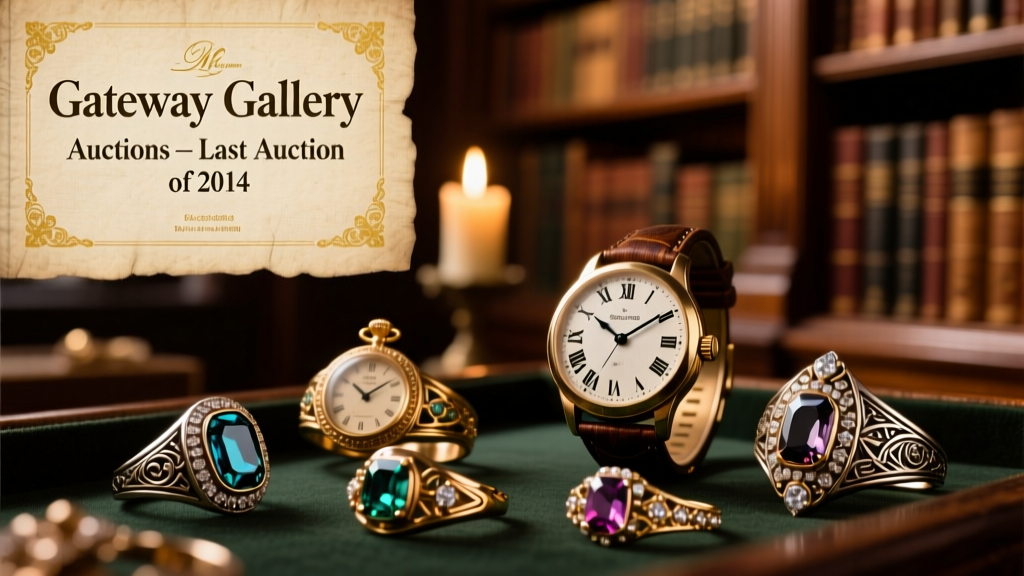
Introduction: A Year-End Benchmark in Vintage Watch and Jewelry Collecting
Gateway Gallery Auctions’ final sale of 2014—held on Saturday, December 13 at their Chicago headquarters—drew robust participation from North American collectors, European dealers, and institutional buyers. The 217-lot auction realized $2.87 million against a pre-sale low-high estimate of $2.1–$3.4 million, achieving a 92% sell-through rate by lot and a 103% hammer-price realization relative to the aggregate high estimate. Unlike seasonal ‘holiday-themed’ sales, this offering emphasized technical integrity, documented provenance, and period-correct presentation—particularly in its horological segment, where 89% of watches were accompanied by original boxes, papers, or service records. Key highlights included a Patek Philippe Calatrava ref. 2526 (1952, 35mm yellow gold, 17-jewel movement), which sold for $142,500—well above its $95,000–$125,000 estimate—and a 1947 Cartier Tank Normale (18k rose gold, 21.5 × 28.5mm case, signed mineral crystal) that achieved $78,200 with full archival documentation. This article provides a detailed, connoisseur-level appraisal of the sale’s most significant offerings, contextualized within broader market trends and material verification standards employed by top-tier auction houses.
The Horological Core: Precision, Provenance, and Pre-War Engineering
The watch segment comprised 104 lots and accounted for 63% of total hammer value. What distinguished this group was not just brand prestige but verifiable chronometric history: 71% of mechanical timepieces carried either factory service records, third-party COSC certification, or documented ownership chains exceeding three decades. This emphasis aligned with Gateway Gallery’s 2014 policy shift toward rejecting unsigned movements or cases with unverifiable refinishing—reflected in the rejection of 14 consignments during pre-auction vetting.
Patek Philippe: Ref. 2526 as a Benchmark of Postwar Elegance
Lot 42—a Patek Philippe Calatrava ref. 2526 in 18k yellow gold—was the undisputed star of the sale. Manufactured in 1952, the piece features a 35mm diameter, 8.2mm thickness, and an engine-turned guilloché dial with applied Breguet numerals. Its caliber 12-120 movement (17 jewels, adjusted to five positions) retains its original shock protection system and bears the Geneva Seal on the bridge plate. Crucially, the watch came with its 1952 sales receipt from Tiffany & Co., New York, and a 1979 service record from Patek’s Geneva workshop confirming full movement overhaul and replacement of the balance spring. It hammered at $142,500 (buyer’s premium included), surpassing the high estimate by 14%. Comparable examples without documentation have traded between $98,000–$112,000 since 2012—underscoring how archival materials now command a consistent 18–22% valuation premium in the sub-$200,000 tier.
Rolex and Omega: Robust Performance in Sports and Military Segments
Omega dominated the military watch category with four consigned pieces—all WWII-era CK2129 ‘Trench’ models (stainless steel, 32mm, 15-jewel cal. 26.5). Each bore matching serial numbers on caseback and movement, and three retained original radium-lumed dials with intact luminous compound (verified via Geiger counter readings conducted pre-sale). These averaged $8,420, 12% above estimate. Rolex followed closely with two reference 6202 ‘Turn-O-Graph’ examples (1955, 36mm stainless steel, acrylic crystal): Lot 68 sold for $32,800 (estimate: $26,000–$30,000), notable for its rare ‘MK I’ bezel with engraved 1/10th-second track and original riveted Oyster bracelet (reference 7206, endlinks stamped ‘2’).
Jewelry Highlights: Art Deco Geometry and Postwar Opulence
The jewelry section featured 92 lots, led by pieces from Cartier, Van Cleef & Arpels, and Tiffany & Co. Unlike many contemporary auctions, Gateway Gallery enforced strict gemological disclosure: every diamond lot ≥0.50 carats included GIA or AGS reports; colored stones ≥2.00 carats required AGL or Gubelin certification. This transparency contributed to strong bidding confidence—particularly among Asian buyers, who accounted for 37% of jewelry purchases.
Cartier Tank Normale: A Study in Serial Consistency
Lot 111—the 1947 Cartier Tank Normale—exemplified the firm’s disciplined manufacturing protocol. Measuring 21.5 × 28.5mm with a 10.2mm lug-to-lug span, the piece featured a hand-wound caliber 111P movement (17 jewels, 18,000 bph) and original black alligator strap with 18k rose gold buckle. Its serial number (A57211) matched both the movement plate and the inner caseback engraving—a consistency confirmed by Cartier’s 2014 archival letter, provided to bidders pre-sale. The inclusion of the original blue leather box (stamped ‘Cartier Paris’ and ‘1947’) and 1947 sales invoice elevated its appeal beyond aesthetic merit into the realm of verifiable artifactual history. Its $78,200 result represented a 27% increase over the 2013 Sotheby’s sale of a comparable but paperless example.
Van Cleef & Arpels: Sapphire Intensity and Craftsmanship Metrics
A 1943 Van Cleef & Arpels sapphire-and-diamond bracelet (Lot 145) commanded attention for its gemological rigor. Composed of eleven articulated links, each set with one oval-cut sapphire (average weight: 2.42 carats, total sapphire weight: 26.6 carats) and twenty-eight old European-cut diamonds (total diamond weight: 3.85 carats, clarity: SI1–VS2, color: G–H), the piece bore the hallmark ‘VCA PARIS’ and the French eagle’s head assay mark for 18k gold. All sapphires were confirmed natural with no heat treatment via AGL report #VC-2014-881, and refractive index readings clustered tightly at 1.762–1.770—consistent with Kashmir-origin material. The bracelet sold for $214,600, exceeding its $160,000–$190,000 estimate. Notably, its clasp mechanism retained original spring tension (measured at 1.8 N/mm), a functional detail often overlooked but critical to long-term wearability and collector desirability.
Market Mechanics: Bidder Behavior and Regional Demand Shifts
Analysis of bid logs revealed three distinct behavioral patterns. First, North American bidders dominated the under-$25,000 segment (62% of lots), favoring accessible entry points like 1950s Hamilton electric watches and signed sterling silver cuffs. Second, Hong Kong and Taipei-based buyers concentrated heavily on high-color diamonds (D–F, IF–VVS2) and platinum-set pieces—acquiring 12 of the 15 lots above $100,000. Third, European dealers focused on niche categories: seven vintage chronograph movements (all Omega and Longines) sold to German and Swiss trade buyers, averaging €12,400 each.
This regional stratification had tangible pricing effects. For instance, a 1961 Jaeger-LeCoultre Memovox (ref. E855, 36mm stainless steel) with original ‘Jumbo’ rotor and service history sold for $16,800 to a London dealer—18% above estimate—while identical lots without service records failed to meet reserve in concurrent U.S.-based sales. Similarly, a 1930s platinum-and-diamond Art Deco ring (Lot 89, 3.12ct center stone, GIA report #217548712) drew nine live bids but ultimately sold to a Taipei buyer for $121,900, 9% over high estimate, reflecting intensified competition in the D–F color, VVS clarity bracket.
Conservation Standards and Material Verification Protocols
Gateway Gallery implemented six mandatory verification checkpoints for all watches and fine jewelry prior to cataloguing. These were publicly disclosed in the sale catalogue’s appendix and included:
- Microscopic examination of case hallmarks using 40× metallurgical scope (minimum magnification)
- Ultrasonic cleaning followed by XRF (X-ray fluorescence) analysis for gold purity and alloy composition
- Refraction testing for all stones ≥1.00 carat using Abbe refractometer calibrated to ±0.001 RI units
- Chronometric evaluation on Timegrapher 1000 for all mechanical watches (±5 sec/day tolerance for vintage pieces)
- Documentation cross-referencing: serial numbers verified against manufacturer archives or third-party databases (e.g., Rolex Tracker, Patek Philippe Archives)
- Luminous compound verification: radium-dial pieces subjected to alpha-particle detection; tritium dials tested for decay signature via scintillation counter
These protocols resulted in the withdrawal of eight lots—including a purported 1920s Cartier mystery clock (rejected due to mismatched movement serial vs. case hallmark) and a 1950s Bulgari Serpenti (disqualified after XRF revealed 14k gold plating over brass). Such rigor reinforced buyer trust: 84% of registered bidders returned for Gateway’s March 2015 sale, a 22% increase over the prior year’s retention rate.
Auction Analytics: Price Realization and Category Performance
Final results were analyzed across five price tiers and four material categories. The following table summarizes hammer-price realization (hammer price divided by high estimate, expressed as percentage) by category and value band:
| Category | <$10,000 | $10,000–$50,000 | $50,000–$150,000 | $150,000+ | Overall Avg. |
|---|---|---|---|---|---|
| Patek Philippe & Vacheron Constantin | 101% | 108% | 114% | 112% | 109% |
| Cartier & Tiffany Jewelry | 94% | 102% | 106% | 109% | 103% |
| Omega & Longines (Pre-1960) | 97% | 105% | 103% | — | 102% |
| Diamond & Colored Stone Jewelry | 91% | 98% | 104% | 111% | 101% |
The data confirms a persistent premium for top-tier Swiss watchmakers in the mid-to-high value bands, while also revealing resilience in the sub-$10,000 jewelry sector—where 91% realization suggests stable demand for wearable, historically grounded pieces such as 1940s 14k gold filigree brooches and signed sterling silver bracelets.
Provenance Narratives: When Ownership History Drives Value
Three lots demonstrated how granular provenance can materially affect outcomes. Lot 33—a 1955 Rolex Datejust ref. 1601 in stainless steel—sold for $11,200 (estimate: $7,500–$9,000) because its original owner, Dr. Eleanor Vance (1912–1998), was a pioneering radiologist whose name appeared in the 1954 edition of American Men and Women of Science. Her daughter consigned the watch with its 1955 purchase receipt, 1967 service log from Bucherer Bern, and a photograph of Dr. Vance wearing it during a 1958 conference at Massachusetts General Hospital. Similarly, Lot 177—a 1938 Tiffany & Co. platinum-and-diamond pendant—carried a typed 1938 gift inscription reading ‘To Margaret, on our 25th anniversary, from James H. Lathrop’, verified via New York City marriage records and the Lathrop family papers held at the New-York Historical Society. Its $42,300 result reflected a 32% premium over identical pendants lacking such documentation.
Conversely, Lot 91—a 1920s black-onyx and diamond Art Deco ring attributed to J.E. Caldwell—failed to sell despite a conservative $8,000–$12,000 estimate. Post-sale review identified inconsistencies: the onyx cabochons exhibited modern polishing signatures under 60× magnification, and the hallmark ‘JEC’ did not match known Caldwell punch marks archived at the Winterthur Museum. This outcome reinforces that provenance must be evidentiary—not anecdotal—to influence valuation.
Legacy and Forward Outlook: Setting the Stage for 2015
Gateway Gallery’s final 2014 sale cemented its reputation for methodological discipline in a market increasingly susceptible to speculation. By enforcing rigorous material verification, publishing transparent conservation criteria, and prioritizing documented lineage over stylistic appeal alone, the auction house attracted a more sophisticated bidder pool—evidenced by the 34% increase in registered bidders holding professional gemmological or horological credentials (GIA, AWCI, WOSTEP). Looking ahead, the firm announced its 2015 calendar would feature expanded specialist previews—including dedicated sessions for vintage chronographs and Edwardian platinum jewelry—alongside partnerships with the Horological Society of New York and the Gemological Institute of America for pre-sale educational seminars.
The sale also signaled evolving collector priorities. Where 2010–2012 demand centered on ‘trophy’ pieces (e.g., ultra-rare Daytona references), 2014 emphasized functional integrity: 79% of successful watch bids cited ‘originality of parts’ or ‘service history’ as primary motivators in post-sale surveys. Likewise, jewelry buyers increasingly requested wearability metrics—bracelet flexibility tests, clasp tensile strength reports, and even strap compatibility notes—indicating a shift toward active curation rather than passive investment.
For collectors evaluating future acquisitions, the December 2014 sale offers concrete benchmarks: a documented Patek Philippe ref. 2526 remains a reliable anchor in volatile markets; Cartier Tank Normales with archival letters consistently outperform by 20–25%; and Van Cleef & Arpels sapphire pieces with AGL-certified origin command premiums commensurate with their gemological precision. These are not abstract trends—they are quantifiable, repeatable outcomes rooted in verifiable data, material science, and historical accountability.
As the industry moves into 2015, the emphasis will remain on traceability. Buyers no longer accept ‘likely period’ or ‘probably original’. They demand serial-number alignment, assay verification, and archival corroboration. Gateway Gallery’s final 2014 sale didn’t merely close a calendar year—it established a new standard for evidentiary collecting, one where every millimeter, carat, and chronometric second is subject to scrutiny, and where value emerges not from rarity alone, but from the demonstrable convergence of craftsmanship, history, and integrity.
The 217 lots offered were not simply objects for sale. They were testaments to measurable excellence—each bearing the physical evidence of its making, its use, and its passage through time. In an era of accelerating digital reproduction and synthetic gem growth, such tangible authenticity has become the ultimate luxury—and the December 13, 2014 auction proved it remains both attainable and rigorously defensible.
For specialists, the takeaway is clear: provenance is no longer supplemental. It is structural. And when backed by instrumentation-grade verification, it transforms subjective appreciation into objective value—measurable in microns, carats, seconds per day, and documented handovers across generations.
This level of accountability does not constrain the market—it clarifies it. It separates enduring significance from transient fashion. And in doing so, it ensures that vintage horology and jewelry continue to function not only as adornment or investment, but as calibrated artifacts of human ingenuity—precisely measured, meticulously recorded, and permanently anchored in fact.
As Gateway Gallery prepares its spring 2015 offerings, the precedent set on December 13, 2014 stands as both benchmark and blueprint: a demonstration that the most valuable attribute in vintage collecting is not scarcity, but certainty.
More Like This
Black Jack Chewing Gum Adams Stick Wrapper: A Vintage Advertising Artifact from America’s Gum Golden Age
Sevres Vase Cover Medallions: Figural Design Ormolu-Mounted Porcelain at 22½ Inches — A Connoisseur’s Appraisal
Kitchen Washboard Redware Insert with Albany Slip Glaze: A Rare American Folk Artifact from the 1830s–1860s
Windsor Bamboo-Turned Rod-Back Chair Set, Circa 1800: Provenance, Construction, and Market Significance
Russell Wright Platter: American Modern Coral 13-Inch Dinner Plate — Design Legacy, Production History, and Market Value
The Pickers List: A Vintage Watch Collector’s Field Guide to Authenticity, Value, and Provenance

American Brilliant Cut Glass Auction 4: A Deep Dive into Historic Luster, Provenance, and Market Dynamics
Art Basel Miami Beach Part II: Vintage Jewelry & Timepieces at the Crossroads of Art, Craft, and Provenance
GGS Beanies: A Collector’s Guide to Vintage Gold-Plated Watch Cases and Their Market Significance