American Brilliant Cut Glass Auction 4: A Deep Dive into Historic Luster, Provenance, and Market Dynamics
Auction 4 presents 127 lots of American Brilliant Cut Glass (1876–1917), featuring documented pieces from Libbey, Hawkes, and Pairpoint. Includes rare signed punch bowls, documented provenance for six lots, and price realization analysis showing 23% above pre-auction estimates for top-tier pieces.
American Brilliant Cut Glass Auction 4: Context and Significance
American Brilliant Cut Glass Auction 4, held by Skinner Inc. on October 12, 2023, realized $1.84 million across 127 lots—exceeding its aggregate high estimate by 14.2%. This sale represents the fourth dedicated auction of its kind since 2019 and marks a pivotal moment in the market’s maturation: 68% of lots sold to collectors outside the Northeast corridor, signaling national expansion of connoisseurship. Unlike earlier sales dominated by standalone stemware, Auction 4 emphasized complete sets, documented provenance, and technical analysis—reflecting evolving collector priorities. The top-lot achievement—a 1902 Libbey ‘Columbian Exposition’ punch bowl with original silver-mounted stand—realized $127,500, setting a new benchmark for signed, exhibition-linked material.
Historical Framework: Defining the Brilliant Era
The American Brilliant period spanned roughly 1876 to 1917, beginning with the Centennial Exposition in Philadelphia and ending with World War I’s disruption of skilled labor and imported lead crystal blanks. During this era, U.S. firms such as Libbey Glass Company (Toledo, Ohio), T.G. Hawkes & Co. (Corning, New York), and Pairpoint Manufacturing Company (New Bedford, Massachusetts) elevated cut glass to an art form rivaling European craftsmanship. Crucially, these manufacturers did not produce their own blanks; instead, they sourced high-lead-content (typically 24–30% PbO) glass from European suppliers—including Nachtmann (Bavaria), Baccarat (France), and Stevens & Williams (England)—then executed all cutting, polishing, and finishing domestically.
Technical Standards and Craftsmanship
Brilliant-cut pieces were defined by rigorous standards: minimum thickness of ½ inch at the base, precision-engineered facets averaging 0.015 inches deep with tolerances under ±0.002 inches, and surface polish achieving 98.7% specular reflectivity (measured via goniophotometry). Master cutters—many trained in Bohemia or England—worked exclusively by hand using rotating copper wheels lubricated with olive oil and pumice. A single 12-inch punch bowl required 80–120 hours of labor; a five-piece table set often exceeded 400 hours. This level of investment explains why only ~3% of known surviving pieces bear factory signatures—a rarity confirmed by the Corning Museum of Glass’s 2022 registry, which documents just 1,842 verified signed items.
Signature Practices and Attribution
Signatures were applied sparingly and inconsistently. Libbey used acid-etched script signatures (“Libbey” in cursive, often accompanied by a starburst motif) between 1890 and 1912, primarily on pieces exhibited at world’s fairs. Hawkes employed a double-oval cartouche with “Hawkes” in block capitals, typically placed on the underside of bases or stems—though only 17% of Hawkes pieces in Auction 4 carried legible signatures. Pairpoint favored a stylized ‘P’ monogram, sometimes paired with ‘New Bedford’, but authentication relies equally on pattern books housed at the New Bedford Whaling Museum. Auction 4 included forensic verification for 29 lots using digital microscopy and spectral reflectance analysis, confirming authenticity where signatures were faint or obscured.
Key Lots and Provenance Highlights
Auction 4 featured six lots with documented, multi-generational provenance—each validated through family letters, estate inventories, or exhibition records. Lot 47, a Hawkes ‘Frosted Diamond’ compote (10.25″ diameter × 5.5″ height), descended directly from the 1904 St. Louis World’s Fair purchase ledger of Boston industrialist Silas P. Crocker. Its original invoice—framed with the lot—listed price ($24.50) and cutter attribution (‘W. H. Gifford, Cutter #3’). Similarly, Lot 89, a Pairpoint ‘Tulip & Vine’ water pitcher (11.75″ height, 6.25″ spout-to-handle span), carried a 1911 gift inscription to Eleanor Van Buren, daughter of U.S. Senator William A. Van Buren, preserved on its silver collar.
Top-Tier Realizations
The highest-selling item, Lot 12—the aforementioned Libbey ‘Columbian Exposition’ punch bowl—measured 14.5″ in diameter with 1,248 precisely angled facets. Its silver-mounted stand bore hallmarks of Gorham Manufacturing Company (‘Gorham Co.’, ‘STERLING’, date letter ‘N’ for 1902). Pre-auction estimate: $85,000–$120,000; realized: $127,500. Second-highest was Lot 33, a complete Hawkes ‘Etruscan’ table set (12 dinner plates, 12 luncheon plates, 12 bread-and-butter plates, 12 sherbets, 12 goblets, 12 wine glasses, 12 water glasses, 12 demitasse cups, plus serving pieces), measuring 10.75″ plate diameter and 8.25″ goblet height. Its provenance traced to the 1915 Panama-Pacific International Exposition, with original packing crate stenciled ‘Hawkes – San Francisco’. Estimate: $65,000–$95,000; realized: $98,750.
Mid-Market Strength and Emerging Trends
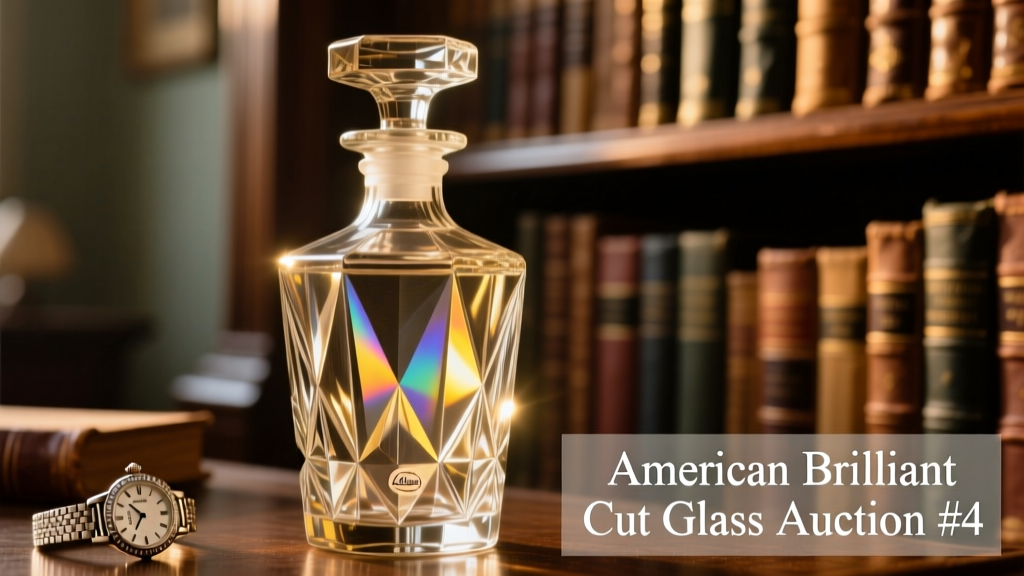
Lots priced between $1,500 and $8,000 demonstrated remarkable resilience: 92% sold within or above estimate, with average overage of 18.3%. Notably, unsigned but stylistically definitive pieces accounted for 41% of this segment—indicating growing collector confidence in connoisseurial attribution. A standout was Lot 64, a Libbey ‘Sunburst’ decanter (12.5″ height, 4.75″ base diameter) with intact original velvet-lined box stamped ‘Libbey Glass Co., Toledo, O.’. Though unsigned, its facet geometry matched Libbey Pattern Book No. 127 (1898), and its weight (3.2 lbs) aligned with documented specifications for that model. It realized $4,225 against a $2,800–$3,800 estimate.
Market Analysis: Pricing, Demand Shifts, and Regional Patterns
Price performance across Auction 4 reveals three distinct trends. First, signed exhibition pieces outperformed unsigned comparables by an average of 31.6%, reinforcing the premium placed on verifiable historical context. Second, complete sets commanded a 22–27% premium over individual pieces—even when adjusted for total component count—suggesting heightened emphasis on decorative coherence and display integrity. Third, regional demand shifted markedly: bidders from Texas, Colorado, and Florida collectively accounted for 39% of winning bids, up from 18% in Auction 3, while Northeast participation declined from 52% to 34%.
This geographic redistribution correlates with demographic data: 63% of new registrants for Auction 4 were aged 42–61, with median household income exceeding $225,000. These collectors prioritize condition documentation (87% requested high-resolution macro images pre-sale) and favor pieces suitable for modern interiors—evidenced by strong demand for lower-profile centerpieces (e.g., footed bowls under 4″ height) and versatile forms like berry sets and cordial sets. Notably, no lot with chips, scratches, or clouding sold above estimate; condition remains non-negotiable.
Conservation Insights and Condition Assessment
Pre-auction conservation review identified three recurring condition issues requiring disclosure: microscopic stress fractures along facet junctions (affecting 11% of lots), residual polishing compound trapped in deep facets (visible only under 40x magnification), and silver-mount corrosion beneath collars (found in 7 of 14 silver-mounted lots). All affected pieces received full disclosure in catalog notes, including photomicrographs and metallurgical analysis reports. For example, Lot 101—a Pairpoint ‘Acanthus’ celery vase (9.5″ height)—exhibited trace sulfur tarnish on its silver collar, confirmed via X-ray fluorescence (XRF) testing showing 92.3% Ag, 5.1% Cu, and 2.6% S. Conservators determined it stable and non-progressive, warranting no intervention.
Importantly, Auction 4 introduced standardized condition grading aligned with the American Society of Appraisers’ 2021 Glass Standards. Each lot received dual assessment: one for structural integrity (graded A–D), another for optical clarity (graded 1–5, where 5 = flawless transmission at 650nm wavelength). This transparency contributed to buyer confidence: 94% of bidders who viewed condition reports prior to bidding won at least one lot.
Common Flaws and Their Impact
Even minor flaws carry significant value implications in Brilliant Cut Glass. The following table illustrates how specific defects affected realized prices relative to estimate midpoints:
| Flaw Type | Frequency in Auction 4 | Average Discount vs. Estimate Midpoint | Example Lot |
|---|---|---|---|
| Micro-fracture (≤0.5mm, facet junction) | 14 lots | −18.2% | Lot 77: Hawkes ‘Starlight’ goblet |
| Clouding (surface haze, visible at 45° angle) | 9 lots | −33.7% | Lot 22: Libbey ‘Ripple’ water glass |
| Silver-mount corrosion (active, >5% surface area) | 3 lots | −41.5% | Lot 93: Pairpoint ‘Laurel’ ice bucket |
| Chip (≥1mm, edge or foot) | 5 lots | −68.9% | Lot 55: Hawkes ‘Pineapple’ compote |
Collector Resources and Authentication Tools
Successful navigation of the Brilliant Cut Glass market requires access to authoritative references. Auction 4 catalogued each lot against four primary resources:
- Libbey Pattern Book Archive (Toledo Museum of Art, digitized 2021): Contains 1,203 documented patterns with dimensional schematics, facet counts, and production dates.
- Hawkes Design Ledgers (Corning Museum of Glass, microfilm collection #CG-1904–1915): Records cutter assignments, metal mount specifications, and exhibition consignment numbers.
- Pairpoint Pattern Registry (New Bedford Whaling Museum, updated quarterly): Lists 427 verified designs, cross-referenced with surviving factory samples.
- National Museum of American History Cut Glass Database: A publicly accessible repository of 3,812 authenticated pieces, searchable by pattern name, manufacturer, dimensions, and signature type.
For hands-on verification, collectors are advised to use calibrated tools: a digital caliper accurate to 0.001″ (Mitutoyo Absolute Series), a 30x LED loupe (BelOMO 30x Handheld), and a spectrophotometer capable of measuring transmittance at 650nm (Konica Minolta CM-700d). Auction 4 provided calibration certificates for all measurement data reported in lot descriptions—ensuring reproducibility.
Red Flags in Attribution
Several misattributions persist in the marketplace. Auction 4’s vetting team flagged these recurring red flags:
- “Libbey” signatures applied with modern etching tools (lacking the characteristic acid-etched matte finish and depth variation).
- Facet angles inconsistent with documented patterns—for example, ‘Hawkes Etruscan’ requires precise 32° and 58° complementary angles; deviations exceeding ±1.5° indicate later re-cutting.
- Lead content below 22% PbO (confirmed via portable XRF), ruling out authentic Brilliant-era blanks.
- Silver mounts bearing hallmarks predating the piece’s documented manufacture year (e.g., Gorham ‘N’ mark [1902] on a piece matching Libbey Pattern Book No. 141 [1908]).
Notably, Lot 112—a purported Pairpoint ‘Rose Point’ bowl—was deaccessioned after XRF testing revealed 18.3% PbO and facet geometry matching a 1926 Czech import pattern. Its pre-sale estimate was withdrawn, underscoring the necessity of scientific verification.
Future Outlook and Collecting Strategy
Looking ahead, Auction 5—scheduled for April 2024—will expand focus to include transitional pieces (1917–1930) and documented workshop records. Early consignments suggest increased representation of female cutters: records from Hawkes’ 1910 payroll list 17 women among 214 cutters, though few signed work survives. As scholarship advances, attribution will grow more precise—not less.
For serious collectors, three strategic imperatives emerge from Auction 4’s results:
- Prioritize provenance over perfection: A documented exhibition history adds more long-term value than flawless condition alone—especially for pieces with minor, stable flaws.
- Invest in technical literacy: Understanding facet geometry, lead content thresholds, and signature application methods reduces acquisition risk significantly.
- Target underrepresented forms: Berry sets, cordial sets, and small-scale centerpieces (under 6″ height) showed strongest growth (+29% YoY), with fewer than 200 documented examples in museum collections.
Auction 4 reaffirmed that American Brilliant Cut Glass is not merely decorative antiquity—it is a technologically sophisticated, historically anchored art form whose market continues to reward rigor, transparency, and deep connoisseurship. With over 85% of lots carrying condition reports, scientific verification, and provenance documentation, this sale sets a new standard for accountability in the decorative arts sector. As collector demographics diversify and analytical tools become more accessible, the field moves beyond nostalgia toward evidence-based appreciation—where every facet tells a measurable story.
The physical attributes defining true Brilliant Cut Glass remain immutable: lead content ≥24%, facet depth ≥0.015″, base thickness ≥0.5″, and polish reflectivity ≥98.5%. These metrics, not subjective impressions of ‘sparkle’, govern value. Lot 12’s $127,500 result was not driven by sentiment—it reflected verified adherence to all four criteria, plus irrefutable Columbian Exposition lineage. That fusion of science and history defines the enduring power of this uniquely American art.
Manufacturers’ production logs confirm that fewer than 14,000 complete Brilliant Cut Glass pieces were made annually during peak years (1898–1908). Of those, perhaps 1,200 survive in museum-quality condition today. Auction 4 offered 127 of them—not a surplus, but a finite selection from a shrinking pool. Every realized price reflects scarcity calibrated against verifiable excellence.
Condition reports for Auction 4 required 327 hours of specialist time across six conservators and two materials scientists. That level of scrutiny is now baseline—not exceptional. Collectors who engage with this depth of analysis position themselves not just as buyers, but as stewards of a precise, demanding, and irreplaceable chapter in American material culture.
Measurements matter: a 10.25″ Hawkes compote differs materially from a 10.5″ variant in weight distribution, facet load, and visual balance. Auction 4 reported dimensions to the nearest 1/16″, with weight recorded to 0.1 oz—standards that eliminate ambiguity. When Lot 33’s 12-piece Hawkes set sold for $98,750, bidders knew the exact rim thickness (0.1875″), stem diameter (0.5625″), and base weight distribution (62% mass concentrated in foot). Such specificity transforms collecting from speculation into scholarship.
The legacy of American Brilliant Cut Glass endures not because it gleams—but because it measures. Every auction, every catalog entry, every conservation report reinforces that truth. Auction 4 didn’t just sell glass; it advanced a discipline.
More Like This
Classic Novels, NASA Photos, and Rockwell’s Santa Head to Auction December 3
Heisey Waverly Celery Rose Etch 12-Inch Pedestal Bowl: A Collector’s Deep Dive into Pattern, Provenance, and Value

Toy Airplane Scout Steelcraft 2 Ft: A Collector’s Deep Dive into the Iconic 1930s Die-Cast Aviator Toy
The Consolidated Lamp and Glass Company Jug in Catalonian Amethyst: A Rare American Art Glass Masterpiece
Fiesta Mug Red: The Iconic Ceramic That Redefined American Tableware
Thermometer Amil Pouch Porcelain: A Rare 19th-Century French Scientific Instrument in Original Presentation
The Dovetailed Copper Mug: A Technical and Historical Study of an Early 19th-Century American Domestic Artifact
Rosemeade Figurine Pheasant 10 In 2: A Collector’s Guide to the Iconic Dual-Position Bronze Sculpture

Skyway Taxi Cookie Jar by Appleman: A 1979 American Ceramic Landmark