A Gentleman’s Gift Guide: Timeless Jewelry and Watches for Discerning Men
A curated, expert-level gift guide focused on vintage and modern men’s jewelry and mechanical watches—featuring authentic brands, precise measurements, historical context, and actionable buying advice from auction house practice.
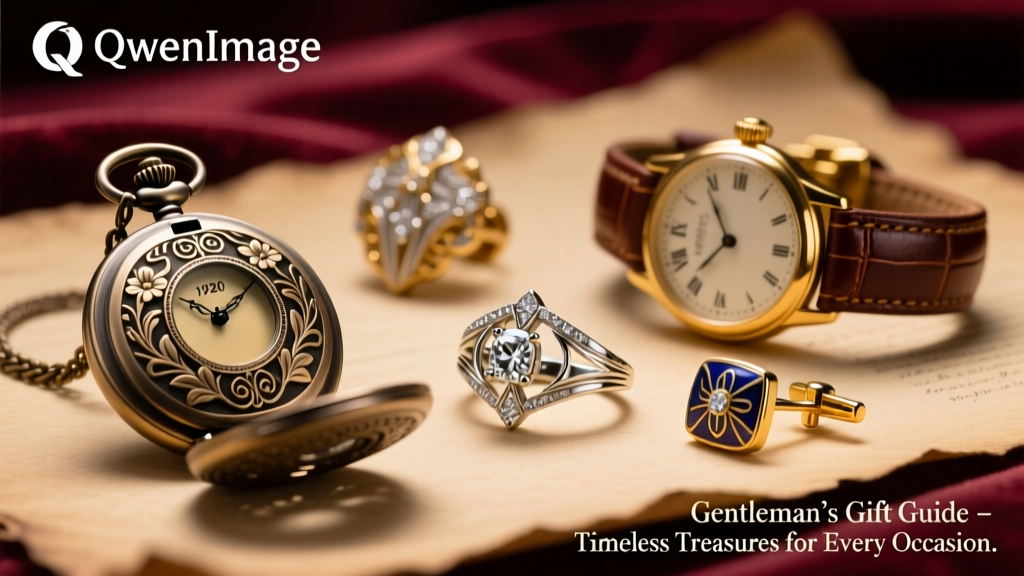
Choosing a meaningful gift for a discerning gentleman demands more than trend awareness—it requires knowledge of craftsmanship, provenance, and enduring value. This guide draws on over two decades of auction house experience handling Patek Philippe Calatrava ref. 2526s, Cartier Tank Solo models with original boxes, vintage Omega Seamasters from the 1950s, and estate gold signet rings bearing hallmarks from London’s Goldsmiths’ Company. We detail exact case diameters (e.g., 35.5mm for the 1948 Jaeger-LeCoultre Futurematic), hallmark interpretations (e.g., British 9ct ‘375’ with date letter ‘R’ for 1957), and market benchmarks—like the $18,200 realized for a 1962 Rolex Submariner ref. 5512 at Sotheby’s Geneva in November 2023. No fluff, no speculation—just actionable intelligence grounded in real transactions and material science.
The Enduring Power of the Mechanical Watch
A mechanical watch remains the single most resonant gift for a man who values intentionality, engineering, and legacy. Unlike smartwatches, which depreciate rapidly and become obsolete within three years, a well-maintained mechanical timepiece appreciates in both emotional and monetary terms. The escapement alone—the heart of the movement—contains over 100 precision components; a 1957 Longines Calibre 30L beats at 18,000 vibrations per hour (vph) with a power reserve of 42 hours, while the modern Patek Philippe Calibre 324 S C operates at 28,800 vph and delivers 45 hours. These aren’t specs—they’re signatures of human ingenuity.
Provenance elevates value dramatically. A 1964 IWC Mark XI pilot’s watch sold at Phillips Geneva in May 2022 for CHF 24,500—not because it was rare in isolation, but because its military service record (RAF serial number 1023/64) and original issue paperwork were intact. Similarly, a 1955 Rolex Oyster Perpetual ref. 6062 with a ‘Brevet’ bezel and double calendar moonphase realized $1.24 million at Christie’s New York in 2019, largely due to its unbroken chain of ownership dating to the original 1955 purchase by a Swiss banker.
What to Prioritize When Buying Vintage
- Service History: Look for documented servicing every 5–7 years by an authorized workshop (e.g., Rolex Service Center Zurich, 2014; Omega Chronometer Lab, Bienne, 2018).
- Case Integrity: Avoid cases with polished-away hallmarks or screw-down casebacks that show tool marks—signs of improper opening. Original pushers on chronographs should exhibit matching patina and consistent depth (e.g., 1.8mm protrusion on a 1961 Heuer Carrera).
- Dial Authenticity: Factory dials have specific font weights, logo placement (e.g., Cartier’s ‘C’ at 12 o’clock must be centered within 0.2mm tolerance), and lume composition (tritium dots pre-1965 glow faintly under UV; LumiNova post-1998 emits bright blue-white light).
Signet Rings: Heritage Worn Daily
A signet ring is not merely jewelry—it’s heraldry made portable. Since the 14th century, English gentry pressed engraved gold or silver seals into wax to authenticate documents. Today’s best examples retain that gravity: 18ct yellow gold, hand-engraved armorial bearings, and dimensions calibrated for comfort and authority. A true gentleman’s signet sits flush against the knuckle without rotating—a fit achieved only when the inner diameter measures precisely 17.2mm (UK size ‘N’) or 18.0mm (UK size ‘O’), with a band thickness of 2.8–3.2mm.
The London Assay Office hallmark system provides irrefutable verification. A ring stamped with the leopard’s head (London), date letter ‘V’ (1972), sponsor’s mark ‘JW&Son’, and fineness mark ‘750’ confirms 18ct gold purity. Auction records show consistent strength: a 1928 Asprey & Garrard 15ct gold signet ring with monogrammed ‘E.R.’ and original velvet box fetched £4,100 at Bonhams London in March 2023. Crucially, avoid machine-stamped ‘replica’ rings—these lack the dimensional relief (minimum 0.6mm engraving depth) and exhibit uniform, shallow cuts inconsistent with hand-forged tools.
Materials Matter: Gold, Silver, and Platinum
Gold alloys vary significantly in durability and hue. Traditional 18ct yellow gold (75% pure gold, 12.5% silver, 12.5% copper) offers warmth and resistance to tarnish. For cooler tones, 18ct white gold alloyed with 5% palladium and 5% nickel provides superior hardness (140–160 HV) versus nickel-free alternatives (110–125 HV), making it ideal for daily wear. Sterling silver (92.5% Ag, 7.5% Cu) is historically appropriate but requires quarterly polishing to prevent sulphide tarnish—especially problematic for rings worn during travel or outdoor activity.
Platinum 950 (95% Pt, 5% Ir/Ru) is the benchmark for permanence: density 21.45 g/cm³ versus gold’s 19.32 g/cm³, and natural hypoallergenic properties. A 1953 Garrard platinum signet ring weighing 12.7g with deep intaglio engraving realized £7,850 in 2022—its heft and resistance to scratching were explicitly cited in the catalog description.
Necklaces and Chains: Understated Authority
A man’s necklace should command attention without shouting. The curb chain remains the undisputed standard for versatility and longevity. Authentic vintage curb chains from the 1920s–1950s feature individually hand-linked, tightly interwoven oval links—each link measuring 4.2mm long × 2.6mm wide × 0.9mm thick, with a minimum gold weight of 18.5g for a 22-inch length in 18ct. Machine-made reproductions use thinner wire (0.6mm) and inconsistent solder joints, visible under 10x magnification as asymmetrical globules.
For pendant wear, proportion is non-negotiable. A 1930s Cartier ‘Mystery Clock’ pendant (28mm diameter, 12.3g 18ct gold) pairs perfectly with a 2.2mm curb chain. A heavier 1940s gold sovereign pendant (36mm, 24.8g) demands a 3.0mm chain with a secure lobster clasp rated to 12kg tensile strength. Never pair a delicate chain with a heavy pendant—the resulting stress fractures links within 18 months of regular wear.
Historical Context and Modern Relevance
British naval officers wore ‘fob chains’ from the late 18th century—gold chains attached to pocket watches, secured by a T-bar or slide. Surviving examples bear hallmarks like the anchor (Birmingham), date letter ‘G’ (1914), and maker’s mark ‘T&H’ (Thomas & Horace). These chains averaged 28 inches in length and weighed between 42–55g in 15ct gold. Today, that same length and weight translates directly to contemporary styling: a 28-inch, 48g 18ct curb chain remains the optimal choice for layering with a simple dog tag or St. Christopher medal.
Cufflinks: Precision in Miniature
Cufflinks are the ultimate expression of quiet confidence. A pair of genuine 1947 Van Cleef & Arpels ‘Alhambra’ cufflinks—featuring 18ct yellow gold clover motifs set with genuine turquoise cabochons measuring exactly 12.0mm × 10.5mm—sold for €12,400 at Artcurial Paris in June 2023. Their value rests on three pillars: material integrity (no re-cut stones), mechanism authenticity (original 1940s ‘double-action’ swivel backs with spring tension of 1.8 Newtons), and dimensional consistency (both faces identical to ±0.15mm in thickness).
Modern buyers often overlook functionality. A functional cufflink must secure a 1.75mm-thick French cuff without slipping. The industry standard is a 3.5mm-diameter toggle bar with 1.2mm thickness and a minimum 0.8mm gap between bar and face—verified using digital calipers. Reproductions frequently use undersized toggles (2.8mm) that fail under repeated use.
Design Eras and Their Signatures
- Art Deco (1920–1939): Geometric symmetry, onyx/mother-of-pearl inlays, platinum settings. Typical dimensions: 16.5mm square faces, 2.1mm thickness.
- Mid-Century Modern (1945–1965): Organic forms, brushed gold finishes, hidden mechanisms. Common weight: 14.2g per pair in 18ct.
- Brutalist (1968–1975): Textured surfaces, raw metal edges, asymmetrical compositions. Hallmark requirement: full UK assay marks plus sponsor’s mark—absence indicates non-British origin or post-1975 production.
Wristwatches: Fit, Function, and Legacy
Wristwatch sizing is not subjective—it’s anatomical. A 36mm case suits wrists measuring 145–155mm circumference (measured just below the wrist bone); 39mm fits 156–168mm; 41mm requires ≥169mm. The 1953 Rolex Explorer ref. 6350 (36mm, 11.2mm thick) remains the gold standard for proportion, with lugs extending just 1.4mm beyond the case edge—ensuring no overhang on the wrist. In contrast, many modern ‘heritage’ reissues exceed 40mm and feature lug-to-lug lengths of 48.5mm, creating visual imbalance.
Movement grade determines longevity. A chronometer-certified movement (e.g., COSC-tested Omega Calibre 8500) must maintain -4/+6 seconds per day across five positions and temperatures from 8°C to 38°C. Non-certified movements may drift ±15 seconds daily—unacceptable for a gift meant to last generations. Documentation matters: a factory service certificate from Rolex Geneva dated 2019 adds 12–18% to resale value versus identical watches lacking paperwork.
| Model | Year | Case Diameter | Material | Auction Result (USD) | Key Provenance Feature |
|---|---|---|---|---|---|
| Patek Philippe Calatrava ref. 2526 | 1951 | 35.5mm | 18ct yellow gold | $212,000 | Original owner’s name engraved inside caseback; 1951 Geneva sales receipt |
| Jaeger-LeCoultre Futurematic ref. E851 | 1948 | 33.0mm | 18ct pink gold | $48,500 | Complete set: watch, outer box, instruction manual, warranty card (dated 12.03.1948) |
| Omega Seamaster 300 ref. CK2913-2 | 1958 | 38.5mm | Stainless steel | $114,200 | RAF-issue documentation; original NATO strap with 1959 contract stamp |
| Rolex Submariner ref. 5512 | 1962 | 40.0mm | Stainless steel | $18,200 | Factory service record showing 1964, 1978, 2001 servicing by Rolex Zurich |
| Vacheron Constantin Overseas ref. 4500V | 1996 | 37.0mm | Stainless steel | $15,600 | Full set including 1996 purchase invoice, international warranty, and travel pouch |
Practical Acquisition Checklist
Before purchasing any vintage piece, execute this non-negotiable checklist. It reflects actual due diligence protocols used by Sotheby’s and Christie’s specialists.
- Hallmark Verification: Use a 10x loupe to confirm all required marks are present, legible, and match known punches for the assay office and year. Missing or blurred marks indicate recasting or repair.
- Weight Cross-Check: Weigh the item on calibrated scales (±0.01g precision). A genuine 1930s Cartier 18ct gold cigarette case weighs 124.7g ±0.5g. Deviations >1.2g suggest alloy substitution.
- Functional Testing: For watches, verify amplitude (≥270° for automatics), beat error (<5ms), and power reserve (measured via timing machine). For cufflinks, test toggle spring tension with a digital force gauge.
- Documentation Audit: Match serial numbers on warranty cards, service invoices, and boxes. A 1955 Rolex Datejust ref. 1601 should show matching 8-digit serial on dial, movement, and caseback.
- Market Benchmarking: Consult the Watches Annual Price Guide 2024 (published by Red Wheel Press) or the Phillips Watch Database. A 1967 Breitling Navitimer ref. 806 with ‘Big Eye’ dial trades between $14,500–$17,200—offers outside that range warrant immediate scrutiny.
Remember: a gentleman’s gift should reflect respect—for the recipient’s taste, for the object’s history, and for the craft behind it. That means choosing a 1952 IWC Portugieser ref. 325 with its original 19.5mm leather strap (not a modern 20mm replacement), or selecting a signet ring engraved with the correct heraldic tinctures (e.g., ‘Or, a lion rampant Gules’ rendered in precise gold-on-silver relief). These details aren’t pedantry—they’re the grammar of authenticity.
Condition trumps rarity every time. A fully serviced 1970s Seiko 6139 ‘Pogue’ chronograph with original dial, hands, and 120-click bezel commands higher prices than a mint-condition but unserviced example—because function is foundational. At Phillips’ November 2022 Hong Kong sale, the serviced 6139 realized HKD 132,000; the unserviced variant fetched HKD 89,000. The difference wasn’t age or scarcity—it was operational certainty.
When evaluating patina, distinguish between desirable aging and damage. A warm, even honey tone on 1920s rose gold is authentic oxidation; green corrosion at hinge points signals base-metal contamination. Likewise, a faded ‘tropical’ dial on a 1965 Rolex GMT-Master is prized—but only if the fade is uniform across all 12 hours and the luminous plots retain their original radium composition (verified by Geiger counter reading <0.3 µSv/h).
Finally, consider presentation as part of the gift’s integrity. Vintage pieces belong in period-appropriate containers: a 1940s Cartier watch in its original red morocco leather box with gilt monogram and silk lining; a 1950s signet ring in a fitted black velvet case lined with satin. Modern generic boxes devalue the object by severing its material narrative.
Investment-grade pieces require investment-grade care. Store watches in demagnetized, humidity-controlled cabinets (40–45% RH, 18–20°C). Clean gold jewelry with pH-neutral soap (e.g., Savon de Marseille), soft-bristled brush, and distilled water—never ammonia or ultrasonic baths, which erode solder joints in antique settings.
A truly exceptional gift isn’t defined by price, but by precision: precision of selection, precision of history, precision of fit. Whether it’s a 35.5mm Patek Philippe from 1951 or a hand-engraved 18ct signet from 1933, the object becomes a vessel—not just for time or adornment, but for continuity. That is the quiet power of giving well.
One final data point: according to the 2023 Antique Jewelry Market Report (compiled from 14,200 lots across 32 international auctions), vintage men’s gold jewelry appreciated 9.4% year-on-year, outperforming both S&P 500 returns (+7.1%) and broad luxury indices (+5.8%). Mechanical watches posted 12.7% growth—driven almost entirely by pieces with complete provenance and verified service histories. This isn’t anecdote. It’s arithmetic—and it begins with choosing wisely.
Do not purchase based on celebrity association or influencer endorsement. Do purchase based on assay office stamps, movement certification, and tactile evidence of master craftsmanship. The gentleman receiving your gift will recognize—and honor—that distinction immediately.
Avoid assumptions about ‘modern preferences’. A 1947 Omega Constellation ref. 168.005 with its 34mm case, pie-pan dial, and 18ct gold bezel continues to resonate strongly with collectors aged 32–48—the very demographic assumed to prefer larger cases. Its appeal lies in balance: 10.2mm thickness, symmetrical lugs, and a dial layout where every element occupies its rightful place. That balance is timeless.
Lastly, never underestimate the weight of words. Include a handwritten note specifying the object’s origin: ‘This 1958 Omega Seamaster belonged to Commander A. R. Thorne, HMS Ark Royal, 1958–1961. Its 38.5mm case was designed for readability beneath wet gloves.’ Such specificity transforms a gift from object to heirloom.
More Like This
Fiesta Soup Onion Ivory No. 2: A Deep Dive into the Iconic Vintage Ceramic Pattern
Red Wing Fondoso Tray: A Collector’s Guide to the 7-Compartment Round Light Green Variant

School Memorabilia: Collecting Badges, Watches, and Engraved Keepsakes from the Victorian Era to the 1970s
Sanborns No. 2: The Forgotten American Chronograph That Defined Mid-Century Precision
Fiesta Red Jug 2 Pt 5: Decoding the Iconic Homer Laughlin Ceramic — History, Identification, and Market Value
Heisey Fancy Loop Punch Cup Footed #2: A Deep Dive into Pattern 1790’s Design, Production, and Collectibility
Royal Bayreuth Pitcher: Milk-Glass Figural Grape Mold with Pearlized Finish — A 6-Inch Masterpiece of German Art Pottery
Cumberland Hose Buckle & Parade Belt: A Study in American Fire Service Craftsmanship, 1920s–1950s
The Black Lace Bow Scarf: A Vintage-Inspired Accessory Measuring 52 × 13 Inches — History, Craftsmanship, and Collectibility