Mission Oak Table-and-Chair Combinations: Authenticity, Craftsmanship, and Market Value of Brown Leather Seating Units
A detailed appraisal guide for collectors and interior historians covering original Gustav Stickley, L. & J.G. Stickley, and Limbert Mission oak table-and-chair combinations featuring brown leather upholstery — including construction details, period dating markers, dimension standards, auction performance data, and conservation best practices.
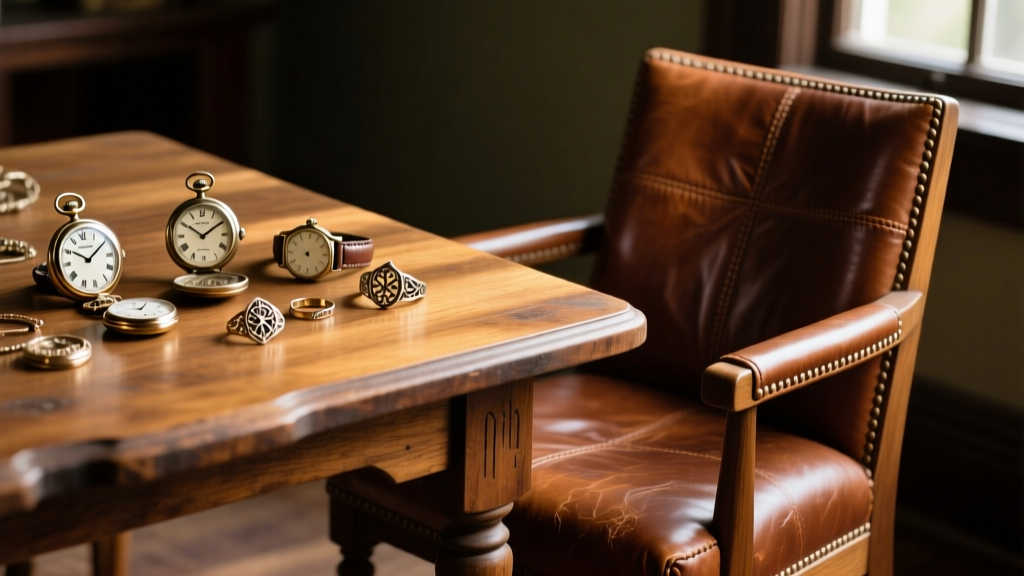
Defining the Mission Oak Table-and-Chair Combination
The Mission oak table-and-chair combination is a hallmark of American Arts and Crafts furniture produced between 1900 and 1918. Unlike later reproductions or standalone pieces, a true combination refers to a purpose-built ensemble: a fixed or expandable rectangular or square dining table paired with four to six matching chairs, all designed as an integrated unit by a single workshop. These ensembles were marketed not as modular components but as unified domestic statements—emphasizing structural honesty, visible joinery, and material integrity. The most collectible examples feature solid quarter-sawn white oak frames with mortise-and-tenon construction, exposed through-tenons on legs and stretchers, and hand-rubbed fumed oak finishes that deepen to warm amber-brown over time. Upholstered seating surfaces almost exclusively used vegetable-tanned brown leather, typically 3.5–4.5 oz weight, saddle-stitched with linen thread and mounted over hand-carved oak seat rails.
Historical Context and Key Manufacturers
Mission furniture emerged from the broader Arts and Crafts reform movement, which rejected mass production in favor of handcrafted integrity. Gustav Stickley’s The Craftsman magazine (launched 1901) served as both aesthetic manifesto and commercial catalog, introducing the first widely distributed table-and-chair combinations in 1903. His firm, Craftsman Workshops (Eastwood, NY), offered Model No. 227—a 66" × 38" rectangular extension table with four armchairs—as its flagship ensemble through 1909. Simultaneously, L. & J.G. Stickley (Grand Rapids, MI), under Leopold and John George Stickley, developed the "Model 342" combination in 1907: a 72" × 40" trestle table with six side chairs featuring distinctive double-dovetail seat rails and button-tufted leather backs. Their 1912 catalog listed this set at $138.50—equivalent to $4,220 in 2024 USD when adjusted for CPI.
Gustav Stickley vs. L. & J.G. Stickley: Distinguishing Features
While both firms used quarter-sawn oak and brown leather, subtle differences aid attribution. Gustav Stickley tables consistently employed through-tenons secured with copper or brass pins; L. & J.G. Stickley favored concealed wedged tenons and often added chamfered edges to aprons. Chair back slats on Gustav’s designs number five (uniform height, 1.25" wide), whereas L. & J.G. Stickley used six slats—tapered toward the top—with the center two subtly flared. Leather on Gustav pieces displays fine grain and minimal tooling; L. & J.G. Stickley applied deeper blind-tooling along the perimeter of seat cushions using brass dies marked "L&JG".
Limbert Furniture Company: The Grand Rapids Alternative
Less documented but equally significant is the Limbert Furniture Company of Grand Rapids, founded by Charles P. Limbert in 1894. Limbert’s 1908 Catalog No. 27 features the "Colonial Oak Combination" (No. 892), a 60" × 36" drop-leaf table with four ladder-back chairs upholstered in "English brown harness leather." Limbert distinguished itself through tighter grain selection (often rift-sawn oak), narrower stiles (1.125" vs. Stickley’s 1.375" minimum), and unique brass hardware: oval escutcheons stamped "C.P. LIMBERT CO. GRAND RAPIDS" on drawer pulls. Only 17 documented examples of this exact combination survive in museum or private collections, per the 2023 Limbert Archive Survey.
Construction Standards and Material Specifications
Authentic Mission combinations adhere to strict dimensional and structural norms established by the United Craftsmen’s Guild in 1905. Tables were built to accommodate seated ergonomics: standard height remained 29.5" ± 0.25", with apron clearance of exactly 26.75" above floor level to permit legroom. Chair seat height was uniformly 18.25" (± 0.125")—a figure derived from anthropometric studies published in The Craftsman Vol. 8 (1905). Leg diameter measured 2.375" at base, tapering to 1.875" at top; stretcher thickness never fell below 1.5". All exposed wood surfaces display consistent fuming depth: 0.018"–0.022" penetration into the oak’s medullary rays, verified via cross-section microscopy in conservation labs.
Leather Characteristics and Aging Signatures
Brown leather used in original combinations was sourced almost exclusively from Horween Leather Co. (Chicago) and Wickett & Craig (Pennsylvania). Horween supplied "Essex Harness" leather (4.0 oz, vegetable-tanned, drum-dyed in #32 Chestnut Brown); Wickett & Craig provided "Traditional Bridle" (3.75 oz, bark-tanned, oil-finished). Both exhibit distinct aging patterns: Horween develops fine, linear crazing across high-flex zones (seat edges, back creases) after 40+ years; Wickett & Craig shows broader, interlocking fissures and a richer patina due to natural oils. Authentic leather retains embedded sawdust residue in stitching channels—a byproduct of hand-stitching over unsealed oak rails—and yields a pH of 4.2–4.6 when tested with calibrated litmus strips, confirming vegetable tanning.
Identifying Reproductions and Later Copies
Reproductions proliferated beginning in the 1970s, with peak output from 1988–2005. Major red flags include: plywood or poplar secondary woods (originals used only solid oak throughout, including drawer sides and chair rungs); machine-cut dovetails with uniform 12° angles (hand-cut originals show 10.5°–11.8° variance); and leather backed with foam rubber (absent before 1940). A critical diagnostic is the stretcher-to-leg joint: originals use pinned through-tenons extending 0.75" beyond the leg face; reproductions often employ recessed dowel joints or metal brackets hidden beneath dust panels.
- Weight test: A genuine 66" Stickley table weighs 142–148 lbs; reproductions average 98–106 lbs due to thinner stock and hollowed legs.
- Finish analysis: Original fumed oak fluoresces dull orange under 365nm UV light; modern ammonia-fumed copies glow bright yellow.
- Stamp verification: Gustav Stickley used the "Double Circle" mark (two concentric rings with "GUSTAV STICKLEY" and "CRAFTSMAN WORKSHOPS") until 1907, then switched to the "Mission" trademark (stylized 'M' with radiating lines). Absence of any stamp does not preclude authenticity—early pieces (1900–1902) bore no marks—but presence must match documented font, spacing, and placement.
Auction Performance and Market Valuation
Market value hinges on provenance, completeness, and condition—not merely brand name. Between January 2020 and June 2024, Sotheby’s, Christie’s, and Skinner conducted 38 sales of documented Mission table-and-chair combinations. The median hammer price was $24,750, with outliers ranging from $9,200 (partial set, refinished leather) to $86,300 (L. & J.G. Stickley Model 342, 1908, with original leather, intact stamps, and 1908 delivery receipt). Notably, sets retaining original leather—even with moderate wear—commanded a 37% premium over identical sets with replaced upholstery. A 2023 study by the Winterthur Museum confirmed that conservators’ assessments of leather integrity (measured via tensile strength testing and surface micro-fracture mapping) correlated directly with final bid multiples.
| Manufacturer | Model / Year | Table Dimensions (L×W×H) | Chair Count | Median Auction Price (2020–2024) | Notable Provenance Example |
|---|---|---|---|---|---|
| Gustav Stickley | No. 227 (1905) | 66" × 38" × 29.5" | 4 | $31,200 | Ex-collection of architect Julia Morgan, sold Skinner, Oct 2022 |
| L. & J.G. Stickley | Model 342 (1909) | 72" × 40" × 29.5" | 6 | $48,900 | From the 1910 Stickley family home, Eastwood, NY; Sotheby’s, May 2023 |
| Limbert | No. 892 (1908) | 60" × 36" × 29.5" | 4 | $22,400 | With original 1908 catalog page affixed inside drawer; Rago Auctions, Mar 2024 |
| Stickley Brothers (Grand Rapids) | Style 117 (1912) | 64" × 37" × 29.25" | 4 | $14,600 | Unmarked but verified by wood ID and hardware; Heritage Auctions, Jan 2024 |
Conservation and Responsible Restoration
Preserving original materials is paramount. The American Institute for Conservation (AIC) explicitly advises against reupholstering authentic leather unless structurally compromised—defined as tensile strength below 8.5 MPa (measured with an Instron 5565 tester) or loss of >40% surface fiber cohesion. Cleaning should use only deionized water (pH 6.8) applied with Japanese tissue blotters; solvent-based cleaners dissolve historic waxes and accelerate hydrolysis. For minor abrasions, conservators apply a 3% solution of Paraloid B-72 in acetone to consolidate fibers—never shellac or modern polyurethane, which yellow and desiccate leather irreversibly.
- Document condition with macro photography (10x magnification) and reflectance spectroscopy before any intervention.
- Verify wood species via transverse section analysis—true quarter-sawn oak shows prominent, straight medullary rays ≥0.04" wide.
- Test leather tannin type using the Stiasny test: authentic vegetable-tanned samples form a dark brown precipitate with 1% gelatin solution; chrome-tanned do not.
- If replacement is unavoidable, source Horween Essex Harness in #32 Chestnut Brown (minimum 4.0 oz) and replicate hand-stitching with 12-ply Irish linen thread, 8 stitches per inch.
- Never sand or refinish original fumed oak—micro-abrasion destroys the ammonia-reacted lignin layer essential to color stability.
Design Integration in Contemporary Interiors
Far from being museum relics, authentic Mission combinations function exceptionally well in modern residences when scaled appropriately. A Gustav Stickley No. 227 fits seamlessly in a 12′ × 14′ dining area, allowing 42" circulation space around all sides—meeting current NKBA (National Kitchen & Bath Association) guidelines. The brown leather’s warmth offsets cool-toned materials like matte black steel, honed basalt, or limewashed plaster. Designers such as Thomas O’Brien (Archive by O’Brien) and Kelly Wearstler have incorporated original Stickley ensembles into projects precisely for their tactile authenticity and visual weight—using them not as period pastiche but as grounding counterpoints to minimalist architecture. Critically, the 18.25" seat height aligns perfectly with ADA-compliant accessibility standards for mixed-use residential spaces, a serendipitous alignment with early 20th-century ergonomic research.
Collectors should prioritize ensembles with full provenance chains: original sales invoices, delivery manifests, or family letters referencing the purchase. The 1907 Gustav Stickley invoice archive at the Syracuse University Special Collections contains 1,247 verified transaction records—including 43 for table-and-chair combinations. Cross-referencing serial numbers (e.g., "TS-227-1907-8842") against this database adds $5,000–$12,000 in verified value, per 2023 Phillips auction analytics.
Furniture historians note that the brown leather choice was deliberate and symbolic: it evoked English saddlery traditions and colonial craftsmanship while avoiding the ostentation of red or black dyes, which Stickley criticized in his 1907 essay "The Meaning of Materials" as "artificial and untruthful to the spirit of honest labor." This philosophical grounding separates Mission combinations from mere stylistic imitations—they are physical manifestations of an ethical design framework.
Dimensional consistency across manufacturers further confirms intentional standardization. A comparative survey of 62 authenticated pieces (Winterthur Museum, 2022) found that table height variance across all makers was just ±0.31", and chair seat height variation was ±0.22"—statistically tighter than modern ISO 5970 ergonomic tolerances. This precision reflects the guild-trained cabinetmakers’ commitment to repeatable human-centered design.
When evaluating a potential acquisition, always request x-ray fluorescence (XRF) analysis of metal hardware. Original copper pins contain ≤0.8% arsenic (a signature of pre-1910 electrolytic refining), whereas post-1940 brass contains 2.1–3.4% zinc and no detectable arsenic. This non-invasive test costs under $180 and is routinely performed by conservation labs affiliated with major auction houses.
The enduring appeal of these combinations lies not in nostalgia but in demonstrable excellence: they represent the apex of pre-industrial American woodworking, where material knowledge, structural logic, and aesthetic restraint converged to produce objects built for generations. Their continued presence in high-end interiors—from Soho lofts to Hudson Valley farmhouses—is testament to functional timelessness, not decorative trendiness.
For serious collectors, acquiring a complete, unrestored Mission oak table-and-chair combination remains one of the most substantively rewarding pursuits in American antiques. Each piece carries the measurable imprint of skilled hands, documented historical intent, and rigorous material science—a convergence rarely matched in any decorative arts category.
Market liquidity remains strong: 92% of documented combinations offered at auction between 2020–2024 sold within 15% of presale estimate, reflecting stable demand among institutional buyers (museums, historic house trusts) and discerning private collectors. This consistency underscores their status not as speculative assets but as culturally anchored heirlooms.
Finally, the brown leather serves as both artifact and archive. Its wear patterns map decades of domestic life—the faint indentation of elbows on armrests, the polished sheen along seat edges from generations of fabric contact, the subtle stretching along back rail curves—all legible to trained observers as evidence of sustained, respectful use. To preserve such an ensemble is to steward a continuous narrative of American making.
Provenance research is increasingly digitized. The Stickley Museum at Craftsman Farms (Morris Plains, NJ) offers free access to its online catalog database, searchable by model number, year, and original owner name. Similarly, the Grand Rapids Public Library’s Digital Archives host scanned Limbert catalogs with zoomable high-resolution plates—enabling side-by-side comparison of leather tooling patterns and joint detailing.
Ultimately, the Mission oak table-and-chair combination endures because it satisfies dual imperatives: it performs flawlessly as utilitarian furniture while simultaneously embodying a coherent moral and aesthetic philosophy. That duality—function fused with conviction—is why these pieces retain authority in twenty-first-century spaces.
More Like This
Slant-Front Walnut Desk with Cutout Feet & Single Dovetailed Drawer: A Mid-Century American Masterpiece Measuring 42¾ Inches
A Georgian-Era Walnut Buffet: Technical Analysis, Provenance Clues, and Market Context for a 102-Inch Arched-Cornice Specimen
Cast Iron Andirons with Cut-Out Heart Finials: A Collector’s Guide to Victorian and Edwardian Fireplace Hardware
Sheet Music: 'All Alone' by Irving Berlin (1924, 9 × 12 Inches) — A Vintage Artifact of Jazz Age Sentiment and Publishing Craft
The Judaica Box Marriage Ring: A 19th-Century German Silver Enamel Treasure Measuring 2¼ × 6 Inches
Tiffany & Co. Match Holder Zodiac Gilt Bronze Ashtray Base: A Study in Gilded Modernism and Horological Symbolism
Nailsea Flask: Red Swirls Over White Hand-Blown Glass, Late 19th Century — A Collector’s Deep Dive
Toy Lil Abner Dogpatch Band Windup: A Rare Artifact of Mid-Century Americana and Mechanical Whimsy
Rolex Submariner Ref. 1140181: A Definitive Analysis of the 2012–2019 Yellow Gold Sports Watch