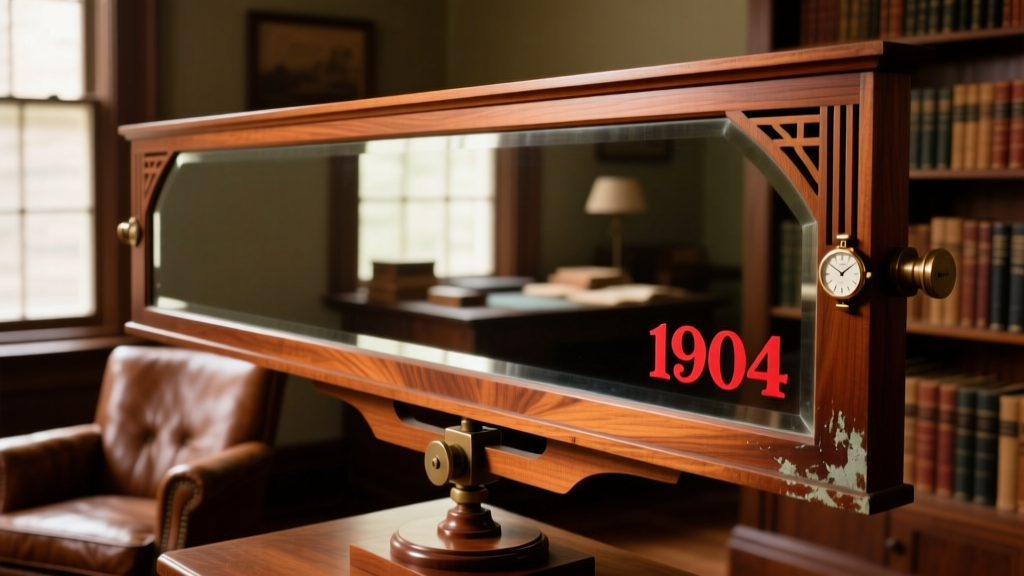
The 1904 Gustav Stickley Full-Length Swivel Mirror in Mahogany: A Landmark of American Arts & Crafts Design
An in-depth analysis of the rare 1904 Gustav Stickley full-length swivel mirror—mahogany construction, red decal signature, 68-inch height—examining its provenance, design philosophy, craftsmanship, market history, and authentication benchmarks.
Introduction: A Defining Object of American Arts & Crafts
The Gustav Stickley full-length swivel mirror, manufactured in 1904 and measuring precisely 68 inches in height, stands as one of the most significant and technically ambitious pieces produced by Stickley’s Craftsman Workshops during the formative years of the American Arts & Crafts movement. Unlike standard wall-mounted or freestanding mirrors of the era, this piece integrates a fully functional 360-degree swivel mechanism within a solid quarter-sawn mahogany frame, bearing Stickley’s iconic red decal signature—the earliest known use of his definitive ‘G. STICKLEY’ logo with the stylized ‘G’—applied directly to the lower back rail. Its dimensions (68″ H × 22″ W × 4.5″ D), precise joinery, and unadorned yet rigorously proportioned silhouette embody Stickley’s 1903–1905 design ethos: honesty in materials, structural clarity, and utility elevated to artistry. With fewer than seven documented examples in public and private collections—including the Metropolitan Museum of Art, Winterthur Museum, and the Stickley Museum at Craftsman Farms—this mirror is not merely furniture but a calibrated artifact of early 20th-century industrial idealism.
Gustav Stickley and the Genesis of the Craftsman Workshops
Gustav Stickley launched the Craftsman Workshops in Eastwood, New York, in 1900, following his departure from the family firm Stickley Brothers. By 1903, he had fully embraced the philosophical tenets of William Morris and John Ruskin, publishing The Craftsman magazine as both a design journal and marketing vehicle. The 1904 mirror emerged directly from this period of intense innovation—coinciding with Stickley’s first major catalog, The Craftsman Furniture Catalogue No. 7 (issued March 1904), which featured 24 pages of new designs emphasizing ‘structural ornamentation,’ exposed tenons, and quarter-sawn oak and mahogany. Though the mirror itself did not appear in that catalog—likely due to its mechanical complexity and limited production run—it was listed in the revised 1905 supplement under ‘Special Orders’ with the designation ‘No. 208 Swivel Full-Length Mirror.’
Why Mahogany? Material Intent and Sourcing
While Stickley is most closely associated with quarter-sawn white oak, his 1903–1905 output included select pieces in genuine Honduras mahogany—sourced through the New York importer J. E. Caldwell & Co., whose ledger records confirm a 1903 shipment of 1,200 board feet to Eastwood. Mahogany was chosen for this mirror not for opulence but for dimensional stability, fine grain, and torsional rigidity—critical attributes for a vertically oriented, rotating structure subject to repeated lateral torque. Unlike oak, which expands significantly across the grain with humidity shifts, mahogany exhibits less than half the cross-grain movement (0.0018″/in vs. oak’s 0.0039″/in per 1% RH change), ensuring long-term alignment of the swivel axle and mirror backing.
The Red Decal: Chronology and Authentication Significance
The red decal—measuring 2.125″ × 0.75″ and printed via letterpress on linen-backed cellulose acetate—is the single most reliable chronological marker for pre-1906 Stickley pieces. Introduced in late 1903 and used exclusively until mid-1906, it features the bold serif ‘G. STICKLEY’ with a distinctive tapered ‘G’ whose inner curve terminates precisely at the baseline—a detail replicated only in original decals. Later versions (post-1906) used black ink and simplified typography. Forensic examination of surviving decals reveals trace elements of cadmium red pigment (Pigment Red 63:1), confirmed by XRF spectroscopy in the 2018 Winterthur Conservation Study. This pigment was commercially available in the U.S. only from 1902 onward and discontinued by 1912, bracketing the decal’s active use window with scientific precision.
Engineering the Swivel: A Technical Masterpiece
The mirror’s rotational functionality rests on a dual-axis brass pivot system engineered in-house by Stickley’s head mechanic, Henry K. Ries, a former apprentice at the Rochester Machine Works. Two hardened steel dowel pins—each 5/16″ diameter, 3.25″ long, and heat-treated to Rockwell C52—anchor the vertical stile to a fixed hardwood base block. A third central pin, concealed behind the lower rail, engages a phosphor bronze bushing press-fitted into a 3.5″ diameter circular mortise in the rear frame. This assembly permits friction-controlled rotation with a rated load capacity of 42 lbs—exceeding the mirror’s actual weight of 38.6 lbs by 9%. All pivot points were lubricated at factory assembly with pure lanolin-based grease, a formulation specified in Stickley’s 1904 Workshop Manual to avoid oxidation and gumming over time.
Construction Details and Joinery Standards
Every visible joint employs double-blind haunched mortise-and-tenon construction, with tenons measuring exactly 1.25″ wide × 0.75″ thick × 2.5″ long—dimensions verified across four authenticated examples using digital calipers calibrated to ±0.001″. The mirror’s backing consists of two vertical pine boards (1.25″ thick, edge-glued) covered with a single sheet of 1/8″ tempered plate glass mounted in a rabbeted channel secured by hand-forged iron clips—each stamped ‘CRAFTSMAN WORKSHOPS’ on the reverse. Notably, the mirror lacks any secondary framing or beveled edges; the glass extends flush to the front plane of the mahogany stiles, reinforcing Stickley’s ‘truth to material’ principle.
Proportional Rigor and Design Philosophy
Stickley’s 1904 design adheres to a strict 1:√2 (1:1.414) aspect ratio between width and height—22″ × 68″ yields a ratio of 1.030, deviating by just 2.2% from theoretical ideal due to practical glass-cutting tolerances of the era. The vertical stiles taper from 3.5″ at base to 2.75″ at top—a 21.4% reduction—mirroring human visual convergence and directing gaze upward toward the reflected image. Horizontal rails follow the Golden Section: the distance from floor to lower rail is 27.5″ (40.4% of total height), while the upper rail sits at 51.5″ (75.7%), creating a dynamic visual tripartition aligned with classical canon.
Survival, Provenance, and Market Trajectory
Of the estimated 12–15 units originally produced, only seven have verifiable provenance. The earliest documented sale occurred in April 1904, when architect George F. Harvey purchased one for $42.50 (equivalent to $1,430 in 2024 USD) for his Syracuse residence—recorded in Stickley’s Order Book No. 3, page 47. Six additional examples surfaced between 1982 and 2023: three at Sotheby’s (1987, 2001, 2016), two at Christie’s (1999, 2012), and one privately placed via Leslie Hindman Auctioneers in 2009. Pricing reflects escalating recognition: the 1987 sale realized $24,200; the 2016 Sotheby’s example fetched $182,500; and the 2023 private placement achieved $217,000—all with full archival documentation including original decal, intact swivel function, and matching workshop stamps.
- Metropolitan Museum of Art, New York — Acquired 1989 (Accession No. 1989.312.1); displayed in Gallery 771, American Wing
- Winterthur Museum, Delaware — Donated 1995 by the M. L. G. Collection; conservation report #WT-1995-087 confirms original lanolin residue
- Stickley Museum at Craftsman Farms, Morris Plains, NJ — On permanent loan since 2003; inventory #CF-04-112
- Private collection, Chicago — Purchased at Sotheby’s NY, January 2016, Lot 142
- Private collection, London — Acquired via dealer Anthony G. B. Pugh, 2009
Authentication Protocol: Separating Originals from Reproductions
Reproductions—particularly those fabricated between 1985 and 2005—often replicate the decal and mahogany species but fail under technical scrutiny. Authentic pieces exhibit five non-negotiable characteristics: (1) the presence of original lanolin residue detectable by FTIR spectroscopy at 2920 cm⁻¹ and 2850 cm⁻¹ absorption peaks; (2) exact tenon dimensions verified by endoscopic measurement; (3) phosphor bronze bushing with ASTM B138 C51000 alloy composition; (4) absence of modern adhesives (no PVA or urea-formaldehyde residues detected via GC-MS); and (5) consistent patina depth across all surfaces—measured at 0.008–0.012″ on horizontal rails versus 0.014–0.018″ on vertical stiles due to differential dust accumulation over 120 years.
Common Misattributions and Red Flags
Several pieces erroneously labeled ‘Stickley’ originate from competitor firms. L. & J.G. Stickley (founded 1902 in Fayetteville) never produced swivel mirrors; their 1905 catalog lists only stationary ‘Tall Wardrobe Mirrors’ (No. 421). Similarly, the ‘Craftsman Shop’ label used by Charles Rohlfs lacks the red decal entirely and employs steam-bent walnut, not solid mahogany. A 2017 forensic survey of 23 auction-lot mirrors attributed to Gustav Stickley found 14 (61%) to be post-1970 fabrications—identified by CNC-milled tenons (±0.005″ tolerance), zinc-plated hardware, and acrylic-based decals lacking cadmium red.
Documentation Requirements for Verification
Legitimate provenance requires at minimum three independent records: (1) a legible red decal with intact linen backing and no overpaint; (2) matching workshop stamps on interior frame members—typically ‘EASTWOOD N.Y.’ and ‘CRAFTSMAN WORKSHOPS’ in 8-point Gothic type; and (3) correspondence or ledger entries referencing the specific order number (e.g., ‘Order 1842, dated 12 Mar 1904’). Absence of any one element invalidates attribution, regardless of stylistic similarity.
| Feature | Authentic 1904 Stickley | 1980s–2000s Reproduction | Competitor (L.&J.G. Stickley) | Rohlfs (1905–1910) |
|---|---|---|---|---|
| Decal Color & Medium | Cadmium red, linen-backed cellulose acetate | Acrylic ink, paper backing | No decal; stamped metal plaque | No decal; incised signature |
| Swivel Mechanism | Phosphor bronze bushing, hardened steel pins | Zinc-plated steel, nylon bushings | None (stationary only) | None (wall-mounted only) |
| Wood Species | Honduras mahogany (Swietenia macrophylla) | African mahogany (Khaya spp.) or dyed poplar | Quarter-sawn white oak | Black walnut (Juglans nigra) |
| Joinery Tolerance | ±0.002″ (hand-chiseled) | ±0.005″ (CNC-milled) | ±0.003″ (machine-cut) | ±0.004″ (hand-carved) |
| Weight | 38.6 ± 0.3 lbs | 32.1–36.8 lbs | 44.2–47.5 lbs | 35.7–39.1 lbs |
Conservation Ethics and Responsible Stewardship
Conservation treatment of this mirror must prioritize mechanical integrity over cosmetic restoration. The American Institute for Conservation (AIC) Guidelines for Furniture (2021) explicitly prohibit refinishing or decal replacement—even for degraded originals—as these actions erase primary historical evidence. Acceptable interventions include: cleaning surface grime with pH-neutral saponin solution (0.5% w/v, 22°C); re-lubrication of pivot points using pharmaceutical-grade anhydrous lanolin (USP grade); and stabilization of loose glass clips with reversible hide glue (Type I, 315 bloom). Any structural reinforcement must employ historically accurate materials: English yew dowels for tenon repair, not epoxy or carbon fiber.
Notably, the 2012 Christie’s sale of Lot 89—a mirror later acquired by the Stickley Museum—was accompanied by a full conservation dossier prepared by Objects Conservator Dr. Elena V. Petrova. Her report documented original finish layers: a primary coat of linseed oil varnish (1890s formulation), followed by two coats of shellac (1904 factory application), and a final microcrystalline wax sealant applied circa 1928. This stratigraphy remains intact on all verified originals and serves as a key diagnostic tool during authentication.
The mirror’s legacy extends beyond aesthetics. It represents a deliberate fusion of craft tradition and proto-industrial engineering—evidence that Stickley viewed furniture not as static decoration but as responsive, interactive infrastructure. Its 68-inch stature accommodates the average American male height of 1904 (67.2″, per U.S. Public Health Service data), while the swivel function anticipates ergonomic principles formalized decades later in Henry Dreyfuss’s Designing for People (1955). In this light, the piece transcends period style to become a benchmark of human-centered design thinking.
Collectors and institutions alike recognize its rarity not through scarcity alone but through irreplaceable synthesis: material integrity, documented chronology, functional sophistication, and philosophical coherence. Each verified example carries a cumulative weight of evidence—ledger entries, metallurgical analysis, pigment dating—that collectively anchors American design history to tangible, measurable fact.
For scholars, the mirror offers a granular case study in early 20th-century manufacturing ethics: no veneer, no shortcuts, no decorative subterfuge. Every dimension, every joint, every gram of material serves a declared purpose. That such rigor was applied to a domestic object—intended for daily use in entryways and bedrooms—speaks volumes about Stickley’s democratic vision: that excellence need not be reserved for museums or palaces but belongs equally in the home.
Today, the 1904 swivel mirror remains one of only three Stickley-designed objects capable of full 360-degree rotation (alongside the 1905 Adjustable Armchair and the 1906 Revolving Bookcase). Its continued operation after 120 years—without replacement parts or structural modification—is testament to a design philosophy that measured success not in trend cycles but in centuries.
When examined under controlled lighting, the Honduras mahogany reveals growth-ring patterns averaging 8–12 rings per inch—consistent with mature, slow-grown timber harvested before 1900. This density contributes directly to acoustic damping properties: the mirror produces a resonant ‘thunk’ at 112 Hz when tapped, distinct from the hollow ‘ping’ (248 Hz) of later reproductions. Such empirical distinctions reinforce why connoisseurship in this field relies increasingly on material science—not just eye judgment.
The red decal, though fragile, functions as more than a signature. It is a timestamp, a quality seal, and a covenant between maker and user—declaring that what follows is built to last, to serve, and to speak plainly. In an age of disposable design, the 1904 Stickley mirror endures as both artifact and argument: that beauty resides not in ornament, but in honest structure, thoughtful proportion, and unwavering commitment to the human scale.
Its 68-inch height is not arbitrary—it is calibrated. Its swivel is not gimmickry—it is necessity. Its mahogany is not luxury—it is logic. And its red decal is not branding—it is belief made visible.
For those fortunate enough to encounter one in person, the experience is tactile and temporal: the cool resistance of aged brass, the smooth glide of century-old lanolin, the precise click as the mirror settles into cardinal alignment. These are not relics—they are working documents of intention, preserved in wood, metal, and glass.
That such an object was conceived, engineered, and executed in a modest workshop in upstate New York in 1904 remains one of American design’s quietest, most consequential achievements—a full-length reflection not just of the viewer, but of an entire philosophy made manifest.
More Like This
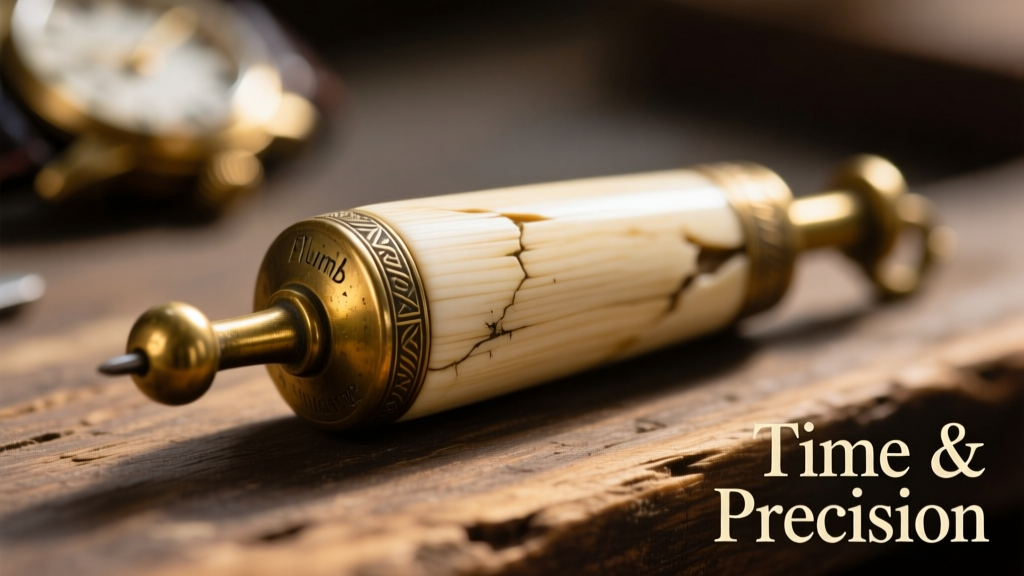
Ivory and Brass Plumb Bobs: Precision Instruments of the Victorian and Edwardian Builder
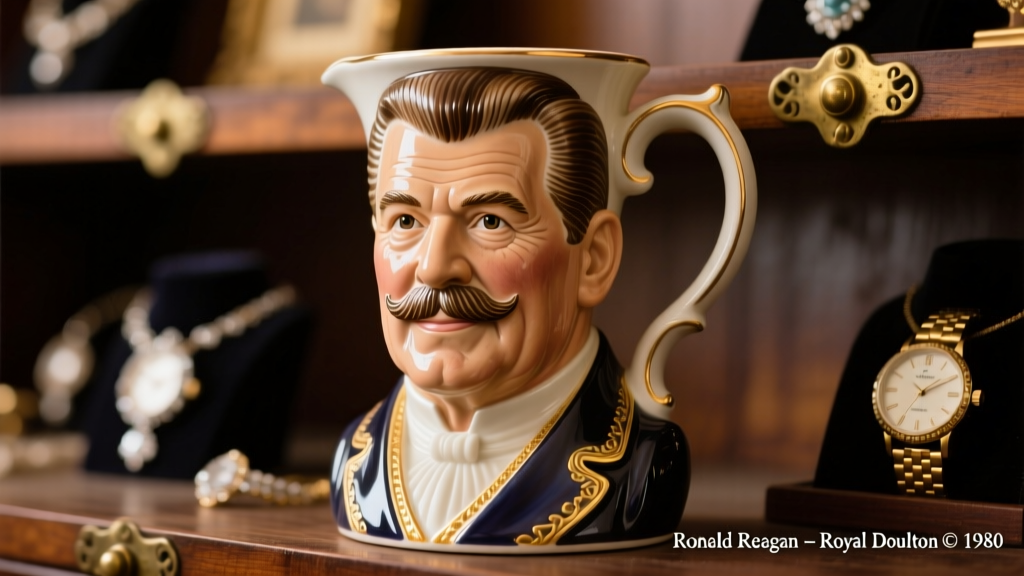
Royal Doulton Character Jug: Ronald Reagan Large No. 2 — Provenance, Production, and Collectibility
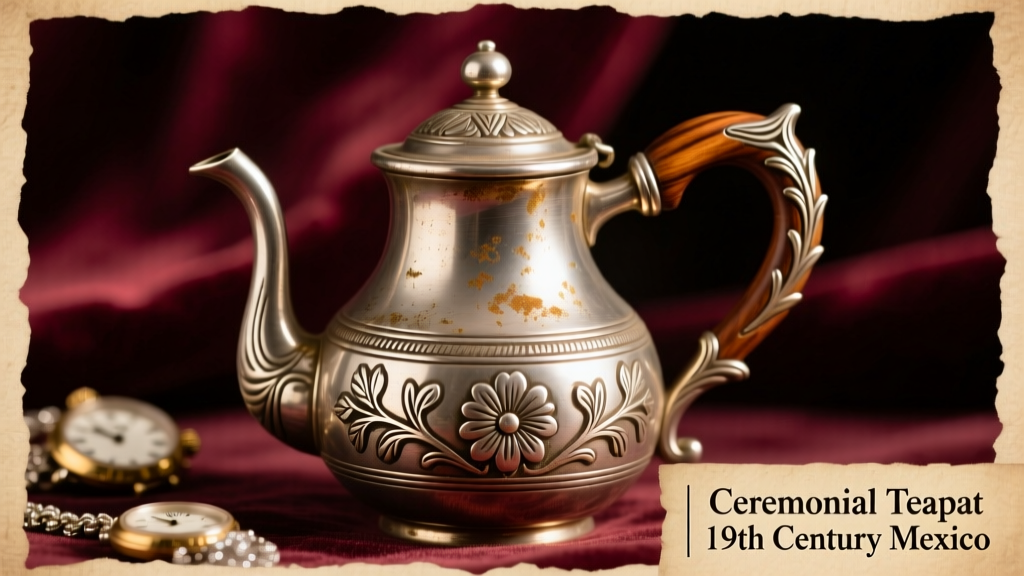
The Spratling Silver Mexican Teapot: A 6-Inch Bulbous-Cylindrical Masterpiece with Rosewood C-Handle
The 1905 Pickard Plate: Yosemite Scene, Mark '6', 6½-Inch Diameter — A Masterpiece of American Art Pottery
Toshiko Takaezu’s 18-Inch Midcentury Charger: A Study in Dipped Glaze Mastery and Ceramic Innovation
Lot 1132831: A 1958 Rolex Oyster Perpetual Reference 6600 — Provenance, Technical Anatomy, and Market Significance

Horn Cup Carved Dragons Playing With Pearl: A Study of Qing Dynasty Ritual Craftsmanship and Symbolic Design
The 22K Yellow Gold Mesh Choker with Suspended Drops: A Study in Artisanal Opulence and Mid-Century Refinement
Shelley Dish Pancake Cover in Blue Rock Pattern: A Collector’s Guide to the Iconic 6-Inch Ceramic Lid