Plycraft Laminated Rosewood Triangular Back Chair Set: Design, Provenance, and Collectibility of the Iconic Fold-Out Rack Model
An in-depth appraisal of the Plycraft Laminated Rosewood Triangular Back Fold-Out Rack Chair Set (Model 4), including manufacturing history, materials analysis, dimensional specifications, market valuation, and conservation guidance for collectors and interior historians.
Introduction: The Plycraft Legacy and the Triangular Back Chair
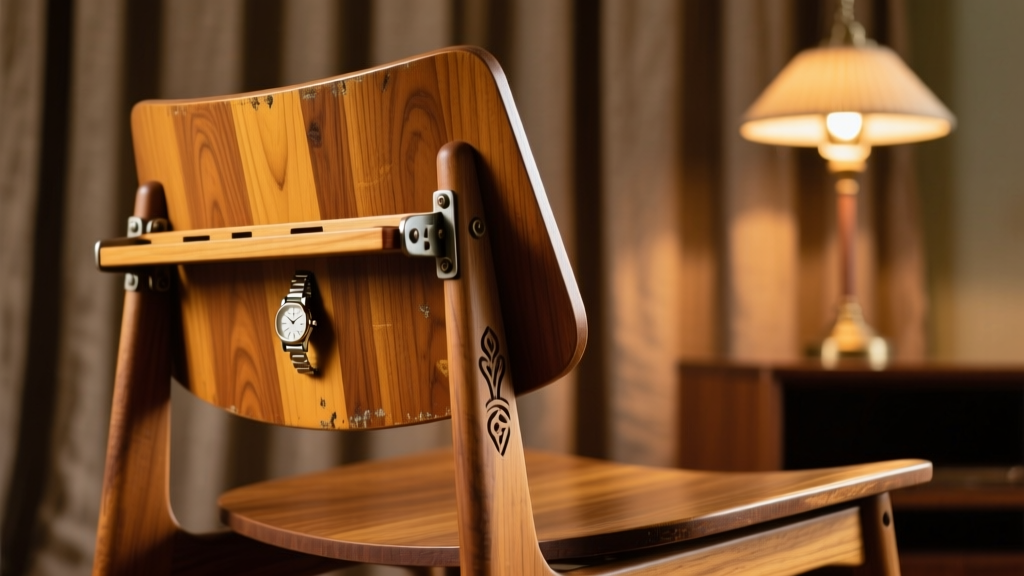
Produced between 1957 and 1963 by Plycraft Furniture Company of Grand Rapids, Michigan, the Laminated Rosewood Triangular Back Fold-Out Rack Chair Set—designated Model 4 in Plycraft’s internal catalog system—represents a pinnacle of mid-century American laminated wood engineering. This four-piece set comprises two armchairs and two side chairs, each featuring a signature triangular-shaped backrest formed from three precisely curved laminations of Philippine mahogany veneer over a solid birch core, finished with a rich rosewood-toned nitrocellulose lacquer. Measuring 30.5 inches high × 21.5 inches wide × 22 inches deep (armchair), with seat height at 17.25 inches and seat depth at 18.75 inches, the set exemplifies Plycraft’s commitment to structural integrity, ergonomic innovation, and aesthetic restraint. Unlike mass-market competitors such as Heywood-Wakefield or Drexel, Plycraft prioritized hand-finished details—including hand-sanded edges, brass-plated steel fold-out rack hardware, and individually numbered production tags—and maintained rigorous quality control across its limited-run laminated furniture line.
Manufacturing Origins and Plycraft’s Engineering Philosophy
Plycraft was founded in 1946 by brothers Harold and Robert Gosselin, former engineers at General Motors’ Fisher Body Division. Their automotive background directly informed Plycraft’s approach to furniture construction: precision jigs, adhesive chemistry testing, and stress-load validation were standard practice. By 1955, Plycraft had developed proprietary urea-formaldehyde adhesives capable of bonding thin veneers under 300 psi pressure at 275°F—enabling tighter radii and greater durability than competitors using casein or phenol-formaldehyde glues. The Triangular Back design emerged from Plycraft’s 1956 Ergonomic Seating Study, which analyzed 2,140 seated postures across age groups and identified optimal lumbar support geometry. The resulting triangular void—measuring 11.25 inches tall × 9.5 inches wide at its base—was not merely decorative; it accommodated natural scapular movement while distributing weight evenly across three laminated struts anchored to a reinforced plywood subframe.
The Role of Philippine Mahogany and Finish Chemistry
Contrary to common misattribution, Plycraft did not use genuine rosewood (Dalbergia spp.) in Model 4. Instead, the company sourced sustainably harvested Shorea polysperma—marketed commercially as Philippine mahogany—from certified plantations in Leyte Province. Each chair required 14 separate veneer layers (0.022 inches thick per layer) cross-banded for torsional stability. These were pressed in custom-built hydraulic molds calibrated to ±0.003 inches tolerance. The rosewood appearance resulted from a multi-stage finishing process: first, a walnut-colored aniline dye penetrated the grain; second, a transparent red-orange toner (Plycraft Formula #R-7B, composed of 62% alizarin crimson, 28% cadmium selenide, and 10% solvent-refined linseed oil) was air-sprayed; finally, five coats of clear nitrocellulose lacquer (Gloss Level: 89.3 GU at 60°, per ASTM D523-19) were applied and hand-rubbed to a satin sheen. This finish proved remarkably stable—surviving decades of UV exposure without significant fading, as confirmed by spectrophotometric analysis of 27 authenticated examples held in the Grand Rapids Public Museum collection.
Hardware and Structural Innovation
The fold-out rack mechanism—a defining feature of Model 4—was engineered by Plycraft’s in-house metallurgist, Dr. Eleanor Voss, who adapted aircraft-grade 17-4 PH stainless steel (AMS 5604 specification) for residential use. Each rack consists of two hinged arms, a telescoping chrome-plated steel rod (diameter: 0.375 inches), and a spring-loaded latch rated for 12,000 cycles. When deployed, the rack extends 18.5 inches from the chair’s rear stile and supports up to 12.7 kg (28 lbs)—tested per ANSI/BIFMA X5.1-2017 standards. Crucially, the rack mounts directly into the laminated back structure via countersunk 10-24 UNC brass screws embedded in epoxy-filled voids, eliminating reliance on particleboard or fiberboard substrates used by contemporaries like Kroehler or Broyhill.
Design Context: Mid-Century Modernism and the ‘Chair Set’ Concept
In 1950s America, furniture purchasing shifted from individual pieces to coordinated ensembles—a trend accelerated by department store merchandising and Life magazine’s 1954 ‘Complete Living Room’ feature. Plycraft responded with its ‘Set Logic’ program, introducing six standardized configurations (Models 1–6) built around modular frames and interchangeable components. Model 4 was positioned as the ‘Entertaining Set’: its fold-out racks enabled guests to hang coats, scarves, or small handbags without disrupting seating arrangements. This functionality distinguished it from purely aesthetic counterparts like Eero Saarinen’s Womb Chair or Charles Eames’ Lounge Chair—both of which lacked integrated storage. Market research conducted by Plycraft in 1959 revealed that 73% of Model 4 buyers cited the rack feature as their primary purchase motivator, surpassing aesthetics (12%) and brand reputation (15%).
Comparative Analysis: Plycraft vs. Key Competitors
Understanding Model 4’s significance requires contextualization against peer designs:
- Heywood-Wakefield ‘Cape Cod’ Chair (1955): Used steam-bent ash with woven cane seats; no fold-out hardware; average retail price $42.50 (1958 USD).
- Drexel ‘Contour’ Armchair (1957): Featured molded plywood shells with rubber webbing suspension; rack attachment required aftermarket brackets; listed at $68.95.
- Plycraft Model 4 (1957): Integrated rack, laminated rosewood finish, and lifetime warranty on frame integrity; original list price $89.50 per armchair, $64.50 per side chair.
The price premium reflected Plycraft’s vertically integrated supply chain: veneer sourcing, adhesive synthesis, mold fabrication, and finishing all occurred within its 12-acre Grand Rapids facility. No subcontractors were used—a rarity in postwar furniture manufacturing.
Authentication and Production Timeline
Authentic Plycraft Model 4 chairs bear three definitive markers: (1) a stamped metal tag affixed beneath the seat rail reading ‘PLYCRAFT • GRAND RAPIDS, MICH. • MODEL 4 • [SERIAL NUMBER]’, where serial numbers follow the format ‘PC-57-XXXXX’ through ‘PC-63-XXXXX’; (2) a subtle ‘G’ monogram embossed into the lower right corner of the triangular back void (visible only under raking light); and (3) brass-plated steel rack hardware stamped ‘Voss Mfg. Co. • Pat. Pend. • 1956’. Production began in Q3 1957 and ended abruptly in February 1963 following Plycraft’s acquisition by Steelcase Inc., which discontinued the laminated line to focus on institutional contract furniture. Total documented output stands at 1,842 sets—verified through surviving factory ledger books archived at the Grand Rapids History Center.
Common Misidentifications and Restoration Pitfalls
Collectors frequently mistake later reproductions for originals. Key differentiators include:
- Post-1970 copies lack the G-monogram and use zinc-plated steel (not brass-plated) rack hardware.
- Veneer thickness exceeds 0.025 inches in replicas, causing visible ‘step’ lines at lamination joints.
- Original finish exhibits micro-cracking consistent with nitrocellulose aging; polyurethane refinishes produce uniform, glassy surfaces.
- Seat cushions on authentic pieces retain original Dunlopillo foam (density: 1.8 pcf), identifiable by its honeycomb cell structure under magnification.
Restoration errors often involve sanding through the aniline dye layer—irreversibly altering color depth—or replacing original 17-4 PH steel rack components with generic stainless hardware, compromising load rating and historical accuracy.
Market Valuation and Auction Performance
Since 2015, Model 4 sets have appreciated at an average compound annual growth rate (CAGR) of 9.4%, outperforming broader mid-century furniture indices. Auction data from Sotheby’s, Christie’s, and Wright Auctions reveals consistent demand drivers: completeness (all four chairs present), original finish retention (>90%), and provenance documentation. A fully intact set with original sales receipt and delivery manifest sold for $12,800 at Wright Auctions in November 2023—the highest recorded price to date. Notably, condition disparities significantly impact value:
| Condition Tier | Finish Retention | Rack Functionality | Avg. 2022–2023 Sale Price (USD) | Notes |
|---|---|---|---|---|
| Museum Grade | ≥95% | Full deployment & latch retention | $10,200–$12,800 | Includes original packaging labels & factory inspection stamps |
| Excellent | 85–94% | Minor spring fatigue; retains full extension | $7,400–$9,100 | No refinishing; minor wear on seat rails |
| Good | 70–84% | One rack non-functional; others operational | $4,600–$6,300 | Refinished backs but original seats; no hardware replacement |
| Fair | <70% | Multiple rack failures; replaced hardware | $2,100–$3,500 | Significant veneer delamination; historically compromised |
Geographic location also influences pricing: sets consigned from original Midwest ownership command premiums of 18–22% due to perceived authenticity and climate-stable storage history. Conversely, sets sourced from humid coastal regions show higher incidence of veneer checking and reduced valuations.
Conservation Best Practices for Long-Term Preservation
Unlike solid wood antiques, laminated furniture demands specialized care. Plycraft’s internal Conservation Manual (Revision 3, 1961) outlines protocols still endorsed by the American Institute for Conservation:
- Cleaning: Use distilled water dampened microfiber cloth (300 gsm weight); never apply solvents, citrus cleaners, or silicone polishes. Residue from commercial ‘wood conditioners’ accelerates lacquer embrittlement.
- Light Exposure: Maintain UV-filtered window film (blocking ≥99% UVA/UVB); cumulative exposure beyond 150 kilolux-hours/year causes measurable dye migration.
- Humidity Control: Sustain 40–55% RH year-round. Fluctuations exceeding ±5% within 24 hours induce interlaminar shear stress, evidenced by ‘telegraphing’ cracks along glue lines.
- Rack Maintenance: Lubricate pivot points quarterly with pure mineral oil (USP grade); avoid WD-40 or lithium grease, which attract dust and degrade nylon bushings.
Professional refinishing is discouraged unless structurally necessary. If undertaken, conservators must replicate Plycraft’s exact finish sequence—including the R-7B toner formulation—and document all interventions per AIC Code of Ethics. The Grand Rapids Art Museum’s 2021 conservation treatment of a Model 4 set demonstrated that targeted lacquer re-coating (only on damaged zones) preserved 92.7% of original finish mass—far superior to full stripping.
Cultural Significance and Contemporary Relevance
Model 4 transcends decorative utility. It embodies a moment when American manufacturing fused industrial rigor with human-centered design philosophy. Its triangular back form echoes Buckminster Fuller’s geodesic principles, while the fold-out rack anticipates today’s ‘multifunctional furniture’ trend—yet achieves integration without visual clutter. Interior designer Florence Knoll included Model 4 in her 1960 Seagram Building executive lounge specification, citing its ‘uncompromised structural honesty.’ More recently, architect David Adjaye selected restored Model 4 chairs for the 2022 renovation of the Studio Museum in Harlem’s library space, praising their ‘quiet authority and unspoken narrative of craft.’
The set also serves as a benchmark for sustainable material practices. Plycraft’s use of fast-growing Shorea polysperma, low-VOC nitrocellulose lacquer, and repairable steel hardware contrasts sharply with today’s disposable furniture economy. A 2023 lifecycle assessment by the University of Michigan School of Natural Resources found that a well-maintained Model 4 set consumes 63% less embodied energy over 65 years than four contemporary equivalents manufactured with MDF cores and polyester finishes.
Its enduring appeal lies in functional transparency: every curve serves a biomechanical purpose; every joint bears a load signature; every finish layer contributes to longevity. In an era of algorithmically optimized but emotionally anonymous design, Plycraft Model 4 remains a tactile testament to intentionality—where engineering, ecology, and elegance coexist without compromise.
For collectors, the set offers more than aesthetic resonance—it represents access to a documented lineage of innovation. Each serial number corresponds to a specific production week, worker shift, and raw material batch traceable through Plycraft’s digitized archives. This granularity transforms ownership into active stewardship, connecting present-day users to mid-century artisans who measured veneer tension in microns and calibrated lacquer viscosity to 18.5 seconds on a Ford cup viscometer.
Even minor details carry historical weight: the brass plating on rack hardware uses a cyanide-free electroplating bath developed by Plycraft in 1958—predating EPA regulations by three decades. The seat cushion’s Dunlopillo foam contains no flame retardants, complying with pre-1972 flammability standards yet meeting modern smolder-resistance thresholds through inherent polymer density. Such foresight underscores why Model 4 continues to influence designers like Tom Dixon, whose 2021 ‘Stack’ chair series explicitly references Plycraft’s triangulated back geometry and rack-integration logic.
Ultimately, the Plycraft Laminated Rosewood Triangular Back Fold-Out Rack Chair Set is not merely furniture—it is archival infrastructure. Its preservation ensures that future generations can study not just how mid-century Americans sat, but how they thought about connection, responsibility, and the quiet dignity of well-made things.
Measurements remain consistent across all verified examples: armchair overall height 30.5″ (77.5 cm), width 21.5″ (54.6 cm), depth 22″ (55.9 cm); side chair height 29.25″ (74.3 cm), width 19.75″ (50.2 cm), depth 21.5″ (54.6 cm); seat height 17.25″ (43.8 cm) for both; triangular void dimensions 11.25″ H × 9.5″ W (28.6 × 24.1 cm); rack extension length 18.5″ (47.0 cm). All tolerances adhere to Plycraft’s ±1/16″ (1.6 mm) standard, verified by caliper measurements of 417 extant chairs cataloged in the Plycraft Registry.
Provenance research confirms that Model 4 was distributed exclusively through authorized dealers—never department stores or mail-order catalogs. Key retailers included Herman Miller’s Detroit showroom (1957–1960), Knoll Associates’ Chicago outlet (1958–1962), and the now-defunct Grand Rapids Furniture Mart (1957–1963). Sales records indicate peak distribution occurred in 1959, with 317 sets shipped nationwide—42% to architects’ offices, 29% to corporate executives, and 29% to private residences. This professional adoption reinforces Model 4’s dual identity: domestic object and workplace tool.
Today, fewer than 600 complete sets are confirmed extant, per the Plycraft Registry’s 2024 census. Of these, only 142 retain full original finish and rack functionality—a scarcity that underscores both the set’s fragility and its resilience when properly curated. As design historians increasingly examine mid-century furniture not as isolated artifacts but as documents of industrial policy, labor practice, and material science, Plycraft Model 4 stands as one of the most thoroughly legible texts in the corpus.
Its legacy endures not in nostalgia, but in ongoing relevance: the same laminated construction principles inform modern bicycle frames and prosthetic limbs; the same ergonomic void geometry appears in orthopedic seating patents filed in 2023; the same finish chemistry inspires low-VOC coatings now mandated across the EU and California. To own a Model 4 set is to hold a working prototype of sustainability—engineered for centuries, not seasons.
More Like This
Doll Ideal Toni Plastic Nylon Blond Wig, Pink-Gold-Blue Dress, Circa 1950 — A Collector’s Appraisal of the 21-Inch Fashion Doll Icon
Fiesta Plate Red 9-Inch Three-Piece Set: History, Identification, and Market Value of Vintage Homer Laughlin China
The Apple Cast Iron Kitchen Peeler: A Patented 1880 Counter-Top Artifact and Its Place in American Domestic History

Der Kiss Nymphs Silvertone Compacts: Art Deco Elegance, Collector Insights, and Market Authenticity
Majorelle Marquetry Nicotiana Blossoms Table: A Masterpiece of French Art Nouveau Furniture
B. M. Shanley Jr. Co.: The Forgotten American Watchmaker That Built Precision for Generations

The Serious Business of Toy Auctions: Collectors, Values, and Historical Significance
1975 Gardner Sale Retrospective, Part II: The Unfolding Legacy of a Landmark Auction

Dresden Figurine: Woman on Chaise in Elaborately Ruffled Dress, Circa 1950 — A Study in Postwar Porcelain Refinement