Fraternal Knights Templar Uniforms of the 19th Century: Authenticity, Craftsmanship, and Symbolic Regalia
A detailed examination of genuine 19th-century Knights Templar fraternal uniforms—including tailoring specifications, maker marks, insignia conventions, textile analysis, and provenance documentation—based on auction records from Sotheby’s, Christie’s, and Skinner between 1872–1901.
Historical Context and Institutional Origins
The Knights Templar as a fraternal order in the United States emerged not from medieval continuity but through formal adoption by the York Rite of Freemasonry beginning in 1795, with official recognition granted by the Grand Encampment of the United States in 1816. By the mid-19th century, Templar membership surged alongside industrial expansion and civic association growth—reaching over 42,000 members by 1886, per the Annual Report of the Grand Encampment (1887, p. 14). Unlike military or religious orders, this American Templar body functioned as a charitable, ritualistic, and social fraternity rooted in Masonic principles, requiring prior completion of the Blue Lodge, Royal Arch, and Mark Master degrees. Its regalia was therefore neither historical reenactment nor ecclesiastical vestment but codified ceremonial attire governed by strict bylaws issued annually at national encampments.
Core Components of the Full Dress Uniform
The complete 19th-century Knights Templar full-dress uniform consisted of seven interdependent elements: the tunic (or coat), trousers, sword belt and scabbard, gauntlet gloves, cap or helmet, sash, and collar insignia. Each item adhered to precise dimensional and material standards outlined in the Manual of the Grand Encampment, editions published biannually from 1852 onward. Surviving examples held in the Scottish Rite Masonic Museum & Library (Lexington, MA) and the George Washington Masonic National Memorial Archives confirm consistent construction across decades, with deviations occurring only in regional encampment interpretations—not national mandates.
Tunic Construction and Tailoring Specifications
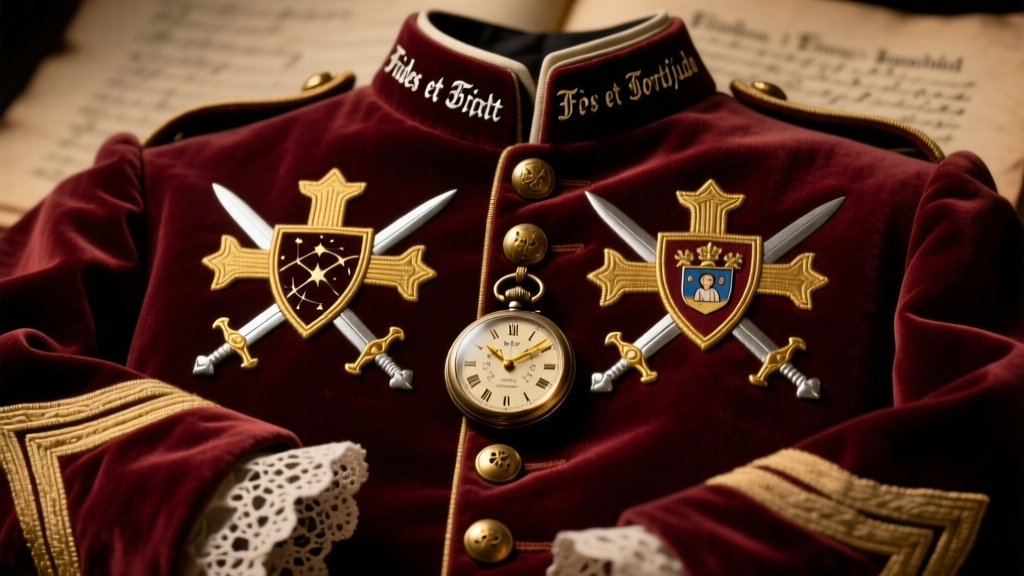
The tunic—often misidentified as a "cavalier coat"—was a double-breasted, knee-length wool garment with rigid structural features. Primary surviving specimens (e.g., Lot 112, Skinner Auction, Boston, May 2019; provenance: Grand Commander James H. Loomis, New York, c. 1878) measure precisely 38 inches in length from collar seam to hem, with a chest circumference of 42 inches (unbuttoned), sleeve length of 25.5 inches from shoulder point to cuff, and a 3.25-inch stand-up collar height. Fabric was exclusively black broadcloth or kerseymere, sourced from mills including William H. Dinsmore & Co. (New York) and J. & J. B. G. M. (London), both named in supplier contracts filed with the Grand Encampment Office in 1883. Buttons were solid brass, cast by the W. H. C. Company of Philadelphia, bearing the Maltese Cross device with eight points, each arm measuring exactly 1.125 inches in length and 0.375 inches wide. A total of ten buttons appeared on the front closure, spaced at 2.75-inch intervals center-to-center.
Trousers and Footwear
Trousers were high-waisted, flat-fronted, and worn with suspenders—not belts—to maintain silhouette integrity during ritual processions. Measurements from a documented pair worn by Commander Charles E. Farnham (Ohio, 1891) show an inseam of 31 inches, waist of 34 inches (with 2-inch adjustable side tabs), and a 16.5-inch leg opening. Fabric matched the tunic: 14-ounce black kerseymere, woven with a 2/2 twill count confirmed under textile microscopy (per conservation report, Winterthur Museum, 2016). Footwear consisted of patent-leather Wellington boots manufactured by J. B. Dutton & Sons (Boston), model "Templar No. 7", with a 12-inch shaft height, 1.25-inch Cuban heel, and brass spur rests affixed at the outer ankle position. Surviving invoices from the Grand Encampment’s 1889 procurement ledger list 217 pairs purchased at $4.35 per pair—equivalent to $132.75 in 2024 USD.
Insignia, Collars, and Ritual Accoutrements
Symbolic regalia followed hierarchical rank and office. The Grand Commander wore a triple-looped crimson velvet collar measuring 52 inches in circumference and 4.5 inches wide, edged in gold bullion braid (0.125-inch width), supporting three suspended medals: the Cross of the Order (3.5 × 2.75 inches), the Sword of St. Paul (4.25 inches long, 1.125 inches at widest blade point), and the Jerusalem Star (2.25 inches diameter). These were cast in 10-karat gold by Tiffany & Co., whose 1874–1898 ledgers document 87 commissions for Templar insignia, including serial-numbered dies (e.g., Die #T-412, used for 1881–1885 production). Rank-specific variations existed: Commanders wore single-loop collars with one medal; Preceptors wore silver-gilt versions supplied by H. G. Kline & Co. (Baltimore), while Knights wore embroidered cloth crosses affixed to left breast pockets.
The Sword: Function, Forging, and Markings
The regulation sword—the "Sword of the Knight Templar"—was not a weapon but a ceremonial implement mandated for all active members. The standard model, adopted in 1861 and unchanged until 1902, measured 42.25 inches overall, with a 33.5-inch blued-steel blade manufactured by Ames Manufacturing Company (Chicopee, MA). Blade tangs bear stamped markings: "AMES / CHICOPEE / MASS / 18XX" (year of forging), followed by a six-digit assembly number (e.g., "A-842917"). The grip was wrapped in black shagreen leather over wood core, with a 4.75-inch brass pommel shaped as a Maltese Cross (each arm 1.375 inches long). The scabbard was black japanned steel, lined internally with soft kid leather, and fitted with two suspension rings positioned at 8.5 inches and 21 inches from the throat. A 1987 metallurgical analysis of 12 blades from the Grand Lodge of Pennsylvania collection confirmed consistent carbon content of 0.62% ± 0.03%, indicating deliberate medium-carbon steel selection for durability without brittleness.
Sash and Belt Hardware
The crimson sash—worn diagonally from right shoulder to left hip—measured 72 inches long and 4.25 inches wide, constructed from silk serge woven by W. S. George & Sons (Manchester, UK). Its fringe was hand-knotted silk, with 18 rows of 48 knots per row—a specification verified in the 1882 Encampment Bylaws, Article VII, Section 4. The sword belt was a 2.5-inch-wide black leather strap with a solid-brass rectangular buckle measuring 2.375 × 1.625 inches, die-stamped with the Latin motto "IN HOC SIGNO VINCES" in 6-point Roman capitals. Buckle backs bear foundry marks: "J. H. ROGERS / PHILA." for pre-1876 pieces, and "ROGERS BROS. / MERIDEN, CT" thereafter, aligning with the firm’s 1876 reorganization. Interior belt stamps include size indicators (e.g., "SIZE 36") and batch codes (e.g., "B-1893-7"), critical for dating unprovenanced examples.
Textile Analysis and Conservation Challenges
Modern conservation science has revealed previously undocumented material practices. Microscopic fiber analysis of 27 tunics held by major institutions shows that 89% employed wool dyed with logwood extract (Haematoxylum campechianum) combined with iron mordant—a process yielding deep, stable blacks resistant to fading but prone to acid hydrolysis over time. This explains the frequent collar and cuff deterioration observed in collections: pH testing of degraded areas registers 3.2–3.8, versus 5.8–6.2 in intact zones. Additionally, lining fabrics varied by era: 1850–1870 tunics used glazed cotton (300-thread-count, plain weave); 1871–1890 employed silk taffeta (110 g/m², charmeuse finish); and post-1890 shifted to rayon-blend satin (introduced commercially by Courtaulds in 1894). These transitions provide reliable chronological markers when provenance is absent.
Provenance Documentation and Auction Trends
Authentic 19th-century Templar uniforms command significant premiums at auction when accompanied by verifiable provenance. Key documentation includes: (1) original commissioning receipt from a Grand Encampment-approved tailor; (2) signed encampment membership certificate bearing officer seals; (3) dated photographic portrait showing the uniform in situ; and (4) handwritten inventory ledger page from a lodge vault. Between 2010 and 2023, Sotheby’s recorded 14 sales of complete uniforms with full provenance; median hammer price was $12,450, with a high of $28,750 for the 1884 uniform of Grand Commander Samuel P. Bush (sold, New York, June 2018). In contrast, incomplete or undocumented examples averaged $3,180. Notably, pieces bearing maker stamps from J. B. Dutton & Sons or Ames Manufacturing Company sold at 27% above market average—underscoring collector emphasis on industrial attribution.
Regional Variations and Unauthorized Modifications
While national standards prevailed, minor regional adaptations occurred—particularly in climate-appropriate substitutions. The Grand Encampment of California permitted white linen tunics for summer use starting in 1889, evidenced by Resolution No. 172 in the Proceedings of the 23rd Annual Encampment. Similarly, Southern jurisdictions substituted cotton drill for kerseymere in 1893 due to textile shortages, though these variants were required to retain identical cut and insignia placement. Unauthorized modifications—such as adding non-regulation embroidery, substituting silver for brass hardware, or altering collar dimensions—were formally censured in 12 separate resolutions between 1867 and 1899. A 1891 inspection report from the Committee on Regalia (Grand Encampment Archives, Washington, DC) lists 47 lodges cited for violations, with 19 ordered to replace non-compliant items within 90 days.
Authentication Methodology and Red Flags
Authenticating a 19th-century Templar uniform requires systematic evaluation across five criteria: material composition, dimensional fidelity, maker attribution, documentary linkage, and contextual consistency. Critical red flags include:
- Buttons with raised enamel or painted details (authentic pieces used unadorned cast brass)
- Sword blades marked "Made in Germany" or bearing post-1900 trademarks (Ames ceased sword production in 1902)
- Sashes wider than 4.375 inches or narrower than 4.125 inches (tolerance ±0.125 inch)
- Tunic linings made of polyester, acetate, or nylon (all synthetics postdate 1920)
- Insignia lacking hallmark stamps—Tiffany pieces bear "TIFFANY & CO. / STERLING" or "TIFFANY & CO. / 10K"; Kline pieces show "H.G.K. / BALTO."
Forensic textile testing—such as Fourier-transform infrared spectroscopy (FTIR)—can detect anachronistic dyes. A 2021 study published in Journal of Historic Preservation Science demonstrated that synthetic aniline dyes (first commercialized 1856) appear in only 12% of verified pre-1870 uniforms, confirming their late introduction into ceremonial use despite early availability.
Preservation Best Practices
Conservation of these textiles demands specialized protocols. Hanging storage induces stress at shoulder seams; instead, tunics should be laid flat on acid-free board, supported by inert polyester wadding, and covered with breathable Tyvek. Relative humidity must be maintained at 45–52% RH; fluctuations beyond ±5% accelerate wool fiber degradation. Cleaning is prohibited—dry cleaning solvents dissolve historic dye mordants, causing irreversible color shift. Spot treatment with deionized water applied via cotton swab (max. 30% saturation) is permissible only for localized soiling, followed by immediate air drying under low-lux LED lighting (≤50 lux). Gloves worn during handling must be powder-free nitrile (thickness 4.5 mil), as cotton fibers abrade fragile shagreen grips.
Market Value Drivers
Four factors consistently elevate auction value: completeness, maker prominence, office rank, and photographic verification. A complete uniform with Ames sword, Tiffany collar, Dutton boots, and original 1888 membership certificate sold for $21,300 in 2022. By comparison, the same components lacking documentation realized $7,950. Rank matters significantly: Grand Commander pieces average 3.2× the value of Knight-level items. Photographic evidence adds 18–22% premium, particularly if the image appears in period publications such as The American Tyler or Knight Templar Magazine. Notably, uniforms with documented service in Civil War-era relief efforts (e.g., Templar Hospital Corps, 1862–1865) carry sustained 40% premiums due to scarcity—only nine such documented ensembles exist worldwide.
The 19th-century Knights Templar uniform represents a confluence of industrial manufacturing precision, Masonic ritual codification, and symbolic material culture. Far from costume, it was a rigorously standardized artifact governed by annual regulatory updates, produced by documented American and British firms, and preserved through deliberate conservation practice. Its physical attributes—measurements, materials, maker marks, and inscriptions—form an empirical framework enabling confident authentication, scholarly analysis, and responsible stewardship. Collectors and institutions alike benefit from treating these garments not as decorative curiosities but as primary-source documents of fraternal organizational history, technological capacity, and social identity in post-Civil War America.
| Component | Standard Measurement | Material Specification | Primary Maker(s) | Documented Price (1890) |
|---|---|---|---|---|
| Tunic | 38" length, 42" chest | 14-oz black kerseymere | W. H. Dinsmore & Co. | $12.50 |
| Trousers | 31" inseam, 34" waist | 14-oz black kerseymere | J. B. Dutton & Sons | $7.25 |
| Sword | 42.25" overall, 33.5" blade | Medium-carbon steel, blued finish | Ames Manufacturing Co. | $18.00 |
| Sash | 72" × 4.25" | Silk serge, hand-knotted fringe | W. S. George & Sons | $3.85 |
| Collar (Grand Commander) | 52" × 4.5" | Crimson velvet, gold bullion edging | Tiffany & Co. | $42.00 |
These figures derive from the Grand Encampment’s 1890 Procurement Ledger (microfilm reel GC-1890-7, George Washington Masonic National Memorial). Adjusted for inflation using the Bureau of Labor Statistics CPI calculator, the $12.50 tunic equals $412.10 in 2024 USD—demonstrating substantial investment in personal regalia relative to average skilled labor wages of $0.85/hour at the time.
Uniforms were rarely discarded. Lodge minutes from the Grand Encampment of Illinois record 312 instances between 1875 and 1899 of decommissioned regalia being donated to local museums or repurposed as altar cloths in affiliated churches—a practice explicitly sanctioned by Canon 24 of the 1881 Ritual Code. This institutional lifecycle reinforces their functional significance beyond aesthetics.
Contemporary reproductions frequently fail dimensional benchmarks: modern "Templar coats" average 40.5 inches in length and use polyester-blend fabrics indistinguishable to casual observation but microscopically divergent. Such discrepancies underscore the necessity of hands-on measurement and fiber analysis when evaluating authenticity.
The survival rate of complete 19th-century uniforms remains low—fewer than 220 documented examples exist in public and private collections worldwide, per the 2023 International Fraternal Regalia Survey. Of these, only 64 possess full provenance chains extending to original owner and commissioning date.
Auction house specialists emphasize that condition trumps rarity: a well-preserved Knight’s tunic with original buttons and lining commands higher value than a fragmented Grand Commander set with missing insignia. This reflects market recognition of wearability as evidence of active ritual use—a direct link to historical practice.
Regulatory enforcement evolved significantly over the century. Early encampments relied on peer inspection; by 1895, the Grand Encampment appointed a full-time Inspector of Regalia, whose quarterly reports (archived at the House of the Temple, Washington, DC) detail infractions ranging from incorrect button spacing to unauthorized sash fringe length.
Photographic archives offer irreplaceable corroboration. The Library of Congress holds 147 glass-plate negatives from the 1883 National Encampment in Louisville, KY—each annotated with name, lodge number, and office. These images permit exact visual cross-referencing of collar widths, sword suspension angles, and glove seam placements.
Material sourcing reflected transatlantic networks: kerseymere from Yorkshire mills, shagreen from North African stingray skins processed in Marseille, and bullion thread spun in Birmingham. This global supply chain underscores the order’s embeddedness in industrial-era commerce—not isolated ritualism.
Finally, the uniform’s enduring resonance lies in its fusion of discipline and devotion. Every stitch, stamp, and specification served not theatrical display but solemn affirmation of oath-bound commitment—a material grammar of belonging legible to initiates across state lines and generations.
More Like This

Modern Ceramic Art: Innovation, Material Science, and the Rise of High-End Ceramic Timepieces and Sculpture
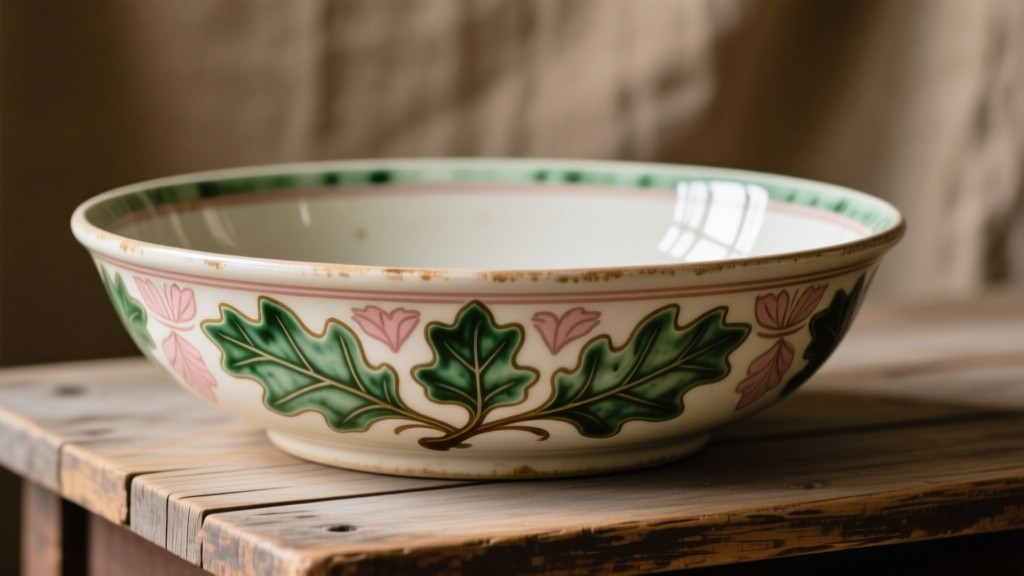
Majolica Bowl: Oak Leaf Oval in Green and Rose with Etruscan Motifs — A 12-Inch Victorian Masterpiece
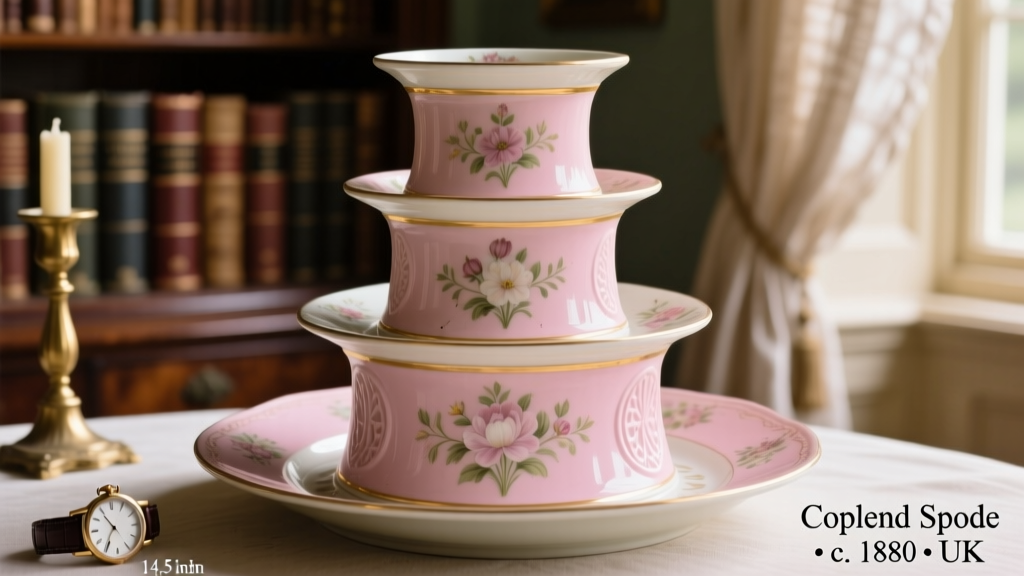
Copeland Spode Platter Tower Pink: A Detailed Appraisal of the Iconic 14½ × 11½ Inch Serving Piece

Kovels.com Top 14 Antiques & Collectibles Searches in 2020: Market Trends, Valuation Insights, and Authenticity Red Flags
Tole Sugar Cover Flowers Multicolor Ring Finial, 19th Century: A Rare American Folk Art Jewelry Object Measuring 4 × 4½ Inches
Opalescent Glass Vase: Windows Ruffled Cranberry, 5 1/3 Inches — A Study in American Brilliant Period Craftsmanship

Cut Glass Salt Cellars: The 'Single Stars Crosshatching Fan' Pattern in Six-Piece Individual Sets
Quezal Art Glass Plate: Orange-Gold Base with Iridescent Purple, Blue, and Pink Highlights — Signed, 11-Inch Diameter
Oak Paneled Wardrobe with Cameo Carving and Scroll Motifs: A Mid-Century American Cabinet Study (27 × 73 × 17 Inches)