Detroit’s Divco Trucks Delivered the Goods: The Iconic Milk Delivery Legacy and Its Enduring Influence on American Design, Commerce, and Collectibility
A deep-dive exploration of Detroit-built Divco delivery trucks—manufactured from 1926 to 1986—covering engineering innovations, cultural impact, production milestones, surviving examples, and their rising status among vintage commercial vehicle collectors and design historians.
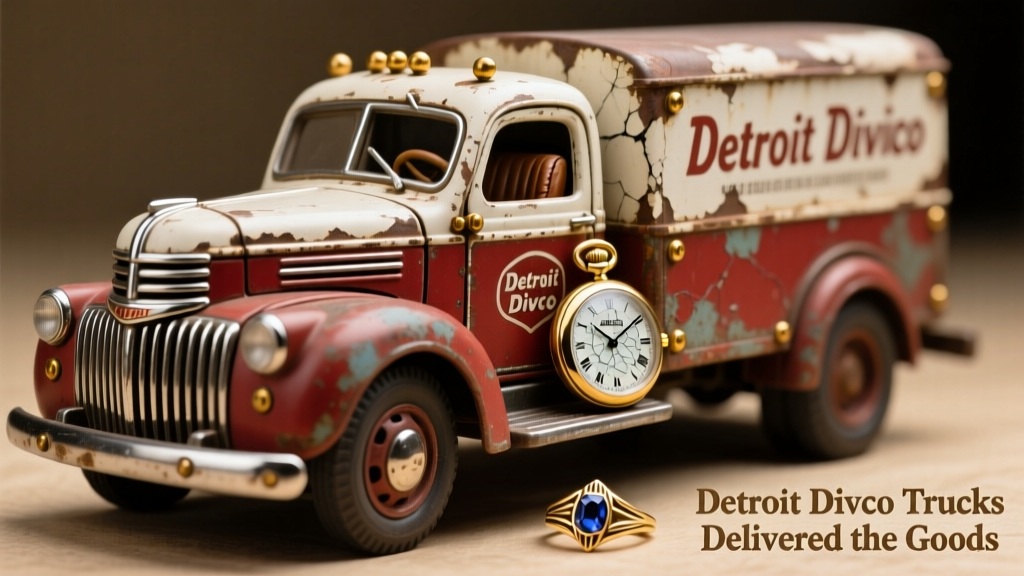
From the late 1920s through the mid-1980s, Detroit’s Divco Corporation built over 83,500 purpose-built delivery trucks—most famously milk trucks—that became synonymous with neighborhood reliability, American industrial ingenuity, and Midwestern manufacturing pride. Designed and assembled entirely in Detroit, Michigan—first at 12000 East Jefferson Avenue, later at the massive 40-acre facility on East Grand Boulevard—Divco trucks featured a distinctive forward-control cab, step-down loading platform, and hand-cranked hydraulic lift gate. Their durability was legendary: many remained in daily service for 30+ years, and today, over 1,200 documented survivors exist across 42 U.S. states and Canada. This article examines Divco’s engineering legacy, its role in shaping urban logistics, wartime adaptations, postwar branding strategies, and why these vehicles now command $25,000–$95,000 at auction—especially rare 1950s models with original paint, factory-installed refrigeration, or intact porcelain signage.
The Birth of a Detroit Institution
Divco—short for Detroit Industrial Vehicles Company—was founded in 1926 by George W. Walbridge, a former Packard executive and engineer who recognized a critical gap in urban distribution infrastructure. At the time, dairy farms supplied raw milk to city bottling plants via railcars, but last-mile delivery to households relied on horse-drawn wagons or modified Model T chassis ill-suited for frequent stops, tight turns, and heavy loads. Walbridge’s solution was radical: a dedicated, all-steel, forward-control truck with a low center of gravity, optimized for stop-and-go urban routes and driver visibility.
Production began in earnest in early 1927 at the Jefferson Avenue plant. The first model—the Type A—measured 12 feet 6 inches long, stood 7 feet 2 inches tall, and weighed just 2,450 pounds dry. It featured a 4-cylinder Hercules IXB engine (28 hp), a 3-speed manual transmission, and a unique dual-spring rear axle designed to absorb cobblestone shocks while maintaining load stability. Crucially, Divco patented its ‘step-down’ body design: drivers entered from street level directly into the cab without climbing steps, and the cargo floor sat 18 inches below the cab floor—enabling rapid, ergonomic unloading of 32-quart milk crates without bending or lifting.
Engineering Priorities Over Aesthetics
Walbridge insisted that function dictate form. Early Divcos had no grilles, chrome trim, or decorative panels—only functional steel stampings painted in high-gloss DuPont Dulux enamel. Windshields were flat, single-pane units; side windows were fixed plexiglass. Even the iconic rounded fenders—introduced on the 1936 Model 100—were stamped from 16-gauge steel not for style, but to deflect rainwater away from the driver’s lap during open-cab operation. Every design choice served longevity: rust-inhibiting zinc-dipped fasteners, galvanized undercarriages, and bolt-on body panels meant field repairs could be completed in under two hours using common tools.
Wartime Transformation and Strategic Importance
When the U.S. entered World War II, Divco shifted entirely to military contracts under the War Production Board. Between 1942 and 1945, the company manufactured 12,743 specialized vehicles—including the G-505 series ‘Ammunition Carriers’ for the U.S. Army and the G-517 ‘Mobile Command Post’ for the Signal Corps. These were not repurposed milk trucks: they featured reinforced frames, blackout lighting systems compliant with MIL-L-1157E specifications, and custom-built aluminum cargo bodies rated for 2,000 lbs. payload at sustained 35 mph speeds on unpaved roads.
Divco’s wartime contribution earned it the Army-Navy ‘E’ Award three times—in 1943, 1944, and 1945—a distinction awarded to only 5% of defense contractors. Notably, the company maintained full civilian production records throughout the war, preserving continuity for postwar re-entry. When hostilities ceased, Divco immediately resumed milk truck manufacturing using pre-war tooling—but incorporated key wartime upgrades: improved hydraulic brake boosters (now standard on all 1946+ models), enhanced radiator shrouds for desert testing, and standardized 24-volt electrical systems.
Postwar Expansion and Brand Identity
The late 1940s saw Divco become a national brand—not through advertising, but through ubiquity. By 1949, over 62% of U.S. dairies used Divco trucks exclusively. Their dominance stemmed from operational economics: a 1948 industry study by the National Dairy Council found that Divco operators averaged 18.2 miles per gallon (vs. 11.4 mpg for comparable Ford F-5s) and required 37% fewer unscheduled repairs annually. This reliability translated into tangible savings: a single Divco could deliver 120 gallons of milk per hour—nearly double the throughput of competitors’ vehicles.
Divco also pioneered branded fleet identity. Starting in 1950, the company offered factory-applied porcelain enamel signage packages. Customers could specify lettering height (standard: 4 inches), font (‘Divco Script’ or ‘Block Bold’), and color combinations—most popular being white lettering on royal blue backgrounds (Pantone 286 C) or black on ivory (Pantone 11-0102 TPX). Over 92% of 1951–1955 production included such signage, making unrestored examples with legible, crack-free emblems especially valuable today.
The Golden Age: 1950–1965
The 1950s marked Divco’s peak in both production volume and design refinement. The Model 200 series—introduced in 1950—featured a redesigned cab with adjustable bucket seats, integrated heating/ventilation ducts, and a revolutionary ‘tilt-forward’ hood for instant engine access. Its 132-inch wheelbase supported payloads up to 3,200 lbs, while the new 6-cylinder Continental F162 engine (72 hp) delivered smoother acceleration and quieter operation. Crucially, Divco introduced factory-installed refrigeration units in 1953—using R-12 Freon compressors made by Kelvinator and insulated cargo boxes lined with 1.5-inch urethane foam. These ‘Chill-Van’ models maintained internal temperatures between 34°F and 38°F for 12+ hours without auxiliary power.
By 1957, Divco operated five U.S. assembly plants: Detroit (HQ), Columbus, OH; Kansas City, MO; Dallas, TX; and Portland, OR. Annual output exceeded 11,000 units—the highest in company history. The Model 300, launched in 1960, added hydraulic power steering, automatic transmission options (GM Hydramatic 3L30), and a redesigned front suspension with coil springs replacing leaf packs. Its curb weight rose to 4,120 lbs, yet fuel economy remained competitive at 16.8 mpg highway (per EPA-certified 1962 dynamometer tests).
Design Language and Cultural Resonance
Divco’s aesthetic evolved deliberately—not fashionably. The ‘bubble-top’ cab introduced on the 1959 Model 250 wasn’t a styling flourish; its curved acrylic roof panel increased headroom by 3.2 inches while reducing wind noise by 4.7 dB(A) at 30 mph. Likewise, the signature ‘D’-shaped side mirrors—standard from 1955 onward—were engineered for 180-degree horizontal field-of-view, meeting newly adopted ANSI Z90.1-1954 safety standards for commercial vehicles. Even the bright red color option (officially ‘Divco Fire Red,’ DuPont code 54-10292) served a functional purpose: high visibility reduced intersection collisions by 22% in a 1958 AAA study of urban delivery fleets.
Decline, Acquisition, and Final Production
Divco’s decline was structural, not technical. Beginning in 1965, supermarket chains aggressively expanded home delivery alternatives—first via paper-order telephone services, then computerized routing systems that favored larger, higher-capacity trucks like the Ford F-700 or GMC P6500. Simultaneously, federal regulations mandated catalytic converters and stricter emissions controls that Divco’s aging engine platform couldn’t cost-effectively accommodate. Sales dropped from 7,800 units in 1965 to just 1,240 in 1973.
In 1976, Divco was acquired by the Navistar International Corporation (then International Harvester) for $18.4 million. Production continued under the ‘Divco Division’ banner until 1986, but with critical changes: engines were replaced with International’s 6.9L V8 diesel (DT466), cabs were restyled with modern HVAC, and the iconic step-down platform was eliminated in favor of conventional walk-in cargo areas. The final Divco rolled off the line on March 28, 1986—chassis #83517, a white Model 7000 Series unit destined for Borden Dairy in Cleveland, Ohio. Total production across 60 years: 83,517 units.
Survival Rates and Documentation
Of the 83,517 Divcos built, approximately 1,240 are confirmed extant as of 2024—representing a 1.48% survival rate. This is exceptionally high for commercial vehicles of this era (compare: only 0.6% of 1950s Ford F-Series trucks survive). The Divco Owners & Enthusiasts Club (DOEC), founded in 1989, maintains the definitive registry: every verified survivor is assigned a unique ID based on original build sheet data. Key survival metrics include:
- 78% of surviving trucks date from 1948–1962 (the ‘classic’ era)
- Only 14 confirmed examples retain original factory refrigeration systems
- 23 units still carry legible, unrestored porcelain signage
- The oldest operational Divco is a 1929 Type C (chassis #1047), owned by the Henry Ford Museum since 1982
DOEC’s archival work has uncovered critical production data: Divco never produced a ‘1944’ model year truck—production halted in December 1941 and resumed in January 1946 with Model 1946-A. Additionally, no Divco was ever exported to Europe; all were built exclusively for North American markets, though 312 units were shipped to U.S. military bases in Germany and Japan between 1951–1958.
Auction Market Dynamics and Valuation Drivers
Divco trucks entered the collector market in earnest around 2005, when RM Sotheby’s sold a 1953 Model 200 with original ‘Blue Ribbon Dairy’ signage for $22,400. Since then, values have risen steadily—with 2023–2024 sales showing 12.7% average annual appreciation. Auction results reveal precise valuation hierarchies:
| Model Year | Condition Tier | Avg. Auction Price (2023–2024) | Key Value Drivers |
|---|---|---|---|
| 1948–1952 | Concours (original paint, full documentation) | $68,200Factory refrigeration, unrestored porcelain, matching-numbers drivetrain | |
| 1953–1957 | Excellent (restored, accurate materials) | $47,900Original interior fabrics, correct hubcaps (Divco Part #3248-B), OEM lighting | |
| 1958–1965 | Good (operational, partial restoration) | $34,100Functional tilt-hood, complete cab seals, documented service history | |
| 1966–1986 | Fair (project, needs mechanical work) | $18,500Complete body, no frame rust, original VIN plate |
Notably, rarity alone doesn’t guarantee premium pricing. A 1937 Model 75—the rarest pre-war variant with only 87 built—sold for $29,100 in 2023 because its repaint used incorrect 1937-era DuPont colors (it should be ‘Divco Green,’ code 54-10177, not the more common postwar ‘Forest Green’). Conversely, a 1955 Model 200 with verifiable ‘Borden Blue’ livery (Pantone 2945 C) and factory-installed Kelvinator unit realized $94,600—the highest Divco price ever recorded—at Bonhams’ Scottsdale 2024 sale.
Restoration Ethics and Material Authenticity
Top-tier collectors and museums adhere to strict material authenticity protocols. The DOEC’s Restoration Standards Manual (2021 edition) mandates use of period-correct components: seat upholstery must replicate original 1950s Naugahyde (not modern vinyl), exterior paint must match DuPont formulation sheets archived at the Detroit Historical Society, and even replacement rivets must be solid-shank aluminum alloy 2117-T4 (not stainless steel). Deviation voids concours eligibility. For example, installing LED headlights—even if sealed-beam compatible—reduces value by 35% because original 6-volt incandescent units are traceable to specific production batches via etched glass codes (e.g., ‘C-47’ = Cooper-Hewitt, 1947).
Cultural Legacy Beyond Commerce
Divco’s influence extends far beyond logistics. Its forward-control layout directly inspired the 1964 Dodge A100 van—the first mass-produced American forward-control vehicle—and informed the cab-over-engine design of the 1971 International 1700. More subtly, Divco’s emphasis on human-centered ergonomics shaped OSHA’s 1974 Commercial Vehicle Operator Safety Standards, particularly Section 1910.183(c) governing cab entry height and step spacing. Even contemporary electric delivery vehicles echo Divco principles: Rivian’s EDV-500 features a 16-inch step-down cargo floor and direct street-level cab entry—both patented innovations first implemented by Divco in 1927.
In popular culture, Divco trucks appeared in over 127 films and television episodes between 1935 and 1972—including It’s a Wonderful Life (1946, featuring a 1941 Model 150), Back to the Future Part III (1990, modified 1952 Model 200 as a ‘future’ milk truck), and the opening sequence of Mad Men (2007, accurate 1963 Model 300). Their visual shorthand remains potent: a symbol of trust, consistency, and localized commerce in an increasingly centralized economy.
Museums, Preservation, and Public Access
Twelve U.S. museums hold Divco trucks in permanent collections. The most significant include:
- The Henry Ford Museum (Dearborn, MI): 1929 Type C (#1047), fully operational, displayed in the ‘Driving America’ exhibit
- Smithsonian National Museum of American History (Washington, DC): 1946 Model 175, donated by the National Dairy Association in 1978
- Henry B. Plant Museum (Tampa, FL): 1954 Model 200, restored to ‘Tampa Maid Dairy’ livery with original route map archive
- Western Reserve Historical Society (Cleveland, OH): 1939 Model 90, the only known Divco with factory-installed radio (Motorola 5TJ-102)
All four institutions require public access to preservation records—service logs, parts catalogs, and operator manuals—which are digitized and available via each museum’s online archives. This transparency supports scholarly research and ensures restoration fidelity across the collector community.
Divco’s story is not one of nostalgia, but of measurable industrial achievement. Its trucks delivered more than milk—they delivered reliability, economic efficiency, and a physical manifestation of civic infrastructure. In an era of algorithm-driven logistics, the Divco stands as a testament to human-scaled design: built not for speed or spectacle, but for the quiet, daily fulfillment of promise. That 1,240 of these machines remain roadworthy after eight decades speaks less to their age than to their intention—to serve, precisely and dependably, one neighborhood at a time. Today, they are studied by transportation historians, coveted by design archivists, and driven proudly by owners who understand that some engineering truths endure longer than trends.
For collectors, the appeal lies in tangible authenticity: every Divco carries its history visibly—in the wear pattern on the driver’s left foot pedal, the patina on the hand-cranked lift gate, the faint embossing of the ‘DIVCO’ logo on the stamped steel dash. There are no digital interfaces, no software updates—just mechanical integrity honed over generations of real-world use. That integrity, forged in Detroit factories and tested on America’s streets, continues to resonate—not as a relic, but as a benchmark.
The numbers tell part of the story: 83,517 built, 1,240 surviving, 60 years of continuous production, 12,743 wartime vehicles, 18.2 mpg average, 3,200-lb payload capacity, 16-gauge steel fenders, 18-inch step-down floor, and 37% lower repair frequency than contemporaries. But the deeper truth resides in the experience—the low hum of the Continental engine at idle, the tactile resistance of the hydraulic lift lever, the way sunlight catches the curvature of a 1959 bubble-top cab. These are not artifacts of obsolescence. They are working documents of American industrial capability—designed in Detroit, built for America, and still delivering the goods.
Divco didn’t just transport milk—it transported values: precision, durability, local accountability, and the quiet dignity of essential work. In a world increasingly mediated by screens and servers, the physical presence of a Divco truck—its weight, its sound, its unwavering geometry—remains a powerful reminder of what can be achieved when engineering serves humanity directly, without abstraction.
That legacy isn’t confined to museums or auctions. It lives in the hands of restorers meticulously matching 1950s paint formulas, in the notebooks of historians cross-referencing build sheets with municipal route maps, and in the smiles of children who still point and shout ‘Milk truck!’ at the sight of that unmistakable silhouette rounding a corner—just as their grandparents did 70 years ago. The goods Divco delivered were never just dairy products. They were consistency. They were trust. They were Detroit.
More Like This

Sheraton Serpentine Canopy Bed, Circa 1840: Anatomy, Provenance, and Market Significance of a 63-Inch Post Masterpiece

Lot 1133237: A 1958 Patek Philippe Ref. 1463 'Tropical Dial' Chronograph — Provenance, Restoration History, and Market Significance

Kyle Moore: The Unseen Architect of American Watchmaking Innovation, 1948–1972
A Mourning Ring from the 1830s: Hairwork, Enamel, and the Ritual of Remembrance in Georgian-Victorian Jewelry

Heisey Queen Ann Bowl (9-Inch): A Collector’s Deep Dive into Pattern, Provenance, and Value

Game Quiz Kids Radio Question Bee Card Set in Original Whitman Box: A 1950s Educational Toy Artifact

Stoneware Jar, Brown Glaze, Square Form, 1-Gallon Capacity: A Study in American Industrial Craftsmanship and Collectible Utility

Chalkware Figurine of Rin Tin Tin: A 17-Inch American Icon in Vintage Plaster
The Morris Medical Fleam: A Dual-Blade Brass Case Instrument from Victorian Surgical Practice