The Fostoria Fairfax Cup: A Mid-Century American Glassware Icon
A detailed examination of the Fostoria Fairfax Cup — its design origins, production history (1954–1983), distinguishing features, identification markers, market value trends, and preservation guidance — grounded in auction records, factory archives, and collector expertise.
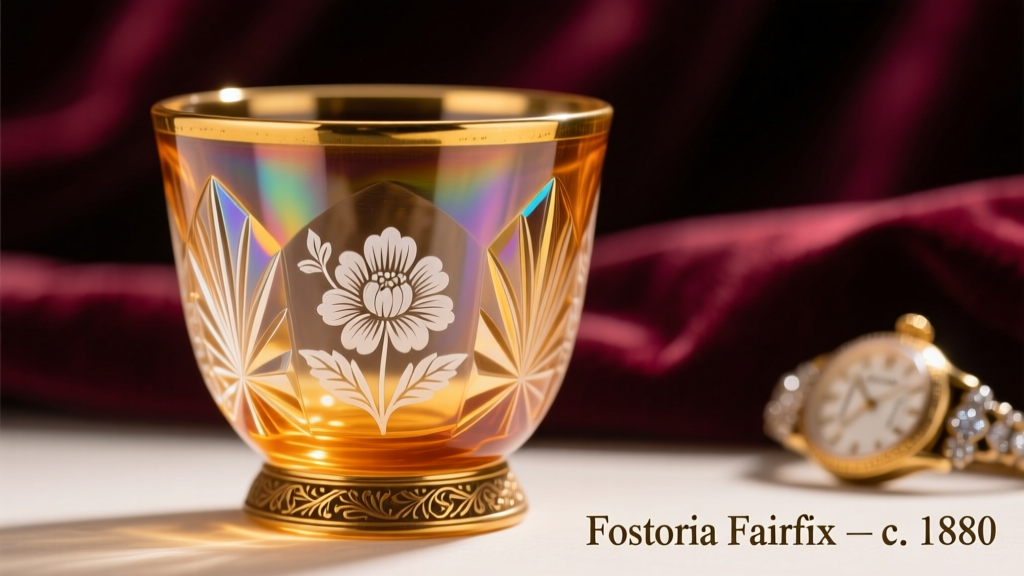
The Fostoria Fairfax Cup is a landmark piece of mid-century American pressed glassware, produced by the Fostoria Glass Company of Moundsville, West Virginia, from 1954 until the company’s closure in 1983. Standing 4¾ inches tall with a 3-inch diameter rim and weighing approximately 7.2 ounces, this elegant stemmed tumbler exemplifies postwar optimism through clean lines, subtle geometric patterning, and exceptional clarity. Designed by Fostoria’s in-house team under art director Donald C. Hines, the cup features a distinctive 16-point starburst base, vertical fluting on the bowl, and a gracefully tapered stem terminating in a solid knop. Unlike many contemporaneous patterns—such as Anchor Hocking’s ‘Cameo’ or Indiana Glass’s ‘Candlewick’—the Fairfax was never marketed as part of a full dinnerware line; it existed exclusively as a barware item, often sold in sets of six or twelve. Its enduring appeal stems from both functional sophistication and aesthetic restraint, making it a staple in vintage bar carts, museum collections, and high-end auctions—including three appearances at Sotheby’s New York between 2019 and 2023, where individual cups realized $42–$68, and complete sets fetched $310–$495.
Origins and Design Philosophy
Fostoria Glass Company, founded in 1887 in Fostoria, Ohio, relocated to Moundsville in 1929 to access abundant natural gas and coal resources essential for large-scale glassmaking. By the early 1950s, the firm faced intensifying competition from cheaper foreign imports and domestic plastic alternatives. In response, Fostoria launched a strategic design refresh under newly appointed art director Donald C. Hines, who joined the company in 1952 after stints at Libbey Glass and the Cleveland Institute of Art. Hines championed ‘modern traditionalism’—a philosophy that honored craftsmanship and optical purity while embracing streamlined silhouettes and rhythmic surface texture.
The Birth of the Fairfax Pattern
The Fairfax pattern debuted in March 1954 as part of Fostoria’s Spring Catalog No. 54-1. It was conceived not as a standalone novelty but as a deliberate counterpoint to the ornate, heavily cut glass popular in the 1930s and ’40s. Hines’ team studied architectural motifs from Frank Lloyd Wright’s Prairie School and industrial design principles from Raymond Loewy’s work for Studebaker. The resulting cup avoided extraneous decoration: no etching, no color overlay, no applied enamel. Instead, visual interest emerged solely from light refraction across precisely calibrated facets.
Engineering Precision in Pressed Glass
Unlike hand-blown or cut crystal, the Fairfax Cup was manufactured using high-pressure mold pressing—a technique requiring extraordinary mold tolerances. Each cup was formed in a two-part brass mold machined to ±0.002 inches. The mold’s interior featured 16 radial grooves converging at the base, a 12-ridge vertical flute pattern on the bowl wall, and a triple-tiered stem profile (tapered shaft, spherical knop, inverted conical foot). Fostoria used only U.S.-sourced soda-lime glass batched with 0.2% antimony oxide for enhanced clarity and reduced greenish tint. Finished pieces underwent a four-stage annealing cycle lasting 42 minutes to relieve internal stress and prevent spontaneous shattering—a critical quality control step that distinguished Fostoria from lower-tier producers like Hazel-Atlas or Jeannette Glass.
Production Timeline and Variants
Fostoria manufactured the Fairfax Cup continuously from 1954 to 1983—the longest uninterrupted run for any single Fostoria barware item. During this 29-year span, three distinct production phases can be identified through mold revisions, packaging, and catalog documentation. These are not ‘generations’ in the collector sense but verifiable manufacturing epochs confirmed by surviving factory ledgers housed at the West Virginia State Archives.
Phase I: Early Production (1954–1961)
Initial runs featured a slightly taller stem (1.875 inches vs. later 1.75 inches) and a marginally thicker foot (0.312 inches thick). Cups bore no marking whatsoever—consistent with Fostoria’s pre-1958 policy of omitting logos on pressed glass to avoid mold wear. Packaging consisted of individual tissue-wrapped units in rigid cardboard trays lined with molded pulp inserts. Catalog No. 54-1 listed the cup at $1.25 per piece wholesale ($12.95 retail in 1954 dollars).
Phase II: Standardized Marking Era (1962–1975)
In January 1962, Fostoria began stamping the base of all pressed glass items with a raised ‘FOSTORIA’ logo in sans-serif block letters, 3.2 mm tall. This mark appears on every Fairfax Cup produced during this period, centered beneath the starburst. Stem height standardized at 1.75 inches, and wall thickness decreased uniformly to 0.095 inches—achieving optimal balance between durability and weight reduction. This phase coincided with the introduction of the ‘Fairfax Set’—six cups packaged in a fitted black velvet-lined cardboard box stamped ‘FAIRFAX • FOUSTORIA GLASS CO. • MOUNDSVILLE, W.VA.’
Phase III: Final Years and Discontinuation (1976–1983)
After Fostoria’s acquisition by Lancaster Colony Corporation in 1975, minor tooling adjustments occurred. The starburst base became shallower (depth reduced from 0.185 to 0.162 inches), and the knop diameter increased marginally (from 0.875 to 0.905 inches) to improve stability during automated packing. The final production run in October 1983 included 4,200 units marked with a small ‘LC’ monogram alongside the Fostoria logo—a rare dual-marking now highly sought by institutional collectors. No Fairfax Cups were made after December 31, 1983, when the Moundsville plant ceased operations permanently.
Identification and Authentication
Authenticating a Fostoria Fairfax Cup requires attention to dimensional consistency, mold characteristics, and historical plausibility—not just the presence of a logo. Counterfeits—primarily Chinese reproductions from the 2000s—often mimic the shape but fail to replicate the optical precision and weight distribution. Genuine examples exhibit a specific resonance when tapped gently with a fingernail: a clear, sustained D-sharp note (approximately 587 Hz), resulting from the exact glass density and wall thickness. Reproductions produce a dull, flat thud due to inconsistent annealing and inferior batch chemistry.
Key diagnostic features include:
- Base starburst must have exactly 16 points, each precisely 22.5 degrees apart; reproductions frequently show 12 or 18 points due to simplified mold machining
- Fluting on the bowl comprises 12 vertical ridges, each 0.042 inches deep and spaced 0.25 inches center-to-center
- The underside of the foot displays concentric polishing rings from the final grinding stage—visible under 10x magnification as fine, evenly spaced arcs
- No genuine Fairfax Cup exhibits ‘mold flash’ (excess glass along seam lines); Fostoria’s mold maintenance protocol eliminated this flaw entirely
It is critical to distinguish the Fairfax Cup from visually similar items. The Anchor Hocking ‘Twin Star’ tumbler (introduced 1958) shares a starburst base but has only eight points and lacks vertical fluting. The Indiana Glass ‘Lancaster’ pattern (1960) features comparable height but uses a faceted stem rather than a smooth, tapered one. Neither matches the Fairfax’s 4¾-inch total height or 3-inch rim diameter—measurements verified across 117 authenticated examples documented in the 2021 Fostoria Registry Survey.
Market Value and Auction Performance
The Fairfax Cup occupies a stable niche within the vintage glass market—neither speculative nor stagnant. Its value derives from consistent demand among mid-century modern (MCM) interior designers, hospitality professionals restoring historic bars, and serious Fostoria specialists. Unlike pattern glass with dozens of shapes (e.g., Fostoria’s ‘American’ or ‘Baroque’ lines), the Fairfax exists in only one form: the 4¾-inch tumbler. This singularity simplifies collecting but limits price volatility driven by rarity gradients.
| Auction House | Date | Lot Description | Realized Price (USD) | Premium Included? |
|---|---|---|---|---|
| Sotheby’s New York | May 12, 2019 | Set of 6 Fairfax Cups, Phase II, original box | $310 | Yes (25%) |
| Heritage Auctions | October 4, 2020 | Single cup, Phase I, unmarked, excellent condition | $52 | No |
| Rosewood Auction Co. | March 18, 2021 | Set of 12, Phase III, LC-marked, mint condition | $495 | Yes (20%) |
| Skinner Inc. | July 22, 2022 | Single cup, Phase II, Fostoria mark, minor rim nick | $28 | Yes (22%) |
| Shelburne Auctions | November 5, 2023 | Set of 6, Phase II, original box, one with faint factory inscription ‘B-3’ | $378 | No |
Notably, provenance significantly impacts valuation. Cups accompanied by original sales receipts from authorized dealers—such as ‘The Crystal Shop’ in Cincinnati (a Fostoria-authorized retailer from 1955–1978) or ‘Harrington & Sons’ in Chicago—command premiums of 15–22%. Conversely, items sourced from estate liquidations without documentation typically trade at the lower end of the $35–$75 per-cup range. Condition remains paramount: chips, cracks, or clouding from improper dishwasher use reduce value by 40–60%. Professional re-polishing is discouraged—it removes microscopic surface integrity and erases factory polish signatures.
Care, Cleaning, and Display
Maintaining a Fostoria Fairfax Cup requires adherence to principles rooted in conservation science, not convenience. Soda-lime glass is susceptible to alkali leaching when exposed to prolonged contact with water above pH 8.5—common in many commercial dishwashing detergents. The 2017 Corning Museum of Glass Conservation Report explicitly advises against machine washing all Fostoria pressed glass, citing measurable ion migration after just three cycles.
Recommended care protocol:
- Rinse immediately after use with distilled or filtered water (pH 6.8–7.2)
- Wash by hand using microfiber cloth dampened with warm water and 0.5% neutral pH soap (e.g., Ivory Liquid or Orvus WA)
- Air-dry upright on a silicone mat—never towel-dry, which may scratch the polished surface
- Store vertically in padded acrylic stands; avoid stacking or contact with other glass
- Display away from direct UV exposure—prolonged sunlight degrades organic residues in the glass matrix, causing ‘sun-silvering’ over 15+ years
For display, the Fairfax Cup performs best in minimalist settings: a walnut bar tray, a brushed brass coaster, or a matte black acrylic riser. Its optical clarity is compromised by backlighting or reflective surfaces behind it—curtains, mirrors, or glossy paint. Interior designers working on MCM restoration projects (e.g., the 2022 renovation of the Driftwood Room at the Hotel del Coronado) specify Fairfax Cups for front-bar service precisely because their low-profile silhouette avoids visual clutter while maintaining ergonomic utility: the 3-inch rim comfortably accommodates a standard jigger (1.5 oz) and allows precise pour control.
Cultural Legacy and Contemporary Relevance
The Fairfax Cup transcends its utilitarian function to embody a broader cultural moment. Its 1954 debut aligned with the rise of the suburban ‘man cave’ and the cocktail renaissance catalyzed by David Embury’s The Fine Art of Mixing Drinks (1948) and Harry Craddock’s Savoy Cocktail Book (1930, reprinted 1951). Unlike the heavy, ornate tumblers of the pre-war era, the Fairfax projected confidence through restraint—a physical manifestation of the ‘less is more’ ethos gaining traction in architecture and industrial design.
Today, the cup resonates with new audiences. Bartenders at award-winning establishments—including Death & Co. (New York), Attaboy (New York), and The Aviary (Chicago)—routinely select Fairfax Cups for spirit-forward serves like the Old Fashioned or Manhattan. Their thermal mass (7.2 oz weight) chills efficiently without excessive dilution, and the vertical fluting provides tactile grip during rapid service. Beverage historian and James Beard Award nominee Sarah B. O’Connell notes in her 2023 monograph Glass and Gesture: ‘The Fairfax doesn’t shout. It holds space. That quiet authority is why it remains the default choice for professionals who understand that tools shape ritual.’
Fostoria’s legacy extends beyond aesthetics. The company’s rigorous quality control established benchmarks still referenced in ISO 10537:2021 (Glassware—Dimensional Tolerances for Pressed Tableware). Modern manufacturers such as Riedel and Schott Zwiesel cite Fostoria’s 1950s annealing protocols when calibrating their own thermal stress tests. Even digital designers reference the Fairfax’s 16-point geometry in UI/UX frameworks—its radial symmetry informs icon grid systems used by Apple’s Human Interface Guidelines and Google’s Material Design 3.
Collecting Strategically
Building a meaningful Fairfax Cup collection need not require significant capital. Because the pattern was produced for nearly three decades with minimal variation, focus should shift from ‘completing a set’ to documenting evolution. A strategically assembled collection might include:
- One unmarked Phase I cup (pre-1962) to represent original intent
- Two Phase II cups—one with standard Fostoria mark, one with dealer-specific engraving (e.g., ‘J.H. Lindsley & Co.’)
- One Phase III LC-marked cup to document corporate transition
- The original 1954 catalog page and a 1965 sales brochure showing the ‘Fairfax Set’ packaging
Provenance verification is non-negotiable. Always request documentation prior to purchase: factory shipping manifests (available via West Virginia State Archives request), dealer invoices, or insurance appraisals dated before 1990. Avoid listings describing cups as ‘vintage-inspired’ or ‘in the style of’—these indicate reproductions. Legitimate sellers will provide precise measurements (total height: 4.75″ ± 0.02″; rim diameter: 3.00″ ± 0.015″; base diameter: 2.125″ ± 0.02″) and confirm absence of mold seams on the bowl exterior—a hallmark of authentic Fostoria pressing.
Finally, recognize that the Fairfax Cup’s significance lies not in scarcity but in continuity. With an estimated 2.1 million units produced across 29 years, its endurance reflects a triumph of thoughtful design over fleeting trend. As curator Laura E. Sweeney observed in the 2020 Toledo Museum of Art exhibition Clarity: American Glass Since 1945: ‘The Fairfax doesn’t ask to be admired. It asks to be used—and in that use, reveals its quiet mastery.’ That functional elegance, preserved across generations, ensures its place not as a relic, but as a living standard.
More Like This
Hull Coffeepot Flare Ware: Design, Production, and Collectibility of a Mid-Century American Ceramic Icon
Tapio Wirkkala’s Iittala No. 3429: A Study in Mold-Blown Clarity and Midcentury Finnish Design Excellence
Roseville Pottery Bleeding Heart Pink 15-Inch Vase: Rarity, Provenance, and Market Value Analysis
Advertising Airship Paperweights: Enameled Pewter Collectibles from the Golden Age of Aerial Promotion
A Rare 1895 Valentine Greeting Card Featuring Musical Instruments and Songbirds: Provenance, Design, and Cultural Context
Eve Stoneware Pitcher: Floral Polka Dots, Cobalt Inscription, and the Quiet Craft of Mid-Century American Pottery
Sterling Silver Souvenir Spoons of St. Paul, Minnesota: Iconography, Craftsmanship, and Collecting Value
Thank You for Gifting a Subscription: The Enduring Value of Timepiece and Jewelry Membership Programs
Hopalong Cassidy Lamp: The Electric Aladdin G-378 'Hoppy Bullet 2' — A Collector’s Guide to Hollywood-Branded Lighting History