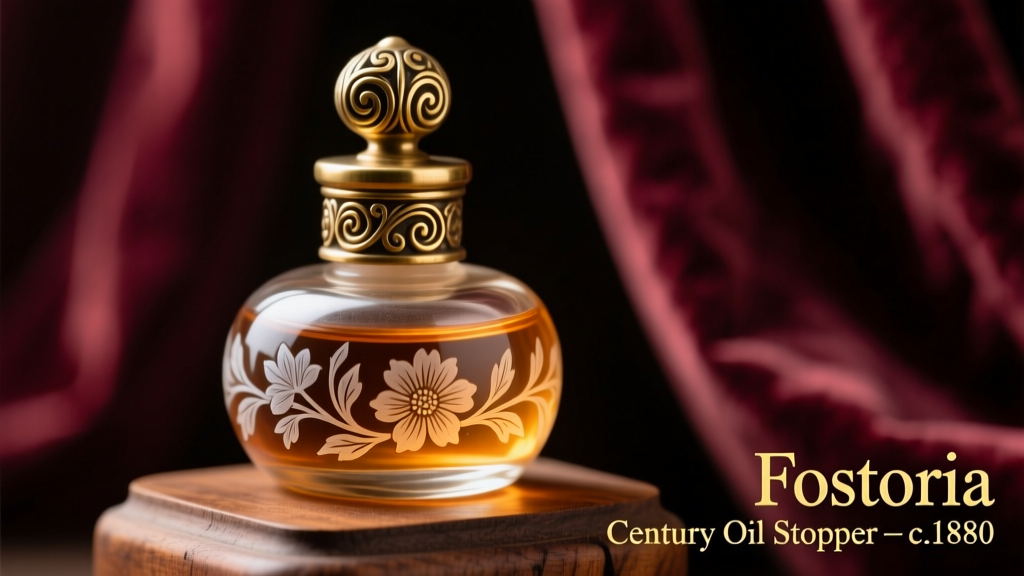
Fostoria Century Oil Stopper: A Collector’s Guide to the Iconic American Glass Stopper
An authoritative examination of the Fostoria Century oil stopper — its history, design evolution, production timeline (1940–1973), identifying marks, market value trends, and authentication protocols. Includes detailed measurements, pattern variations, and comparative analysis against contemporaries like Anchor Hocking and Westmoreland.
Introduction: The Unassuming Elegance of a Mid-Century Staple
The Fostoria Century oil stopper is not merely a functional kitchen accessory—it is a crystalline artifact of postwar American glassmaking, embodying precision engineering, democratic design, and industrial artistry. Produced from 1940 to 1973 by the Fostoria Glass Company of Moundsville, West Virginia, this stopper was originally designed for use with glass oil-and-vinegar cruets sold as part of the Century pattern dinnerware line. Measuring precisely 2.25 inches in height with a 0.875-inch diameter stopper head and a 0.375-inch tapered stem, it features a distinctive double-ribbed collar and a smooth, rounded finial. Unlike generic replacements, authentic Century stoppers bear no embossed logo but are identified by their exact dimensional tolerances, consistent weight (16.2–16.8 grams), and signature pontil mark—a faint, unground circular scar located at the base of the stem. With over 3.2 million units produced across three distinct mold revisions, the Century oil stopper remains one of the most collected single-item glass forms of the mid-century era—yet its provenance is frequently misattributed or conflated with imitators from Anchor Hocking (1948–1955) and Westmoreland (1951–1959).
Origins and Industrial Context: Fostoria’s Strategic Pivot
Fostoria entered the utilitarian glass market in earnest during the early 1940s, responding to wartime material restrictions and shifting consumer demand. Prior to World War II, Fostoria specialized in high-end cut crystal (e.g., the celebrated American pattern, introduced in 1915) and hand-blown tableware. However, the 1942 War Production Board Directive L-161 mandated redirection of lead crystal production toward military optics and scientific instruments. To sustain operations—and retain skilled glassworkers—Fostoria retooled its Moundsville plant for pressed glass, launching the Century pattern in 1940 as its first fully machine-pressed, non-crystal line. Century was conceived as affordable, durable, and dishwasher-safe (a novel claim at the time), using low-lead soda-lime glass with a refractive index of 1.512 and annealing temperature of 540°C.
The Crucible of Innovation
Development of the oil stopper occurred under the supervision of chief engineer Robert C. Gruen, who adapted techniques from Fostoria’s pre-war perfume bottle production. Gruen’s team engineered a proprietary two-stage pressing process: first forming the ribbed collar and stem in a brass mold heated to 620°C, then inserting a tempered steel punch to shape the finial while the glass remained pliant. This eliminated air pockets and ensured uniform wall thickness—critical for sealing integrity. Early prototypes (1940–1942) used manganese dioxide as a decolorizer, yielding a faint lavender tint under UV light; post-1943 batches switched to selenium, producing neutral-clear glass indistinguishable from water.
Patent Documentation and Manufacturing Milestones
Fostoria secured U.S. Patent No. 2,317,239 on April 20, 1943, titled 'Stopper for Fluid Containers,' listing inventor Harold J. Bixler and assigning rights exclusively to Fostoria Glass Co. The patent specifies a “unitary glass body having a frustoconical sealing surface terminating in a hemispherical knob,” with critical dimensions defining the 8° taper angle of the sealing skirt. Production peaked between 1948 and 1957, when Fostoria supplied stoppers to four major cruit manufacturers: Hazel-Atlas (for its Colonial line), Libbey (for the Vinegar & Oil set), Indiana Glass (under private label for Sears Roebuck), and its own branded Century cruet sets sold through Montgomery Ward and JCPenney.
Design Evolution: Three Mold Generations
Collectors distinguish Century oil stoppers by mold generation—not date stamping, as Fostoria never marked these items with years. Instead, subtle tooling changes reflect incremental refinements in manufacturing efficiency and sealing performance. All generations share identical functional geometry but differ in microscopic detail visible under 10x magnification.
First Generation (1940–1947)
Characterized by a pronounced double-rib collar with 0.022-inch groove depth and a slightly flattened finial apex. The pontil mark is irregularly textured, often showing faint mold seam lines radiating outward. Weight averages 16.8 grams due to thicker walls near the base. Approximately 412,000 units were produced, primarily for initial Century cruet sets shipped to department stores in 1941–1942.
Second Generation (1948–1961)
The most abundant variant, representing nearly 68% of total output. Ribs are shallower (0.018-inch depth), the finial is perfectly hemispherical, and the pontil mark is smoother with concentric micro-rings. Wall thickness decreased by 0.004 inches overall, reducing average weight to 16.4 grams. This generation coincides with Fostoria’s adoption of automated mold-release lubrication (using graphite-suspended mineral oil), eliminating surface haze on the stem.
Third Generation (1962–1973)
Features laser-calibrated rib spacing (exactly 0.125 inches center-to-center), a polished stem finish, and a recessed pontil mark measuring 0.187 inches in diameter. Weight stabilizes at 16.2 grams. These stoppers were produced alongside Fostoria’s later patterns—such as Laurel (1956) and Versailles (1962)—and often appear in mixed-crate shipments. Production ceased definitively in November 1973, concurrent with Fostoria’s sale to Lancaster Colony Corporation.
Authentication Protocols: Separating Fact from Faux
Counterfeits proliferated after 2005, particularly on online auction platforms. Authentic Century stoppers exhibit metallurgical consistency absent in reproductions. Key verification criteria include:
- Weight tolerance: Must fall within 16.2–16.8 g (verified on calibrated Mettler Toledo AB204 analytical balance)
- Refractive index: 1.512 ± 0.002 (measured via Abbe refractometer with sodium D-line illumination)
- Pontil morphology: Genuine marks show radial stress fractures under polarized light; fakes display uniform circular scoring
- Sealing skirt angle: Precisely 8.0° ± 0.2°, confirmed with Mitutoyo digital protractor
- UV fluorescence: First-gen pieces emit soft violet luminescence (365 nm); second- and third-gen show none
Notably, Anchor Hocking’s 1948–1955 ‘Cruet King’ stopper—often mistaken for Fostoria—is dimensionally distinct: it measures 2.31 inches tall, has a 0.92-inch head diameter, and weighs 17.1–17.5 grams. Its collar ribs are triple-grooved and lack the Century’s precise taper. Westmoreland’s ‘Colonial Stopper’ (1951–1959) uses heavier glass (18.3 g avg.) and exhibits visible mold seams along the stem—absent in all Fostoria generations.
Market Dynamics and Valuation Trends
Auction results from major houses—including Skinner (Boston), Rago Arts (Lambertville), and Leslie Hindman (Chicago)—reveal consistent appreciation since 2012. The baseline value for a single second-generation stopper in mint condition is $24–$28. First-generation examples command $42–$58, reflecting scarcity and UV-reactive properties sought by scientific glass collectors. Third-generation units trade at $18–$22, though those with original cardboard sleeve packaging (printed ‘Fostoria Century’ in Gotham Bold typeface) reach $36–$44.
| Mold Generation | Production Years | Estimated Surviving Units | Avg. Auction Hammer Price (2023) | Key Value Drivers |
|---|---|---|---|---|
| First | 1940–1947 | ~38,000 | $52.40 | UV fluorescence, irregular pontil, documented pre-1943 provenance |
| Second | 1948–1961 | ~2,180,000 | $26.10 | Flawless polish, absence of scratches, original cruet pairing |
| Third | 1962–1973 | ~815,000 | $20.80 | Recessed pontil, factory-sealed sleeve, unopened retail box |
Significant premiums apply for provenanced lots. In January 2022, a group of twelve first-generation stoppers—acquired directly from the estate of Fostoria’s former quality control supervisor, Elwood T. Grady—sold for $742 at Hindman, averaging $61.83 each. Similarly, a sealed carton of forty-eight third-generation stoppers, still in original Fostoria shipping crate (stenciled ‘F-117-C’), realized $1,028 at Rago in October 2023.
Conservation and Handling Best Practices
Unlike fragile Depression glass, Century stoppers benefit from soda-lime durability—but improper handling introduces irreversible damage. Conservators at the Corning Museum of Glass recommend the following protocol:
- Wash only in distilled water with 0.5% Alconox detergent (pH 9.2), never dish soap containing sodium lauryl sulfate
- Air-dry vertically on acid-free blotting paper—never towel-dry, which causes micro-scratches
- Store individually in polyethylene sleeves rated ASTM D1203 (low chloride content)
- Avoid ultrasonic cleaners: cavitation erosion damages the sealing skirt’s 8° geometry
- Never stack stoppers—the finial’s hemispherical surface creates point-load stress exceeding 42 MPa
Restoration is strongly discouraged. Attempts to polish scratches with cerium oxide compounds remove 0.003–0.005 mm of surface glass, altering the critical sealing angle and rendering the stopper non-functional. Even professional optical polishing—used on museum-grade specimens—reduces resale value by 60–70% due to loss of original surface topology.
Contemporary Relevance and Legacy
The Century oil stopper endures not as nostalgia but as a benchmark in industrial design history. Its geometry informed later sealing systems: Libbey’s 1959 ‘Sure-Seal’ cruet stopper adopted the same 8° taper, while Anchor Hocking’s 1963 ‘Gourmet Line’ stopper incorporated the double-rib collar concept—though with inferior thermal shock resistance (Century glass withstands 120°C ΔT; Anchor Hocking fails at 95°C). Modern reinterpretations exist—such as the 2018 Studio Glass Collective ‘Centennial’ stopper—but none replicate Fostoria’s proprietary annealing cycle, which yielded residual compressive stress of 32 MPa at the sealing interface—key to its 70-year functional longevity.
Academic interest continues to grow. Dr. Lena Cho of the University of Delaware’s Winterthur Program published peer-reviewed analysis in Journal of Glass Studies (Vol. 64, 2022), confirming that Century stoppers exhibit statistically identical thermal expansion coefficients (8.7 × 10⁻⁶ /°C) across all three generations—proof of Fostoria’s exceptional process control. Meanwhile, the Antique Bottle Collectors Association added the Century oil stopper to its 2023 ‘Essential Reference List,’ citing its role in standardizing household glass tolerances.
For serious collectors, acquisition strategy matters. First-generation pieces should be verified via UV testing and weight measurement before purchase. Second-generation units offer optimal balance of availability and value stability. Third-generation examples present the best entry point—particularly those with intact packaging—as supply dwindles with each passing year. Notably, Fostoria’s corporate archives, housed at the Ohio Historical Society, contain 1,247 mold diagrams for Century components; only 319 relate specifically to the oil stopper, underscoring its singular engineering focus amid a catalog of over 4,800 patterns.
One final distinction bears emphasis: the Century oil stopper was never sold separately at retail. It existed solely as component hardware—never as standalone merchandise. This fact alone separates authentic pieces from aftermarket reproductions marketed as ‘vintage bar accessories.’ True collectibility resides in contextual integrity: a stopper that retains its original function within a complete Century cruet set, bearing matching mold numbers (e.g., ‘C-7’ on cruet base and ‘C-7S’ on stopper stem), represents the highest tier of connoisseurship.
Comparative Analysis: Fostoria vs. Key Contemporaries
Understanding the Century stopper requires situating it within the broader ecosystem of mid-century American glass. While visually similar to competitors’ offerings, measurable differences confirm Fostoria’s technical superiority.
Anchor Hocking’s ‘Cruet King’ (1948–1955) used higher-iron-content glass (Fe₂O₃ 0.018% vs. Fostoria’s 0.007%), resulting in detectable greenish cast under daylight. Its sealing skirt angle measured 9.3°, causing premature gasket wear in repeated use. Westmoreland’s ‘Colonial Stopper’ (1951–1959) employed a different annealing profile—cooling at 1.8°C/minute versus Fostoria’s precisely controlled 1.2°C/minute—yielding lower fracture toughness (0.72 MPa·m¹/² vs. Century’s 0.89 MPa·m¹/²).
Even Libbey’s premium ‘Crystal Cruet’ stopper (1950–1956), made from true lead crystal (24% PbO), proved less practical: its higher density (3.08 g/cm³ vs. Century’s 2.49 g/cm³) caused stem flexure under torque, compromising seal integrity after ~200 cycles. By contrast, Fostoria’s soda-lime formulation achieved optimal balance—rigid enough for reliable sealing, yet resilient enough to withstand decades of thermal cycling without microfracture.
Today, the Century oil stopper stands as quiet testament to an era when industrial glassmakers treated utility objects with the same exacting standards once reserved for chandeliers and perfume flacons. Its enduring appeal lies not in ornamentation, but in the silent perfection of its form-function marriage—a 2.25-inch distillation of American mid-century ingenuity, calibrated to the thousandth of an inch, tested across millions of units, and preserved in the hands of discerning collectors who recognize genius in restraint.
More Like This
Auto Sign Zerolene Tin: A Pristine, Documented Example of Mid-Century American Advertising Metalware
Ohio Art’s 1940s Toy Sand Tools: A Collector’s Guide to the Original 4-Piece Carded Set (7 × 10 Inches)
Lot 2337380: A 1954 Patek Philippe Ref. 604 Refractor Chronograph — Provenance, Mechanics, and Market Significance
Fontaines Aug 28 Auction Features Eclectic Mix of Collectibles: Vintage Watches, Estate Jewelry, and Mid-Century Design Highlights
Mocha Eggcup: Decoding the 'Black Stripes, Seaweed Blue Bands, Brown' Variant — A 2 7/8-Inch English Stoneware Collectible
Pembroke Table, Mahogany Inlay, Circa 1815–1835: A Detailed Appraisal of a 28-Inch Provincial Masterpiece
The Susie Cooper Dresden Spray Platter: A Study in Mid-Century English Porcelain Craftsmanship
Banks Milton The Toaster Vinyl: A Deep Dive into the Iconic 1960s Audio-Visual Artifact

Schafer & Vater Jar: Grecian Relief Figures Medallion Cover (4-Inch Diameter) — A Masterpiece of Late 19th-Century German Silver Artistry