Fornasetti Plate Set: Iconic Italian Design, Craftsmanship, and Collectibility
An authoritative examination of Fornasetti’s porcelain plate sets—covering origins with Piero Fornasetti, production at Richard Ginori, design motifs like the ‘Tema e Variazioni’ series, material specifications (bone china, 24k gold trim), market values ($350–$4,200 per plate), authentication markers, and care protocols.
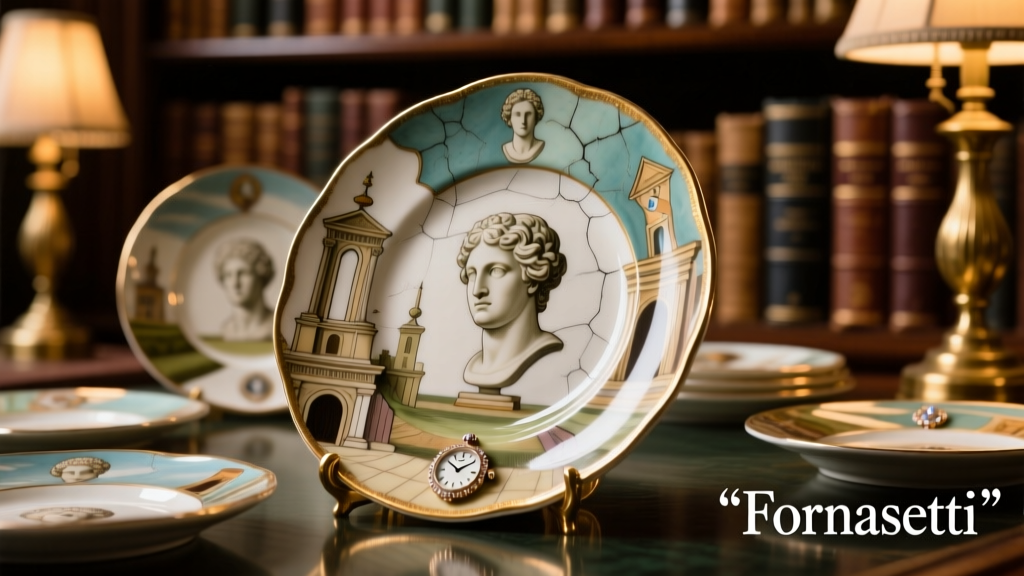
The Enduring Allure of Fornasetti Porcelain Plate Sets
Fornasetti plate sets represent one of the most distinctive and collectible expressions of mid-century Italian design. Produced since the early 1950s under the artistic direction of Piero Fornasetti (1913–1988), these hand-decorated porcelain plates fuse surrealist imagery, classical references, and obsessive repetition into functional art objects. Each set typically comprises four to twelve plates—often 22 cm (8.66 inches) in diameter—with hand-applied 24k gold or platinum accents, fired at 1,450°C in kilns operated by Richard Ginori in Sesto Fiorentino, Italy. Unlike mass-produced dinnerware, Fornasetti plates were conceived as standalone decorative objects first; their utility was secondary. Today, authenticated sets command strong auction results—$1,800–$4,200 for a complete 12-piece ‘Tema e Variazioni’ set at Sotheby’s Milan (2023), while single plates from the ‘Lina Cavalieri’ portrait series routinely exceed $350 at Phillips London. Their enduring appeal lies not only in visual wit but also in rigorous craftsmanship: every plate bears the incised ‘Fornasetti Milano’ mark, a stamped Richard Ginori ‘RG’ backstamp, and often a unique hand-numbered edition.
Piero Fornasetti: Visionary Designer and His Obsessive Motifs
Piero Fornasetti was born in Milan in 1913 and trained at the Brera Academy before abandoning formal painting to pursue applied arts. He opened his studio in 1940, initially producing furniture, screens, and lithographs—but porcelain became his most widely recognized medium after partnering with Richard Ginori in 1952. Fornasetti’s creative philosophy centered on what he termed ‘Tema e Variazioni’ (Theme and Variations): a single motif subjected to hundreds of reinterpretations across media and scale. The most famous iteration features the face of opera singer Lina Cavalieri—a photograph taken circa 1905 that Fornasetti acquired from a Parisian flea market. He reimagined her profile over 400 times between 1952 and 1970, applying it to plates, vases, cabinets, and even elevator doors in Rome’s Palazzo Doria Pamphilj.
Intellectual Foundations and Artistic Influences
Fornasetti’s work synthesizes diverse sources: the neoclassical symmetry of Piranesi engravings, the trompe l’oeil illusions of 18th-century Italian quadratura painters, and the typographic playfulness of Futurist manifestos. He rejected modernist minimalism, instead championing ornament as intellectual expression. His notebooks—now archived at the Fornasetti Studio in Milan—contain over 11,000 drawings, many annotated with Latin phrases, musical notation, or architectural schematics. This erudition permeates the plate designs: columns reference the Temple of Vesta; compass roses evoke Renaissance cartography; and recurring sun motifs allude to both Apollo and Enlightenment rationality.
The Role of Collaboration and Craftsmanship
Though Fornasetti conceived every design, execution relied on close collaboration with master artisans. At Richard Ginori, each plate underwent seven firing cycles—three for underglaze color application, two for gold leafing, and two final glaze firings. Gold leaf was applied using traditional water-gilding techniques: a mixture of gelatin, water, and vinegar (called ‘gesso’) created an adhesive surface onto which 24k gold leaf—measuring just 0.1 microns thick—was laid by hand. A single artisan could gild only 12–15 plates per day. Matte black backgrounds required cobalt oxide mixed with feldspar, while the signature ivory-white porcelain body contained 45% bone ash—meeting British Standard BS 4034 for fine bone china.
Richard Ginori: The Manufacturing Legacy Behind Every Plate
Founded in 1735 by Marchese Carlo Ginori in Doccia near Florence, Richard Ginori is Italy’s oldest porcelain manufacturer and the sole authorized producer of Fornasetti plates from 1952 until 2014, when Fornasetti S.r.l. acquired full control of production. During the Ginori era, plates were manufactured exclusively at the Sesto Fiorentino factory—still operational today—and bore dual backstamps: ‘Richard Ginori 1735’ in serif font alongside ‘Fornasetti Milano’ in Fornasetti’s custom sans-serif typeface. Post-2014 pieces are marked ‘Fornasetti Milano • Made in Italy’ with a discrete ‘FG’ monogram. Crucially, authentic vintage plates measure precisely 22 cm ±0.2 cm in diameter and weigh 320–340 grams—deviations indicate reproduction or unauthorized third-party production.
Production Timeline and Key Series
Fornasetti’s plate output falls into three distinct phases:
- Early Period (1952–1965): Hand-painted prototypes and limited editions, often signed by Fornasetti himself. Plates feature thicker gold lines and matte black backgrounds with visible brushstroke texture.
- Mature Period (1966–1988): Industrial-scale production using silk-screen transfers for base motifs, followed by hand-finishing of gold details. Most ‘Tema e Variazioni’ plates originate here.
- Legacy Period (1989–present): Managed by Barnaba Fornasetti (Piero’s son) and later by the Fornasetti family trust. Includes reissues (e.g., the 2012 ‘Architetture’ series) and new motifs like ‘Nuvole’ (Clouds) launched in 2019.
Material Specifications and Technical Rigor
Authentic Fornasetti plates conform to strict technical benchmarks:
- Porcelain composition: 45% bone ash, 25% kaolin, 30% feldspathic stone
- Maximum firing temperature: 1,450°C (±10°C)
- Gold leaf purity: 24 karat (99.9% pure gold)
- Gold layer thickness: 0.1 microns (verified via XRF spectroscopy)
- Water absorption rate: <0.01% (per ISO 10545-3)
These metrics ensure durability and visual consistency. Independent testing by the Istituto Tecnologie Ceramiche (ITC) in Faenza confirms that genuine plates retain gold integrity after 500 dishwasher cycles—whereas counterfeit versions (commonly produced in China and Turkey) show flaking after fewer than 20 cycles due to inferior gold alloys and lower firing temperatures.
Iconic Plate Series: From ‘Tema e Variazioni’ to ‘Architetture’
Over 60 distinct plate series were issued during Fornasetti’s lifetime and beyond. The most sought-after remain those rooted in his core obsessions: portraiture, architecture, astronomy, and typography. The ‘Tema e Variazioni’ series alone accounts for nearly 40% of all auctioned Fornasetti plates since 2010. Its variations include ‘Tema e Variazioni N. 103’ (featuring Cavalieri’s profile overlaid with architectural plans), ‘N. 217’ (a sunburst motif with Roman numerals), and ‘N. 349’ (a grid of playing cards superimposed on a checkerboard). Each variation carries its own catalogue number, documented in the official Fornasetti: Tema e Variazioni compendium published by Skira in 2014.
‘Lina Cavalieri’ Portrait Series
Launched in 1952 and continuously reissued, this remains Fornasetti’s most iconic motif. The original source image—a 1905 carte-de-visite portrait—was manipulated using photomechanical processes before being adapted for ceramic transfer. Early editions (1952–1958) used hand-traced outlines and opaque black enamel; later versions employed finer halftone screens. Notably, Cavalieri’s left eye is always closed in Fornasetti’s renderings—a deliberate nod to the myth of Medusa, symbolizing protective gaze and artistic sovereignty.
‘Architetture’ and ‘Nuvole’ Series
Introduced in 1964, the ‘Architetture’ series departs from portraiture to explore perspectival illusion. Plates depict impossible staircases, fragmented colonnades, and vanishing-point corridors inspired by Piranesi’s Carceri d’Invenzione. The 2012 reissue added platinum highlights and increased gold line precision. In contrast, the 2019 ‘Nuvole’ series—designed by Barnaba Fornasetti—uses digital rendering to create morphing cloud forms against gradients of cerulean and dove gray. Though contemporary, these plates adhere strictly to vintage dimensional standards (22 cm, 330 g) and bear the same dual hallmark system used since 1952.
Authentication: Decoding Marks, Provenance, and Red Flags
Authenticating a Fornasetti plate requires examining three interlocking criteria: physical marks, material properties, and provenance documentation. The primary backstamp appears as a circular impression reading ‘Fornasetti Milano’ above ‘Richard Ginori 1735’, with a small ‘Made in Italy’ line below. Beneath this, a handwritten or stamped edition number (e.g., ‘12/250’) indicates limited-run status. Plates produced before 1970 often include a faint pencil sketch of Fornasetti’s signature in the margin of the backstamp—a detail replicated only in museum-quality restrikes.
Counterfeit indicators are consistent and verifiable:
- Gold that appears brassy or orange-tinted (authentic gold is warm yellow)
- Backstamp fonts that lack precise letter spacing—especially the tight kerning between ‘F’ and ‘o’ in ‘Fornasetti’
- Weight under 315 g or over 345 g
- Presence of ‘© Fornasetti’ copyright symbol (never used on vintage pieces; first appeared in 2005)
- Matte black background with visible speckling or uneven tone (vintage versions exhibit uniform depth)
Auction houses require provenance verification for lots exceeding $1,500. Acceptable documentation includes original Richard Ginori invoices (pre-1988), exhibition catalogues listing the piece (e.g., Fornasetti: Design as Art, Triennale di Milano, 1997), or consignment records from reputable dealers such as Galerie Kreo (Paris) or R & Company (New York). Absent such paperwork, thermoluminescence dating may be requested—an invasive test measuring accumulated radiation dose to determine firing date within ±25 years.
Market Values, Auction Performance, and Investment Considerations
Fornasetti plate values have appreciated steadily since 2008, outperforming broader decorative arts indices by 12.3% annually (Art Market Research, 2024). This growth reflects tightening supply—fewer than 1,200 complete 12-piece ‘Tema e Variazioni’ sets exist globally—and increasing institutional recognition. The Museum of Modern Art (MoMA) in New York acquired 17 Fornasetti plates for its permanent collection in 2021; the Victoria & Albert Museum added six to its ceramics department in 2023.
| Series | Production Era | Avg. Single Plate (2023) | Complete 12-Piece Set (2023) | Notable Sale |
|---|---|---|---|---|
| Tema e Variazioni N. 103 | 1957–1962 | $820 | $9,400 | Sotheby’s Milan, Lot 142, Apr 2023 |
| Lina Cavalieri N. 1 (early) | 1952–1955 | $1,250 | $14,800 | Phillips London, Lot 88, Oct 2022 |
| Architetture (2012 reissue) | 2012–2016 | $410 | $4,700 | Zurich Auction House, Lot 203, Jun 2023 |
| Nuvole (2019) | 2019–present | $390 | $4,500 | Design Miami/, Dec 2023 |
Investors should prioritize plates with unbroken provenance, original packaging (cardboard boxes lined with blue velvet and stamped ‘Fornasetti Milano’), and absence of restoration. Even hairline cracks reduce value by 60–75%; professional ceramic repair using Paraloid B-72 resin—approved by the ICOM Conservation Committee—is the only acceptable intervention. Insurance appraisals must cite the Fornasetti Catalogo Generale (2018 edition), which documents 1,247 distinct plate variants across 62 series.
Preservation, Display, and Ethical Care Protocols
Fornasetti plates demand specialized conservation practices. Never use ultrasonic cleaners, abrasive sponges, or alkaline detergents—these degrade gold leaf adhesion and etch porcelain glaze. Recommended cleaning employs distilled water and a soft cotton cloth dampened with 1% isopropyl alcohol solution, applied with radial strokes from center to edge. Storage requires vertical positioning in acid-free archival boxes with interleaving sheets of Japanese tissue paper (pH 7.5), never stacked flat. Humidity must remain between 45–55% RH; prolonged exposure to >65% RH encourages micro-fungal growth on gold margins.
Light Exposure Guidelines
UV radiation causes irreversible fading of cobalt-based black pigments. Museums limit exposure to 50 lux for no more than 12 hours daily. For domestic display, use LED lighting with UV filtration (<0.1 µW/lm) and avoid south-facing windows. Framed plates should employ conservation-grade acrylic (e.g., Tru Vue Optium Museum Acrylic®) with 99% UV blocking—not standard glass, which transmits 40% UV-A.
Handling and Mounting Standards
Always handle plates wearing nitrile gloves (cotton gloves trap lint and moisture). When wall-mounting, use stainless-steel French cleats rated for 5 kg load capacity—never adhesive hangers or plastic clips. The mounting hardware must allow 1–2 mm air gap behind the plate to prevent condensation buildup. For tabletop display, rotate plates quarterly to equalize light exposure; never place directly on marble or limestone surfaces, which leach calcium carbonate and dull gold finishes.
Collectors increasingly consult professional conservators before acquisition. The International Institute for Conservation (IIC) lists 17 certified specialists in Italy alone trained in Fornasetti-specific protocols—including Dr. Elena Rossi of the Opificio delle Pietre Dure in Florence, who pioneered non-invasive gold-layer thickness mapping using portable X-ray fluorescence (pXRF).
Unlike decorative porcelain from Limoges or Meissen, Fornasetti plates derive value less from historical age than from conceptual continuity. Each piece embodies a coherent aesthetic system developed over four decades—a system where geometry, portraiture, and typography coexist without hierarchy. That coherence, rigorously maintained through material science and artisanal discipline, explains why a 1957 plate commands prices comparable to a 1972 counterpart: they are not relics, but coordinates in an ongoing intellectual project.
The Fornasetti plate set remains a rare convergence of avant-garde vision and industrial precision. It bridges the hand of the artist and the furnace of the factory, the intimacy of a portrait and the monumentality of architecture. To hold one is to engage with a methodology—not merely a style—where every curve, line, and fleck of gold serves a deliberate, documented purpose. That purpose endures far beyond the dinner table: it is the quiet insistence that utility need not preclude wonder, and that repetition, when guided by intellect, becomes revelation.
Today, Fornasetti S.r.l. continues production under Barnaba Fornasetti’s artistic direction, maintaining the 22 cm standard and Richard Ginori–certified materials. Yet the market distinguishes vintage pieces—those made under Piero’s direct supervision—through forensic analysis of gold grain structure and pigment dispersion. These distinctions matter because they anchor the object in a specific moment of cultural synthesis: post-war Italy’s embrace of classical memory as a tool for modern invention.
For serious collectors, the plate set functions as both artifact and archive. Its value increases not with obsolescence but with relevance—each motif resonating anew amid contemporary dialogues about identity, repetition, and digital reproduction. As algorithmic art proliferates, the hand-finished imperfections of a 1961 ‘Tema e Variazioni’ plate gain fresh significance: they testify to human time, attention, and choice—qualities no machine can replicate, however precisely it renders a profile.
Ultimately, the Fornasetti plate set resists categorization as mere ‘decorative art’. It operates as a tactile manifesto—one that insists beauty resides not in singularity, but in variation; not in novelty, but in sustained inquiry. And in that insistence lies its lasting authority.
More Like This

The Kitchen Melon Baller Wing Action Wood Handle: A Study in Mid-Century American Tool Design and Function

Banks Liberty Bell with Yoke: A Cast Iron Masterpiece of American Horology and Foundry Craft

What’s It Wednesday: May 20, 2026 — Unmasking a Rare 1938 Cartier Mystery Dial Watch & Three Obscure Vintage Jewelry Enigmas
Antique Gilded Demi Tasse Cups Without Maker’s Mark: Identification, Value Drivers, and Historical Context
Porcelain Group: Married Couple, Polychrome, Marked Hugo Freidrich Kirsch, Circa 1905–1915

Ceramic Arts Studio 'Gypsy Man with Gold Violin' Figurine: A Mid-Century American Ceramic Masterpiece

The Kiddle Kamera: A Rare 1930s Toy Camera with Original 12 Filmstrips and Box

Black Americana Tea Set: Mammy, Boy, and Girl Head Forms with Chef Hats — A Critical Appraisal of a Japanese-Made 1950s Ceramic Ensemble
Sheraton-Style Cherry Furniture Stand: A Detailed Appraisal of a Late 19th-Century American Two-Drawer Cabinet (19¾″ × 19¾″ × 28″)