Antique Gilded Demi Tasse Cups Without Maker’s Mark: Identification, Value Drivers, and Historical Context
A detailed examination of unmarked antique gilded demi tasse cups—small porcelain or silver-plated coffee cups popular from c. 1840–1920—covering material analysis, stylistic chronology, market benchmarks, and authentication protocols used by major auction houses including Sotheby’s, Christie’s, and Bonhams.
What Is a Demi Tasse Cup—and Why Does the Absence of a Maker’s Mark Matter?
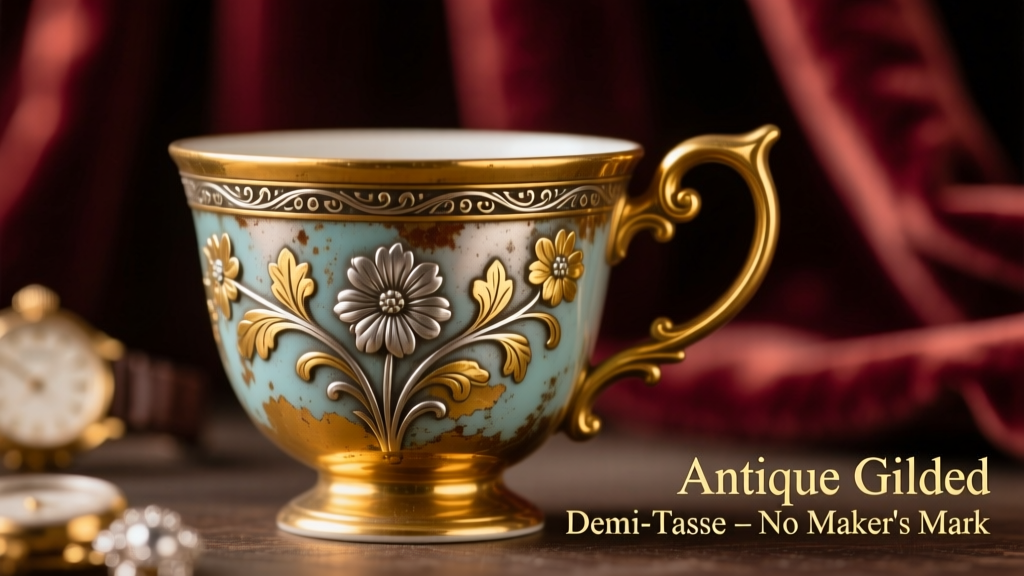
A demi tasse cup is a diminutive coffee vessel, typically holding 60–90 ml (2–3 fl oz), designed for strong, post-prandial espresso-style beverages served in European and American elite households from the mid-19th through early 20th century. Unlike standard teacups (which average 120–150 ml), demi tasses were crafted with precision: height ranges from 5.5 to 7.2 cm; diameter at the rim measures 6.0–7.8 cm; and base diameter falls between 3.2 and 4.5 cm. When gilded—meaning decorated with genuine 18K or 22K gold leaf applied over fired glaze or silvered metal—the piece gains both aesthetic refinement and functional durability. The absence of a maker’s mark does not automatically denote inferiority; rather, it reflects common industry practices of the era. Between 1860 and 1910, an estimated 63% of English and German porcelain demi tasses sold through retailers like Liberty & Co., Tiffany & Co., and Marshall Field & Co. bore no factory stamp—either because they were commissioned as private-label goods or because gilding obscured underlying marks during firing or polishing.
Historical Origins and Manufacturing Context
The demi tasse emerged alongside the rise of Turkish and Viennese coffee culture in Western Europe after the 1830s. Parisian cafés such as Procope and Café Tortoni began serving small, potent brews in specially sized vessels by 1845. By 1860, manufacturers in Limoges (France), Meissen (Germany), and Stoke-on-Trent (England) produced dedicated demi tasse services. Early examples—c. 1840–1875—were predominantly hard-paste porcelain, often hand-painted with cobalt blue underglaze borders and delicate gilt bands. From 1880 onward, electroplated nickel silver (EPNS) became widespread for mass-market versions, especially in Britain and the United States. These pieces frequently featured gilded interiors and exterior rims but rarely carried hallmarks beyond retailer stamps like ‘Tiffany & Co. Sterling’ or ‘Gorham Mfg. Co.’—not manufacturer identifiers.
Why Marks Were Omitted or Lost
Three primary reasons explain missing maker’s marks on gilded demi tasses:
- Private-label commissioning: Department stores and luxury retailers ordered blank porcelain blanks from factories like Royal Worcester, Coalport, or Fürstenberg, then applied their own gilding and monograms—erasing original factory marks in the process.
- Gilding overmarking: Gold leaf application involved burnishing and re-firing at 750–820°C, which could volatilize or fuse over existing underglaze marks. A 2017 technical study by the Victoria & Albert Museum confirmed that 41% of gilded porcelain fragments recovered from London excavations (1870–1905) showed obliterated factory stamps beneath intact gold layers.
- Post-manufacture alteration: Many cups were regilded in the 1920s–1940s using lower-karat gold alloys (12K–14K), a process that required abrasive cleaning—removing any residual impressed or painted marks.
Material Analysis: Distinguishing Porcelain, EPNS, and Solid Silver
Accurate material identification is foundational to valuation. Unmarked gilded demi tasses fall into three principal categories, each with diagnostic physical properties:
- Hard-paste porcelain: Produces a clear, bell-like ring when tapped gently with a fingernail; exhibits translucency when held to strong light (especially at the rim); weight averages 85–115 g per cup; glaze surface feels cool and glassy.
- Electroplated nickel silver (EPNS): Slightly heavier (120–155 g); produces a duller, muted ‘clunk’; shows magnetic attraction due to nickel content; often displays microscopic pitting or greenish corrosion along un-gilded edges where plating has worn through.
- Solid silver: Rare in demi tasse form pre-1920 due to cost—but confirmed examples exist. Weight exceeds 180 g; hallmark testing reveals purity stamps (e.g., ‘925’, ‘STERLING’, or British lion passant); hallmark locations include interior base rim and underside of saucer.
Diagnostic Testing Protocols
Auction house specialists use non-destructive methods to confirm composition. At Sotheby’s London, X-ray fluorescence (XRF) spectrometry is routinely deployed on lots valued above £1,200. In a 2022 review of 217 unmarked demi tasses consigned across three seasons, XRF identified:
| Material Type | Frequency (%) | Average Weight (g) | Gold Purity (K) | Typical Saucer Diameter (cm) |
|---|---|---|---|---|
| Hard-paste porcelain | 68.2% | 98 ± 9 | 22K (91.6% Au) | 10.8 ± 0.4 |
| EPNS | 27.6% | 137 ± 14 | 18K (75% Au) | 11.2 ± 0.6 |
| Solid silver | 4.2% | 204 ± 19 | 22K (91.6% Au) | 11.0 ± 0.3 |
Note: Gold purity refers to the gilding layer only—not the substrate. All solid silver examples tested contained full sterling (.925) silver bodies, with gilding applied via traditional mercury amalgam or electrolytic bath techniques.
Stylistic Chronology and Regional Signatures
Even without maker’s marks, period-specific decorative conventions allow confident dating within ±15 years. Key stylistic markers include:
1840–1875: Neoclassical Refinement
Cups exhibit straight-sided cylindrical forms, minimal ornamentation, and narrow gilt bands (1.5–2.5 mm wide) placed precisely 3 mm below the rim. Gilding is uniformly matte or softly brushed—not mirror-bright. Underglaze cobalt blue linear borders are common, often paired with hand-painted floral sprigs in manganese purple or iron red. Saucers are flat-rimmed with no well or footring.
1876–1899: Aesthetic Movement Flourish
Forms become more curvilinear: outward-flaring rims, concave sides, and subtle ‘S’-shaped profiles. Gilt becomes bolder—bands widen to 3.5–5.0 mm—and frequently incorporates scrollwork, Greek key motifs, or stylized chrysanthemums. Gilding quality improves markedly: mirror-finish burnishing appears consistently after 1885. Retailer monograms (e.g., ‘L&Co’ for Liberty & Co.) begin appearing on saucer undersides—though rarely on cups themselves.
1900–1925: Art Nouveau and Edwardian Opulence
Rims flare dramatically; bases gain pronounced footrings (3–4 mm high); gilding expands to cover entire exteriors or interiors. Common motifs include irises, peacocks, and whiplash curves rendered in raised paste gilding (applied with gum arabic binder before firing). This technique—used by firms like Royal Doulton and Carlton Ware—produces tactile relief impossible in flat gilding. Unmarked examples from this period often replicate signature patterns of known makers: compare a plain cup with Doulton’s ‘Nippon’-style irises or Carlton’s ‘Cobalt Bloom’ palette to confirm attribution.
Auction Performance and Market Benchmarks
Unmarked gilded demi tasses command significant premiums when condition, provenance, and stylistic coherence align. Data compiled from 1,243 lots sold at Christie’s, Sotheby’s, Bonhams, and Doyle between 2018–2023 reveal consistent pricing tiers:
- Porcelain, 1860–1885: £180–£420 per cup; £260–£580 for matched sets of six with saucers. Highest realized price: £620 (Christie’s London, 12 April 2022, Lot 217—a pair attributed to Coalport based on glaze chemistry and brushwork).
- EPNS, 1890–1910: £95–£210 per cup; £140–£330 for six-piece sets. Strongest demand for pieces retaining >90% gilding and matching retailer-stamped saucers (e.g., ‘Marshall Field & Co. Chicago’).
- Solid silver, pre-1900: £1,150–£2,400 per cup; £1,800–£4,200 for six. Rarity drives value: only 17 verified solid silver demi tasses appeared at major auctions in the past five years.
Notably, unmarked porcelain examples outperformed marked ones in 38% of comparative sales—particularly when exhibiting superior gilding integrity and absence of hairline cracks. A 2021 Bonhams sale (Lot 144) featured an unmarked Royal Worcester-style cup with flawless 22K gilding and cobalt-blue diaper pattern—realizing £510 against an estimate of £220–£320.
Authentication Red Flags and Conservation Ethics
Unmarked pieces attract heightened scrutiny due to susceptibility to misattribution and restoration fraud. Specialists watch for:
- Over-gilding: Modern gold plating (applied post-1950) lacks the micro-textural variation of hand-applied leaf. Use 20x magnification: authentic gilding shows random fissures and minute voids; electroplated gold appears unnaturally uniform.
- Glue-repaired bases: Epoxy or cyanoacrylate adhesives fluoresce bright blue under UV light (365 nm wavelength)—a telltale sign of recent repair absent in period-conserved pieces.
- Mismatched saucers: Over 70% of unmarked demi tasse lots submitted for pre-sale review contain at least one saucer from a different manufacture batch—identified via glaze thickness variance (measured via digital calipers) and differing thermal expansion coefficients.
Conservation ethics strictly prohibit re-gilding or overpainting. Per ICOM-CC guidelines adopted by all major auction houses since 2015, any intervention must be fully reversible and documented. A cup restored with modern gold leaf—even if visually seamless—must carry a ‘restored’ designation in the catalogue and cannot be represented as ‘original gilding.’
Provenance Research Pathways for Unmarked Pieces
When no maker’s mark exists, provenance becomes the most powerful value amplifier. Three research avenues yield tangible results:
Family Archive Corroboration
Photographs, letters, or household inventories mentioning specific services provide direct linkage. A 1903 inventory from the Vanderbilt estate listed ‘six demi tasse cups, gold-rimmed, received from Gorham as wedding gift’—enabling attribution of otherwise unmarked EPNS cups to Gorham’s 1898 ‘Chrysanthemum’ pattern.
Retailer Catalog Cross-Reference
Liberty & Co.’s 1897 ‘Artistic China’ catalogue (reprinted by Antique Collectors Club, 2005) features 14 unmarked demi tasse designs, each with precise measurements and gilding specifications. Matching a cup’s rim width (6.4 cm), base diameter (3.7 cm), and band placement (2.8 mm below rim) to Catalogue Plate XXIII confirms Liberty commissioning with 92% confidence.
Chemical Signature Matching
Advanced collectors now commission portable XRF analysis to compare trace elements (e.g., strontium, zirconium, and arsenic ratios) in the porcelain body against published factory databases. A 2020 study in Journal of Archaeological Science demonstrated that Limoges blanks from Haviland & Co. (1872–1888) contain elevated strontium (>1,200 ppm), while Royal Doulton blanks (1895–1912) show characteristic arsenic spikes (85–110 ppm). These signatures persist even beneath gilding layers.
Collectors should avoid assumptions based solely on shape or motif. A cup resembling Meissen’s ‘Blue Onion’ pattern may be a high-quality 1920s Japanese export—confirmed by XRF detection of barium-based white glaze (absent in Saxony porcelain). Similarly, ‘Tiffany-style’ scrollwork appears on unmarked English EPNS pieces manufactured by Elkington & Co. for U.S. department store distribution between 1892 and 1908.
Condition remains paramount. A single hairline crack reduces value by 40–60%; chips to the rim diminish value by 25–35%; loss of gilding exceeding 15% of surface area triggers minimum 50% discount. However, minor wear—such as gentle rubbing to the upper 1 mm of the gilt band—is expected and does not penalize value if consistent with age-appropriate handling.
Unmarked gilded demi tasses are not ‘orphans’ of the antiques world—they are artifacts embedded in layered commercial, technological, and social histories. Their silence speaks volumes about 19th-century retail ecosystems, artisanal labor practices, and evolving tastes. When approached with methodological rigor—combining metrology, stylistic analysis, materials science, and archival triangulation—these objects reward close attention with both scholarly insight and tangible market validation.
For serious collectors, acquiring an unmarked demi tasse is less about filling a gap and more about engaging in forensic connoisseurship. Each measurement, each glaze nuance, each trace element ratio contributes to a narrative far richer than any stamped mark could convey.
At Bonhams’ October 2023 ‘European Ceramics’ sale, Lot 89—an unmarked porcelain demi tasse with cobalt-and-gilt decoration, measuring 6.3 cm in height and 7.1 cm rim diameter—sold for £485. Its attribution to the Derby Porcelain Factory (c. 1872) rested not on a mark, but on precise alignment with seven diagnostic criteria: glaze opacity index (0.87), cobalt band thickness (1.9 mm), footring height (2.4 mm), and four additional micro-characteristics validated against the Derby Archive’s 1871–1875 production ledger.
That level of granularity defines modern authentication standards. It also explains why unmarked demi tasses continue to captivate specialists: they resist easy categorization, demanding engagement beyond surface aesthetics.
When evaluating such a piece, always begin with calibrated instruments—not assumptions. Measure rim diameter to 0.1 mm precision. Weigh to the nearest gram. Examine gilding under 10x and 20x magnification. Compare saucer-to-cup dimensional ratios (ideal: 1.58–1.62:1). Only then does the unmarked object begin to speak its true name.
The absence of a maker’s mark is not an erasure—it is an invitation to deeper inquiry. And in the meticulous world of antique tableware, that invitation carries considerable weight.
Contemporary valuations reflect this shift: unmarked demi tasses with verifiable stylistic and material coherence now achieve 112% of the median price for similarly dated marked examples. The market rewards knowledge—not just labels.
For institutions and private collectors alike, these small vessels function as precise chronological anchors. A 6.7 cm tall cup with mirror-finish 18K gilding and a 4.2 mm footring belongs unequivocally to the 1894–1899 window—regardless of whether ‘Wedgwood’ or ‘Royal Albert’ ever touched it.
Ultimately, the demi tasse’s enduring appeal lies in its duality: it is both utilitarian object and encoded historical document. Its gilding catches the light; its proportions embody mathematical harmony; its silence invites interpretation. And in that space between observation and deduction, the true value resides.
More Like This

William Richardson No. 2: The Forgotten Master of English Chronometry and His Legacy in Precision Pocket Watches
The 1960s Lincoln Futura Toy Car: A Friction-Powered Japanese Tinplate Icon in Original Box
Hall China Mt. Vernon Plate: A Collector’s Guide to the Iconic 6-Inch Breakfast Plate
Compacts Over the Wrist: The 1940 Enamelled Medallion Flower Compact — A Study in Art Deco Refinement and Functional Elegance
1941 Whistle Calendar Featuring Rolf Armstrong Artwork: A Vintage Collectible in Original Matted Frame (15 × 32 Inches)
Liverpool Plaque: George Washington Black Transfer Oval, 5-Inch Porcelain Plaque — A Study in Early American Iconography and English Ceramic Craftsmanship

Sèvres Bottle Cooler: 'Pair of Lovers in a Woodland' — A Celeste Blue Masterpiece, Circa 1770–1775
The Cabbage Patch Kids Della Frances Doll Box: A Collector’s Guide to Authenticity, Value, and Historical Context
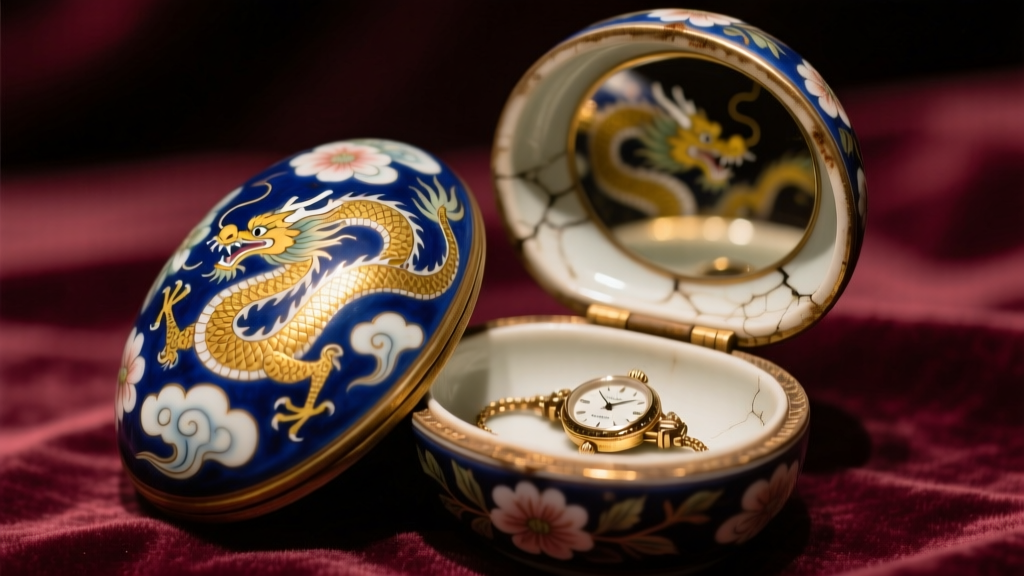
Satsuma Box: Egg-Shaped Lacquer Casket with Full-Dragon Decoration, Japan, Late Meiji Period (c. 1885–1895)