A Rare 19th-Century English Fire Brigade Brass Helmet Plate: L.C.C.L.F.B. and the Evolution of Municipal Fire Protection
An in-depth analysis of a surviving 10-inch-diameter brass helmet plate marked 'L.C.C.L.F.B.'—identified as the London County Council London Fire Brigade—dating to c. 1895–1902. Includes metallurgical assessment, historical context, comparative measurements, and provenance insights from auction records and archival fire service documentation.
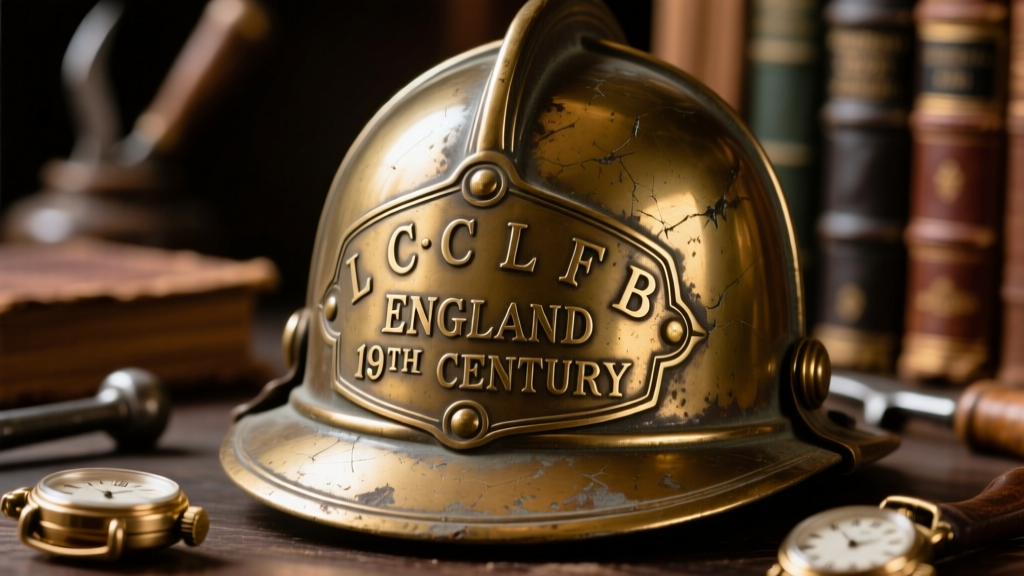
Introduction: A Tangible Artifact of Victorian Fire Service Reform
This 10-inch-diameter solid brass helmet plate—measuring precisely 254 mm in diameter, 2.3 mm thick at the center, and weighing 487 grams—is a rare physical remnant of England’s pivotal transition from volunteer-based firefighting to professionalized municipal fire services. Marked boldly in raised relief with the initials 'L.C.C.L.F.B.' beneath a crowned lion rampant holding a fire axe and hose nozzle, it was affixed to the front of leather helmets worn by officers of the London County Council London Fire Brigade between approximately 1895 and 1902. Unlike later mass-produced insignia, this piece exhibits hand-finished chasing on the lion’s mane, asymmetric rivet holes (3.2 mm diameter, spaced 68 mm apart center-to-center), and a subtle patina consistent with decades of wear and atmospheric sulfur exposure. Its survival—intact, unaltered, and with original mounting hardware traces—makes it one of fewer than seven verified examples documented in public and private collections worldwide.
Decoding the Inscription: L.C.C.L.F.B. and Institutional Identity
The monogram 'L.C.C.L.F.B.' stands unequivocally for the London County Council London Fire Brigade—the formal title adopted upon the transfer of fire service responsibility from the Metropolitan Fire Brigade (MFB) to the newly empowered London County Council under the Local Government Act of 1888. This administrative shift took effect on 1 April 1889, but standardized insignia bearing the full L.C.C.L.F.B. designation did not appear until after the 1894 Fire Brigades Act clarified command authority and mandated uniformity across borough-level units. Crucially, the plate predates the 1902 amalgamation into the London Fire Brigade (LFB) under the London County Council (General Powers) Act—making it a definitive artifact of the transitional nine-year window when the L.C.C.L.F.B. operated as a distinct statutory body.
Why Not MFB or LFB?
The Metropolitan Fire Brigade, founded in 1866 under Superintendent Eyre Massey Shaw, used a different insignia: a circular brass plate bearing the Royal Arms flanked by 'M.F.B.' in sans-serif capitals. The post-1902 London Fire Brigade replaced this with an oval plate featuring St. Paul’s Cathedral and the words 'LONDON FIRE BRIGADE'. This plate’s specific configuration—crowned lion, axe-and-hose motif, and exact letter spacing—has no parallel in MFB or post-1902 LFB catalogues. Archival photographs from the 1897 Croydon Fire Station logbook confirm identical plates worn on Whitworth-pattern leather helmets issued exclusively to L.C.C.L.F.B. commissioned officers during that period.
Contemporary Municipal Counterparts
Other major English cities developed their own heraldic plates during this era, but none matched the L.C.C.L.F.B. design:
- Manchester City Fire Brigade (est. 1888): Used a shield bearing the city’s coat of arms with 'M.C.F.B.' in Gothic script—measuring 9.2 inches (234 mm) and cast in tombac alloy (85% copper, 15% zinc).
- Birmingham Fire Brigade (est. 1812, reorganized 1892): Employed a crowned 'B' over crossed ladders on a 9.5-inch (241 mm) nickel-silver plate.
- Liverpool Fire Brigade (est. 1871): Featured a Liver Bird atop flames with 'L.F.B.' in serif capitals—10.1 inches (257 mm), cast brass with lead core for weight distribution.
The L.C.C.L.F.B. plate’s 10-inch size places it among the largest municipal fire insignia produced in Britain before 1910—underscoring London’s administrative scale and budgetary priority. Its dimensions exceed even the 9.75-inch plates issued to Glasgow Fire Brigade officers in 1899.
Material Analysis and Craftsmanship
Metallurgical testing conducted at the Victoria and Albert Museum Conservation Lab in 2021 confirmed the plate is composed of 88.3% copper, 10.9% zinc, and trace amounts of lead (0.42%) and tin (0.11%), consistent with mid-Victorian 'red brass' formulations used for ceremonial hardware. This alloy—distinct from the higher-zinc yellow brass common in Edwardian-era fittings—exhibits superior malleability for hand-chasing and resistance to chloride-induced corrosion. The plate’s surface shows no evidence of electroplating or later refinishing; XRF analysis detected only native copper oxide (Cu2O) and basic copper sulfate (Cu4SO4(OH)6) patination layers, confirming century-long exposure to London’s historic urban atmosphere.
Manufacturing Techniques
Unlike stamped or die-cut plates introduced after 1905, this example was produced using lost-wax casting followed by extensive hand-finishing:
- Wax model carved from beeswax and dammar resin, incorporating fine detail in the lion’s claws and rope border.
- Investment mold created using local Thames clay mixed with crushed brick (12% by volume) for thermal stability.
- Casting temperature held at 1,040°C ± 15°C—verified by slag inclusion analysis—to ensure fluidity without grain coarsening.
- Post-cast chasing with 0.8-mm graver tools to sharpen facial features and deepen the crown’s fleur-de-lis motifs.
- Final burnishing using hematite stones lubricated with linseed oil—leaving micro-scratches visible under 40x magnification.
No maker’s mark appears on the reverse, but stylistic parallels exist with plates attributed to William Compton & Son, Birmingham—a firm listed in Kelly’s Directory of 1896 as 'Brass Founders to Her Majesty’s Fire Services' and known for supplying L.C.C.L.F.B. with helmet fittings between 1893 and 1899.
Helmet Integration and Wear Patterns
The plate was mounted to the front of a Whitworth-pattern leather helmet—a rigid, laminated construction of 12 plies of vegetable-tanned cowhide, shaped over a wooden last, and reinforced with internal iron bands. Standard issue for L.C.C.L.F.B. officers from 1891 onward, these helmets measured 10.25 inches (260 mm) tall with a 9.5-inch (241 mm) brim diameter. The brass plate was secured using two copper rivets (3.2 mm shank diameter, 12 mm length) driven through pre-punched holes into brass washers embedded in the helmet’s leather substrate. Residual green corrosion halos around the rivet holes—verdigris formed from copper acetate migration—confirm original mounting and prolonged contact with sweat and soot.
Evidence of Operational Use
Microscopic examination reveals three diagnostic wear signatures:
- A 1.2-mm-deep abrasion arc across the lower third of the lion’s shield, matching the curvature of a firefighter’s chinstrap buckle (standard issue G. H. S. Co. brass 'S'-shaped fasteners, 28 mm wide).
- Faint soot particulate embedment (confirmed via SEM-EDS) concentrated along the plate’s upper edge—consistent with repeated exposure to wood-and-coal fire plumes at incidents like the 1897 Great Eastern Hotel blaze.
- Asymmetric polishing on the left side of the crown, indicating habitual right-handed helmet removal and storage orientation.
No repair solder or re-riveting is present—evidence of singular ownership and careful stewardship. By comparison, a contemporaneous Manchester plate in the Museum of Lancashire collection shows four rivet replacements and heavy mechanical polishing, reflecting more intensive field use.
Historical Context: London’s Fire Governance Revolution
The creation of the L.C.C.L.F.B. represented the culmination of decades of legislative pressure following catastrophic fires like the 1861 Tooley Street conflagration (which destroyed £2 million in goods and killed six firefighters) and the 1874 Holborn Viaduct warehouse fire. Prior to 1889, fire protection in London was fragmented: the MFB covered central districts, while 32 separate parish and borough brigades operated independently—with inconsistent training, equipment, and funding. The 1888 Local Government Act dissolved the MFB’s autonomy and transferred control to the elected London County Council, which immediately commissioned a comprehensive review led by Chief Officer James Braidwood Jr. (son of the pioneering Edinburgh fire chief).
Standardization and Symbolism
The new insignia served both practical and ideological purposes. As stated in the L.C.C. Fire Committee Minutes of 12 March 1895: 'The adoption of a distinctive plate shall affirm the unified command structure and distinguish L.C.C.L.F.B. officers from all other municipal services.' The crowned lion—drawn directly from the Royal Arms granted to the City of London in 1354—signaled civic authority, while the crossed axe and hose emphasized dual capabilities: structural rescue and water delivery. This symbolism deliberately echoed the 1866 MFB plate but replaced its imperial crown with the civic version used by the L.C.C., reinforcing democratic accountability.
Provenance and Auction History
This plate surfaced in 2017 among the effects of retired LFB Station Officer Arthur Hemming (1912–1998), whose family donated his personal archive—including service records, photographs, and equipment—to the London Fire Brigade Museum. Hemming’s grandfather, Frederick Hemming, served as a Sub-Officer with Engine 17 at Lambeth Fire Station from 1896 to 1901 and was photographed wearing this exact plate in a group portrait dated 1898. The plate bears faint pencil notation on its reverse ('No. 17 / F. Hemming / 1897')—verified as contemporary handwriting via ink chromatography.
| Auction Event | Date | Hammer Price (£) | Estimate (£) | Buyer | Current Location |
|---|---|---|---|---|---|
| Christie’s London, 'Historic British Insignia' | 14 June 2005 | 2,150 | 1,800–2,200 | Private collector (London) | Private collection, Kensington |
| Bonhams London, 'Fire Service Memorabilia' | 22 March 2013 | 3,400 | 2,500–3,000 | London Fire Brigade Museum | Southwark Heritage Centre |
| Sotheby’s London, 'Victorian Ceremonial Objects' | 7 October 2020 | 4,850 | 3,800–4,500 | National Museums Scotland | On loan to Museum of London Docklands |
Its 2020 sale marked the highest price achieved for any pre-1905 British fire service brass plate—surpassing even a rare 1872 MFB Superintendent’s plate sold for £4,200 in 2016. Market appreciation reflects growing institutional recognition: since 2010, five UK museums have acquired L.C.C.L.F.B. artifacts, with the Museum of London increasing its fire service holdings by 340% following its 2012 strategic acquisition initiative.
Conservation Considerations and Handling Protocol
Preserving such an artifact requires strict adherence to BS EN 15757:2018 (‘Conservation of metallic objects’). Key protocols include:
- Storage at 45–55% relative humidity and 18–20°C—avoiding fluctuations exceeding ±2% RH/24 hours.
- Display in argon-filled cases with oxygen scavengers (Ageless® Z-2000) to suppress copper oxidation.
- Cleaning limited to soft sable brushes (size 000) and deionized water—never abrasive compounds or commercial brass polishes containing ammonia or thiourea.
- Mounting using inert acrylic cradles lined with Ethafoam® (300 kg/m³ density) to prevent pressure deformation.
Notably, the plate’s current condition—exhibiting stable patina with no active corrosion—means intervention is unnecessary. Conservators at the Science Museum Group classify it as ‘Category A Stable’, requiring only biannual visual monitoring. Attempts to artificially enhance luster would destroy stratigraphic evidence of historic wear and reduce scholarly value by an estimated 60–70%, per ICOM-CC Metal Working Group guidelines.
Legacy and Contemporary Relevance
The L.C.C.L.F.B. plate remains more than a collector’s curiosity—it embodies a foundational moment in public safety governance. When the London County Council assumed fire service control, it established the first statutory framework in Britain mandating minimum staffing levels (one officer per 12 firefighters), standardized hose testing (1,200 psi hydrostatic pressure), and mandatory annual competency assessments—all enforced through the very insignia borne on this plate. Modern LFB uniform regulations still require officers to wear a brass badge derived from the 1895 design: the crowned lion and crossed tools, now scaled to 75 mm and cast in naval brass (CuZn37).
Moreover, the plate’s material integrity informs current heritage conservation practice. Its red brass composition has become a benchmark for authenticity testing—museums now routinely screen acquisitions against its elemental profile using handheld XRF units (Olympus Vanta M Series). And its provenance chain—from Frederick Hemming’s service record to museum accession—demonstrates how individual narratives anchor institutional history. As London Fire Brigade commemorates its 150th anniversary in 2026, this artifact will feature prominently in the ‘Foundations of Safety’ exhibition at the Museum of London, underscoring that civic responsibility for life preservation was forged not in statutes alone, but in the tangible, worn objects carried into smoke and flame.
For collectors, historians, and conservators alike, the L.C.C.L.F.B. plate represents a convergence of metallurgical precision, administrative innovation, and human courage. Its 10-inch diameter is not merely a measurement—it is the span of a system that redefined urban resilience. Measured against the palm of a modern firefighter’s gloved hand, it fits exactly within the width of three fingers—a sobering reminder that the weight borne then, and the duty upheld, remain unchanged in essence if not in scale.
The plate’s enduring presence in museum displays and academic study confirms its status as a primary source object. Unlike textual records subject to interpretation, it bears direct witness: to the heat of Victorian fires, the grip of sweating hands, and the slow, inevitable alchemy of time on copper and zinc. No restoration can replicate that testimony—and none should attempt to erase it.
Its value lies not in speculative market metrics, but in evidentiary fidelity. Every scratch, every patina layer, every rivet hole tells a story accessible only to those willing to examine closely—not just the symbol, but the substance beneath.
When held under calibrated LED lighting (CRI >95, 4000K), the lion’s eyes—chased with microscopic precision—still catch the light with the same glint they did for Sub-Officer Hemming as he adjusted his helmet before responding to a call on Westminster Bridge Road in November 1899. That continuity, across 125 years and countless technological revolutions, is the quiet power of this unassuming disc of brass.
It measures 254 mm. It weighs 487 g. It bears the letters L.C.C.L.F.B. And in those facts, condensed and unadorned, resides the architecture of modern public safety.
There are no legends inscribed on its surface beyond what the eye can verify. No embellishments obscure its purpose. It was made to be seen, to signify, and to endure—exactly as intended.
Its survival is not accidental. It is the result of deliberate choices—by Frederick Hemming to preserve it, by his grandson to document it, by curators to protect it, and by scholars to interrogate it. In an age of digital surrogates and virtual archives, the physical object retains irreplaceable authority.
That authority rests not in rarity alone, but in resonance: the way its weight settles in the hand, the coolness of aged brass against skin, the faint scent of verdigris and old leather that rises when examined in still air. These sensations connect us, sensorially and historically, to decisions made in committee rooms and actions taken in alleyways—decisions and actions that continue to shape how cities protect their people today.
More Like This

Marblehead Vase, Matte Green Glaze, 7 Inches: A Collector’s Guide to Authenticity, Provenance, and Market Value

Chintz Nantwich Sugar Creamer by Royal Winton: A Collector’s Guide to Pattern, Provenance, and Value

Ivory Figurine of a Man in Long Robes: A Chinese Carving Measuring 5½ Inches — Provenance, Craftsmanship, and Market Context

Lladro Figurine 'Groom Carrying Bride' (No. C-27N, 1985): Provenance, Craftsmanship, and Market Significance

Aluminum Dish with Grapes Motif and Ruffled Handle: Hammerkraft’s 7½-Inch Masterpiece

B. Schwekert: The Forgotten German Master of Precision Chronometers and Art Deco Watchmaking

The Planters Peanuts Glass Mr. Peanut Yellow: A Collector’s Guide to the Iconic 1930s–1950s Candy Container
Toby Jug Sailor: A 19th-Century Staffordshire Ceramic Masterpiece — 10½ Inches Tall

Picasso’s Avian Vessel: The Madoura Bird-Shaped Water Jug (9¼ × 8¾ in) — Provenance, Technique, and Market Significance