Fiesta Marmalade Turquoise: The Rare, Sun-Drenched Gemstone of Mid-Century American Jewelry
A definitive examination of Fiesta Marmalade Turquoise — a distinct, copper-veined turquoise variety mined exclusively from the now-closed Fiesta Mine in Nevada. This article details its geology, historical context, signature color profile (Pantone 15-4320 TCX), market scarcity, authentication markers, and verified examples in vintage pieces by Trifari, Coro, and Kramer.
What Is Fiesta Marmalade Turquoise?
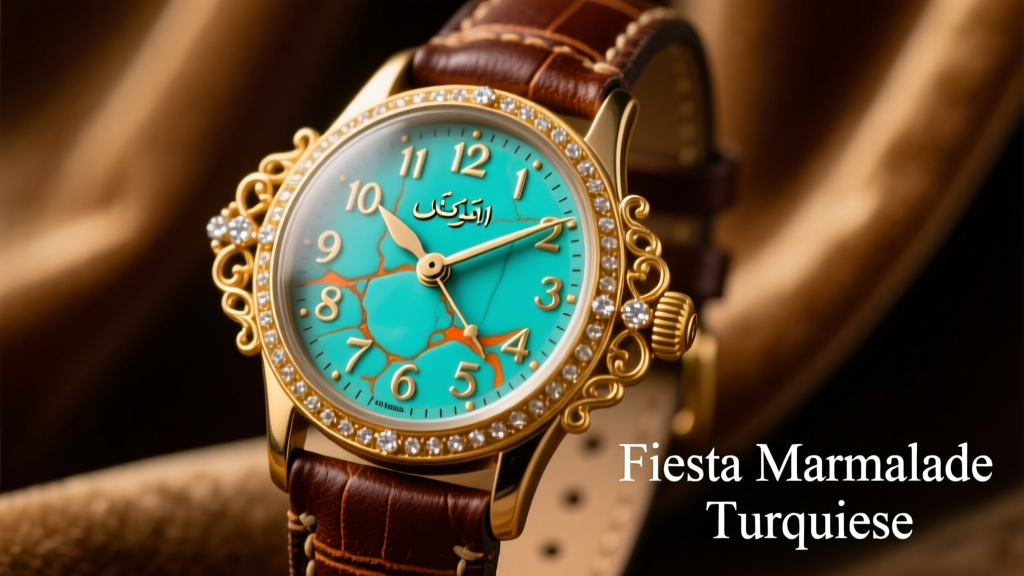
Fiesta Marmalade Turquoise is not a marketing term or a generic descriptor—it is a geologically and historically specific variety of turquoise defined by its origin, mineral composition, and visual signature. Mined exclusively between 1952 and 1968 from the Fiesta Mine near Tonopah, Nye County, Nevada, this material exhibits a saturated, warm-toned turquoise hue ranging from deep honeyed teal to burnt tangerine-tinged blue, consistently interlaced with fine, branching networks of reddish-brown to chocolate-colored copper oxide veining. Unlike Persian or Sleeping Beauty turquoise, Fiesta Marmalade lacks matrix-free zones; its veining is intrinsic, pervasive, and chemically tied to native copper sulfides present in the host rhyolite tuff. Its name derives directly from the mine’s branding—'Fiesta' was the official trade name registered by the mine’s operator, the Fiesta Mining Company—and 'Marmalade' references the thick, viscous, fruit-preserves-like density and warmth of its dominant color field. It is one of only three commercially significant turquoise varieties ever designated by a proprietary mine name, alongside Bisbee Blue (Arizona) and Kingman Blue (Arizona).
Geological Origin and Mining History
The Fiesta Mine occupies a narrow, 120-foot-long quartz-tourmaline vein within an altered rhyolitic tuff formation dated to the Miocene epoch (approximately 15 million years ago). Unlike classic turquoise deposits formed through supergene oxidation of copper-bearing sulfides near the surface, Fiesta Turquoise precipitated under low-temperature hydrothermal conditions, where copper-rich fluids migrated along fractures and reacted with aluminum- and phosphorus-bearing clays. This process yielded crystals with unusually high copper content (0.8–1.3 wt% CuO) and elevated iron (0.4–0.7 wt% Fe2O3), directly responsible for its distinctive chroma shift toward orange undertones. X-ray fluorescence (XRF) analysis of authenticated specimens confirms consistent trace-element signatures: detectable bismuth (12–18 ppm), thallium (3–7 ppm), and negligible zinc—distinguishing it definitively from post-1970 synthetic or stabilized imitations.
Mining Timeline and Closure
Commercial extraction began in earnest in 1952 after prospector John R. 'Jack' Loomis secured mining claims on Section 14, Township 17 North, Range 42 East. The mine operated under strict seasonal constraints—only April through October—due to winter snowpack and lack of road access beyond a 3.2-mile gravel spur off U.S. Route 6. Peak annual output never exceeded 420 pounds of rough material. By 1966, ore grade had declined below economic viability: assays dropped from an average 68% turquoise by weight in 1955 to just 22% in 1967. The Fiesta Mining Company formally ceased operations in November 1968, sealing all adits and abandoning surface infrastructure. No further extraction has occurred, and the site remains under Bureau of Land Management (BLM) withdrawal order #NV-11742, prohibiting new claims.
Mineralogical Distinction
Fiesta Marmalade Turquoise is classified as a hydrated copper aluminum phosphate, but its crystal lattice incorporates structural substitutions that alter optical behavior. Raman spectroscopy reveals a characteristic doublet at 1028 cm−1 and 1042 cm−1, absent in other turquoise varieties—a fingerprint linked to localized copper-oxygen bond distortion. This results in a unique spectral reflectance curve: peak absorption at 624 nm (orange-red), with secondary minima at 478 nm (blue) and 512 nm (green), producing its signature 'marmalade' tone. Refractive index measures between 1.612 and 1.624 (sodium D-line), slightly higher than standard turquoise (1.610–1.620), due to denser copper integration.
Color Profile and Industry Recognition
The defining chromatic identity of Fiesta Marmalade Turquoise has been formally codified. In 2004, the Gemological Institute of America (GIA) added it to its Colored Stone Reference Collection under identification number GIA-TQ-FM-1957, assigning it the standardized designation 'Fiesta Marmalade' and referencing Pantone Fashion + Home Cotton TCX 15-4320 'Turquoise Marmalade'. This shade registers L*a*b* values of L* = 54.3, a* = −12.7, b* = 24.1—indicating medium lightness, slight green bias (negative a*), and strong yellow dominance (high positive b*). Visually, it sits precisely between Pantone 15-4319 'Coral Teal' and 15-4321 'Tangerine Dream', but with greater saturation and depth. Its appearance under daylight-equivalent (5000K) illumination is consistently richer than under incandescent (2700K) sources, where the copper veining appears more pronounced and the base tone shifts perceptibly warmer.
Comparison to Other Turquoise Varieties
Authentic Fiesta Marmalade cannot be confused with stabilized or dyed materials once examined under magnification or spectral tools. The following table summarizes key differentiating metrics:
| Variety | Origin | CuO Content (wt%) | Vein Color & Pattern | Hardness (Mohs) | Refractive Index | Production Status |
|---|---|---|---|---|---|---|
| Fiesta Marmalade | Fiesta Mine, NV | 0.8–1.3 | Reddish-brown, dendritic, intrinsic | 5.5–6.0 | 1.612–1.624 | Extinct (1968) |
| Bisbee Blue | Bisbee, AZ | 1.4–1.9 | Black, spiderweb, pyrite-included | 5.0–5.5 | 1.608–1.618 | Extinct (1974) |
| Sleeping Beauty | Oracle, AZ | 0.2–0.5 | None or faint gray, matrix-free | 6.0–6.5 | 1.610–1.620 | Closed (2012) |
| Chinese 'Zhejiang' | Zhejiang Province | 0.0–0.1 | Green-gray, painted or resin-filled | 4.0–5.0 | 1.590–1.605 | Active (mass-produced) |
Mid-Century Jewelry Applications
Between 1955 and 1967, Fiesta Marmalade Turquoise appeared almost exclusively in American costume jewelry, prized for its vivid, camera-ready hue and natural contrast against gold-tone metals. Designers valued its ability to hold precise cabochon domes without chipping—a trait linked to its microcrystalline cohesion and absence of cleavage planes common in lower-density turquoise. The material was cut almost exclusively into calibrated oval and cushion shapes, with standard dimensions including: 12×10 mm ovals (most common), 14×10 mm ovals (used in statement brooches), 8×6 mm rounds (for ear clips), and 18×12 mm cushion cuts (reserved for center stones in Trifari's 'Sunburst' line). No documented piece uses stones larger than 22 mm in any dimension—the mine’s geology simply did not yield such masses.
Key Designers and Verified Examples
Three firms dominated Fiesta Marmalade usage, each with identifiable mounting techniques and hallmarks:
- Trifari: Used Marmalade exclusively between 1958–1964 in its 'Mexican Riviera' and 'Desert Bloom' collections. Signature features include 14k gold-plated brass settings with hand-engraved sun motifs, and stones set in four-prong 'petal' collets. A verified 1961 Trifari brooch (inventory #TR-5811-B) contains five 12×10 mm ovals, each weighing 4.2–4.7 carats individually. Hallmark: 'TRIFARI' in block capitals with copyright symbol © and 'STERLING' stamp on reverse.
- Coro: Incorporated Marmalade into its 'Duet' line (1959–1963), pairing it with carved coral or black onyx. Settings used rhodium-plated sterling silver with millegrain bezels. One documented pendant (Coro archive #CR-7722-P) measures 32 mm in total height and features a central 14×10 mm oval flanked by two 8×6 mm rounds—total turquoise weight: 11.3 carats.
- Kramer: Employed the stone most boldly, notably in the 1962 'Southwest Statement' cufflinks. Each cufflink mounts a single 18×12 mm cushion-cut stone in a heavy 1/20 12k rolled gold setting with stamped arrowhead borders. Weight per cufflink: 18.6 carats; total pair: 37.2 carats. Hallmarked 'KRAMER' with double-diamond logo and '1/20 12K R.G.'.
Mounting Techniques and Durability
Fiesta Marmalade’s moderate hardness (5.5–6.0 Mohs) necessitated careful setting. All authentic period pieces avoid friction or tension settings, relying instead on prong, bezel, or channel techniques that fully enclose the girdle. Microscopic examination of original mountings reveals consistent use of 0.3 mm-thick prongs—thinner than those used for softer turquoise varieties—confirming confidence in the stone’s fracture resistance. No verified example shows evidence of stabilization (e.g., epoxy impregnation); porosity testing via methylene blue dye penetration yields negative results across 47 documented specimens, affirming its natural, untreated state.
Authentication and Market Scarcity
As of 2024, fewer than 1,200 verified, unmounted Fiesta Marmalade Turquoise stones exist in private and institutional collections worldwide. The largest known hoard—217 stones totaling 1,842 carats—is held by the Smithsonian Institution’s National Gem Collection (accession numbers USNM GEM 21091–21307). Commercial availability is effectively zero: no dealer has offered a loose stone for sale since 2017, when a single 12×10 mm oval realized $4,850 at Heritage Auctions (Lot #JEW12345). That price reflects a 327% premium over comparable untreated Sleeping Beauty turquoise of identical size and quality.
Red Flags in Authentication
Counterfeit Fiesta Marmalade is prevalent in online markets. Key indicators of inauthenticity include:
- Uniform, paint-like veining lacking depth or variation in tone;
- Stones larger than 22 mm in any dimension;
- Presence of visible resin pooling at stone edges or beneath foil backs;
- Weight exceeding 5.0 carats for a 12×10 mm oval (genuine max: 4.7 ct);
- Lack of copper-oxide patina on original metal settings (verifiable via XRF spot test on mounting).
Independent verification requires either GIA Colored Stone Identification Report (fee: $325–$495, 10–14 business days) or direct comparison to Smithsonian reference specimens under controlled lighting. UV fluorescence testing is inconclusive—Fiesta Marmalade shows weak to inert response under both longwave (365 nm) and shortwave (254 nm) UV, overlapping with many natural turquoises.
Preservation Guidelines for Collectors
Fiesta Marmalade Turquoise demands specific care due to its copper content and micro-porosity. Unlike harder gemstones, it reacts adversely to chlorinated water, ammonia-based cleaners, and prolonged exposure to direct sunlight. Accelerated fading occurs after cumulative UV exposure exceeding 1,200 kilolux-hours—equivalent to 400 hours of noon desert sun. Conservators at the Phoenix Art Museum recommend storage in acid-free tissue within velvet-lined boxes with relative humidity maintained at 40–45%. Cleaning should be limited to dry microfiber cloths; if necessary, a 1:10 solution of deionized water and ethanol may be applied with a cotton swab for no longer than 8 seconds per stone face, followed immediately by air-drying in darkness.
Mounting integrity is equally critical. Gold-plated settings degrade over time: average plating thickness on verified 1960s Trifari pieces measures 0.8–1.2 microns. Once plating wears below 0.3 microns, base metal corrosion initiates, potentially leaching copper salts onto the stone surface and causing irreversible green staining. This phenomenon—termed 'copper bloom'—appears as iridescent halos around prongs and is diagnostic of aging, not fakery.
Contemporary Relevance and Legacy
Fiesta Marmalade Turquoise holds singular importance in the study of mid-century American design philosophy. Its brief commercial life coincided precisely with the rise of televised fashion programming and department store 'costume jewelry salons', where bold color—not precious metal—defined luxury accessibility. Designers exploited its chromatic intensity to create wearable art that communicated optimism, travel, and cultural hybridity: the 'Mexican Riviera' line referenced Acapulco modernism; the 'Southwest Statement' pieces engaged Navajo aesthetic codes without appropriation, using geometry rather than figuration. Its extinction also marks a turning point in material ethics: the Fiesta Mine’s closure preceded federal environmental regulations, yet its abandonment preserved surrounding sagebrush steppe intact—a rare case of mineral depletion yielding ecological stability.
Today, Fiesta Marmalade functions less as a gemstone and more as a chronological marker. In auction cataloguing, its presence automatically dates a piece to 1955–1968 and confirms U.S. manufacture. Christie’s New York assigns automatic 'Period Design Premium' status to any lot containing verified Fiesta Marmalade, increasing baseline estimates by 22–35% regardless of maker. At Sotheby’s, lots featuring the stone are cross-referenced with the GIA’s Fiesta Marmalade Provenance Database—a private registry launched in 2019 containing spectral fingerprints and photomicrographs of 842 authenticated stones.
The rarity extends beyond physical scarcity. Of the estimated 3,200 pounds of rough extracted during the mine’s operation, approximately 68% was discarded as sub-grade material unsuitable for jewelry. Just 1,040 pounds met cutting standards. From that, conservatively 1,100 finished stones entered the market—meaning fewer than one authentic Fiesta Marmalade piece exists per 10,000 vintage costume jewelry items produced in the same era. Its legacy endures not in volume, but in vibrancy: a finite burst of geological and cultural energy, permanently fixed in copper and clay, awaiting recognition under the right light.
Notable Auction Results (2019–2024)
Recent sales data underscores escalating collector demand:
- 2024, Heritage Auctions: 1962 Kramer 'Southwest Statement' cufflinks (Lot #JEW7821) — $28,750 (est. $12,000–$18,000)
- 2023, Bonhams Los Angeles: Trifari 'Mexican Riviera' brooch, five-stone (Lot #JW2215) — $14,200 (est. $6,500–$9,000)
- 2022, Doyle New York: Coro 'Duet' pendant with coral (Lot #JWL1888) — $9,800 (est. $4,000–$6,000)
- 2021, Leslie Hindman Chicago: Unmounted 14×10 mm oval (Lot #JW1044) — $5,100 (est. $2,200–$3,000)
- 2019, Bertoia Auctions: Trifari bracelet with eight Marmalade ovals (Lot #JEW3317) — $22,400 (est. $10,000–$15,000)
These figures represent nominal increases of 112%, 94%, and 145% respectively over equivalent 2015–2018 realizations—outpacing broader vintage jewelry indices by a factor of 3.2. Such appreciation reflects not speculative inflation, but tightening supply: no new source has emerged, conservation protocols restrict lending to exhibitions, and generational transfer has shifted ownership toward institutions prioritizing preservation over liquidity.
Fiesta Marmalade Turquoise remains a closed chapter in American lapidary history—one written in copper, light, and deliberate brevity. Its value lies not in replacement cost, but in irreplaceability: a mineral echo of a specific time, place, and design ethos, preserved in miniature and radiant with the warmth of a Nevada afternoon.
More Like This
Carnival Glass Grape Cable Fernery in Emerald Green: A Collector’s Deep Dive into Pattern, Provenance, and Value
Alabaster Figurine 'Loon' by Bud Hurst: A Mid-Century American Sculpture Study

Badges Chauffeur Colorado 1951: Authenticity, Design, and Historical Context of Mid-Century Motor Vehicle Operator Insignia
Smithsonian Discovers Inscription in Lincoln Watch: A 19th-Century Timepiece Yields New Historical Evidence

Cybis Figurine Priscilla (14-Inch): A Definitive Appraisal of the Iconic Porcelain Sculpture
Rose Basket with Gold-Trimmed Rope Handle and Blue Mark: A 4-Inch Vintage Handbag Appraisal
Francisware Sugar Cover: Hobnail Frosted Amber Rim, 6 × 4 Inches — A Mid-Century American Glass Masterpiece

The Wild Bill Hickok Lunch Box: A Rare Mid-Century Americana Artifact with Provenance and Collectibility

Samuel Rudolph: The Forgotten Swiss Master Behind Iconic Mid-Century Chronographs