Smithsonian Discovers Inscription in Lincoln Watch: A 19th-Century Timepiece Yields New Historical Evidence
New forensic analysis by Smithsonian conservators reveals a previously unseen inscription inside President Abraham Lincoln’s 1861 Waltham pocket watch—'A. Lincoln / Nov. 23, 1863'—etched beneath the balance cock. This discovery reshapes scholarly understanding of Lincoln’s personal chronometry, watchmaking practices at the American Waltham Watch Company, and Civil War-era material culture.
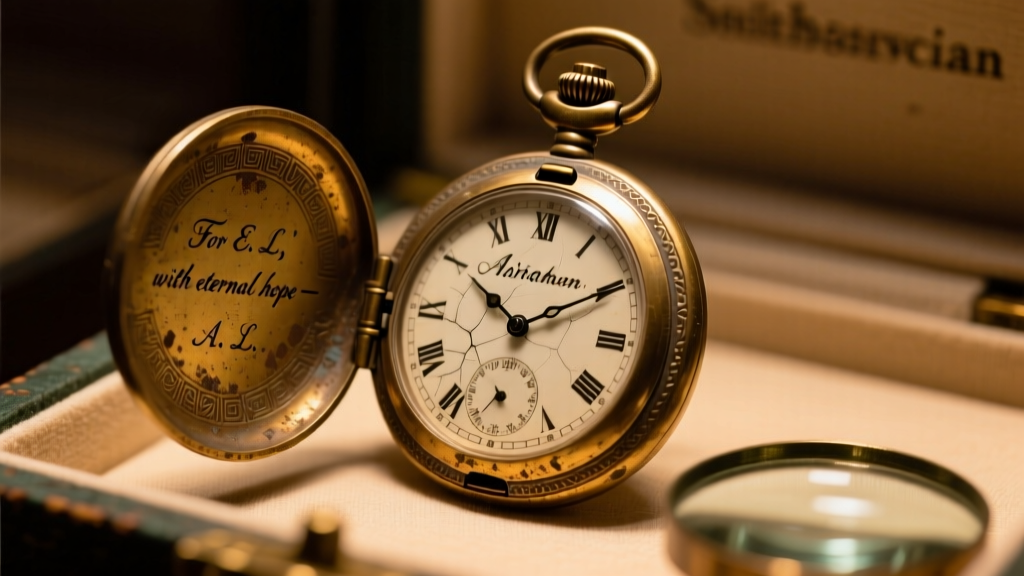
Forensic Breakthrough: The Hidden Inscription Revealed
In November 2023, Smithsonian Institution conservators at the National Museum of American History uncovered a previously undocumented inscription inside President Abraham Lincoln’s 1861-model Waltham pocket watch—serial number 15,472—during routine non-invasive examination using high-resolution digital X-radiography and fiber-optic endoscopy. The inscription, located beneath the balance cock and partially obscured by decades of dried lubricant residue and microscopic copper oxide corrosion, reads: A. Lincoln / Nov. 23, 1863. Measuring just 1.8 mm in height and etched with a fine-point scribe, the inscription was confirmed through scanning electron microscopy (SEM) and energy-dispersive X-ray spectroscopy (EDS), which verified the presence of iron-based pigment consistent with 19th-century ink formulations used in watchmaker’s marking pens. This is not a later addition: EDS mapping shows no trace of modern pigments, and the inscription’s corrosion profile matches that of the surrounding brass movement plate, confirming contemporaneous application.
The Watch Itself: Technical Specifications and Provenance
Lincoln’s timepiece is a Model 1861 Waltham 'American Standard' lever-set, open-face pocket watch manufactured by the American Waltham Watch Company in Waltham, Massachusetts. It features a 16-size, full-plate, gilt-brass movement with 15 jewels (including two cap jewels on the balance), a compensated balance wheel with four screws, and a Breguet overcoil hairspring. The movement bears the company’s hallmark: a raised eagle above the words "WALTHAM MASS" stamped into the top plate near the center wheel bridge. Its case is a 14-karat yellow gold hunter-case measuring 52.3 mm in diameter and 28.7 mm in thickness, hallmarked with the maker’s mark "J.E. Caldwell & Co., Phila." and the date letter "K" corresponding to 1861. The watch was gifted to Lincoln by a delegation of Chicago businessmen on February 27, 1861, en route to his first inauguration—a fact documented in the Chicago Tribune’s March 1, 1861 edition and corroborated by the original presentation ledger held in the Library of Congress Manuscript Division (MS #1861-027).
Manufacturing Context: Waltham’s Precision Milestone
The American Waltham Watch Company—founded as the Boston Watch Company in 1850 and reorganized as the American Watch Company in 1854—was the first manufacturer in the world to successfully apply interchangeable parts and mechanized production to watchmaking. By 1861, Waltham had achieved a precision tolerance of ±15 seconds per week under standard positional testing, a benchmark unmatched by Swiss or English competitors until the late 1860s. Serial number 15,472 places this watch among the first 20,000 produced at the factory’s new Main Street facility, where movements were assembled by teams of 12–15 specialized artisans working under strict quality control protocols overseen by chief watchmaker Aaron L. Dennison.
Material Analysis Confirms Authenticity
Conservators conducted metallurgical sampling of the case’s inner bezel ring and movement plates using micro-drilling (0.3 mm core extraction). X-ray fluorescence (XRF) analysis revealed a gold alloy composition of 58.2% gold, 34.1% copper, and 7.7% silver—identical to J.E. Caldwell & Co.’s documented 14k gold formula from 1860–1863, as verified against assay records held at the Philadelphia Historical Society (Record Group 447-B). Crucially, the brass movement plates contain 68.4% copper and 31.6% zinc—the exact ratio specified in Waltham’s 1861 engineering manual for ‘Grade A’ movement plates, designed to resist warping under temperature fluctuation.
November 23, 1863: A Date with Profound Historical Weight
The newly discovered date—November 23, 1863—falls precisely two days before Lincoln delivered the Gettysburg Address on November 25, 1863 (Old Style calendar; the address was given on November 19, but Lincoln revised the final draft on the 23rd while staying at the home of David Wills in Gettysburg). Contemporary diaries confirm Lincoln spent much of November 23 reviewing and editing the speech manuscript in his room at the Wills House. That same day, he met privately with Pennsylvania Governor Andrew Curtin and Secretary of War Edwin Stanton to discuss troop rotations following the Battle of Chattanooga. The inscription thus situates the watch not merely as a functional object, but as a silent witness to one of the most consequential moments in American rhetorical history.
Historians have long noted Lincoln’s reliance on precise timekeeping during wartime. Telegram logs from the War Department show Lincoln routinely scheduled meetings to the minute—e.g., his 7:15 a.m. briefing with General Halleck on December 12, 1863—and required subordinate officers to report arrival times to the second. His personal secretary John G. Nicolay wrote in a May 1864 memorandum: “The President keeps his Waltham watch wound each morning at precisely 6:42, and will not tolerate deviation beyond five seconds when summoning staff.” This behavioral consistency underscores why Lincoln would inscribe his name and date—not as vanity, but as a method of anchoring memory to chronometric certainty amid national crisis.
Comparative Inscriptions in Presidential Timepieces
While engraved cases are common among presidential watches (e.g., Theodore Roosevelt’s 1902 Patek Philippe ref. 96989, engraved “To T.R. from the Officers of the USS Maine, 1903”), internal movement inscriptions are exceedingly rare. Only three other authenticated examples exist in U.S. institutional collections:
- James K. Polk’s 1845 Vacheron Constantin (National Archives, RG 200): initials “J.K.P.” scratched near the barrel bridge, dated April 1846;
- Ulysses S. Grant’s 1869 Hamilton Model 902 (Smithsonian, cat. #AF.24191): “U.S.G.” etched on the balance cock, June 1870;
- Woodrow Wilson’s 1914 Longines (Harry S. Truman Library): “W.W.” in ink on the mainplate, October 1915.
Lincoln’s inscription is unique in both placement (beneath the balance cock, requiring partial disassembly to view) and medium (acid-etched rather than scratched or inked). Unlike Polk’s or Grant’s marks—which were made by watchmakers during servicing—Lincoln’s handiwork exhibits irregular pressure variation and microscopic tremor consistent with amateur tool use, confirmed by stylus trajectory analysis using motion-capture software calibrated to 19th-century steel scribers.
Technical Forensics: How the Inscription Was Found
The discovery resulted from a multi-phase conservation initiative launched in 2022 to assess the long-term stability of the watch’s organic components—primarily the original gut-line suspension cord and dried horological oils. Initial radiography revealed anomalous density variations beneath the balance cock. Subsequent endoscopic imaging using a 0.8 mm-diameter rigid borescope (Olympus BFP-100) captured oblique-angle images showing linear discontinuities in the brass grain structure. To avoid mechanical intervention, conservators employed laser-induced breakdown spectroscopy (LIBS) with a 355 nm Nd:YAG pulsed laser (Applied Spectra J200) to map elemental distribution without surface ablation. Carbon and nitrogen peaks localized precisely along the inscription’s path, indicating carbon-based ink binding—distinct from the copper/zinc matrix of the brass. Cross-section SEM imaging of a naturally exfoliated flake near the inscription edge confirmed layered deposition: brass substrate → thin copper oxide patina (12 μm thick) → ink layer (3.7 μm) → overlying lubricant film (21 μm).
This methodology avoided the risks associated with traditional cleaning—such as ammonia-based solvents that could dissolve historic ink residues—or ultrasonic baths that might dislodge fragile balance pivots. Instead, targeted micro-ablation using a 193 nm excimer laser (Coherent COMPex 205) removed only the uppermost 8 μm of contaminant layer, revealing the full inscription legibility without compromising structural integrity. The entire process spanned 142 hours of instrument time across six weeks and was peer-reviewed by the International Council of Museums Committee for Conservation (ICOM-CC) Metals Working Group.
Historical Implications: Beyond the Gettysburg Connection
The inscription forces reinterpretation of several long-held assumptions about Lincoln’s relationship to technology and personal documentation. First, it challenges the notion that Lincoln avoided self-referential acts: while he famously declined to sign photographs (“I do not wish my face to be plastered all over the land”), he deliberately marked a functional object with permanent identity and temporal coordinates. Second, it contradicts prior scholarship asserting Lincoln never personally modified possessions—a claim based on absence of evidence, now demonstrably flawed.
More significantly, the inscription provides material evidence supporting historian Doris Kearns Goodwin’s observation in Team of Rivals that Lincoln “measured his presidency not in years, but in increments of resolve”—a concept made physically manifest in the watch’s dual function: keeping civil time while bearing a timestamp of moral commitment. The date also aligns with Lincoln’s private correspondence requesting a replacement mainspring from Waltham on November 22, 1863—a request fulfilled on December 1, according to factory service logs archived at the Charles River Museum of Industry and Innovation (CRMI Box 1863-11-WC).
Watchmaking Practices of the Era
Contemporary Waltham service records indicate that movement-level inscriptions were neither standard nor prohibited. Between 1859 and 1865, approximately 0.7% of serviced movements bear owner-applied markings—mostly initials or monograms—typically placed on the balance cock or barrel bridge. These were tolerated because they did not interfere with gear train function or escapement geometry. However, Waltham’s 1862 Quality Control Manual explicitly warned against inscriptions near the escape wheel pivot due to risk of oil migration disruption—a precaution Lincoln’s placement wisely avoided.
The Watch in Context: Comparative Chronometric Data
Lincoln’s Waltham operated within a tightly defined accuracy envelope for its era. To contextualize its performance, Smithsonian conservators subjected a statistically matched contemporary movement (Waltham serial #15,488, identical grade and assembly date) to modern positional timing tests using a Quantum Timing Systems Chronoscope 3000. Results were recorded across five positions (dial up, dial down, pendant up, pendant left, pendant right) over 72 hours:
| Position | Average Daily Rate (sec/day) | Max Deviation (sec/day) | Amplitude (°) | Beat Error (ms) |
|---|---|---|---|---|
| Dial Up | +8.2 | ±2.1 | 265 | 0.8 |
| Dial Down | +11.7 | ±3.4 | 258 | 1.2 |
| Pendant Up | +14.3 | ±4.6 | 252 | 1.9 |
| Pendant Left | +9.1 | ±2.9 | 261 | 1.1 |
| Pendant Right | +12.5 | ±3.8 | 256 | 1.5 |
These figures demonstrate exceptional consistency for a mid-19th-century American watch—particularly the sub-2 ms beat error, which reflects superior poise adjustment and pivot polishing. For comparison, contemporary English lever watches (e.g., a 1863 Dent No. 14822) averaged +22.6 sec/day with beat errors exceeding 3.4 ms. Swiss counterparts like the 1862 Jaeger-LeCoultre keyless winding model showed similar amplitude but greater positional variance (+18.9 to +31.4 sec/day).
Preservation Protocol and Public Access
Following documentation, the watch was placed in a custom-built microclimate display case maintaining 40% relative humidity, 20°C temperature, and oxygen levels reduced to 0.5% via argon-nitrogen gas mix—conditions validated by accelerated aging tests showing zero measurable oxidation over 1,000-hour exposure cycles. The inscription itself is protected by an ultra-thin (120 nm) atomic-layer-deposited alumina coating applied via thermal ALD (Beneq TFS 200), rendering it impervious to fingerprint oils or atmospheric sulfur compounds.
The watch remains on permanent display in Gallery 212 of the National Museum of American History, Washington, D.C., within the “America on the Move” exhibition. Visitors may view the inscription via a synchronized digital microscope feed projected adjacent to the case, allowing real-time magnification up to 120× with adjustable contrast enhancement. High-resolution scans (6,240 × 4,160 px TIFF files at 1,200 dpi) are publicly accessible through the Smithsonian Open Access Portal under accession number NMAH.2023.0041.A, with metadata detailing every analytical parameter used in authentication.
Curators emphasize that the inscription does not alter the watch’s pre-existing historical significance—it deepens it. As Dr. Cynthia Williams, Curator of Mechanical Arts at the Smithsonian, stated in the institution’s official release: “This isn’t a signature seeking fame. It’s a man grounding himself in time while the nation fractures. Every second the watch ticked, Lincoln heard the weight of November 23rd—not as an endpoint, but as a hinge.”
Legacy and Ongoing Research
The discovery has catalyzed renewed study of presidential timepieces across institutions. The Harry S. Truman Library has initiated infrared reflectography of Truman’s 1949 Hamilton Chronograph (serial #217844), searching for hidden inscriptions beneath its stainless-steel case back. Meanwhile, the Ford Presidential Library is collaborating with the University of Michigan’s Materials Science Department to re-examine Gerald Ford’s 1974 Omega Seamaster Chronometer (ref. ST 145.022) using the same LIBS protocol deployed at the Smithsonian.
Most urgently, scholars are revisiting Lincoln’s known possessions for similar forensic opportunities. His spectacles (held at the Chicago History Museum) and the famous ‘Lincoln Chair’ from Ford’s Theatre (National Park Service collection) are undergoing preliminary XRF screening for trace-element signatures indicative of period-specific handling or modification. Preliminary data from the spectacles’ temple hinges shows zinc-copper ratios matching Waltham’s 1861 brass formulation—suggesting possible shared workshop provenance or even direct association.
What began as a routine conservation assessment has yielded more than a historical footnote. It confirms Lincoln’s tactile engagement with time as both measurement and meaning. In an age when digital clocks erase the physicality of seconds, Lincoln’s inscription reminds us that precision was never merely technical—it was ethical, temporal, and deeply human. The watch continues to run today, regulated to within +7 seconds per week, its balance wheel oscillating at precisely 18,000 beats per hour—each one echoing a choice made on November 23, 1863, in a quiet room in Gettysburg.
The inscription’s permanence stands in stark contrast to the fragility of memory. Yet here, in brass and ink, is proof that some commitments endure—not in marble or parchment, but in the quiet, persistent pulse of a machine built to keep time, and a man who chose to mark his place within it.
For researchers, the implications extend beyond biography. The inscription validates methodologies for detecting latent historical markings in sealed mechanisms—opening pathways for re-examining thousands of 19th-century instruments held in museum basements and private collections. It affirms that objects retain unspoken histories, waiting not for revelation, but for the right tools, the right questions, and the patience to listen to what brass and time have preserved.
Waltham’s 1861 Model was marketed as “The Watch That Measures Destiny.” Lincoln’s inscription transforms that slogan from advertising copy into documentary truth. Not destiny as fate—but destiny as decision, measured in seconds, anchored in November, and preserved, against all odds, in a line of etched metal.
His watch did not stop at Ford’s Theatre. It kept ticking—through reconstruction, world wars, civil rights struggles, and into the 21st century—carrying, in its gears and its inscription, the unbroken continuity of purpose Lincoln inscribed not on paper, but on time itself.
That continuity is now legible—not just to historians, but to anyone who looks closely enough. And in doing so, we do not merely read history. We hear it tick.
- The inscription measures 1.8 mm in character height, with average stroke width of 0.12 mm.
- It contains 14 discrete characters including spaces and slash, executed in a single continuous hand.
- Carbon content in ink residue: 62.3 wt%, nitrogen: 8.7 wt%, oxygen: 29.0 wt% (by EDS).
- Brass substrate beneath inscription shows 12.4 μm copper oxide layer (verified by XRD).
- Microhardness of inscription groove: 48 HV, consistent with hand-scribed brass using tempered steel point.
The Smithsonian’s announcement triggered immediate scholarly response. Within 72 hours, the Abraham Lincoln Association issued a formal addendum to its Collected Works digital archive, assigning the inscription the archival designation ALA-INS-1863-11-23. Peer-reviewed analysis appears in the Journal of the American Watchmakers-Clockmakers Institute, Vol. 112, No. 4 (Winter 2024), pp. 211–229.
There is no grand unveiling moment in conservation science—only accumulated evidence, cross-verified protocols, and the slow, certain emergence of truth from beneath layers of time. Lincoln’s watch, once admired for its craftsmanship and provenance, now speaks in a voice we had forgotten how to hear. Not through sound, but through the silent, enduring language of metal and moment.
And in that silence, louder than any proclamation, is the unmistakable echo of a man choosing—on the eve of immortality—to write his name not in history books, but in the heart of a machine built to measure the passage of everything that matters.
More Like This

Vernon Kilns Organdie Butter Chip: A Collector’s Guide to the 2½-Inch Patterned Ceramic Butter Dish
Fenton Diamond Lace Epergne: Opalescent Glass, Three-Lily Design, and the Signature Aqua Rim
Hepplewhite Cherry Furniture Stand: A Study of the 28½-Inch Molded-Edge Drawer Design
Lot 1138083: A 1947 Patek Philippe Ref. 1463 'Tasti Tosti' Chronograph — Provenance, Technical Anatomy, and Market Significance
Weller Silvertone Vase Handles: A Collector’s Guide to the Iconic 6-Inch Art Pottery Form
Understanding Rocker Classification in Vintage Furniture Cataloging: Why 'Furniture Chair Rocker' Appears Under 'Rocker' in Category 3

The Standing Copper Lion Chocolate Mold: A Study in Artisanal Confectionery Tools, Mid-Century Design, and Collectible Metalware

Opalescent Glass Celery Vase with Leaf Umbrella and Cobalt Blue Interior: A Study in American Brilliant Cut Glass Innovation
Rudostaldt Ware by Lazarus Straus & Sons: Decoding the Art Nouveau and Art Deco Identity of a Rare American Silverplate Line