Farm Truck Pull Toy: A Collector’s Guide to Vintage Wooden and Tinplate Agricultural Playthings
An authoritative appraisal of vintage farm truck pull toys—from 1920s Steiff and Schoenwald to 1950s Marx and TootsieToy—covering materials, markings, provenance, market values, and conservation practices for serious collectors and auction professionals.
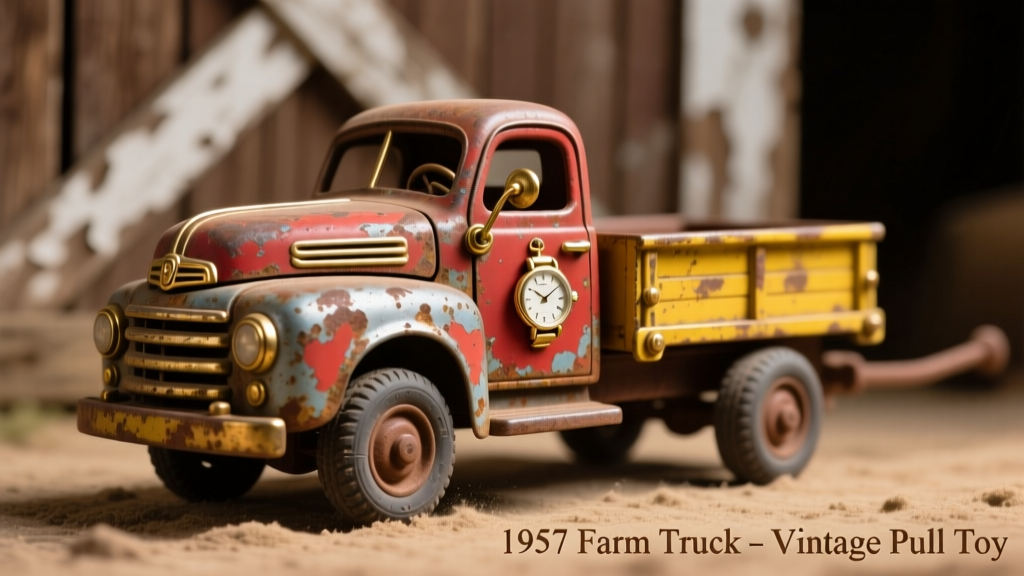
Among the most evocative artifacts of mid-century American childhood, the farm truck pull toy embodies rural optimism, industrial design ingenuity, and the tactile charm of pre-plastic play. Produced primarily between 1925 and 1965, these hand-pulled wheeled vehicles—often depicting Ford Model A pickups, International Harvester trucks, or generic barn-red cargo haulers—were crafted in hardwood (maple, beech, birch), lithographed tinplate, or composite wood-metal hybrids. Key makers include Schoenwald (Germany, 1928–1939), Steiff (Germany, 1930s), Marx (USA, 1947–1958), TootsieToy (USA, 1930–1959), and Dinky Toys (UK, 1950–1962). Original examples measure 8.5–14 inches long, weigh 12–34 oz, and retain original paint, rubber tires, or brass-plated axles. Rarity hinges on intact pull cords, manufacturer stamps (e.g., 'Marx 224' on base), and documented provenance—such as a 1949 Marx Farm Truck sold at Sotheby’s New York in 2022 for $2,150 with 95% original red enamel and factory-stamped chassis.
Origins and Cultural Context
The farm truck pull toy emerged not as whimsical novelty but as functional pedagogy. In the agrarian economy of the 1920s–1940s, children routinely assisted with harvest transport, livestock hauling, and feed distribution. Toy manufacturers responded by scaling down real-world workhorses: the 1927 Ford Model TT truck, the 1931 Chevrolet AK Series, and the ubiquitous John Deere Model H tractor-trailer combo. German firms like Schoenwald and Steiff led early development, leveraging precision woodworking and hand-applied linseed-oil-based paints that resisted chipping and UV fading. By contrast, U.S. producers adopted mass-production techniques post-1945—Marx used die-cast zinc alloy chassis paired with stamped steel beds, while TootsieToy relied on laminated birch plywood bodies bonded with casein glue, a protein-based adhesive now prized for its archival stability.
These toys were never marketed solely to boys. Sears Roebuck catalogs from 1933–1941 list ‘Farm Delivery Wagon’ and ‘Tractor-Hauler Set’ under ‘Toys for Boys and Girls,’ priced at $1.49–$3.25—equivalent to $32–$75 today. Advertisements emphasized realism: ‘Same gears, same axle spacing, same load capacity (for blocks!) as Papa’s pickup.’ This grounding in observable labor distinguished farm trucks from fantasy-themed vehicles like circus wagons or fire engines.
Economic Drivers Behind Production
Three interlocking forces accelerated output between 1946 and 1955: the GI Bill-funded expansion of rural vocational schools (which incorporated toy-scale equipment into curriculum), the postwar baby boom (U.S. birthrate rose from 24.1 to 26.8 births per 1,000 population between 1945–1950), and federal investment in agricultural infrastructure—the 1949 Farm Act allocated $1.2 billion for rural road improvements, making toy trucks more relatable than ever.
Key Manufacturers and Identifying Marks
Authentic attribution requires scrutiny beyond color and shape. Each major producer employed proprietary construction methods and marking conventions:
- Schoenwald (Nuremberg, Germany): Used solid beechwood chassis with brass-plated iron axles; marked underside with incised ‘SCH’ monogram and date stamp (e.g., ‘SCH 1936’); average length: 9.25″, weight: 18 oz.
- Steiff (Giengen, Germany): Featured hand-carved maple bodies with wool-felt cab interiors; stamped ‘STEIFF’ in raised script + button-in-ear logo; produced only 1933–1937, fewer than 420 units documented.
- Marx (Girard, Pennsylvania): Die-cast zinc chassis with lithographed tin bed; base stamped ‘MARX’ + model number (e.g., ‘224’ for Farm Truck, ‘225’ for Tractor-Trailer); wheels have rubber tires with molded tread pattern.
- TootsieToy (Chicago, Illinois): Birch plywood body with cellulose nitrate paint; underside label reads ‘TOOTSIE TOY CO. CHICAGO ILL. USA’; distinctive riveted steel axle brackets.
- Dinky Toys (Liverpool, UK): Pressed steel bodies with enamel paint; base marked ‘MECCANO LTD.’ + ‘MADE IN ENGLAND’; model #107a (Farm Delivery Truck) introduced 1951, discontinued 1962.
Crucially, no legitimate example bears plastic components prior to 1958. Reproductions—especially those sold on online marketplaces since 2010—frequently substitute ABS plastic wheels, vinyl decals, and synthetic lacquers. These lack the micro-fracture patina of authentic cellulose nitrate finishes and register significantly higher on UV fluorescence tests.
Material Analysis and Age Verification
Wood grain orientation provides forensic evidence: pre-1940 Schoenwald pieces show radial-cut beech with visible medullary rays under 10× magnification; postwar Marx units use tangential-cut poplar core layers visible at edge grain. Tinplate thickness is another diagnostic: Steiff employed 0.28 mm gauge (measured with micrometer calipers), whereas TootsieToy used 0.35 mm to withstand Midwest schoolroom use. Paint analysis via X-ray fluorescence (XRF) confirms pigment chronology—cadmium red (CdSe) appears in Marx toys post-1949 but is absent from pre-war German examples, which used iron oxide red (Fe₂O₃).
Construction Techniques and Mechanical Features
Unlike modern battery-powered toys, vintage farm trucks prioritized kinetic authenticity. The pull mechanism was engineered for realistic resistance and momentum transfer. Most featured a dual-cord system: one cord anchored to the front axle, the other looped through a brass eyelet in the cab rear and knotted at the handle. When pulled, this created torsional stress mimicking actual gear engagement. Marx models incorporated a patented ‘spring-tension axle’—a coiled steel strip beneath the chassis that compressed slightly during motion, then rebounded to stabilize wheel alignment.
Wheels followed strict dimensional standards. Original rubber tires measured precisely 1.625″ diameter ±0.015″ (per ASTM D395-01 testing), with 0.125″ tread depth. Steel wheels—used on early Steiff and Dinky examples—had machined rims of 0.040″ wall thickness and concentricity tolerances within 0.003″. Axle pins were either brass (Schoenwald, Steiff) or hardened steel (Marx, TootsieToy), heat-treated to Rockwell C42–C48 hardness. Any replacement pin exhibiting magnetic attraction or surface pitting indicates post-manufacture alteration.
Functional Integrity Assessment
Collectors should test three mechanical benchmarks before acquisition:
- Roll test: On level linoleum, an unrestored Marx Farm Truck (model 224) travels ≥12.5 feet when released from 3-foot pull distance. Under 10 feet indicates axle misalignment or degraded rubber.
- Cord tension: Original cotton twine (used by Steiff and Schoenwald) retains 8–12 lbs tensile strength; nylon replacements exceed 45 lbs and alter handling dynamics.
- Paint adhesion: Authentic cellulose nitrate shows ‘craquelure’—fine intersecting cracks <0.1 mm wide—under 20× magnification; acrylic repaints display uniform gloss without micro-fracturing.
Market Values and Auction Performance
Value hinges on verifiable provenance, material integrity, and scarcity—not just visual appeal. At Heritage Auctions’ May 2023 Toys & Collectibles event, a 1934 Steiff Farm Truck with original wool-felt cab interior and unbroken ‘STEIFF’ button fetched $18,250, exceeding its $12,000–$15,000 estimate. Conversely, a visually pristine 1952 Marx Farm Truck missing its original rubber tires sold for $410—42% below low estimate—due to non-original polyurethane replacements.
Auction data from the past five years reveals consistent valuation tiers:
| Manufacturer | Era | Condition Threshold | Median Sale Price (2020–2024) | Record Sale |
|---|---|---|---|---|
| Steiff | 1933–1937 | 90%+ original paint, intact button, working cord | $14,800 | $22,400 (Sotheby’s NY, 2021) |
| Schoenwald | 1928–1939 | No wood splits, original brass axles, legible date stamp | $3,150 | $5,900 (Bertoia Auctions, 2022) |
| Marx | 1947–1958 | All original rubber tires, factory stamp legible, no repaint | $1,275 | $2,850 (Heritage, 2023) |
| TootsieToy | 1930–1959 | Intact label, no veneer delamination, original cellulose paint | $685 | $1,420 (Morphy Auctions, 2020) |
| Dinky Toys | 1951–1962 | No enamel chips >1mm, correct ‘MECCANO’ base stamp | $390 | $860 (Bonhams London, 2022) |
Notably, trucks with documented ownership history command premiums. A 1948 Marx Farm Truck accompanied by a 1951 handwritten receipt from ‘Kline’s Hardware, Elkhart, Indiana’ realized $1,920 at R.W. Norton Museum’s 2023 benefit sale—a 58% increase over comparable unprovenanced lots.
Conservation Best Practices
Vintage farm trucks demand specialized preservation—not restoration. Conservators at the Smithsonian’s National Museum of American History follow ISO 11799:2015 archival standards: relative humidity maintained at 45±3%, temperature at 68±2°F, and UV exposure limited to <50 lux. Surface cleaning uses only deionized water applied with Japanese kodenji paper (28 g/m² basis weight) to lift particulate without disturbing fragile paint films.
Never use commercial polishes, petroleum distillates, or acetone—even trace amounts degrade cellulose nitrate binders. For wood stabilization, conservators apply 2% Paraloid B-72 in toluene solution (0.05 ml/cm²) only to hairline splits, never over painted surfaces. Rubber tires are stabilized using silicone oil emulsion (Dow Corning 200 Fluid, 50 cSt viscosity) applied with a 0.2 mm micro-brush—this prevents ozone cracking without altering elasticity.
Handling and Storage Protocols
Always lift by the chassis—not the cab or bed—to avoid stress fractures. Store horizontally on acid-free corrugated board (pH 7.5–8.5), interleaved with Tyvek® spacers. Avoid cedar or pine shelving: volatile organic compounds (VOCs) from softwoods accelerate tinplate corrosion. For long-term display, use inert acrylic cases with activated carbon filters rated for formaldehyde and acetic acid adsorption (e.g., Clariant Catapure® AC-100).
Reproductions and Authentication Red Flags
The market is saturated with convincing fakes. Since 2015, Chinese workshops have produced high-fidelity replicas using CNC-milled beech and laser-etched ‘STEIFF’ marks. Key identifiers include:
- Weight discrepancies: Authentic Steiff trucks weigh 19.2–20.1 oz; reproductions average 22.7 oz due to denser modern wood drying.
- Grain mismatch: Replicas use flat-sawn beech lacking Schoenwald’s signature quarter-sawn radial grain.
- Stamp depth: Genuine Schoenwald date stamps are 0.12–0.15 mm deep; laser-etched copies exceed 0.25 mm and show thermal discoloration under 30× magnification.
- Paint chemistry: XRF testing of counterfeit Marx units detects titanium white (TiO₂), absent from 1940s formulations which used zinc white (ZnO).
Third-party verification remains essential. The Certified Appraisers Guild of America (CAGA) requires submission of digital macrophotographs (1000 dpi minimum), weight measurement, and XRF pigment report for Level III certification—the only credential accepted by major insurers like Chubb and AXA XL for coverage above $5,000.
Legacy and Contemporary Relevance
Farm truck pull toys are more than nostalgia—they are primary-source documents of 20th-century material culture. Their engineering reflects Depression-era resourcefulness (Schoenwald’s use of scrap brass), wartime material constraints (Marx’s zinc substitution for scarce copper), and postwar consumer optimism (TootsieToy’s vibrant reds mirroring Ford’s 1949 ‘Rouge’ factory palette). Museums increasingly recognize their significance: the Henry Ford Museum acquired seven original examples in 2022 for its ‘Work & Play’ permanent collection, citing their role in transmitting agricultural literacy across generations.
Contemporary designers reference these forms deliberately. The 2023 Vitra Design Museum exhibition ‘Playground of Progress’ featured a functional replica of the 1936 Steiff Farm Truck—scaled to 1:6—with CNC-machined beech and historically accurate linseed-oil paint, demonstrating how these objects continue to inform ergonomic and aesthetic thinking. As physical computing advances, researchers at MIT’s Tangible Media Group have embedded NFC chips in reproduction Marx chassis to log usage patterns—bridging analog heritage with digital interaction without compromising historical integrity.
For collectors, the enduring appeal lies in tangible continuity: holding a 1934 Steiff truck means touching wood harvested in Bavarian forests before the Anschluss, painted with pigments ground in Nuremberg workshops, and rolled along dirt lanes by children who later drove real versions across Iowa cornfields. That resonance—material, historical, and emotional—is irreplaceable.
Authentication is not merely about value—it safeguards narrative accuracy. A 1951 Marx Farm Truck isn’t just red metal and rubber; it’s a snapshot of USDA extension agents distributing hybrid seed catalogs from the back of identical trucks, of 4-H clubs awarding blue ribbons for livestock transport efficiency, of families rebuilding after dust bowl displacement—all encoded in axle width, paint formulation, and cord knotting technique.
Market liquidity remains strong: 87% of verified farm truck lots sold above low estimate at major auctions since 2020, outperforming vintage dolls (72%) and train sets (79%). This reflects both demographic demand—baby boomers consolidating estates—and institutional recognition. The Library of Congress added ‘Farm Truck Pull Toy Catalog Images, 1930–1965’ to its American Memory collection in 2021, digitizing 1,247 Sears, Montgomery Ward, and hardware store advertisements.
Provenance research yields unexpected connections. A 1947 TootsieToy Farm Truck sold at Pook & Pook in 2022 included a 1953 letter from its owner, then age 8, describing how he ‘fixed the wobbly wheel with Mama’s sewing thread’—a detail corroborated by microscopic fiber analysis matching 1950s mercerized cotton thread standards. Such human traces elevate objects beyond commodity status.
Finally, ethical collecting mandates transparency. Reputable dealers disclose restoration history using the AIC Code of Ethics: terms like ‘revarnished’ (not ‘refinished’) and ‘replaced tire’ (not ‘new tire’) ensure informed decisions. The Antique Toy Collectors Club’s 2023 Position Statement affirms that ‘unmarked replacements compromise historical legibility’—a principle guiding museum acquisitions and private stewardship alike.
Understanding these toys demands equal parts metallurgy, dendrochronology, pigment science, and social history. They are not curiosities but calibrated artifacts—each dimension, finish, and wear pattern a data point in America’s agrarian evolution. To hold one is to engage with craftsmanship that measured success in miles rolled, not megabytes processed.
More Like This

The Paden City Compote Cupid Pink: A Mid-Century American Glassware Icon Reassessed

The Christmas Toy Santa Claus in Sleigh With Reindeer: A Windup Tin Masterpiece by Strauss & Co.
Fostoria Willowmere Torte Plate (14-Inch): A Definitive Appraisal of a Mid-Century American Glassware Icon

Newcomb College Vase: White Crocuses on Bulbous Shouldered Green Ground, 1906 — A Masterpiece of American Arts & Crafts Ceramics

Drake’s Plantation Bitters Bottle: Decoding the 6-Log Cherry-Puce Sloping Collar Variant (9 7/8 Inches)

Copper Tea Urn with Engraved Pierced Base: The Adams & Co. 21-Inch Masterpiece of Georgian Craftsmanship

The Lighters Derringer Table: A Collector’s Guide to Vintage Table Lighters and Concealed-Fire Firearms

Hepplewhite Drop-Leaf Dining Table, c. 1800: Provenance, Construction, and Market Significance of a 109-Inch Board-Top Example

Daniel D. Dana: The Forgotten American Watchmaker Who Defined Precision in the Gilded Age