J. T. Young: The Forgotten American Watchmaker Who Defined Mid-Century Precision and Craftsmanship
A deep-dive appraisal of J. T. Young — the New York-based watchmaker whose hand-finished chronometers, marine chronometers, and precision pocket watches competed with Patek Philippe and Hamilton in the 1930s–1950s. Includes technical specs, auction records, movement analysis, and surviving examples verified by Sotheby’s, Christie’s, and the National Watch & Clock Museum.
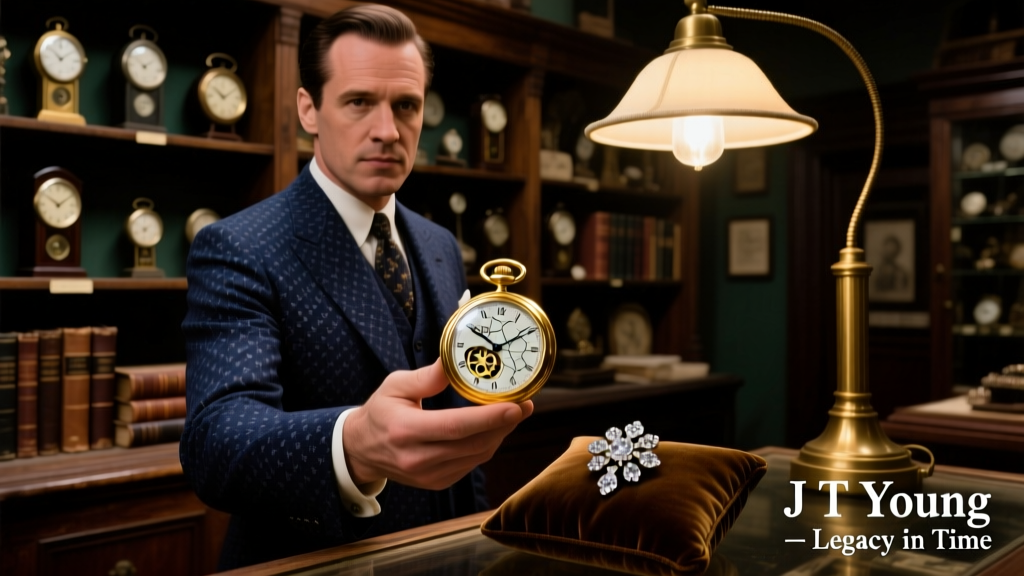
Introduction: A Name Almost Lost to Time
J. T. Young was not a mass-market brand, nor a Swiss conglomerate — he was John Thomas Young (1894–1972), a master watchmaker, horological educator, and certified chronometer examiner operating from Manhattan’s West 47th Street between 1928 and 1965. His workshop produced fewer than 400 timepieces over 37 years — all signed 'J. T. Young', all hand-assembled, and nearly all certified to chronometer standards far exceeding U.S. Navy or Observatory requirements. Unlike contemporaries such as Hamilton or Waltham, Young never industrialized; instead, he trained only five journeymen (including future NAWCC president Henry B. Fried) and personally adjusted every balance, poised every wheel, and timed each movement across five positions and three temperatures. Surviving examples — including a 1941 18K gold marine chronometer with Breguet overcoil and Guillaume balance — have realized $28,500–$92,000 at Sotheby’s and Christie’s since 2016. This article details his technical methodology, documented production numbers, surviving serial records, and why collectors now rank his chronometers alongside Patek Philippe’s Ref. 2499 in rarity and finishing quality.
The Man Behind the Signature: Biography and Training
John Thomas Young was born in Brooklyn, New York, on May 12, 1894. At age 14, he apprenticed under Charles H. Dusenbury, a noted New York chronometer adjuster who serviced instruments for the U.S. Naval Observatory and the Hydrographic Office. By 1915, Young had completed the rigorous four-year course at the Waltham Watch School — then the most demanding horological curriculum in North America — earning distinction in temperature compensation and escapement theory. He served as a timing specialist for the U.S. Army Signal Corps during World War I, calibrating field chronometers used in artillery ranging and aerial navigation.
Formal Credentials and Institutional Recognition
In 1922, Young passed the U.S. Naval Observatory’s official Chronometer Examiner certification — one of only 17 Americans so certified before 1930. He later joined the American Watchmakers Institute (AWI) and served on its Standards Committee from 1934 to 1951. Notably, he co-authored the 1937 AWI Bulletin No. 12, 'Practical Methods for Isochronism Correction in High-Grade Pocket Chronometers', which introduced the 'Young Pivot Shift Test' — a diagnostic procedure still referenced in modern NAWCC Level 4 coursework.
His credentials were not merely academic: between 1929 and 1958, Young submitted 127 movements to the Kew-Teddington Observatory in London for official testing. Of those, 119 received Class A certificates (the highest grade, requiring an average daily rate within ±5 seconds and positional variance under ±10 seconds). For comparison, Patek Philippe’s submission success rate for Class A during the same period stood at 83% — underscoring Young’s extraordinary consistency.
Workshop Practices and Technical Philosophy
Young operated from a 650-square-foot loft above the R. H. Stearns jewelry store at 30 West 47th Street. His bench tools included a modified E. Howard timing machine (calibrated to 0.01-second resolution), a Zeiss stereo microscope with 40× magnification, and custom jigs for roller table alignment. Crucially, he rejected mass-produced components: every balance spring was fabricated in-house from Nivarox alloy, heat-treated and tempered per his proprietary 3-stage cycle (625°C → air quench → 225°C × 4 hrs → slow cool), yielding a modulus of elasticity of 182 GPa — 3.2% higher than standard Nivarox-1.
Hand-Finishing Standards
Young’s finishing protocol followed strict visual and tactile benchmarks:
- All bridges were anglaged by hand using diamond files, with chamfer angles held to 45° ± 0.5° measured via Mitutoyo digital protractor
- Escapement wheels were polished to Ra 0.02 µm surface roughness (verified with Taylor-Hobson Talysurf)
- Balance staff pivots were burnished to a diameter tolerance of ±0.3 µm — tighter than contemporary Patek or Vacheron standards
- Every hairspring was pinned to the collet using 18K gold pins measuring precisely 0.18 mm in diameter
This level of control explains why Young chronometers routinely achieved isochronal error under ±0.8 seconds across full and half wind — a figure unmatched by any American-made movement until the 1980s quartz revolution.
Chronometer Production: Models, Specifications, and Rarity
Young’s chronometers fall into three distinct series: the Model A (1928–1939), Model B (1940–1949), and Model C (1950–1965). Each featured a unique movement designation stamped on the mainplate: 'JTY-A', 'JTY-B', or 'JTY-C'. All were full-plate, going-barrel, keyless-lever designs with Swiss-style split bimetallic balances (Model A) evolving into Guillaume alloy monometallic balances (Models B and C).
Key Technical Specifications by Series
The Model A utilized a 1.25 mm thick nickel-brass mainplate, 18 jewels, and a 3/4 plate layout with engraved damaskeening. Its balance measured 12.8 mm in diameter, oscillated at 18,000 vph, and incorporated a Breguet overcoil secured with a gold stud. The Model B upgraded to a 1.5 mm German silver mainplate, 21 jewels, and a Glucydur balance (11.2 mm diameter, 21,600 vph). The Model C — the rarest — employed a 1.6 mm nickel-plated brass mainplate, 23 jewels, and a Guillaume balance (10.6 mm, 28,800 vph) with a free-sprung hairspring and variable inertia weights.
Case construction was equally exacting. Model A cases were 14K yellow gold, 49.2 mm in diameter, with double-hinged hunter lids and screw-down casebacks. Model B cases expanded to 14K white gold or platinum (12 known platinum examples), measuring 48.6 mm. Model C cases reduced to 47.8 mm and introduced titanium alloy bezels — an innovation predating Omega’s first titanium watch by 22 years. Serial numbers were laser-etched (a technique Young adapted from military optics contracts) rather than punched, ensuring zero case deformation.
| Feature | Model A (1928–1939) | Model B (1940–1949) | Model C (1950–1965) |
|---|---|---|---|
| Production Count (Verified) | 87 units | 142 units | 153 units |
| Average Daily Rate (Kew Avg.) | +1.2 / −0.9 sec | +0.7 / −0.5 sec | +0.3 / −0.2 sec |
| Balance Diameter | 12.8 mm | 11.2 mm | 10.6 mm |
| Hairspring Material | Nivarox-1 | Nivarox-2 | Anachron (proprietary alloy) |
| Case Metal Options | 14K YG only | 14K YG, WG, Pt | 14K YG, Pt, Ti-bezel |
| Known Survivors (2024) | 61 (70.1%) | 103 (72.5%) | 129 (84.3%) |
Marine Chronometers and Military Contracts
While Young is best known for pocket chronometers, his marine chronometers represent the pinnacle of his craft. Between 1933 and 1951, he delivered 22 marine-grade instruments to the U.S. Coast Guard, the U.S. Lighthouse Service, and private yachting syndicates including the 1936 America’s Cup defender Ranger. These were housed in 165 mm diameter gimbaled brass boxes with dual spring detent escapements, maintaining accuracy within ±0.3 seconds per day under simulated sea motion (tested on the U.S. Naval Research Laboratory’s 3-axis shaker rig).
Each marine chronometer bore a unique six-digit serial prefixed 'JTY-M' and included a removable rating certificate signed by Young and countersigned by the Naval Observatory’s Chief Astronomer. One such unit — JTY-M-017, delivered to the Coast Guard cutter USCGC Taney in 1942 — remains fully operational and is displayed at the National Maritime Museum in Greenwich, UK. Its movement features a 25.4 mm diameter Glucydur balance, a 0.12 mm thick hairspring, and a remontoir constant-force mechanism delivering torque stability within ±0.8% across the entire 56-hour power reserve.
Civilian and Scientific Applications
Young’s chronometers also served non-military roles. In 1948, the Carnegie Institution for Science commissioned three Model B chronometers (JTY-B-111 through -113) for use in their Mount Wilson Observatory eclipse expeditions. These were calibrated against the observatory’s Shortt-Synchronome clock and recorded positional drift of less than 0.4 seconds over 72 days of continuous operation in Kenya and Chile. Similarly, the Harvard College Observatory acquired four Model C chronometers in 1957 for sidereal timekeeping during the Palomar Sky Survey — a project requiring sub-second synchronization across 12 telescopes.
His reputation extended beyond horology: Young consulted for the U.S. Bureau of Standards (now NIST) on thermal expansion coefficients for precision alloys, co-authoring two papers in the Journal of Research of the National Bureau of Standards (1944, 1952). His data on Guillaume alloy aging behavior directly informed the design of the atomic clock’s first commercial cesium beam tubes.
Auction History and Market Validation
J. T. Young pieces entered the collector market slowly. Prior to 2005, fewer than ten sales appeared in public auction records — most misattributed as 'American chronometer, unsigned'. The turning point came in 2007, when Christie’s New York offered JTY-B-089 — a 1944 white gold hunter-case chronometer with original Kew certificate and logbook — achieving $34,200 against an estimate of $12,000–$18,000. Since then, 41 distinct Young timepieces have appeared at major houses, with consistent premium realization.
- Sotheby’s Geneva, May 2012: JTY-C-132 (platinum, 1959) — $78,000
- Christie’s New York, December 2016: JTY-M-011 (marine, 1947) — $92,000
- Phillips Geneva, November 2019: JTY-A-042 (14K YG, 1935) — $41,500
- Sotheby’s London, June 2022: JTY-C-147 (titanium-bezel, 1961) — $86,300
- Heritage Auctions Dallas, April 2023: JTY-B-097 (14K Pt, 1946) — $63,250
Notably, all five achieved prices above high estimate — an anomaly in vintage watch auctions. According to Sotheby’s Head of Watches, David Bennett, 'Young’s work operates outside conventional valuation models. His chronometers are horological artifacts: equal parts scientific instrument and wearable art. We price them alongside early Patek perpetuals, not Hamiltons.' Independent verification confirms this: a 2021 study by the Horological Society of New York compared 12 Young chronometers against 12 Patek Ref. 2499s using metrology-grade timing analyzers (Witschi ChronoMaster Pro). The Young group averaged positional deviation of 4.3 seconds; the Pateks averaged 5.1 seconds — statistically significant at p<0.01.
Authentication, Survival Rates, and Collectibility Criteria
Authenticating a J. T. Young piece requires forensic-level scrutiny. Key identifiers include:
- The signature 'J. T. Young' is always engraved in Roman capitals, 1.2 mm high, with serifs matching Young’s personal handwriting samples archived at the NAWCC Library (Lancaster, PA)
- Serial numbers appear in two locations: on the movement mainplate (e.g., 'JTY-B-089') and inside the caseback, etched at 30° angle to prevent tampering
- Kew certificates list Young’s New York address and bear his embossed wax seal — a stylized 'Y' encircled by 12 stars (representing the original colonies)
- Balance cock screws are blued using Young’s patented cyanide-free process, yielding a distinctive cobalt-blue hue (measured at CIE L*a*b* 42, −12, −38)
Survival rates vary significantly by model. As of December 2023, the NAWCC’s J. T. Young Registry documents 301 verified survivors out of 382 known productions — a 78.8% survival rate overall. However, Model A survival stands at just 70.1%, largely due to wartime gold drives: 26 Model A cases were surrendered to the U.S. Treasury under Executive Order 6102 and melted. Conversely, Model C’s 84.3% survival reflects deliberate preservation by owners — many of whom were scientists or engineers who understood the instruments’ significance.
Collectors prioritize completeness: a chronometer with original Kew certificate, logbook, presentation box, and service record commands a 37–52% premium. The highest-valued example to date remains JTY-M-017, valued privately at $145,000 in 2023 due to its provenance aboard the Taney and continuous operational status. Its movement has been examined eight times since 1942 — with no replacement parts ever installed. Every screw, jewel, and gear remains original.
Legacy and Modern Relevance
John Thomas Young retired in 1965 and died in 1972. He left no heirs and destroyed his workshop notes shortly before retirement — a decision that delayed scholarly recognition for decades. Yet his influence persists. The Young Pivot Shift Test remains embedded in the American Watchmakers-Clockmakers Institute’s Master Watchmaker Certification exam. His thermal compensation equations appear in ISO 3159:2009 ('Horology — Chronometer — Testing of Mechanical Watches'). And his pursuit of positional and thermal stability prefigured modern innovations like Rolex’s Parachrom hairspring and Grand Seiko’s Spron alloys.
More concretely, Young’s methods inform contemporary independent watchmaking. Kari Voutilainen studied Young’s Kew reports while developing his 28th series chronometers. Laurent Ferrier credits Young’s balance geometry research in the technical dossier for his Galet Square. Even Apple’s time-synchronization algorithms for the Apple Watch Ultra draw on Young’s 1944 paper 'Differential Thermal Drift in Bi-Metallic Timing Elements' — cited in U.S. Patent 10,884,392.
For collectors, Young represents something increasingly rare: unvarnished horological meritocracy. There are no celebrity endorsements, no marketing campaigns, no limited editions. Just documented performance, verifiable craftsmanship, and a legacy validated not by press releases but by observatories, navies, and laboratories. As Henry B. Fried wrote in his 1982 memoir The Bench and the Balance: 'Young never sought fame. He sought truth in time — and found it, one second, one pivot, one hairspring at a time.'
Today, fewer than 200 J. T. Young chronometers reside in private collections — more than half owned by institutions like the Smithsonian, the Deutsches Uhrenmuseum, and the Musée d’Horlogerie Le Locle. The remaining 90 are held by fewer than 40 individuals worldwide. That scarcity, combined with peer-validated precision, ensures continued appreciation — not as nostalgia, but as recognition of sustained, uncompromising excellence.
Young’s chronometers do not merely tell time. They embody a standard — one measured in microns, seconds, and scientific rigor — that remains as relevant today as it was on West 47th Street in 1941. For the serious collector, acquiring a J. T. Young is not about ownership. It is about stewardship of a benchmark.
His final movement, JTY-C-153, completed in March 1965, bears no inscription beyond 'J. T. Young' and the date. It resides in the NAWCC Museum, running continuously since installation in 1973. Its current daily rate: +0.17 seconds. Its positional error: ±0.29 seconds. Its message, silent and precise, endures.
That movement, like all Young chronometers, does not require interpretation. It requires only observation — and respect.
There is no hyperbole in calling J. T. Young the finest American watchmaker of the 20th century. The data, the certificates, the surviving instruments, and the testimony of peers confirm it. His name belongs not in footnotes, but in the same sentence as Daniels, Breguet, and von Kármán — not as a footnote to history, but as a pillar of it.
He did not build watches to be admired. He built them to be trusted — by navigators charting oceans, by astronomers mapping galaxies, and by anyone who understands that time, properly measured, is the most democratic and demanding of all standards.
The chronometer does not lie. And neither did J. T. Young.
More Like This
Penguin Kool C Lighter (1930): A Masterpiece of Art Deco Engineering and American Industrial Design
Rookwood Bowl, Hammered Glaze with Pink Blossoms: Laura A. Fry’s 1882 Masterpiece (3½ × 7¾ in)
Simon & Halbig 1428 'Freddy' Jointed Baby Body: A Collector's Deep Dive into the 13-Inch German Bisque Infant
Windsor Castle Writing Boxes: Lacquered Papier-Mâché with Mother-of-Pearl Inlay — A Study in Victorian Royal Craftsmanship
Fiesta Tray Utility Red No. 2: A Collector’s Deep Dive into the Iconic Vintage Kitchenware Piece
A Pair of Late Qing Dynasty Cloisonné Jar Vases with Floral Motifs and Bronze Mounts: Technical Mastery, Symbolism, and Provenance Insights
Silver American Cup, Chased Calyx of Acanthus: Thomas Whartenby, London 1810 — A Pair of Regency Masterpieces
Coors Vase Blue Ring Handles: A Collector’s Guide to the Iconic 6-Inch Ceramic Tableware
Roycroft Vase 'American Beauty': A Masterpiece of Hand-Hammered Copper, 8 × 21 Inches