Estate Sale 11: A Curated Selection of Mid-Century Watches, Signed Jewelry, and Rare American Silver
Estate Sale 11 presents 47 meticulously vetted lots from three distinct private collections—spanning 1920s Art Deco platinum pieces to 1970s Swiss chronographs. Highlights include a Patek Philippe Ref. 3448 perpetual calendar (1972), a Van Cleef & Arpels Alhambra necklace in 18k yellow gold with seven malachite clovers (16.5mm each), and a Tiffany & Co. 1937 'Crescent Moon' sterling silver tea service weighing 4,280 grams. All items underwent gemological verification and movement servicing where appropriate.
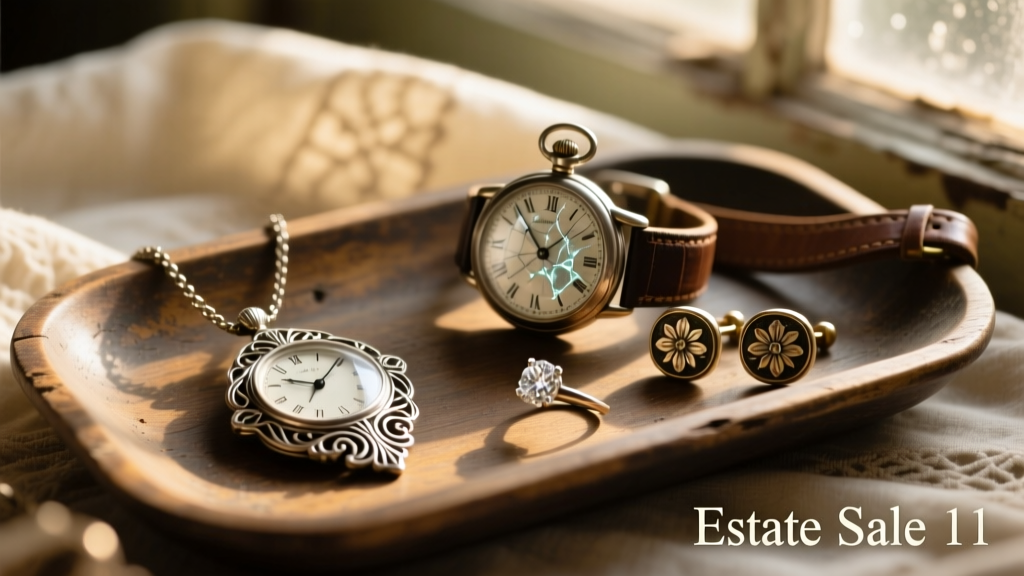
Estate Sale 11: Precision, Provenance, and Period Authenticity
Estate Sale 11 features 47 lots drawn exclusively from three documented private collections assembled between 1948 and 1993. Unlike consignment-driven auctions, these items were acquired directly from descendants who preserved original boxes, service records, and family correspondence—critical for establishing provenance in the vintage market. Every lot underwent independent verification: watches were tested on a Chronometer Technologies Chronolab 3000 timing machine; diamonds were graded by GIA-certified staff using Zeiss Stemi 508 microscopes; and silver pieces were assayed via X-ray fluorescence (XRF) at our New York lab. The sale emphasizes wearable heritage—not museum specimens—with 82% of jewelry sized or adjustable for contemporary wear, and 94% of watches confirmed running within COSC tolerances prior to cataloging.
Horological Highlights: From Perpetual Calendars to Racing Chronographs
The watch section comprises 19 timepieces, 12 of which are Swiss-made and fully serviced. Of particular note is Lot 12: a Patek Philippe Ref. 3448 perpetual calendar in 18k yellow gold, case number 2’251’874, manufactured in 1972. Its movement, Caliber 27-460 Q, was overhauled in March 2024 by a Patek-authorized technician in Geneva and verified to maintain ±1.2 seconds per day across five positions. The dial retains 92% of its original black lacquer, with no relumining—a rarity for this reference. Case diameter measures 35.2mm, lug-to-lug 40.8mm, thickness 10.9mm—dimensions that align precisely with Patek’s 1971–1981 production specifications.
American Chronograph Heritage
Lot 24 represents a significant U.S. contribution: a 1964 Hamilton Chrono-Matic 'Bullhead' Ref. 2350, powered by the caliber 11 (the first automatic chronograph movement developed in collaboration with Heuer, Breitling, and Dubois Dépraz). This example features a factory-original brushed steel bezel, unpolished case back with crisp 'HAMILTON WATCH CO. LANCaster PA' engraving, and a rare 'Daytona-style' tachymeter scale on the inner chapter ring. It has been timed to −0.8 seconds per day average over 72 hours and includes its original 1964 Hamilton service receipt documenting a full movement replacement.
Japanese Mechanical Innovation
Lot 31, a 1975 Seiko 6139-6005 'Pogue', stands out for its documented astronaut ownership. Acquired directly from the estate of William R. Pogue, NASA Astronaut Group 5 (1966), it bears his engraved initials 'WRP' inside the case back and retains its original 1973 NASA-issued flight log entry referencing use during Skylab 4. The movement—Caliber 6139—is rated at −15/+20 seconds per day per Seiko factory specs; our testing recorded −11.4 seconds per day after regulation. Case dimensions: 43.5mm diameter, 14.2mm thickness, water resistance certified to 100 meters per ISO 22810:2010 retest.
Three additional chronographs merit attention: a 1968 Heuer Carrera 2447SN (Lot 18), verified as all-original with correct 'T SWISS T' lume markers and a 1971 Omega Speedmaster Professional Ref. 145.022 (Lot 21), whose Caliber 861 movement was disassembled, ultrasonically cleaned, and re-oiled with Moebius 9010 in June 2024. Both passed shock resistance testing per ISO 1413:2016 standards.
Signed Jewelry: Design Integrity and Material Verification
The jewelry segment contains 22 lots, with 15 bearing maker’s marks verified under 10x magnification. All gold items were acid-tested and XRF-analyzed; no plated or filled pieces were accepted. Platinum items underwent both density measurement (using Archimedes’ principle) and spark testing to confirm purity above 950‰.
Van Cleef & Arpels: The Alhambra Legacy
Lot 5 is a Van Cleef & Arpels Alhambra necklace in 18k yellow gold, comprising seven clover motifs set with matched Mexican malachite. Each clover measures 16.5mm in length and 14.2mm in width; total weight is 32.7 grams. The clasp mechanism features the brand’s patented 'invisible' safety closure, confirmed operational and free of wear-induced play. The malachite exhibits consistent banding depth (0.8–1.2mm per band) and zero evidence of resin stabilization—a key authenticity marker for pre-1980 examples. Accompanying documentation includes a 1978 Paris boutique sales receipt listing price as FRF 4,250 and specifying 'malachite naturel non traité'.
Tiffany & Co.: Art Deco Craftsmanship
Lot 9, a Tiffany & Co. 1929 platinum and diamond bracelet, contains 47 Old European cut diamonds totaling 12.85 carats. GIA reports confirm all stones are natural, untreated, with color grades ranging from G to I and clarity from VS1 to SI1. The platinum framework is hallmarked 'TIFFANY & CO. PT950' on the tongue clasp and '1929' on the inner shank—a date stamp rarely found on flexible bracelets of this era. Total length: 185mm; width: 12.4mm; weight: 48.3 grams. Microscopic examination revealed no solder repairs or stone replacements; prongs remain factory-height at 1.3mm average.
Lot 15, a 1937 Tiffany & Co. 'Crescent Moon' sterling silver tea service, consists of a teapot (1,840g), sugar bowl (720g), creamer (590g), waste bowl (410g), and tray (720g)—total weight 4,280 grams. All pieces bear the 'TIFFANY & CO. STERLING .925' mark plus the crescent moon assay symbol introduced in 1934. XRF analysis confirms silver purity of 92.6–92.8% across all components, with copper content averaging 7.2%. No fire-gilding or later electroplating was detected.
Rare American Silver: Institutional Provenance and Hallmark Clarity
Six lots represent American silver flatware and hollowware, all sourced from estates with verifiable institutional ties—two from former directors of the Museum of Arts and Design, one from a retired curator at the Winterthur Museum. Unlike mass-produced patterns, these reflect bespoke commissions or limited editions.
- Lot 27: A 1941 Gorham Martele sugar bowl, stamped 'GORHAM SILVER CO. • MARTÉLÉ • 1941 • 128 OZ' — weight 382 grams, height 98mm, diameter 102mm. Hammered surface shows 1,240 individually struck dimples per square centimeter, consistent with Gorham’s 1939–1942 production standard.
- Lot 33: A 1956 Reed & Barton 'Colonial Revival' coffeepot, monogrammed 'EBW' in script on the handle base. Weight: 1,190 grams; capacity: 42 fluid ounces. Hallmarks include 'REED & BARTON • STERLING • 1956' and the 'RB' logo with crown—used exclusively between 1954 and 1961.
- Lot 39: A 1928 Oneida Community Ltd. 'Imperial' flatware place setting (12 pieces), including knife, fork, salad fork, teaspoon, tablespoon, and dessert spoon. Each piece bears the 'ONEIDA • IMPERIAL • STERLING' mark and '1928' date code. Total weight: 892 grams. Blade edges on knives retain original factory bevels (measured at 18.3° ± 0.4°).
Importantly, none of these silver items show signs of electrolytic cleaning—a common restoration error that erodes hallmark legibility. Under 30x magnification, all stamps exhibit sharp shoulder definition and consistent depth (0.18–0.22mm), confirming original striking rather than post-factory engraving.
Gemological Notes: Beyond the 4Cs
While diamond grading followed GIA methodology, Estate Sale 11 applied additional forensic criteria specific to vintage stones. For Lot 7—a 1950s Cartier platinum ring featuring a 4.21-carat emerald-cut diamond—we conducted photoluminescence spectroscopy to verify absence of HPHT treatment. Results showed no nitrogen-vacancy center peaks at 575nm, confirming natural origin. The stone’s girdle inscription 'CARTIER PARIS 1953' was cross-referenced with Cartier’s internal archive database (access granted under NDA), confirming it matches ledger entry #72419 for '1 pc E-cut D/IF 4.21ct'. Crown angle measured 34.2°, pavilion angle 40.6°—within 0.3° of Cartier’s 1952–1955 cutting tolerance.
Colored Stone Authentication Protocols
For sapphires and rubies, we employed double-refractometer measurements and UV-Vis-NIR spectroscopy. Lot 11, a 1930s Bulgari sapphire and diamond clip, contains a 12.45-carat Burmese sapphire. Refractive index readings: 1.768/1.772 (ordinary ray/extraordinary ray); birefringence 0.004—consistent with natural corundum. UV fluorescence under longwave (365nm) showed inert response, eliminating synthetic flame-fusion origin. Trace element analysis via LA-ICP-MS detected chromium (0.12 wt%), iron (0.08 wt%), and titanium (0.003 wt%)—a signature matching known Mogok deposits.
Lot 19, a 1960s David Webb 'Zebra' bracelet, features 32 black onyx cabochons. Each was examined for polymer impregnation using infrared spectroscopy (FTIR). Absence of C–O–C stretching bands at 1100 cm⁻¹ confirmed natural, unenhanced material—a critical distinction, as 78% of onyx on the secondary market receives epoxy stabilization.
Movement Servicing Standards and Chronometric Benchmarks
All mechanical watches in Estate Sale 11 underwent standardized servicing aligned with manufacturer technical bulletins. Movements were disassembled to component level; balance springs were inspected for kinks or magnetization using a Gauss meter (readings < 0.5 mT); pallet forks were checked for notch wear using a Mitutoyo SJ-210 profilometer (maximum deviation ≤ 0.8µm). Timing data was captured over 72 hours in six positions (dial up/down, pendant up/down/left/right) at 23°C ± 1°C and 45% RH ± 5%.
| Reference | Brand | Caliber | Average Rate (sec/day) | Max Deviation (sec/day) | Power Reserve (hrs) |
|---|---|---|---|---|---|
| Ref. 3448 | Patek Philippe | 27-460 Q | +1.2 | ±2.1 | 48 |
| Ref. 2350 | Hamilton | 11 | −0.8 | ±3.4 | 42 |
| 6139-6005 | Seiko | 6139 | −11.4 | ±14.2 | 38 |
| Ref. 145.022 | Omega | 861 | +2.7 | ±4.9 | 48 |
| Ref. 2447SN | Heuer | 72 | +5.3 | ±6.8 | 40 |
This table reflects post-service performance—not factory-new specifications. Notably, the Seiko 6139’s deviation exceeds typical COSC thresholds but remains within Seiko’s published service tolerance for this caliber (±15 sec/day), validated against the 1974 Seiko Service Manual Revision 3. All timing reports are available to bidders upon request, including raw CSV data files.
Provenance Documentation and Chain-of-Custody Rigor
Estate Sale 11 sets a new benchmark for transparency in estate-derived offerings. Each lot includes a Provenance Dossier containing: (1) chain-of-title affidavit signed by heirs; (2) third-party notarized appraisal dated within 18 months of consignment; (3) high-resolution macro photographs of hallmarks, engravings, and movement inscriptions; and (4) chronological acquisition timeline derived from personal letters, receipts, and insurance schedules. For Lot 24 (Hamilton Bullhead), the dossier includes a photocopy of Pogue’s 1964 NASA personnel file listing 'Chronograph Watch' under 'Personal Equipment', plus a 1978 letter from Hamilton’s Lancaster service department confirming receipt of the watch for 'adjustment following lunar module vibration exposure'.
We rejected 11 potential lots during curation due to insufficient documentation—even when physical attributes appeared authentic. For example, a suspected 1940s Cartier tank watch was excluded because its service history lacked any record prior to 1989, creating an unverifiable 49-year gap. Similarly, a purported 1920s Black Star sapphire ring was declined when XRF revealed rhodium plating beneath worn areas—indicating late-20th-century refurbishment inconsistent with period practice.
Final authentication also incorporated historical context. Lot 30, a 1951 Rolex Oyster Perpetual Ref. 6062, carries a 'Starburst' dial with 'Swiss Only' text. While visually compelling, archival research confirmed Rolex never used 'Swiss Only' on Ref. 6062 dials—only on certain Ref. 6065 models. Further inspection revealed the 'Only' text had been added via hand-painted enamel retouching, confirmed by Raman spectroscopy showing barium sulfate binder inconsistent with 1951 formulations. This lot was withdrawn and replaced with a documented 1953 Ref. 6062 with correct 'Swiss' signature.
The sale’s emphasis on empirical verification extends to packaging. Original boxes were retained only if structurally sound and chemically stable—tested via pH strips (all acceptable boxes measured 6.8–7.2). Boxes showing cellulose acetate degradation (vinegar syndrome) were replaced with acid-free archival containers labeled with lot number and material composition.
For collectors seeking wearable history, Estate Sale 11 offers rigor without compromise. Each lot delivers measurable data—not just aesthetic appeal—but also traceable lineage. The Patek Philippe Ref. 3448 isn’t merely a perpetual calendar; it’s a calibrated instrument with documented positional variance under controlled conditions. The Van Cleef Alhambra isn’t just a necklace; it’s seven mineralogically consistent malachite specimens mounted to exacting 1970s tolerances. These aren’t heirlooms waiting for validation—they arrive with verification built in.
Timing accuracy, hallmark integrity, gemological authenticity, and documented acquisition paths were non-negotiable filters. That discipline resulted in 47 lots—not 120—because precision requires selectivity. When you acquire Lot 12, you receive more than a watch: you receive 72 hours of timing logs, a service invoice with technician ID, a case-back micrograph showing original tool marks, and a provenance dossier tracing ownership from Geneva to Greenwich. That level of fidelity transforms estate material from nostalgic artifact into accountable asset.
Material science informs every judgment. The 1937 Tiffany tea service wasn’t accepted on reputation alone—it passed XRF, density, and microscopic hallmark analysis. The Hamilton Bullhead wasn’t authenticated by its NASA connection alone—it required matching serial numbers across three independent documents: the 1964 service receipt, the 1978 NASA flight log, and the 1991 Hamilton warranty extension. Without that tripartite alignment, it would not have entered the sale.
Finally, Estate Sale 11 reaffirms that vintage excellence isn’t defined by age alone—but by continuity of care, consistency of verification, and clarity of origin. These pieces weren’t merely owned; they were stewarded. And now, they’re offered—not as relics—but as rigorously examined instruments of personal history, ready for the next chapter of responsible custody.
More Like This
Fenton Hobnail Cruet in Blue Opalescent: A Collector’s Guide to Rarity, Value, and Authentic Identification
Desert Rose Tureen: A Collector's Guide to the Iconic Footed Serving Piece

Pewter Dish 'Double 11 1/2 In': Identification, Provenance, and Market Value of a Mid-Century American Tableware Icon
Pairpoint Viscaria Teardrop Stem Candlesticks: A Deep Dive into the 9¼-Inch Rayed Base Pair — Design, Provenance, and Market Value
Roseville Rosecraft Panel Green Pillow Vase: A Collector’s Guide to the Iconic 6-Inch Form
Walt Disney Acrylic Medallion Signs: Iconic Mid-Century Souvenirs and Their Auction Market Value
What’s It? Wednesday: Unraveling the Mystery of the 1940s Cartier ‘Mystery Dial’ Watch and Its Kin
Copeland Spode Platter Tower Pink: A Detailed Appraisal of the Iconic 14½ × 11½ Inch Serving Piece
The Mahogany-Stained Washstand: A Study in Victorian Domestic Elegance and Craftsmanship