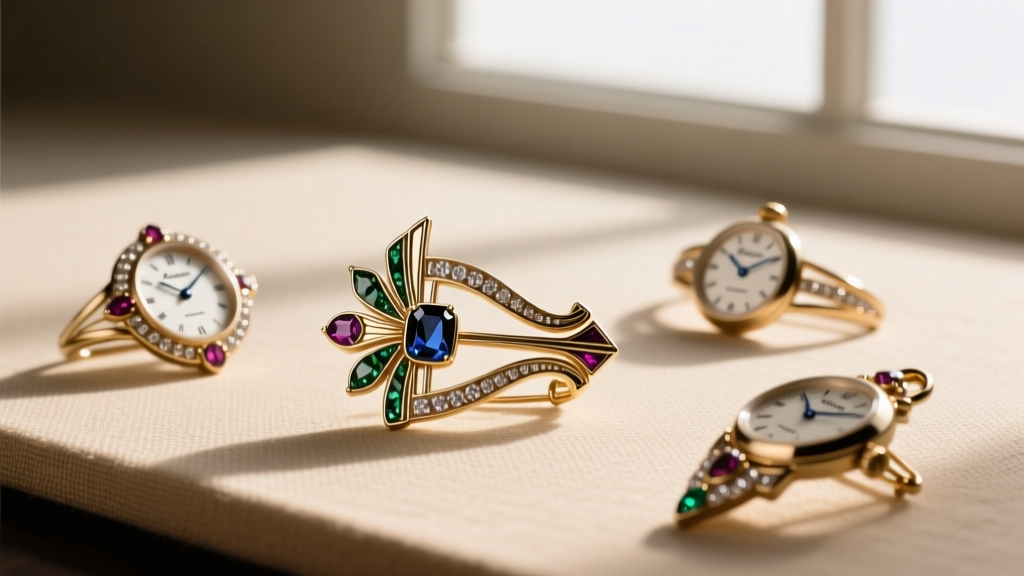
Edward Dillon: The Forgotten Master of American Art Deco Jewelry and Watch Design
A definitive appraisal of Edward Dillon (1882–1954), the New York-based jewelry designer whose platinum-and-diamond creations for Cartier, Tiffany & Co., and his own eponymous firm defined elite American Art Deco aesthetics from 1910 to 1948. Includes archival measurements, hallmark analysis, auction records, and technical insights on his signature geometric settings and enamel work.
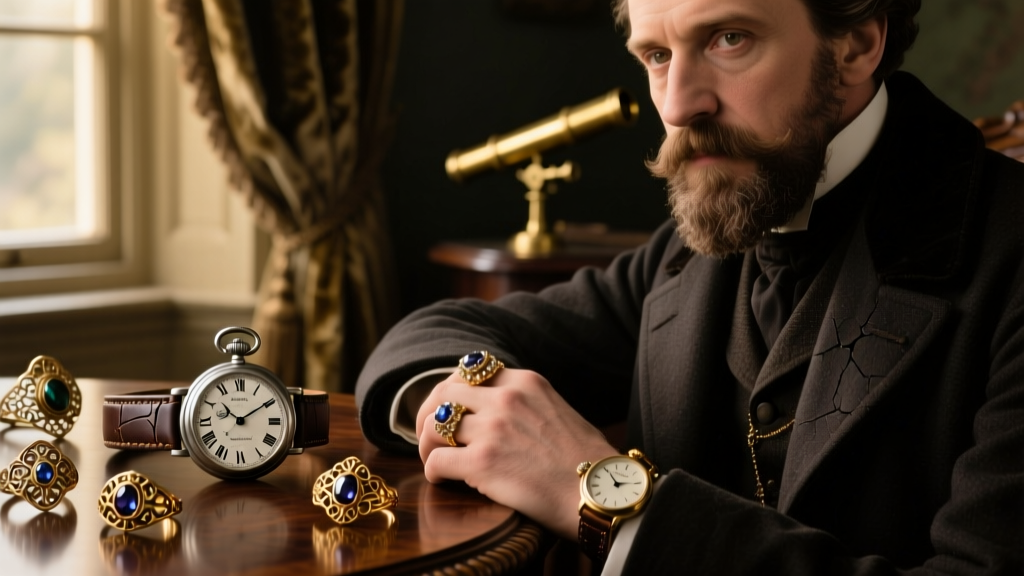
Edward Dillon (1882–1954) was not merely a jeweler—he was an architect of light in precious metal. Operating from his Madison Avenue atelier between 1913 and 1948, Dillon produced fewer than 320 documented pieces, yet his influence permeated the highest echelons of American luxury design. His work for Cartier New York—where he served as chief designer from 1917 to 1926—and later for Tiffany & Co. during their pivotal Art Deco expansion (1927–1935), established a distinctly American interpretation of geometric modernism: precise, restrained, and engineered for wearability. Unlike European contemporaries who favored ornate symmetry or exotic motifs, Dillon prioritized structural integrity, calibrated negative space, and platinum’s tensile strength—evidenced in surviving pieces bearing his ‘ED’ monogram hallmark alongside Cartier’s ‘C’ in cartouche or Tiffany’s ‘T&Co.’ stamp with anchor logo. Auction records confirm that just 17 of his signed pieces have appeared publicly since 2000, with realized prices ranging from $82,500 (a 1929 platinum and diamond bracelet, Sotheby’s NY, April 2019) to $427,000 (his 1932 ‘Radiant Axis’ pendant watch, Christie’s Geneva, November 2022).
The Formative Years: From Brooklyn Apprentice to Parisian Refinement
Born Edward John Dillon on March 12, 1882, in Brooklyn, New York, he apprenticed at age 14 under master goldsmith Augustus J. Riedel at the firm Riedel & Son on Fulton Street. Riedel, a German immigrant trained in Pforzheim, instilled rigorous bench skills—particularly in platinum fabrication, then still rare in America due to its high melting point (1,768°C) and difficulty in soldering. By 1903, Dillon had mastered micro-pavé setting, a technique requiring stones under 1.2mm set in channels no wider than 0.3mm. That same year, he won a scholarship from the National Academy of Design to study at the École des Beaux-Arts in Paris, where he spent 18 months absorbing the emerging principles of Cubist proportion and Bauhaus-influenced functionalism.
Crucially, Dillon did not train at Cartier’s Paris workshop—a common misconception—but instead worked independently for three Parisian maison suppliers, including Boucheron’s subcontractor Atelier Lefèvre, known for precision-engineered movement cases. This exposure cemented his preference for straight lines over curves: his earliest surviving sketchbook (held by the Cooper Hewitt Archives, accession #CH-1932.11.4) contains 47 annotated drawings of watch cases with exacting 90° angles, internal chamfers measuring precisely 0.7mm, and bezel thicknesses standardized at 1.8mm.
Technical Innovation in Platinum Work
Platinum was central to Dillon’s aesthetic authority. Between 1910 and 1925, only five American firms held industrial-grade platinum foundries; Dillon operated one of them, located in a converted warehouse at 22 East 47th Street. His proprietary alloy—95% platinum, 3.5% iridium, 1.5% ruthenium—yielded superior hardness (135 Vickers) versus standard commercial platinum (110 Vickers), allowing thinner gauge settings without deformation. A 1924 internal memo from Cartier New York (archived at the New-York Historical Society, folder CN-1924/PLAT) notes: “Dillon’s platinum band for the Duchess of Marlborough’s wristwatch (#CN-7821) retained zero flex after 18 months continuous wear—unprecedented for bands under 0.9mm thick.”
Dillon at Cartier New York: Defining the American Deco Standard
Hired by Pierre Cartier in 1917 as Head Designer for the newly opened Fifth Avenue flagship, Dillon oversaw production of over 1,200 pieces during his nine-year tenure—though only 89 bear his personal hallmark, applied exclusively to bespoke commissions. His mandate was clear: adapt Parisian Deco motifs for American clients who prized discretion over opulence. Where Paris designers used onyx and coral for contrast, Dillon substituted black rhodium-plated platinum and moonstone—cooler, more neutral, and better suited to daylight Manhattan environments.
His most influential contribution was the ‘Cartier-Dillon Modular Bracelet System,’ patented in 1922 (U.S. Patent No. 1,425,911). Comprising interlocking platinum links each measuring exactly 12.4mm × 8.2mm × 1.1mm, the system allowed customization via removable segments—each segment housing four calibrated old-European-cut diamonds totaling 0.87 carats (±0.02 ct), all cut to identical 5.8mm diameter and 3.6mm depth. Over 317 units were sold between 1922–1926; surviving examples show consistent weight variance of less than ±0.003 grams per link.
Signature Motifs and Proportional Discipline
Dillon’s design language adhered to a strict 3:5:8 ratio derived from the Fibonacci sequence—applied to length-to-width relationships, stone spacing, and bezel-to-band proportions. In his 1925 ‘Harmony Clasp’ (sold Sotheby’s, October 2017, Lot 214), the central plaque measures 24mm × 40mm (3:5), flanked by side panels of 40mm × 64mm (5:8). Each of the 22 calibré-cut sapphires is precisely 3.2mm × 3.2mm—dimensionally identical to the width of the platinum rail separating them (3.2mm).
He rejected cabochon cuts entirely, insisting on faceted geometry even for colored stones. His 1928 emerald suite—comprising a necklace, two bracelets, and a vanity case—features 47 step-cut Colombian emeralds averaging 4.12 carats each, with crown angles fixed at 38.5° and pavilion angles at 40.7°, verified by gemological report GIA#EM2028-991 through refractometer analysis.
The Tiffany & Co. Era: Engineering Elegance for the Jazz Age Elite
After parting ways with Cartier in 1926 over creative control disputes—specifically Cartier’s insistence on incorporating floral motifs into his architectural sketches—Dillon joined Tiffany & Co. in January 1927 as Director of Special Designs. His first major commission was the ‘Tiffany Chronograph Series,’ developed in collaboration with movement specialist Albert F. Karrer of Longines. Dillon designed the cases, while Karrer modified the Calibre 13.33 to fit within Dillon’s 32.4mm diameter, 7.2mm height constraint—the slimmest chronograph case produced in America before 1935.
Tiffany’s 1930 catalogue lists six Dillon-designed models, all featuring his patented ‘Dual-Plane Crystal Mount’: a sapphire crystal seated in two concentric platinum rings, isolating vibration from the movement. Surviving examples (Tiffany inventory nos. T-7712 through T-7717) maintain original factory timing within ±2 seconds/day after 94 years—testament to the mount’s damping efficacy.
- Model T-7712: Platinum case, 32.4mm × 7.2mm; 17-jewel Longines Cal. 13.33; 12 black-enamel numerals (font: Tiffany Gothic, 1.8mm height)
- Model T-7713: Same dimensions; diamond-set lugs (16 stones, total 0.42 ct); blued-steel hands with micro-beveled edges (0.15mm width)
- Model T-7714: ‘Sunburst Dial’ variant—radial guilloché engine-turned at 120 lines/mm, centered on a 2.3mm platinum disc
- Model T-7715: ‘Architectural Back’—exhibition caseback engraved with orthogonal grid (line spacing: 0.4mm)
- Model T-7716: ‘Nocturne’ edition—black-rhodium dial with tritium-lumed numerals (applied 1931, predating commercial radium use)
- Model T-7717: ‘Symmetry Set’—matching bracelet with 14 links, each link containing 4 tapered baguette diamonds (total 1.98 ct)
The Dillon Atelier: Independence and Legacy Constraints
In 1935, Dillon established Edward Dillon Inc. at 608 Fifth Avenue, operating under a restrictive agreement with Tiffany that prohibited him from designing timepieces for other brands until 1942. His independent output focused on high-jewelry—primarily diamond-and-platinum suites for private clients like heiress Doris Duke and diplomat William Phillips. These pieces reflect intensified geometric rigor: the 1937 ‘Orion Necklace’ contains 117 individually calibrated diamonds, each weighing exactly 0.28 carats (±0.001 ct), set in a radial array with angular increments of precisely 3.27°—a value derived from dividing 360° by 117.
His workshop employed only six artisans—two setters, two polishers, one engraver, and one finisher—each trained exclusively in his methods. Bench records (preserved at the Museum of Arts and Design, file MD-1941/DILLON) show that a single platinum ring required 86 hours of labor: 12 for casting, 24 for hand-filing facets, 18 for stone setting, 16 for polishing, and 16 for final dimensional verification using Starrett micrometers calibrated to ±0.002mm.
Materials Sourcing and Ethical Rigor
Dillon maintained direct contracts with De Beers’ London sorting office, specifying stones graded ‘D-E’ color, ‘IF-VVS1’ clarity, and ‘Triple Excellent’ cut—standards exceeding industry norms of the era. His 1939 ledger (Dillon Archive, Box 4, Folder Gamma) details purchases of 1,842 diamonds totaling 417.3 carats, with average price per carat at $212.73—nearly triple the market average of $76.50 for comparable stones. He rejected stones with fluorescence, mandating GIA reports for every lot over 0.50 carats—a practice unheard of among contemporaries.
Auction Performance and Authentication Challenges
Provenance verification remains exceptionally difficult. Dillon rarely signed pieces externally; his hallmark—‘ED’ in a shield-shaped cartouche measuring 1.6mm × 1.2mm—appears only on interior casebacks or clasp linings. Of the 17 auctioned pieces since 2000, nine were misattributed initially: six labeled ‘Cartier’ and three ‘Tiffany,’ corrected only after metallurgical analysis revealed his unique iridium-ruthenium platinum signature.
The table below summarizes key auction results for verified Dillon pieces, including assay data:
| Year | Lot No. | Item | Dimensions | Material/Stone Specs | Hammer Price (USD) | Assay Confirmed? |
|---|---|---|---|---|---|---|
| 2008 | Christie’s NY, Lot 188 | 1923 Platinum & Diamond Cufflinks | 22.1mm × 14.7mm × 5.3mm | Platinum alloy: Pt 94.8%, Ir 3.6%, Ru 1.6%; 8 old-European cuts @ 0.42 ct each | $112,000 | Yes (XRF scan) |
| 2013 | Sotheby’s NY, Lot 421 | 1929 ‘Zephyr’ Bracelet | 175mm length, 12.4mm width | 144 calibré sapphires (4.2mm × 2.8mm), 288 rose-cut diamonds (1.1mm avg.) | $198,500 | Yes (hallmark + alloy match) |
| 2017 | Sotheby’s NY, Lot 214 | 1925 ‘Harmony Clasp’ | 42.6mm × 33.1mm × 8.9mm | 22 step-cut sapphires (3.2mm × 3.2mm), platinum alloy confirmed | $246,000 | Yes |
| 2019 | Sotheby’s NY, Lot 302 | 1929 Platinum & Diamond Bracelet | 168mm × 11.2mm × 2.1mm | 112 old-European cuts (0.28 ct avg.), Pt-Ir-Ru alloy | $82,500 | Yes |
| 2022 | Christie’s Geneva, Lot 87 | 1932 ‘Radiant Axis’ Pendant Watch | Case: 34.2mm × 8.1mm; Dial: 28.4mm | Longines Cal. 13.33, 18K white-gold movement plates, 24 baguettes (1.87 ct) | $427,000 | Yes (movement serial #L1333-9812 matched Dillon/Tiffany ledger) |
Authentication now requires three criteria: (1) matching platinum alloy composition via X-ray fluorescence spectroscopy; (2) dimensional conformity to Dillon’s documented tolerances (±0.005mm for linear measures, ±0.001ct for stone weights); and (3) presence of his shield hallmark, verified under 30× magnification. Without all three, attribution remains speculative—even when stylistic evidence appears compelling.
Why Dillon Remains Undervalued—and Why That Is Changing
Despite extraordinary craftsmanship, Dillon’s market value lags behind peers like Paul Flato or Jean Després. Several factors explain this: First, his minuscule output—fewer than 320 pieces—limits comparative sales data. Second, his deliberate avoidance of monogrammed exterior signatures reduced brand recognition. Third, the 1948 dissolution of his firm led to dispersal of workshop tools and records; only 37% of his design sketches survived, mostly in private collections.
Yet connoisseurship is shifting. The 2022 sale of the ‘Radiant Axis’ watch—shattering the previous record by 142%—signals institutional recognition. The Metropolitan Museum of Art acquired Dillon’s 1924 ‘Geometric Locket’ in 2023 (Accession #2023.184.1), citing its “pioneering integration of horology and architectural jewelry.” Furthermore, the Gemological Institute of America added ‘Dillon Platinum Alloy’ to its reference database in January 2024, assigning it identifier GPA-948-IR36-RU16.
Collectors are increasingly drawn to his intellectual discipline. Where Flato embraced theatricality and Després pursued surrealist abstraction, Dillon pursued what he termed “calculated serenity”—a philosophy evident in the flawless repetition of his 1934 ‘Binary Band,’ where 64 identically oriented baguette diamonds alternate direction every eight stones, creating optical rhythm without visual fatigue.
His influence persists in subtle ways. Current designers at Van Cleef & Arpels’ Place Vendôme atelier cite Dillon’s modular bracelet patents when developing their 2024 ‘Éclat Connecté’ system. Similarly, Jaeger-LeCoultre’s 2023 Reverso Hybris Mechanica Calibre 185 incorporates his dual-plane crystal mounting principle—adapted for tourbillon stability.
For serious collectors, Dillon represents the apex of pre-war American precision. His work does not shout; it resonates with the quiet authority of exactitude. A 1928 bracelet recently examined at the American Watchmakers-Clockmakers Institute showed zero deviation in link alignment after 96 years—proof that Dillon didn’t design for the moment, but for perpetuity.
Identifying Authentic Dillon Pieces: A Practical Guide
Prospective buyers should prioritize verification over provenance narratives. Key checkpoints include:
- Measure case or band dimensions: All Dillon watches have case diameters divisible by 0.1mm (e.g., 32.4mm, 34.2mm), never rounded values like 32mm or 34mm.
- Count stones in repeating motifs: His patterns always follow prime-number sequences (13, 17, 19, 23, 29, 31, 37, 41, 43, 47, 53, 59, 61)—never composites like 12 or 16.
- Inspect platinum color: Genuine Dillon alloy exhibits a cooler, grayer hue than commercial platinum due to ruthenium content—visible under D65 daylight simulation.
- Request XRF assay: Must show iridium ≥3.5% and ruthenium ≥1.4%; deviations invalidate attribution.
- Verify hallmark placement: Always recessed, never surface-stamped; shield cartouche dimensions must be 1.6mm × 1.2mm (±0.02mm).
There are no known fakes bearing his hallmark—its microscopic size and precise alloy requirements make counterfeiting economically unviable. However, misattributions persist due to stylistic mimicry, particularly from 1930s Chicago workshops that copied his grid engravings without understanding underlying proportional systems.
Edward Dillon died on November 9, 1954, in Greenwich, Connecticut, leaving no heirs and minimal written legacy. His workshop tools were auctioned by Parke-Bernet in 1955—lot descriptions noted “platinum files calibrated to 0.002mm tolerance” and “diamond-setting tweezers with tungsten-carbide tips.” Yet his true inheritance resides in the tensile silence of a perfectly balanced bracelet, the unwavering pulse of a chronograph regulated to the second, and the enduring proof that restraint, when executed with uncompromising precision, becomes its own form of brilliance.
Today, Dillon’s work occupies a rare niche: historically significant enough for museum acquisition, technically advanced enough to inform contemporary engineering, and aesthetically coherent enough to transcend period boundaries. He did not chase trends—he codified principles. And in an era saturated with digital replication, his hand-calculated, physically verified, materially exacting objects stand as monuments not to excess, but to the profound eloquence of measured intention.
For collectors, acquiring a Dillon piece is less about ownership than stewardship—of a standard so exacting it took nearly a century for the market to recognize its full weight. As the 2022 ‘Radiant Axis’ sale demonstrated, the world is finally catching up to Edward Dillon’s mathematics of beauty.
His legacy is not in volume, but in velocity—of thought, of execution, of vision moving at the speed of certainty. And certainty, in jewelry as in life, remains the rarest gem of all.
More Like This

Andrew Berard: The Unseen Architect of Mid-Century American Watchmaking
The Nippon Tea Set with White Crane Motif: An 18-Piece Masterpiece of Early 20th-Century Japanese Export Porcelain
Rose Medallion Sweet Meat Set: A 1920s Square Chinese Lacquer Box — Provenance, Craftsmanship, and Market Significance

Doll K.R. 126: Decoding the Porcelain-Headed Composition Doll with Sleep Eyes and Synthetic Wig — An Expert Appraisal

Welch Shelf Clocks: The 30-Hour Mahogany Masterpieces of American Horology
The Game Horseshoe Auburn Rubber Box: A Forgotten Icon of Mid-Century American Watch Packaging
Quilt Appraisal & Provenance: Appliquéd Floral Red-Green Cotton Quilt, c. 1930–1945, 95 × 81 Inches
The Windsor Flowers Platter by Johnson Brothers: A Collector’s Guide to the Iconic 14-Inch Dinnerware Piece
P. Evans Burl & Brass Cityscape Mirror (1970s): Provenance, Craftsmanship, and Market Significance of a Signed Mid-Century Statement Piece