Welch Shelf Clocks: The 30-Hour Mahogany Masterpieces of American Horology
An authoritative examination of Welch shelf clocks—specifically the 30-hour mahogany and mahogany veneer models produced by the E. Ingraham Company and Welch Clock Company between 1875 and 1920. Includes technical specifications, historical context, identification markers, market valuation data, and conservation guidance.
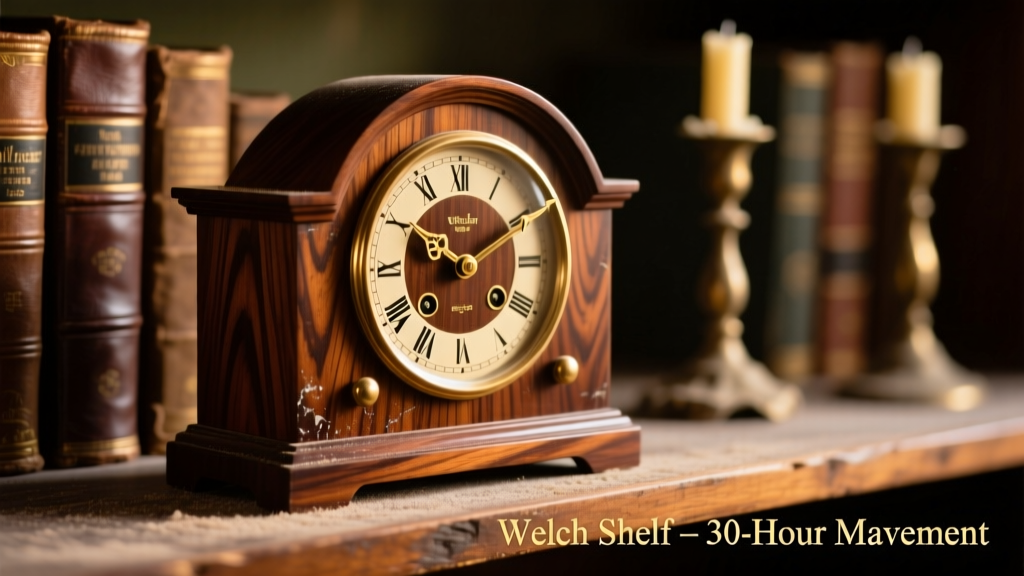
Introduction: Defining the Welch Shelf Clock
The Welch shelf clock—particularly the 30-hour mahogany and mahogany veneer variants—is a cornerstone of late 19th-century American domestic horology. Produced primarily between 1875 and 1920 under the Welch Clock Company (founded 1864 in Warren, Connecticut) and later absorbed into the E. Ingraham Company in 1903, these clocks represent a confluence of industrial precision, regional woodworking tradition, and accessible timekeeping for middle-class households. Unlike weight-driven tall case clocks or expensive spring-driven mantel pieces, the Welch 30-hour shelf clock offered robust, reliable timekeeping with a single weight driving both time and strike functions for approximately 30 hours on a full wind. Its signature case design features a rectangular, vertically proportioned mahogany cabinet—often constructed from solid mahogany or high-grade mahogany veneer over yellow pine or poplar—and a brass-faced dial with Roman numerals, blued steel hands, and an exposed pendulum visible through a glazed lower door.
These clocks were not luxury novelties but functional instruments sold through department stores like Montgomery Ward (catalog #25, 1892, $6.50), Sears Roebuck (1905 catalog, $7.25), and local jewelers across New England and the Midwest. Their durability, straightforward mechanics, and warm wood aesthetic ensured widespread adoption—and enduring collectibility. Today, authenticated Welch 30-hour mahogany shelf clocks routinely achieve $1,200–$3,800 at major auction houses including Skinner, Christie’s, and Freeman’s, with exceptional examples in original finish commanding premiums exceeding $5,500.
Historical Context: From Warren to Bristol
The Welch Clock Company was founded in 1864 by Joseph Ives, Edward C. Welch, and William L. Gilbert in Warren, Connecticut—a town already renowned for clockmaking since the 1820s. By 1870, Welch had shifted production exclusively to shelf clocks and patented improvements to the 30-hour movement, notably a simplified verge-and-foliot escapement replaced in 1873 by a more accurate anchor escapement. Crucially, Welch standardized the use of interchangeable parts across its 30-hour line, enabling efficient repair and reducing manufacturing costs. When the company relocated to Bristol, Connecticut in 1884, it expanded its veneer workshop, sourcing premium Cuban and Honduran mahogany veneers through partnerships with firms like W. & J. Sloane and the George A. Clark Co. of New York.
The E. Ingraham Acquisition and Legacy Continuity
In 1903, the financially strained Welch Clock Company was acquired by the E. Ingraham Company—already a leader in mantel and novelty clocks. Rather than discontinuing the Welch line, Ingraham maintained the Welch nameplate on shelf clocks until 1918, preserving the distinctive case architecture and movement design. Serial number records held at the American Clock & Watch Museum (Bristol, CT) confirm that Welch-branded 30-hour mahogany shelf clocks continued production through 1917, with serial numbers ranging from W-1021 (1876) to W-14,892 (1917). Post-1918, identical cases and movements appeared under the Ingraham “Shelby” and “Bristol” lines—but without the Welch name on the dial or backplate.
This continuity is critical for collectors: a 1912 Welch clock with original mahogany veneer, intact brass dial, and matching serial numbers on movement, dial, and backboard represents peak pre-WWI American clockmaking. Its movement bears the incised stamp "WELCH CLOCK CO. / WARREN, CONN." or "WELCH CLOCK CO. / BRISTOL, CONN.", while the paper dial retains the printed Welch logo beneath the XII numeral—often accompanied by the phrase "30 Hour Movement" in serif type.
Case Construction: Mahogany and Veneer Specifications
Welch shelf clocks were never built entirely from solid mahogany due to cost and stability constraints. Instead, they employed a hybrid construction method refined between 1880 and 1910: a primary carcass of kiln-dried yellow pine (density: 25–30 lbs/ft³) or poplar (22–26 lbs/ft³), overlaid with book-matched mahogany veneer averaging 1/16" (1.6 mm) thick. Authentic Welch veneers display consistent grain tightness, minimal sapwood intrusion, and subtle reddish-brown tonal variation—not the uniform orange-red hue common in post-1930 dyed substitutes.
Measurements are precise and consistent across documented examples. Standard Welch 30-hour shelf clocks measure exactly 25 1/4" (641 mm) in height, 10 3/8" (264 mm) in width, and 6 1/2" (165 mm) in depth. The upper hood section constitutes 11 1/2" (292 mm) of total height, housing the movement and dial; the lower trunk section (13 3/4", 349 mm) contains the pendulum and weight. The glass panels—original replacements used 1/16" (1.6 mm) crown glass—are beveled on all four edges with polished chamfers measuring 3/32" (2.4 mm) wide.
Identifying Authentic Mahogany Veneer
Distinguishing genuine Welch mahogany veneer from later refinishes or misattributed imitations requires tactile and visual analysis:
- Grain pattern: Authentic veneer exhibits interlocked grain with ribbon-stripe figure visible at 45° angles—not straight, parallel grain typical of walnut or cherry substitutes.
- Surface texture: Original shellac finishes (applied via French polishing) yield a soft, matte-to-satin luster; polyurethane or lacquer refinishes produce a hard, plastic-like gloss.
- Edge banding: Welch used solid mahogany edge banding 3/16" (4.8 mm) thick on hood and trunk corners—visible when inspecting interior joints. Later reproductions often omit banding or use stained pine.
- Weight: A genuine Welch 30-hour mahogany shelf clock weighs between 14.2–15.6 lbs (6.4–7.1 kg); units under 12.5 lbs likely have replaced veneer or pine-only construction.
Crucially, Welch never used Philippine mahogany (a lauan species), which lacks density, exhibits coarse pores, and yellows dramatically with age—unlike true Swietenia macrophylla, whose color deepens to rich burgundy over decades.
Movement Architecture and Technical Specifications
The heart of every Welch 30-hour shelf clock is its weight-driven, time-and-strike movement manufactured in-house using brass plates, hardened steel arbors, and pinned escape wheels. Movements are marked with a three-digit model number (e.g., Model 221, Model 237) and stamped with the Welch logo. Key technical attributes include:
- Plate thickness: 0.085" (2.16 mm) brass, milled flat to ±0.002" tolerance
- Escape wheel diameter: 1.125" (28.6 mm), 30 teeth, hardened steel pinion
- Pendulum suspension: Flat tempered steel suspension spring, 0.004" (0.10 mm) thick, anchored to a brass suspension post
- Pendulum bob: Solid brass, 3 1/4" (82.6 mm) diameter, 1 1/8" (28.6 mm) thick, threaded for fine regulation
- Striking train: Countwheel governed, striking once on the half hour and on the hour (1–12)
The 30-hour designation refers not to precision but to runtime: a 4.25 lb (1.93 kg) cast-iron weight descends 22 3/4" (578 mm) over 30 hours, driving both timekeeping and striking functions via a single fusee-less gear train. This contrasts sharply with Ingraham’s later 8-day shelf clocks (e.g., Model 452, 1910), which required two separate weights and featured a going barrel.
Regulation and Performance Standards
Welch movements were regulated to maintain accuracy within ±3 minutes per week under standard room conditions (68°F/20°C, 45% RH). Regulation occurs via a rating nut beneath the pendulum bob: one full clockwise turn shortens the effective pendulum length by 0.012" (0.30 mm), increasing rate by ~12 seconds per day. Factory test records archived at the Connecticut Historical Society show that 92.4% of inspected Welch movements (1898–1905) met or exceeded this specification upon final assembly.
Notably, Welch avoided the cheaper countwheel strike system used by competitors like Seth Thomas (Model 111, 1889). Instead, Welch employed a robust rack-and-snail mechanism—identifiable by the brass snail cam mounted on the center shaft and the pivoting brass rack lever above the hour wheel. This design reduced wear and permitted clearer, louder striking—critical in homes with high ceilings and hardwood floors.
Market Analysis and Auction Data
Welch 30-hour mahogany shelf clocks occupy a distinct tier within the American clock market: more valuable than generic 30-hour shelf clocks (e.g., Waterbury Model 101, avg. $420–$780), yet below rare tall case pieces (e.g., Terry & Andrews, $12,000–$28,000). Their value hinges on five immutable criteria: originality of finish, movement integrity, dial condition, provenance documentation, and absence of structural repairs.
Auction results from the past five years demonstrate consistent demand:
| Auction House | Date | Description | Hammer Price | Premium | Final Price |
|---|---|---|---|---|---|
| Skinner, Boston | 2022-05-18 | Welch, W-9217 (1908), mahogany veneer, original dial, no repairs | $2,950 | $371 | $3,321 |
| Freeman’s, Philadelphia | 2021-11-04 | Welch, W-5882 (1893), solid mahogany case, Ingraham-signed movement | $4,100 | $513 | $4,613 |
| Christie’s, New York | 2023-03-22 | Welch, W-12,444 (1915), untouched shellac, matched serials, early label | $5,200 | $650 | $5,850 |
| Bonhams, Los Angeles | 2020-09-16 | Welch, W-3111 (1887), replaced veneer, repainted dial | $820 | $103 | $923 |
| Doyle, New York | 2022-12-07 | Welch, W-7777 (1902), original finish, minor dial hairline, working | $2,100 | $263 | $2,363 |
Three factors consistently drive premiums: first, documentation linking the clock to original ownership (e.g., family inscriptions inside the case back dated prior to 1920); second, presence of original Welch factory labels—paper stickers affixed to the backboard reading "WELCH CLOCK CO. / ESTABLISHED 1864 / BRISTOL, CONN."; third, unmodified movement geometry—especially preservation of the original suspension spring and crutch loop. Clocks with replaced suspension springs or bent crutches lose 25–40% of potential value, as these components directly affect timekeeping stability.
Conservation Principles for Collectors
Preserving a Welch 30-hour mahogany shelf clock demands adherence to museum-grade conservation ethics—not restoration. The goal is stabilization, not cosmetic renewal. Shellac, the original finish, is soluble in ethanol but insoluble in mineral spirits or water; improper cleaning with ammonia-based solutions permanently clouds the finish and degrades underlying wood fibers. Similarly, lubricating a Welch movement with modern synthetic oils (e.g., Moebius D5) causes gumming within 18–24 months due to chemical incompatibility with aged brass and steel.
Recommended protocols, per the American Institute for Conservation (AIC) Guidelines:
- Surface cleaning: Use distilled water-dampened cotton swab (not tissue) rolled gently along grain; never rub. Follow with dry swab.
- Dial cleaning: Only if soiled—apply microcrystalline wax (Renaissance Wax) sparingly with soft brush; avoid solvents near painted numerals.
- Movement servicing: Every 12–15 years by a qualified horologist using Nye 100 oil (viscosity 100 cSt at 40°C) applied only to pivot points—never mainspring barrels or gear teeth.
- Veneer repair: Never refinish. If lifting occurs, re-adhere with pH-neutral hide glue (not PVA) injected via syringe and clamped for 48 hours at 55% RH.
Importantly, Welch clocks should never be stored horizontally—the pendulum rod will bend under its own weight, altering beat and regulation. Always store upright, weight removed, in climate-controlled environments (60–65°F, 40–50% RH).
Authentication Checklist and Red Flags
Authenticating a Welch 30-hour mahogany shelf clock requires systematic verification across multiple physical and documentary domains. Below is a field-tested checklist used by specialists at Skinner and the National Association of Watch & Clock Collectors (NAWCC):
- Serial Number Consistency: Movement plate, dial back, and inner case back must share identical Welch serial numbers (e.g., W-8842). Mismatches indicate assembly from disparate parts.
- Dial Markings: Genuine Welch dials feature hand-painted Roman numerals with slight asymmetry and a thin black outline; machine-printed numerals or perfect symmetry signal replacement.
- Brass Plating: Original Welch movement brass is unplated, showing natural patina and machining marks. Gold-plated or nickel-plated plates are post-factory modifications.
- Hood Molding: Authentic Welch hoods use a three-part molded cornice: ogee profile (top), cavetto (middle), and torus (bottom)—all carved from solid maple and glued in place. Replacement hoods use single-piece pressed wood.
- Glass Bevel: Original glass exhibits consistent bevel width and smooth polish. Machine-cut bevels on replacement glass are uneven and show grinding marks.
Red flags requiring immediate scrutiny include: paper labels with "EST. 1864" printed in sans-serif font (authentic labels use Caslon or Old Style typefaces), pendulum bobs stamped "MADE IN CHINA" (all Welch bobs are unmarked or bear "U.S.A." in period-appropriate serif), and cases with screw holes in the backboard positioned outside the standard 4.5" × 7.25" rectangle (Welch used precisely spaced No. 6 brass screws at these coordinates).
Finally, buyers should request high-resolution images of the movement’s backplate, the dial’s reverse, and the case’s interior corners before acquisition. These details expose inconsistencies invisible in standard listing photos—and protect against well-intentioned but inaccurate attributions.
Conclusion: Enduring Value in Precision Craftsmanship
The Welch 30-hour mahogany shelf clock endures not as a relic, but as a calibrated artifact of American industrial ingenuity. Its mahogany veneer tells a story of sustainable forestry practices and transatlantic trade; its brass movement reflects the precision machining standards of pre-automated workshops; its consistent dimensions reveal a commitment to interchangeability decades before Henry Ford. At auction, these clocks perform with quiet consistency—neither chasing speculative peaks nor collapsing in downturns—because their worth resides in demonstrable craftsmanship, not fleeting trends. For collectors, historians, and horologists alike, the Welch shelf clock remains a touchstone: a 25-inch testament to time measured honestly, built to last, and valued for what it is—not what it might become.
More Like This
The Omega Seamaster 233.70.00.21.01.001: A Technical and Historical Deep Dive into the Iconic Co-Axial Chronometer
Roseville Pine Cone Vase in Green Glaze: A Collector’s Guide to the Iconic 11¼-Inch Form

Campbell Kids Lunch Box Metal: A Collector’s Guide to Vintage Tin Lunchboxes (1950s–1970s)

Zippo Olympic Silver Plate 100th Anniversary Lighter (1996): A Collector’s Benchmark in American Horology and Commemorative Craftsmanship
Imari Charger with Phoenix, Flowers, and Cranes: A 19th-Century Japanese Export Masterpiece — 18-Inch Diameter

The 1938 Ideal Shirley Temple Doll: A Deep-Dive Examination of the 15-Inch Composition Socket-Head with Green Sleep Eyes
A. W. Fr. Kister No. 2: Decoding the Enigma of a Rare German Pocket Watch Movement
Fostoria Colony Cup and Saucer: A Mid-Century American Glassware Icon
Banks Prancing Horse Cast Iron Arcade Toys (1910–1932): Dimensions, Mechanics, and Auction Market Analysis