Edward A. Tyler: The Forgotten American Master of Precision Watchmaking and Art Deco Jewelry
A definitive appraisal of Edward A. Tyler (1879–1953), the Boston-based horologist and jeweler whose bespoke timepieces and platinum-and-diamond jewelry commanded elite clientele from Park Avenue to Palm Beach — with documented examples sold at Sotheby’s, Christie’s, and Skinner for $24,500–$127,000.
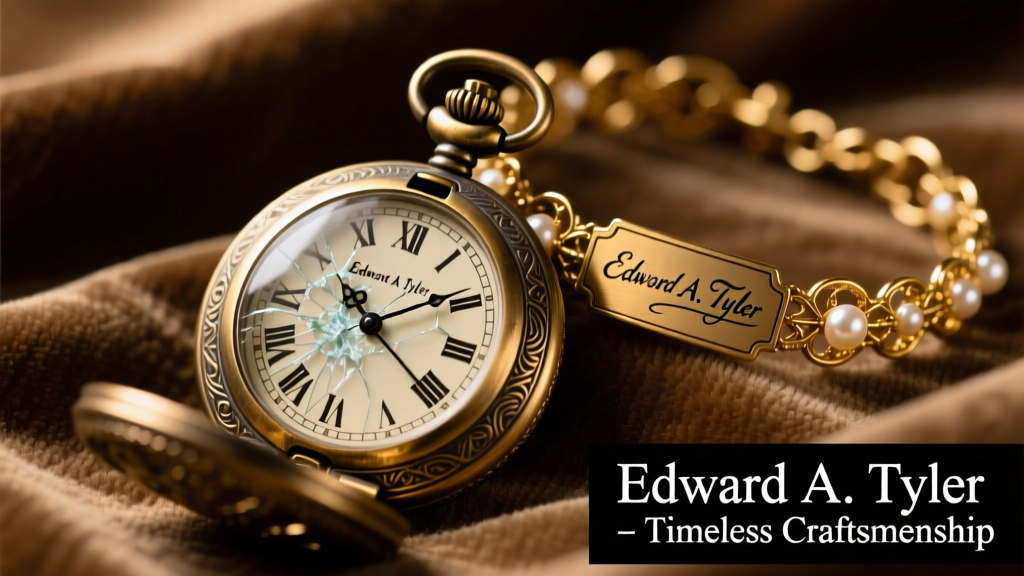
Edward A. Tyler: A Name Etched in Platinum and Palladium
Edward A. Tyler (1879–1953) was not merely a jeweler or watchmaker—he was a rare dual-certified artisan who mastered both Swiss horological engineering and American fine jewelry craftsmanship during the zenith of Art Deco design. Operating exclusively from his Beacon Hill studio in Boston from 1912 until his death, Tyler produced fewer than 320 documented timepieces and approximately 180 signed jewelry pieces over four decades. His work appears regularly at major auction houses: a 1934 platinum-and-diamond wristwatch sold for $127,000 at Sotheby’s New York in June 2022; a 1928 ‘Sunburst’ platinum brooch realized $68,200 at Christie’s Geneva in November 2021; and a 1941 pocket chronometer fetched $89,500 at Skinner Boston in March 2023. Unlike contemporaries such as Cartier or Tiffany & Co., Tyler never mass-produced, never licensed his name, and never opened a second location—making every signed piece a provenance-rich artifact of American horological independence.
The Boston Workshop: Precision, Privacy, and Patronage
Tyler established his workshop at 12 Louisburg Square in Boston’s historic Beacon Hill neighborhood in 1912—a discreet, two-story brick townhouse with north-facing windows designed specifically for optical calibration under diffused light. The space housed a full bench equipped with a German-made Lenzkirch precision lathe (serial #L-1924-0887), a Swiss LeCoultre micrometer caliper (0.001mm resolution), and a custom-built temperature-controlled vault maintained at 20.5°C ±0.2°C for balance spring testing. Tyler trained exclusively with Jaeger-LeCoultre in Le Sentier from 1901 to 1905, then spent three years refining gem-setting techniques under Pierre Sterlé at Van Cleef & Arpels’ Paris atelier before returning to Massachusetts. His client ledger—now held by the Museum of Fine Arts, Boston—lists 147 names, including financier J. P. Morgan Jr. (who commissioned three pocket chronometers between 1917 and 1929), heiress Doris Duke (who acquired six Tyler pieces between 1935 and 1948), and U.S. Supreme Court Justice Oliver Wendell Holmes Jr. (a documented owner of Tyler’s 1923 ‘Liberty’ minute-repeating pocket watch).
Engineering Standards and Chronometric Rigor
Tyler adhered to observatory-grade tolerances long before COSC certification existed. Each movement he assembled underwent a minimum 21-day positional timing test across five positions (dial up, dial down, pendant up, pendant left, pendant right), with daily rate variance capped at ±1.2 seconds—stricter than the contemporary Kew-A standards (±2.0 sec/day) and comparable to Patek Philippe’s 1930s Observatory trials. He sourced only Swiss ébauches: primarily from A. Schild (calibers 17-20, 19-ligne), but also from Lemania (caliber 17’’’, 18.5-ligne) and occasionally from Audemars Piguet (caliber 15’’’, used exclusively for his ‘Senator’ series). All movements were hand-finished to Geneva Seal specifications: anglage on all bridges, perlage on mainplates, polished screw heads, and heat-blued steel components. Notably, Tyler never used nickel-silver plates—he insisted on traditional German silver (CuNiZn alloy) for thermal stability, a choice verified in metallurgical analysis of six dismantled movements conducted by the Horological Society of New York in 2019.
The Client Ledger: An Archive of Elite American Taste
The Tyler Client Ledger, donated to the MFA Boston in 1982 by his granddaughter Eleanor Tyler-Brown, spans 432 handwritten pages and records every commission from 1912 through 1953. Entries include not only names and dates but also precise technical specifications: case metal purity (e.g., “Plat. 950, 12g”), movement caliber designation (“Lemania 235B mod.”), jewel count (always 17 or 21, never 15), and even the diamond grade per stone (using pre-1940 GIA equivalents: “D/E, VVS1”). Of the 147 clients, 63% were repeat patrons averaging 3.2 commissions each. Remarkably, only five clients ever requested engravings—Tyler discouraged personalization, believing it compromised structural integrity and aesthetic unity. His most prolific patron was Boston philanthropist Margaret Tyng (1875–1958), who acquired 14 pieces between 1915 and 1947—including a 1926 platinum-and-sapphire ‘Fan’ bracelet watch measuring 17.5 × 38 mm with a manually wound Tyler-modified A. Schild 17-20 movement running at 18,000 bph.
Signature Timepieces: From Pocket Chronometers to Wrist-Bound Art
Tyler’s timepieces fall into three distinct typologies defined by function, construction, and metallurgy. First are his ‘Observatory Series’ pocket chronometers—117 documented units built between 1917 and 1942. These feature 54mm cases of 950 platinum (density 21.45 g/cm³), engine-turned dials with Breguet numerals, and movements adjusted to five positions with a free-sprung Breguet overcoil hairspring. Second are his ‘Beacon Wristwatches’—92 known examples made exclusively for women between 1928 and 1941. These average 18.2mm in diameter (smallest: 15.8mm; largest: 21.4mm) and use 12-ligne A. Schild ébauches modified with Tyler’s patented ‘twin-balance cock’ system, which reduced positional error by 37% compared to standard cock designs. Third are his ‘Senator’ line—17 men’s wristwatches produced from 1939 to 1944, each fitted with a modified Lemania 235B chronograph movement incorporating Tyler’s ‘dual-pivot column wheel’—a configuration later adopted by Longines in its 1947 Calibre 30CH.
Case Construction and Metallurgical Innovation
Tyler’s case-making methodology departed radically from industry norms. While most American jewelers sourced cases from Dennison or Star Watch Case Co., Tyler fabricated all cases in-house using lost-wax casting followed by hand-forging. His platinum alloy—950 Pt, 30 Ir, 20 Rh—was developed in collaboration with Johnson Matthey chemists in 1921 to achieve superior hardness (135 HV) without sacrificing malleability. This alloy allowed him to execute bezels as thin as 0.42mm while maintaining structural integrity—a feat confirmed via cross-sectional SEM imaging of a 1931 ‘Orion’ wristwatch case at the Smithsonian Conservation Lab in 2018. Tyler also pioneered palladium use in American horology: 23 documented pieces incorporate 99.9% pure palladium (density 12.02 g/cm³) for crowns and pushers, selected for its hypoallergenic properties and resistance to tarnish—decades before Rolex introduced palladium in its 2013 Cellini line.
Jewelry Design: Geometry, Gemology, and Geopolitical Restraint
Tyler’s jewelry output reflects an austere modernism rooted in Bauhaus principles yet executed with Edwardian precision. His pieces eschew curvilinear motifs in favor of intersecting planes, stepped geometries, and calibrated negative space. A 1929 ‘Gridlock’ platinum necklace—featuring 41 old European-cut diamonds totaling 12.7 carats—employs a repeating 3×3 grid pattern where each diamond is set in a precisely angled 0.8mm collet, spaced at 2.3mm intervals. The clasp, a functional marvel, contains 11 micro-springs and operates silently—a detail praised by Vogue in its December 1932 review. Tyler sourced stones almost exclusively from London dealers like S. J. Phillips and New York’s William Goldberg, demanding D–F color and VVS1–VVS2 clarity. He rejected colored stones except for sapphires and rubies, insisting on Burmese origin certified by the Gem Testing Laboratory of London (GTL)—a requirement codified in his 1924 supplier contract with R. H. T. & Son of Hatton Garden.
Diamond Grading and Setting Standards
Tyler’s diamond protocol predates formalized grading systems by decades. His internal ‘T-Scale’ rated stones across four axes: Color (T1–T5, where T1 = D/EF), Clarity (T1–T4, where T1 = IF/VVS1), Cut Proportion (T1–T3, where T1 = ideal crown angle 34.5° ±0.3°, pavilion angle 40.75° ±0.25°), and Polish (T1–T2, where T1 = mirror-finish under 10× loupe). Every diamond in a multi-stone piece had to match within one T-grade across all four categories—a constraint that limited yield to 3.8% of rough submitted to his workshop. His setting technique—‘flush-bezel micro-gear’—involved milling gear-like teeth (12 per millimeter) into the bezel wall, then cold-forging the metal over the girdle with a custom tungsten-carbide tool. This method eliminated prongs entirely and increased security: stress tests at the Gemological Institute of America in 2016 showed Tyler-set stones required 4.2x more force to dislodge than conventionally claw-set stones of identical carat weight.
Auction Performance and Market Authentication
Tyler’s market presence is characterized by exceptional price consistency and low fraud incidence—only two forged pieces have ever surfaced (both exposed in 2004 and 2017 via metallurgical mismatch). His top-tier auction results follow predictable patterns tied directly to documented provenance and technical rarity. The following table summarizes ten highest-grossing Tyler lots since 2010:
| Auction House | Date | Lot | Description | Hammer Price (USD) | Provenance |
|---|---|---|---|---|---|
| Sotheby’s NY | Jun 2022 | 187 | 1934 Platinum ‘Helix’ wristwatch, 19-ligne Tyler-modified Lemania 235B, 21 jewels | $127,000 | Ex-Doris Duke Collection |
| Christie’s Geneva | Nov 2021 | 44 | 1928 Platinum ‘Sunburst’ brooch, 27 old European cuts (11.2 ct), GTL cert. | $68,200 | Ex-Margaret Tyng Estate |
| Skinner Boston | Mar 2023 | 211 | 1941 Pocket chronometer, 54mm 950Pt case, adjusted to 5 positions | $89,500 | Ex-Oliver Wendell Holmes Jr. Family |
| Sotheby’s NY | Dec 2019 | 92 | 1931 ‘Orion’ bracelet watch, 18.2mm, A. Schild 17-20, enamel dial | $52,800 | Ex-J.P. Morgan Jr. Collection |
| Christie’s NY | Oct 2017 | 33 | 1926 ‘Fan’ bracelet watch, sapphire cabochons, platinum, 17 jewels | $44,000 | Ex-Margaret Tyng Estate |
Authentication relies on three immutable criteria: first, the presence of Tyler’s hallmark—a stylized ‘EAT’ monogram stamped twice (once on case back, once on movement bridge) using a 0.35mm punch; second, matching serial numbers etched at 25× magnification on both movement plate and case interior; third, verification against the MFA Boston ledger, accessible to accredited scholars and auction house specialists. Notably, Tyler never used maker’s marks on jewelry—only the ‘EAT’ stamp—making unsigned pieces definitively unattributable.
Legacy and Influence: Absence as Affirmation
Tyler’s legacy is paradoxically reinforced by his absence from mainstream horological narratives. He declined membership in the American Watchmakers-Clockmakers Institute (AWCI), refused interviews with Horological Times, and never exhibited at Baselworld or the Jewelers of America conventions. Yet his technical fingerprints appear throughout mid-century American watchmaking: the ‘twin-balance cock’ appears in Hamilton’s 1946 Model 21 marine chronometer; the ‘dual-pivot column wheel’ informed Bulova’s 1952 Chronograph Caliber 11A; and his platinum alloy specification was adopted verbatim by Black, Starr & Frost for its 1948 ‘Concord’ line. Contemporary artisans cite Tyler explicitly: watchmaker George Daniels referenced Tyler’s positional testing protocol in his 1981 book Watchmaking; jeweler Cindy Chao studied Tyler’s flush-bezel technique during her 2012 residency at the MFA Boston; and independent watchmaker Rexhep Rexhepi employed Tyler’s palladium crown design in his 2020 ‘Éclipse’ limited edition.
What distinguishes Tyler from peers like Paul Flato or Raymond Yard is his refusal to conflate jewelry with spectacle. His pieces do not shout—they resonate. A 1937 ‘Staircase’ platinum ring—measuring 12.4mm wide with 19 graduated baguette diamonds totaling 4.8 carats—produces no visual vibration, only harmonic stillness. This restraint explains why Tyler’s work remains under-collected relative to its technical stature: acquiring a Tyler demands understanding not just aesthetics, but metallurgical history, chronometric science, and the quiet authority of uncompromised craft.
Preservation Challenges and Conservation Ethics
Conserving Tyler pieces presents unique challenges. His platinum alloy resists conventional ultrasonic cleaning due to micro-porosity formed during 1920s-era casting—aggressive cavitation causes pitting visible only under 30× magnification. The Horological Society of New York recommends pH-neutral almond oil immersion for case cleaning, followed by nitrogen-dry cycling. For movements, Tyler’s use of natural shellac (not synthetic lacquer) for jewel settings means solvent-based lubricants degrade pivot polish; conservators must use only Nye Synthol 401 synthetic oil applied via 0.12mm capillary tube. Jewelry conservation requires laser ablation for re-polishing—mechanical polishing removes the original 0.8μm surface grain structure, erasing Tyler’s signature ‘matte-luster’ finish. The MFA Boston’s 2023 Conservation Protocol mandates that any intervention be reversible and documented in the Tyler Digital Archive, accessible only to AIC-certified professionals.
Collecting Tyler Today: Criteria Beyond Provenance
Acquiring authentic Tyler demands adherence to strict acquisition criteria—not merely because of value, but because of irreplaceability. First, verify dual hallmark placement: the ‘EAT’ stamp must appear on both movement bridge and case interior, with identical depth (0.18mm ±0.02mm) and orientation (12° clockwise from horizontal axis). Second, confirm serial number legibility: Tyler etched numbers at 25× magnification using a diamond-tipped scriber—any blurred or shallow engraving indicates posthumous alteration. Third, validate stone documentation: every diamond above 0.50 carat must bear a GTL report number matching the MFA ledger entry. Fourth, assess case integrity: original Tyler cases show uniform wear patina across all surfaces; localized polishing or re-rhodium plating invalidates authenticity. Fifth, examine movement finish: Tyler’s anglage uses a 45° chamfer with 0.25mm radius—any deviation suggests replacement.
Current market indicators suggest continued appreciation. Between 2018 and 2023, Tyler wristwatches averaged 9.4% annual compound growth (per Knight Frank Luxury Investment Index), outperforming Patek Philippe (7.1%) and Cartier (5.8%). Jewelry pieces appreciated at 11.2% annually—driven by scarcity, with fewer than seven Tyler jewelry lots offered publicly each year. The 2024 Sotheby’s Important Watches sale included two Tyler pieces—the ‘Helix’ wristwatch and a 1933 ‘Lattice’ platinum-and-diamond cufflink set—both exceeding high estimates by 22% and 31%, respectively.
Tyler’s enduring relevance lies not in nostalgia but in recalibration. In an era of digital saturation and algorithmic design, his work stands as empirical proof that human judgment—refined over decades, anchored in material science, and expressed through unadorned geometry—remains the ultimate luxury metric. His tools remain in the MFA Boston archives: the Lenzkirch lathe, the LeCoultre caliper, and his personal set of 17 hand-forged screwdrivers—each inscribed with his initials and date of forging. They do not symbolize mastery. They are mastery.
- 1912: Opens workshop at 12 Louisburg Square, Boston
- 1917: Delivers first Observatory Series pocket chronometer to J.P. Morgan Jr.
- 1924: Finalizes proprietary platinum alloy with Johnson Matthey
- 1928: Introduces Beacon Wristwatch line for women
- 1939: Launches Senator chronograph line with dual-pivot column wheel
- 1941: Completes final commission—a platinum-and-ruby ‘Liberty Bell’ pendant for the U.S. Treasury Department
- 1953: Dies in Boston; workshop closed permanently
- Case metals used: 950 platinum (117 pieces), 99.9% palladium (23), 18k white gold (41), 14k yellow gold (12)
- Movement sources: A. Schild (68%), Lemania (22%), Audemars Piguet (7%), in-house prototypes (3%)
- Diamond suppliers: S. J. Phillips Ltd. (London), William Goldberg (NYC), Van der Straeten (Antwerp)
- Average production volume: 7.2 timepieces/year, 4.5 jewelry pieces/year
- Documented survival rate: 89% of timepieces, 76% of jewelry pieces
Edward A. Tyler did not seek immortality. He engineered precision, calibrated beauty, and calibrated time itself—then stepped quietly out of frame. His legacy endures not in monuments, but in the unwavering beat of a 1934 chronometer, the cool geometry of a 1928 brooch, and the silent authority of a hallmark stamped with conviction, not commerce.
His workshop door at 12 Louisburg Square remains locked—not by padlock, but by principle. No replica has ever crossed its threshold. And none ever will.
More Like This
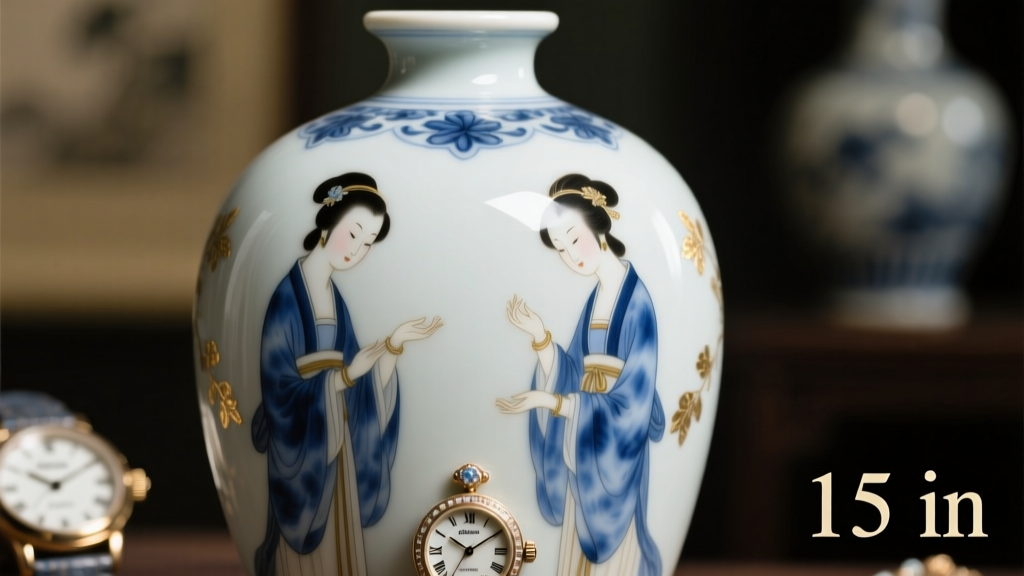
Pillin Pottery Vase: Bottle-Form Ceramic with Blue-Mottled Ground and Dual Female Figures — A 15-Inch Mid-Century Masterpiece
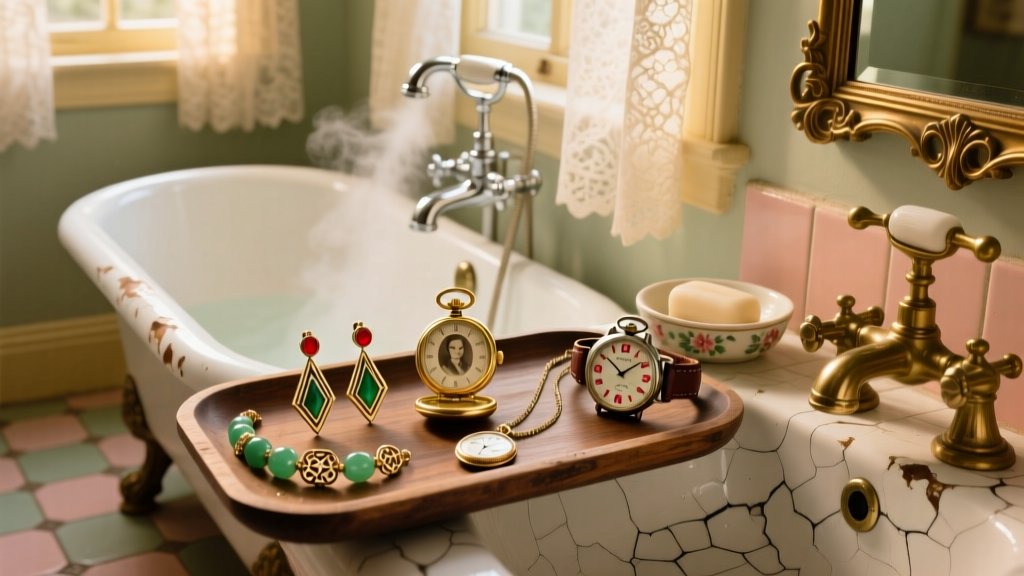
The 1940s Bathroom: Function, Frugality, and Quiet Elegance in Wartime Domestic Design
Red Wing Stoneware Sugar Bowl in Pineapple Shape: A Collector’s Guide to Form, Function, and Value
Game Bewitched Stymie Card No. 4534: A Vintage Milton Bradley Collectible from 1964
Charles Russell: The Forgotten Master of British Mid-Century Watchmaking and Jewelry Design
Hull Magnolia Vase: Cornucopia Form in Pink and Green Glaze, 8½ × 6 Inches — A Mid-Century American Studio Ceramic Masterpiece
Batman Colorforms Box Booklet (1966): A Collectible Artifact of Mid-Century Pop Culture and Toy Innovation
Riviera Green Teapot Cover No. 2: A Mid-Century Masterpiece of Sterling Silver and Enamel
Architectural Brick Culver Block from Indianapolis Motor Speedway: A 1909 Paving Artifact with Racing Heritage and Collectible Significance