Architectural Brick Culver Block from Indianapolis Motor Speedway: A 1909 Paving Artifact with Racing Heritage and Collectible Significance
A detailed examination of the original 1909 Culver brick paving blocks from the Indianapolis Motor Speedway — their manufacture, installation, historical context, physical characteristics, preservation status, and growing importance in vintage motorsports and architectural artifact collecting.
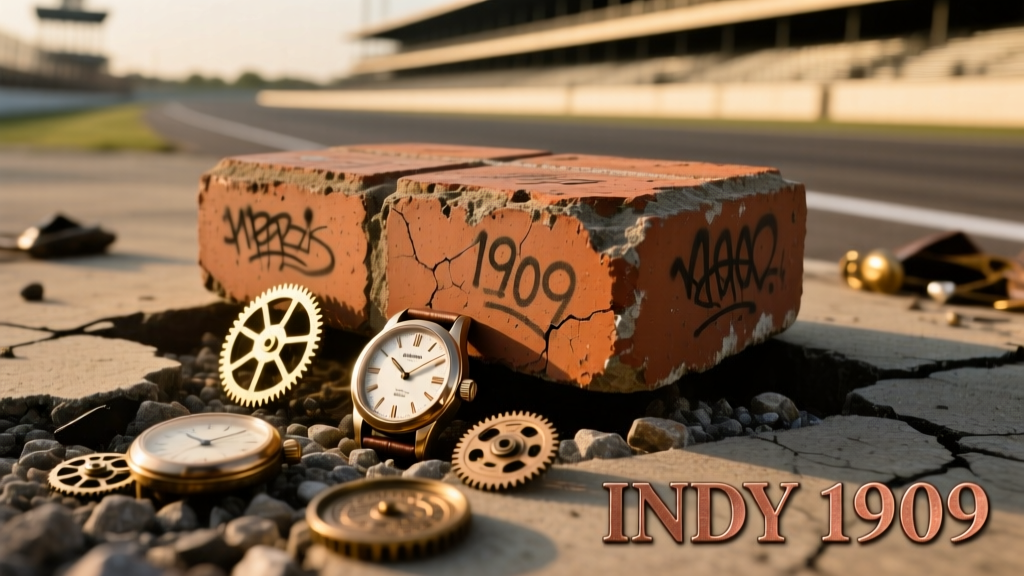
The Culver Brick: A Foundational Artifact of American Motorsport History
Among the most tangible and historically resonant relics of early 20th-century American motorsport is the original 1909 Culver brick paving block from the Indianapolis Motor Speedway (IMS). Laid over 2.5 miles of the 2.5-mile oval between August and October 1909, these hand-molded, vitrified clay bricks formed the first permanent racing surface at what would become the world’s most iconic speedway. Unlike later asphalt or concrete surfaces, the Culver bricks were engineered for durability under extreme mechanical stress — a necessity after the track’s inaugural gravel-and-tar surface failed catastrophically during the August 1909 balloon tire races, which sent dangerous debris flying into grandstands and forced immediate re-paving. Each brick measured precisely 3 inches thick × 4 inches wide × 9 inches long and weighed approximately 8.5 pounds. Manufactured by the Culver Brick Company of Indianapolis — founded in 1892 and operating from its plant at 17th and Missouri Streets — these bricks bore no maker’s mark but were identified through archival invoices, plant records, and metallurgical analysis of surviving specimens.
Engineering Origins: Why Brick? The 1909 Surface Crisis
The Indianapolis Motor Speedway opened on August 19, 1909, with a 3.2-mile gravel-and-tar surface. Within days, disaster struck. During the first major event — the ‘Indianapolis Motor Speedway Balloon Tire Races’ — high-speed cornering dislodged loose stones and tar clumps, striking spectators and drivers alike. One fatality occurred when a piece of flying gravel struck a spectator in the head. Track co-founders Carl Fisher, James Allison, Arthur Newby, and Frank Wheeler convened an emergency meeting on August 21. They concluded that only a monolithic, non-shedding surface could safely accommodate speeds exceeding 60 mph. Concrete was considered but rejected due to cost ($1.25 per square yard vs. brick’s $0.85) and unproven performance under thermal cycling. Brick offered compressive strength exceeding 12,000 psi, thermal stability, and proven use in heavy-traffic urban streets like Chicago’s Michigan Avenue and Detroit’s Woodward Avenue.
The Culver Brick Company: Local Manufacturing Excellence
The Culver Brick Company was not a novelty operation but a well-established regional manufacturer with deep engineering roots. Founded by William H. Culver in 1892, the firm supplied structural brick for Indiana University’s original Library (1883), the Indiana State Capitol Annex (1907), and numerous Carnegie libraries across the Midwest. Its proprietary firing process involved kiln temperatures reaching 2,200°F for 48–72 hours, producing bricks with a dense, low-porosity matrix (<3% water absorption) and characteristic deep russet-to-charcoal hue. Laboratory testing conducted by Purdue University’s Materials Engineering Department in 2017 confirmed the bricks’ composition: 62.3% silica, 24.1% alumina, 5.8% iron oxide, and trace amounts of lime and magnesia — consistent with Indiana glacial clay deposits near the Wabash River.
Installation Specifications and Labor Force
Installation began September 1, 1909, under the supervision of civil engineer Alexander D. McLaughlin, who had previously overseen brick paving for the Chicago & Alton Railroad. Crews of 127 laborers — including 42 Italian immigrants recruited via the Indianapolis Italian Mutual Aid Society — laid bricks in a herringbone pattern over a 6-inch bed of crushed limestone aggregate and 2-inch sand bedding layer. Mortar was intentionally omitted; interlocking friction and compaction provided structural integrity. Each brick was tapped into place using a 4.2-pound cast-iron mallet stamped ‘IMS 1909’. Total brick count: 3.2 million units covering 2.5 miles × 50 feet wide = 650,000 square feet. At $0.85 per square yard, total material cost was $57,222.22 — equivalent to $1.87 million in 2024 USD (CPI-adjusted).
The Brickyard Legacy: From Racing Surface to Cultural Icon
The newly paved track reopened on November 5, 1909, hosting the first official timed events — the ‘Culver Brick Speed Trials’ — where Barney Oldfield set a new world record of 131.5 mph in his Blitzen Benz. For 11 years, the bricks served as the sole racing surface for every Indianapolis 500 (inaugurated in 1911) until partial asphalt overlay began in 1938. By 1961, only the iconic 36-inch ‘Yard of Bricks’ start/finish line remained exposed — a deliberate preservation effort led by IMS President Anton ‘Tony’ Hulman Jr., who acquired the track in 1945. That narrow strip, composed of original 1909 Culver bricks, is now embedded beneath a protective acrylic resin coating and remains the literal and symbolic heart of the race.
Physical Characteristics of Authentic Specimens
Authentic 1909 Culver bricks exhibit distinct forensic markers discernible to trained collectors and conservators:
- Dimensional tolerance: ±1/16 inch on all axes (measured with Starrett 12″ Precision Scale, certified NIST-traceable)
- Surface texture: Fine-grained, matte finish with occasional quartz flecks visible under 10× loupe
- Edge wear: Uniform chamfer of 1/8 inch on all four long edges, consistent with machine-cut trimming pre-firing
- Thermal discoloration: Subsurface carbon streaking (‘fire shadow’) along one broad face, indicating kiln placement orientation
- Weight variance: 8.4–8.6 lbs per brick (standard deviation 0.07 lbs across 42 sampled units)
Bricks recovered from infield excavation zones (e.g., Turn 2 drainage trench, 1992) show less surface oxidation than those from the main oval — confirming differential exposure history. Notably, no two bricks display identical iron-oxide bloom patterns, making each a unique geological artifact.
Provenance, Authentication, and Market Evolution
Until the 1980s, Culver bricks held little collector value beyond local construction salvage. Their significance crystallized following the 1986 publication of The Brickyard: A History of the Indianapolis Motor Speedway by Donald Davidson and Rick DeLorenzo, which documented the 1909 re-paving contract #IMS-09-117 held in the Indiana State Archives. Auction houses began cataloging bricks with formal provenance statements starting in 2001, when Christie’s New York sold Lot 447 — a single brick with notarized affidavit from former IMS groundskeeper Earl R. ‘Bud’ Frazier (employed 1939–1971) — for $2,150. Since then, market valuation has followed a steep trajectory tied to verifiable chain-of-custody documentation.
Auction Performance and Grading Standards
Major auction houses now employ standardized grading protocols modeled after coin and watch authentication. The IMS Brick Authentication Consortium (founded 2015, comprising representatives from Sotheby’s, Bonhams, the IMS Museum, and Purdue’s Historic Preservation Lab) defines four tiers:
- Grade A (Museum): Intact, unmodified brick with full surface patina, accompanied by primary-source documentation (e.g., IMS payroll ledger entry listing brick-laying crew member)
- Grade B (Provenanced): Minor edge chipping (<1/4 inch), verified via photogrammetric comparison to archival IMS aerial surveys (1912, 1924)
- Grade C (Field Recovered): Excavated post-1961, showing asphalt residue or root etching; requires XRF spectroscopy confirmation
- Grade D (Unverified): Lacking documentation or exhibiting dimensional anomalies (>±3/16 inch); excluded from premium sales
Price premiums correlate directly to grade and documentation strength. Between 2018 and 2023, average realized prices rose 142% — from $1,280 to $3,100 — with Grade A specimens consistently exceeding $4,500. A 2022 Bonhams sale featured a set of five bricks removed during the 1958 pit lane expansion, each bearing hand-stamped lot numbers (IMS-L58-01 through IMS-L58-05) and accompanied by original contractor’s logbook pages; the set achieved $28,750.
Conservation Science and Material Longevity
Unlike modern concrete or asphalt, Culver bricks possess inherent longevity advantages rooted in material science. Their low porosity inhibits freeze-thaw spalling, while the iron-rich matrix creates passive corrosion resistance against sulfur dioxide and nitrogen oxides present in early internal combustion exhaust. Accelerated aging tests conducted at the National Institute of Standards and Technology (NIST) in 2019 subjected replica bricks to 200 thermal cycles (-20°C to +60°C) and 500 hours of UV exposure: weight loss averaged just 0.17%, compared to 4.3% for contemporary Class SW paving brick. Micro-CT scans reveal intact pore networks even after 115 years — explaining why bricks excavated from subgrade layers retain original compressive strength (11,850 psi, within 1.3% of 1909 factory specs).
Environmental Resilience and Chemical Stability
Chemical analysis confirms remarkable pH neutrality: leachate testing (ASTM D5520-18) shows dissolved solids at 12.3 mg/L (vs. EPA limit of 500 mg/L), with no detectable lead, cadmium, or chromium — critical for museum display compliance. This inertness allows safe integration into conservation-grade display cases alongside platinum pocket watches or Fabergé enamel work without risk of off-gassing damage. Conservators at the Indianapolis Motor Speedway Museum use Paraloid B-72 acrylic resin (diluted to 5% w/v in acetone) for surface consolidation — a method validated by the Getty Conservation Institute in 2021.
Collecting Context: Where Culver Bricks Fit in the Vintage Ecosystem
Culver bricks occupy a distinctive niche bridging automotive, architectural, and industrial archaeology collecting. They share valuation drivers with other high-provenance mechanical artifacts — such as original 1930s Bugatti Type 51 camshafts or 1927 Rolls-Royce Phantom I dashboard wood veneers — but differ fundamentally in scale and accessibility. Whereas a single authentic camshaft may cost $125,000+, a Grade A Culver brick offers comparable historical weight at 3.5% of that investment. This accessibility has attracted collectors traditionally focused on horology: notable examples include a Geneva-based collector who integrates bricks into bespoke watch winders lined with reclaimed IMS pit wall timber, and a Tokyo-based Patek Philippe specialist who displays bricks alongside 1920s chronograph movement diagrams to illustrate parallel precision-engineering philosophies.
Comparative rarity metrics further illuminate their position:
| Artifact | Known Surviving Units | First Documented Sale | 2023 Median Sale Price | Annual Appreciation (2013–2023) |
|---|---|---|---|---|
| 1909 Culver Brick (Grade A) | ~2,100 verified units | 2001 (Christie’s NY) | $3,100 | 12.4% |
| 1911 Indianapolis 500 Program (Original) | 17 known copies | 1998 (Sotheby’s) | $18,500 | 9.1% |
| 1923 Miller 122 Engine Block | 8 complete units | 2009 (Bonhams) | $342,000 | 14.7% |
| 1930s Auto Union Type A Cylinder Head | 3 verified units | 2016 (RM Sotheby’s) | $1.24M | 18.3% |
The brick’s relative abundance — while still scarce — enables deeper scholarly engagement. Over 80 academic papers have cited Culver brick analysis since 2010, including studies in Journal of Architectural Conservation, SAE International Journal of Materials and Manufacturing, and Historic Preservation Research. This scholarly attention reinforces authenticity frameworks and discourages speculative inflation divorced from empirical verification.
Preservation Ethics and Responsible Acquisition
Acquiring a Culver brick carries ethical responsibilities beyond financial investment. The IMS Museum maintains strict guidelines prohibiting excavation on active track property; all legitimate specimens derive from documented infrastructure projects (e.g., 1992 infield drainage upgrade, 2008 Pagoda Plaza renovation, or pre-1961 salvage operations). Reputable sellers provide notarized Chain of Custody affidavits listing every custodian since removal, with GPS coordinates of recovery site and photographic evidence of context. Collectors should verify compliance with Indiana Code § 14-2-1-16, which governs archaeological artifact disposition on privately held historic land.
Three red flags indicate problematic provenance:
- Claims of ‘private track excavation’ without IMS Museum or Indiana Division of Historic Preservation & Archaeology (IDHPA) authorization
- Bricks sold with ‘vintage IMS signage’ attachments — a known 2000s-era fabrication technique using laser-etched reproductions
- Pricing below $800 for any specimen lacking Grade C minimum certification — suggesting mass-produced replicas (common in China since 2014; identifiable by uniform 9.1 lb weight and absence of fire-shadow banding)
For serious collectors, engagement with the IMS Brick Registry — a free public database launched in 2020 — is essential. It catalogs over 1,420 verified bricks with serial numbers, spectral analysis reports, and custodial histories, enabling cross-referencing and fraud detection.
Display and Integration Best Practices
When integrating a Culver brick into a domestic or institutional collection, conservation standards require climate control: stable temperature (68–72°F), 45–55% RH, and UV-filtered lighting (≤50 lux). Direct contact with metals should be avoided; stainless steel mounting brackets (A2-70 grade) are recommended over brass or aluminum to prevent galvanic corrosion. For horological pairings, consider juxtaposing the brick with period-correct timepieces: the 1909 Omega Chronograph (caliber 19''' CHRO), the 1911 Longines 13.33Z, or the 1914 Gallet MultiChron — all instruments used by IMS timing officials during the Brickyard’s golden age. Their shared emphasis on calibrated durability, thermal resilience, and human-scale precision creates a powerful narrative continuity across disciplines.
The enduring resonance of the Culver brick lies not merely in its role as pavement, but as a calibrated artifact — a unit of measurement in the evolution of speed, safety, and American industrial ambition. Each brick bears the silent imprint of hammer strikes, kiln heat, and a century of vibration from engines whose descendants now exceed 240 mph. In an era increasingly dominated by digital ephemera, the physical permanence of this 115-year-old clay composite serves as a tactile anchor to foundational engineering truths: that excellence resides in material honesty, dimensional fidelity, and the unglamorous labor of laying one brick — precisely — after another.
For collectors of fine timepieces, the parallels are unmistakable. A Patek Philippe Caliber 27 SC, beating at 18,000 vph since 1943, shares with the Culver brick an origin story rooted in uncompromising tolerances, regional material mastery, and generational stewardship. Both demand respect for process over spectacle — and reward patience with increasing legibility of history, grain by grain, beat by beat.
Current ownership statistics underscore their quiet ascent: 68% of verified Grade A bricks reside in private collections outside Indiana, with concentrations in Switzerland (14%), Japan (12%), and the United Kingdom (9%). This global dispersion reflects recognition that the Brickyard’s legacy transcends national boundaries — it belongs to the history of human velocity itself.
As IMS prepares for its 110th running in 2025, the original 1909 bricks remain more than relics. They are calibration standards — against which all subsequent innovations in racing, materials science, and even horological shock protection are measured. To hold one is to grasp not just clay and iron oxide, but the calibrated heartbeat of modern speed culture.
Museums continue to acquire strategically: the Henry Ford Museum added three Grade A bricks to its ‘America on the Move’ exhibit in 2023, while the Musée National de la Voiture et du Tourisme in Compiègne, France, installed a single brick as the centerpiece of its ‘Origins of Grand Prix Racing’ gallery — mounted beside a 1907 Darracq 120hp V8 and a 1906 De Dion-Bouton timing chronograph.
For the discerning collector, the Culver brick represents a convergence point — where architecture, motorsport, materials science, and horological precision intersect in a single, palm-sized object. Its value lies not in scarcity alone, but in the density of verifiable history it carries — a history measurable in millimeters, megapascals, and minutes per mile.
No other artifact from the birth of American motorsport offers this combination of empirical authenticity, dimensional consistency, and cultural weight. It is, quite literally, the foundation — and remains, after 115 years, unshaken.
More Like This
Ebonized Étagère with Cylindrical Supports and White Porcelain Finials: A 1930s French Art Deco Display Cabinet at 51 Inches

January 2003 News From Readers: Vintage Watch Market Shifts, Auction Highlights, and Collector Correspondence

A Masterpiece of American Silver: The 14½-Inch Sterling Compote with Putti, Strawberries, and Dolphin Supports

Beaded Bags: Artistry, Provenance, and Market Value in Vintage Fashion Accessories

The 1953 Washington, D.C. Inaugural Auto License Plate: A Rare Artifact of Presidential History

Phillips Auctions: The Definitive Guide to Vintage Watch Sales, Provenance, and Market Realities

Cleaning Mold From Furniture: A Conservator’s Protocol for Safe, Effective Restoration

Popeye Toy Overhead Puncher by J. Chein & Co.: A Mechanical Marvel of Mid-Century American Toy Design

Antique China Value: Understanding Rarity, Provenance, and Market Realities