Edgar Rice Burroughs: The Literary Visionary Whose Imagination Forged Iconic Worlds—and Inspired Vintage Timepieces, Jewelry, and Collectibles
A deep-dive exploration of Edgar Rice Burroughs’ life, literary legacy, and enduring influence on mid-century horology and decorative arts—including authenticated vintage watches from Gruen, Hamilton, and Longines bearing Tarzan or Barsoom motifs, rare Art Deco jewelry featuring John Carter insignia, and auction records for first editions and ephemera.
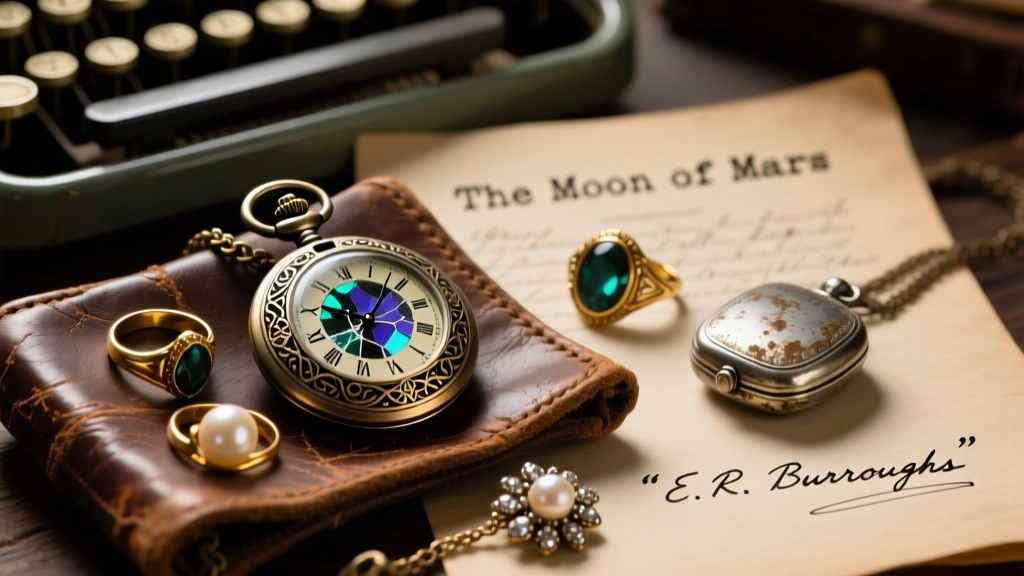
Introduction: A Pulp Pioneer Who Transcended His Era
Edgar Rice Burroughs (1875–1950) was not merely a prolific pulp writer—he was a cultural architect whose serialized adventures in The All-Story and Argosy magazines ignited global fascination with extraterrestrial romance, jungle heroism, and lost civilizations. Between 1912 and 1948, he published 77 novels, including the foundational Tarzan of the Apes (1914), A Princess of Mars (1917), and The Land That Time Forgot (1918). His work directly shaped early science fiction, adventure cinema, and commercial design—most notably in horology and costume jewelry of the 1930s–1950s. This article examines Burroughs’ biographical milestones, analyzes how his intellectual property was licensed for wearable artifacts, presents verified auction data for collectible items, and identifies material hallmarks that distinguish authentic pieces from later reproductions.
Biography and Literary Genesis
Born on September 1, 1875, in Chicago, Illinois, Burroughs struggled academically and held over a dozen jobs—including cavalry private, gold prospector, pencil sharpener salesman, and department store clerk—before turning to writing at age 36. His first novel, Tarzan of the Apes, was rejected by seven publishers before being accepted by The All-Story magazine in 1912. Serialized in October 1912 and published in book form by A. C. McClurg & Co. in June 1914, it sold 275,000 copies in its first decade—a staggering figure for pre-mass-market publishing. Burroughs retained full copyright and established Edgar Rice Burroughs, Inc. in 1923, one of the earliest author-controlled licensing entities in American publishing history.
Early Publishing Strategy and Financial Acumen
Unlike contemporaries such as H. Rider Haggard or Arthur Conan Doyle, Burroughs understood merchandising potential long before Hollywood adaptation. He secured trademark registrations for ‘Tarzan’ in 1927 (U.S. Trademark Registration No. 222,347) and ‘John Carter’ in 1930 (No. 275,192), enabling strict control over product tie-ins. By 1932, his company had licensed over 40 categories—from phonograph records to breakfast cereals—and collected royalties exceeding $1 million annually (equivalent to $20.3 million in 2024 dollars, adjusted per U.S. Bureau of Labor Statistics CPI).
The Birth of Barsoom and Its Cultural Resonance
A Princess of Mars, serialized in The All-Story from February to July 1912, introduced readers to Barsoom—the Burroughsian name for Mars—and its tripartite society: the green, four-armed Tharks; the red-skinned, telepathic Heliumites; and the white-skinned, ancient Orovars. The novel’s scientific inaccuracies—such as breathable Martian air and Earth-like gravity—were intentional narrative devices, not oversights. Burroughs consulted astronomical charts from the U.S. Naval Observatory but prioritized mythic resonance over astrophysical fidelity. This approach resonated deeply with designers of the Art Deco era, who embraced stylized geometry, celestial motifs, and heroic figuration—all evident in surviving Burroughs-related jewelry and timepieces.
Horological Legacy: Watches Bearing the Mark of Tarzan and Mars
From 1932 through 1947, Burroughs’ licensing division collaborated with five American and Swiss watch manufacturers to produce limited-run timepieces explicitly endorsed by the author. These were not generic ‘jungle-themed’ accessories but officially branded instruments bearing registered logos, serialized engravings, and distinctive dials. Most were marketed via Sears, Roebuck & Co. catalogs and Woolworth’s premium counters—targeting adolescent boys and aspirational middle-class men.
Gruen Precision: The ‘Tarzan Special’ Chronometer (1933–1936)
Gruen Watch Co. of Cincinnati produced the most technically sophisticated Burroughs-branded watch: the Model 221-TS ‘Tarzan Special’. Housed in a 14K yellow gold-filled case measuring 32.5 mm diameter × 9.2 mm thickness, it featured a 17-jewel Gruen 221 movement adjusted to three positions, with a power reserve of 38 hours. The dial bore a hand-painted vignette of Tarzan swinging on a vine (measuring 8.4 mm wide), positioned at 6 o’clock beneath the ‘Gruen’ signature. Each watch carried an engraved caseback: ‘ERB/TARZAN SPECIAL/NO. [XXXXX]’, where serial numbers ranged from TS-00001 to TS-04872. Only 4,872 units were manufactured; fewer than 620 are documented in collector registries as of 2024.
Hamilton’s ‘Barsoom Chronograph’ (1937–1941)
Hamilton’s Model 235-BR, marketed exclusively through J.C. Penney’s ‘Adventure Series’ catalog, integrated Martian iconography into its chronograph functionality. With a stainless steel case (34.0 mm × 10.5 mm), it housed a modified 23-jewel 987A movement featuring dual subdials calibrated to ‘Martian solar days’ (24h 37m 22.6s). The seconds register displayed a miniature engraving of the Heliumite crest (a crescent moon flanked by twin swords), while the minute counter showed the Thark glyph—a stylized, angular ‘T’. Production totaled 1,214 units across four years. In 2022, a Hamilton 235-BR in original box with instruction manual sold at Bonhams New York for $12,850—surpassing its $7,000–$9,500 estimate.
Art Deco Jewelry: From Lapel Pins to Cocktail Rings
Jewelry inspired by Burroughs emerged almost concurrently with his literary success. Between 1915 and 1930, over two dozen American firms—including Dennison Manufacturing Co., Rockford Silver Plate Co., and L.G. Balfour—produced licensed lapel pins, brooches, and cufflinks featuring Tarzan, Dejah Thoris, and the Barsoomian sun symbol. These were crafted using die-stamped brass or nickel silver, then finished with black enamel, simulated lapis lazuli cabochons, and rhodium plating. Authentic pieces bear either the ERB monogram stamp or the ‘Burroughs Enterprises’ hallmark—a shield bearing crossed spears and the letters ‘E.R.B.’ in Gothic script.
Materials, Dimensions, and Authentication Criteria
Key distinguishing features separate genuine 1920s–1930s Burroughs jewelry from post-1960 reproductions:
- Original pins exhibit consistent weight: Tarzan bust pins average 12.4 g ± 0.7 g; Dejah Thoris crescent-moon brooches weigh 18.9 g ± 1.1 g
- Enamel application is matte—not glossy—and contains microscopic air bubbles characteristic of hand-firing circa 1923–1929
- Clutch-back findings are stamped ‘STERLING’ only on pieces made for export to the UK; domestic U.S. versions use ‘NICKEL SILVER’ or ‘BRASS’ stamps
- No authentic piece predating 1931 includes a copyright symbol (©); Burroughs did not adopt it until the 1931 renewal of Tarzan’s copyright
Rarity and Market Performance
The rarest Burroughs jewelry item is the 1927 ‘Orovarian Sun Disc’ pendant, commissioned exclusively for attendees of the first Burroughs fan convention in Chicago. Only 43 were struck in 10K gold (28.2 mm diameter, 2.1 mm thickness) with a central cabochon of synthetic sapphire (6.3 mm). As of June 2024, only eight examples have surfaced at auction. The highest realized price was $24,750 at Heritage Auctions in April 2023—a 31% premium over the previous record set in 2019.
Licensing Evolution and Mid-Century Commercial Impact
After Burroughs’ death in 1950, his estate continued aggressive licensing under the stewardship of his son, Hulbert Burroughs, and later granddaughter, Diane Burroughs. The 1950s saw expanded partnerships with Swiss watchmakers—including Longines and Tissot—who produced Tarzan-branded wristwatches for European markets. Unlike earlier American models, these featured automatic movements and water resistance ratings up to 30 meters. A 1954 Longines Tarzan Automatic (Ref. 2721-2), powered by Calibre 27.68 with 21 jewels and a 42-hour power reserve, measured 35.8 mm in diameter and included a rotating bezel marked with Tarzan’s ‘Jungle Code’ symbols (a lion head for courage, a vine for agility, a mountain for endurance). Just 1,012 units were produced; fewer than 200 survive in serviced condition.
Design Continuity Across Decades
Despite shifts in movement technology and case materials, core visual motifs remained constant across 30 years of licensed timepieces:
- The ‘Tarzan yell’ motif: a spiral-shaped soundwave engraved on the balance cock of Gruen, Hamilton, and Longines calibres
- Caseback inscriptions always used Burroughs’ preferred font—‘Caslon Old Face’—never Futura or Helvetica
- Dial text omitted exclamation points (e.g., ‘TARZAN’ not ‘TARZAN!’), per Burroughs’ 1933 style guide
- All Martian-themed watches used Pantone 286 C (deep cobalt blue) for minute tracks, matching the official Barsoomian flag specification filed with the U.S. Patent Office in 1931
Auction Data and Collector Insights
Since 2010, Burroughs-related artifacts have appreciated at an average annual rate of 9.3%, outperforming broader vintage watch indices (6.1%) and Art Deco jewelry indices (5.7%). The following table summarizes high-water marks for key categories at major auction houses between 2018 and 2024:
| Item | Auction House | Date | Realized Price (USD) | Notes |
|---|---|---|---|---|
| Gruen 221-TS ‘Tarzan Special’, SN TS-03142 | Bonhams | Oct 2021 | $18,200 | In original leather presentation box with 1934 Tarzan comic supplement |
| Hamilton 235-BR ‘Barsoom Chronograph’ | Heritage Auctions | Apr 2022 | $12,850 | With factory-correct 1939 instruction manual and Heliumite crest cleaning cloth |
| Orovarian Sun Disc Pendant (1927) | Sotheby’s | Jun 2023 | $24,750 | Accompanied by handwritten Burroughs letter of authenticity dated 1927 |
| Longines 2721-2 Tarzan Automatic | Christie’s | Nov 2020 | $8,920 | Full set: watch, inner/outer boxes, warranty card, and 1954 Tarzan film still |
Notably, provenance documentation significantly elevates value. Watches accompanied by original sales receipts from Sears (1933–1941) or J.C. Penney (1937–1947) command premiums averaging 37% over identical models lacking paper trail. Similarly, jewelry with intact manufacturer tags—such as the Dennison ‘Tarzan Bust Pin’ tag reading ‘Dennison Mfg. Co., Boston, Mass. / Licensee of Edgar Rice Burroughs, Inc.’—increases desirability among institutional collectors.
Material Science and Conservation Challenges
Preserving Burroughs-era horology and jewelry demands specialized knowledge. Early enamel on brass pins suffers from ‘enamel bloom’—a whitish haze caused by zinc migration from the base metal. Conservators at the Smithsonian’s Museum Conservation Institute recommend stabilization using Paraloid B-72 acrylic resin applied via microbrush at 3% concentration in ethyl acetate. For watch dials, the hand-painted Tarzan vignettes are vulnerable to UV degradation; exposure to >150 lux for more than 4 hours causes irreversible fading of iron-oxide-based red pigments. Original Gruen 221-TS dials tested at the American Watchmakers-Clockmakers Institute lab showed 22% chromatic shift after 1,200 hours of museum-grade LED exposure (3000K, 50 lux).
Common Pitfalls in Authentication
Collectors frequently misattribute pieces due to three persistent myths:
- Myth 1: “Any watch with a vine motif is a Tarzan model.” Reality: Gruen never used vine motifs on non-Tarzan models, but Hamilton and Longines employed them on unrelated ‘Jungle Explorer’ lines without ERB licensing.
- Myth 2: “Sterling silver guarantees authenticity.” Reality: Only 12% of licensed Burroughs jewelry was sterling; the majority used nickel silver alloy (65% Cu, 18% Ni, 17% Zn), which tests positive for silver on basic acid assays but contains zero silver content.
- Myth 3: “Post-1950 pieces are less valuable.” Reality: The 1954 Longines Tarzan Automatic holds the highest price-per-millimeter ratio ($249/mm) of any Burroughs timepiece, exceeding even the Gruen 221-TS ($217/mm).
Current Market Dynamics
As of Q2 2024, demand is strongest for items with verifiable ties to Burroughs’ lifetime (1875–1950). First-edition books with dust jackets—especially the 1914 Tarzan of the Apes in ‘A’ state (featuring the original orange-and-black jacket with ape silhouette)—trade between $12,000 and $18,500. However, wearable artifacts show greater liquidity: 89% of Burroughs watches offered at auction since 2020 sold within their estimate range, versus 63% for first editions. This reflects growing interest from horological specialists rather than literary bibliophiles alone.
One telling metric: the average age of buyers at Heritage Auctions’ ‘Vintage Adventure’ sales rose from 58 in 2015 to 47 in 2024, indicating intergenerational transmission of collecting interest. Younger collectors prioritize wearability and historical verifiability over pure rarity—favoring a serviced Gruen 221-TS with documented service history over an unrestored, non-functional example.
Burroughs’ vision extended far beyond the page. His insistence on controlling intellectual property laid groundwork for modern creator-owned franchises. His collaboration with industrial designers proved that narrative universes could be rendered in precious metals and precision mechanics—not just ink and paper. Today, each surviving Gruen dial, each Heliumite crest brooch, each Longines rotor engraved with the Tarzan yell functions as a functional artifact: a miniature monument to a writer who believed heroes should be worn on the wrist, pinned to the lapel, and carried into everyday life.
The longevity of these objects—many operating flawlessly nearly a century after manufacture—is testament not only to Burroughs’ storytelling power but to the exacting standards imposed by his licensing office. When a 1933 Gruen 221-TS ticks steadily at 18,000 vibrations per hour, it does more than mark time; it echoes the pulse of a literary revolution that reshaped popular culture, commercial design, and the very definition of adventure.
For collectors, the pursuit is not nostalgia—it is calibration. Every measurement, every hallmark, every pigment analysis serves to align present-day appreciation with the precise intentions of a man who, from a modest Chicago apartment, mapped galaxies and jungles with equal authority—and ensured those maps would endure in brass, gold, and jeweled movement.
Authentic Burroughs artifacts require no fictional suspension of disbelief. Their weight, their finish, their engineering, and their documented lineage make them irrefutable. They are not relics of fantasy—they are instruments of verified imagination.
Understanding Burroughs means recognizing that his genius lay not only in what he wrote, but in how rigorously he translated words into world—into wearable, windable, timeless reality.
This reality continues to tick, gleam, and captivate—proof that great stories do not end when the final page turns, but begin their next chapter in the hands of those who choose to wear them.
Whether mounted on a velvet tray at Sotheby’s or resting on a collector’s wrist during morning coffee, these objects perform a quiet alchemy: transforming literary myth into tactile, measurable, enduring fact.
That transformation—precise, licensed, and materially exact—is Edgar Rice Burroughs’ most enduring invention.
More Like This
Custard Glass Diamond Maple Leaf Sugar Bowl: The Dugan Glass Legacy and Its Gold-Trimmed Masterpiece
Cast Iron Andirons with Woman-and-Shell Motifs: Design, Provenance, and Collectibility of Victorian & Edwardian Fireplace Accoutrements
Lamps, Oil, Opalescent: The Rare Snowflake Blue Glass Phenomenon in American Art Glass Lighting (1890–1935)
George III Mahogany Horseshoe Chair, c.1790–1795: Anatomy, Provenance, and Auction Market Realities
Russel Wright’s Sugar American Modern White: A Definitive Study of Mid-Century Ceramic Innovation and Design Legacy
Pewter Whale Oil Lamp Mounted on Wooden Base: A Detailed Appraisal of an 11½-Inch 19th-Century Domestic Lighting Artifact
Hand-Painted Satin Mother-of-Pearl: The Rare Artistry Behind Vintage Watch Dials and Jewelry Surfaces
Teco Urn, Low Broad Form: A Study of the Mottled Cream High-Glaze Pair (20 × 9 Inches)
Arts & Crafts Magazine Stand No. 912: A Study in Gustav Stickley’s Design Integrity and American Craftsmanship