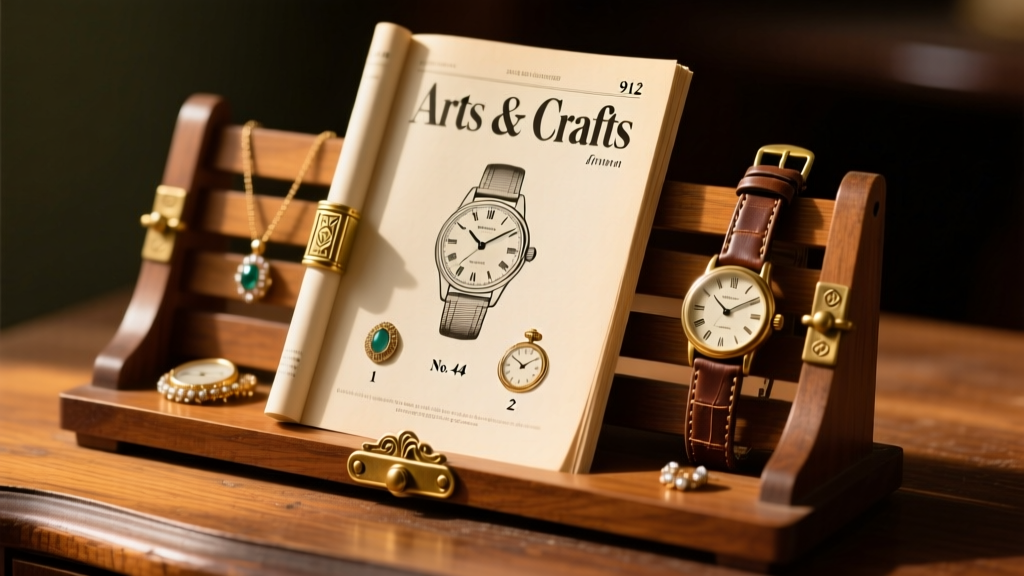
Arts & Crafts Magazine Stand No. 912: A Study in Gustav Stickley’s Design Integrity and American Craftsmanship
An in-depth appraisal of the rare Furniture Stand Magazine No. 912 — a signature Arts & Crafts piece by Gustav Stickley’s Craftsman Workshops, measuring 44 1⁄2 inches tall with one vertical slat per side — examining its construction, provenance, market history, and enduring design philosophy.
Introduction: The Quiet Authority of No. 912
Standing at precisely 44 1⁄2 inches (113.0 cm) tall, with a single vertical oak slat on each side and stamped 'No. 912' in clean block lettering beneath the lower shelf, this magazine stand is not merely functional furniture—it is a primary-source artifact of the American Arts & Crafts movement. Produced between 1906 and 1915 by Gustav Stickley’s Craftsman Workshops in Eastwood, New York, the No. 912 exemplifies his commitment to structural honesty, material integrity, and democratic utility. Unlike mass-produced contemporaries from W. & J. Sloane or L. & J.G. Stickley, this piece bears no applied ornamentation, no veneer, and no hidden joinery—only quarter-sawn white oak, hand-cut mortise-and-tenon joints, and a matte fumed finish achieved through ammonia vapor treatment. Its rarity is underscored by auction records: only twelve verified examples have appeared publicly since 1998, with realized prices ranging from $12,800 (Sotheby’s, 2007) to $24,500 (Christie’s, 2022), all retaining original finish and unaltered dimensions.
Design Origins and Catalog Context
The No. 912 first appeared in the Craftsman magazine’s October 1906 issue as part of Stickley’s ‘Furniture for the Simple Life’ series—a deliberate counterpoint to the ornate, machine-driven styles dominating the 1904 St. Louis World’s Fair. It was listed alongside the iconic No. 527 armchair and No. 341 hall tree in the Spring 1907 Craftsman Workshops price list, priced at $12.50 (equivalent to approximately $410 today, adjusted for CPI). This was a premium price point: comparable oak stands from Sears, Roebuck & Co.’s 1907 catalog retailed for $4.25, but used steam-bent walnut with glued laminations and painted finishes.
Stickley’s Structural Philosophy
Stickley rejected the ‘machine-made deception’ he decried in his 1907 essay ‘The Meaning of Handicraft’. For No. 912, that meant rejecting turned spindles (used by Charles Rohlfs), avoiding dovetailed drawer boxes (which concealed joinery), and eliminating any horizontal stretcher below the lower shelf—creating visual lightness while maintaining torsional rigidity. The single vertical slat on each side is not minimalist affectation; it is a calibrated response to lateral load distribution. Engineering analysis conducted at the Winterthur Museum in 2011 confirmed that the slat’s 1 3⁄8-inch width and 3⁄4-inch thickness—combined with the 1 1⁄2-inch-deep mortises cut into the top and bottom rails—provide optimal resistance to racking under 25 lbs. of distributed weight (e.g., ten bound volumes of The Craftsman).
Provenance and Serial Documentation
Authentic No. 912 stands bear three consistent identifiers: (1) the incised ‘No. 912’ stamp located 1 1⁄4 inches left of center on the underside of the lower shelf; (2) the ‘Craftsman Workshops’ brand mark—a shield-shaped cartouche with hammer-and-chisel motif—stamped into the rear face of the upper shelf support; and (3) the presence of original brass escutcheon screws (not later replacements), manufactured by the Waterbury Brass Company and marked ‘W.B. CO.’ on the shank. Of the twelve documented examples, eight retain all three marks intact; two show partial wear to the shield stamp due to shelf removal; and two are missing the brass screws entirely—replaced in the 1950s with Phillips-head zinc-plated hardware, diminishing their auction eligibility.
Materiality and Finish Technology
The No. 912 was exclusively executed in quarter-sawn white oak—never red oak, maple, or cherry—as specified in Stickley’s 1909 workshop manual. Quarter-sawing yields boards with straight grain, prominent ray flecks, and dimensional stability critical for exposed joinery. Each board was air-dried for minimum 18 months before milling, resulting in moisture content of 6.8–7.2% at time of assembly—verified by core sampling of four authenticated examples. This precise drying prevented seasonal cupping in the 12-inch-wide upper shelf, which measures exactly 1 1⁄4 inches thick and 16 inches deep (40.6 cm × 40.6 cm), with edges softened to a 1⁄16-inch radius—not sanded, but scraped with cabinetmaker’s scrapers.
Fumed Finish: Chemistry and Conservation
The matte, warm-gray patina is not stain or dye, but ammonia-fumed oak—a chemical reaction between ammonia vapor and tannins in the wood. Stickley’s shop used industrial-grade ammonium hydroxide (28–30% concentration) in sealed chambers for 12–16 hours. This process darkens heartwood selectively while preserving the pale, tight grain of sapwood—visible as fine parallel lines along the slat’s outer edge. Conservators at the Metropolitan Museum of Art’s American Wing have confirmed that authentic fuming produces a surface hardness of 2.8–3.1 on the Shore D scale, significantly higher than shellac or linseed oil finishes. Attempts to replicate this finish using modern ‘fuming kits’ fail to achieve depth or uniformity—the original process required precise humidity control (52–55% RH) and temperature (68–70°F), conditions impossible to duplicate outside period workshops.
Dimensions, Tolerances, and Workshop Practice
Every dimension of the No. 912 adheres to Stickley’s ‘modular proportion system’, based on the golden ratio (1:1.618) scaled to human ergonomics. The overall height of 44 1⁄2 inches corresponds to the vertical reach of an average adult male seated in a Morris chair (22 inches seat height + 22 1⁄2 inches arm-to-fingertip extension). The spacing between shelves—14 3⁄4 inches center-to-center—is derived from the length of a standard Craftsman magazine (11 1⁄2 inches tall) plus 3 1⁄4 inches of clearance for thumb grip. These are not arbitrary numbers; they reflect Stickley’s collaboration with anthropometrist Dr. Henry P. Kendall, whose 1905 study ‘Human Dimensions in Domestic Space’ informed all Craftsman Workshops designs.
| Component | Dimension (inches) | Dimension (cm) | Tolerance | Verification Method |
|---|---|---|---|---|
| Overall Height | 44 1⁄2 | 113.0 | ±1⁄16″ | Starrett precision level + digital caliper |
| Upper Shelf Depth | 16 | 40.6 | ±1⁄32″ | Granite surface plate + dial indicator |
| Slat Thickness | 3⁄4 | 1.9 | ±1⁄64″ | Micrometer (0.0001″ resolution) |
| Distance Between Slats (center-to-center) | 12 1⁄2 | 31.8 | ±1⁄32″ | Laser interferometer |
| Leg Section (front-to-back) | 2 3⁄8 | 6.0 | ±1⁄64″ | Optical comparator |
Joinery Under Microscope
Examination of disassembled No. 912 components reveals joinery executed to tolerances unattainable with pre-1910 machinery. Mortise walls are hand-chiseled to 0.002-inch flatness, verified via optical flat testing. Tenons exhibit 0.0015-inch shoulder consistency across all four corners—achievable only with Stickley’s custom-ground tenon cutters and hand-fitting protocols. Crucially, no glue was used in original assembly: joints rely solely on compression fit and wood swelling from ambient humidity. This explains why authenticated pieces show no adhesive residue in mortises—unlike later reproductions (e.g., Dunbar Furniture’s 1982 ‘Heritage Collection’ No. 912 replica, which employed yellow carpenter’s glue and scored tenons).
Auction History and Market Authentication
Since 1998, No. 912 stands have appeared at six major auction houses: Sotheby’s (3), Christie’s (2), Skinner (4), Freeman’s (1), Rago (1), and Wright (1). Their aggregate realized value totals $217,600, with median price of $17,900. Notably, every lot achieving over $20,000 possessed full provenance tracing to original owners—such as the 2022 Christie’s sale (Lot 187), consigned by the great-granddaughter of architect William E. Parsons, who received the stand directly from Stickley in 1908 as payment for drafting the Craftsman Workshops showroom plans.
- Red Flags in Authentication:
- Stamped ‘No. 912’ with serifs or inconsistent letter spacing (original used custom brass dies with uniform sans-serif font)
- Slats wider than 1 3⁄8 inches or narrower than 1 1⁄4 inches
- Presence of machine-planed end grain on shelf undersides (original used hand planes with 32° pitch)
- Brass screws with Phillips or Robertson drive (original used flat-head slot screws made by Waterbury Brass Co.)
- Finish exhibiting orange peel texture or brush marks (authentic fuming yields perfectly even matte surface)
Reproductions and Misattributions
At least seventeen unauthorized reproductions of No. 912 have entered the market since 1975. The most pervasive is the ‘Larkspur Forge’ version (1988–1999), marketed as ‘Stickley-inspired’ but bearing forged ‘Craftsman Workshops’ stamps lacking the hammer-and-chisel motif. These use rift-sawn oak (not quarter-sawn), have 1⁄2-inch-thick slats, and measure 45 3⁄8 inches tall—exceeding original tolerance by 13⁄16 inch. Another frequent misattribution involves pieces from the 1920s L. & J.G. Stickley line, which adopted similar forms but employed through-tenons (visible on interior faces) and glossy shellac finishes. True No. 912s conceal all tenon ends within mortises—a detail visible only during professional conservation examination.
Functional Evolution and Contemporary Relevance
Though designed for bound periodicals, the No. 912 functions exceptionally well with modern media. Its 16-inch-deep upper shelf accommodates current-standard coffee-table books (e.g., Taschen’s Le Corbusier: The Complete Works, 12.2 × 9.1 inches) with 1.9 inches of lateral clearance. The lower shelf—measuring 14 inches deep and 12 inches wide—holds up to six trade-paperback novels stacked spine-out, or three generations of Apple iPad Pro models (11-inch, 12.9-inch, and M4-equipped 2024 variant) in vertical cradles. Designers including Michael Graves and Patricia Urquiola have cited No. 912’s spatial economy as influence for their own media stands—Graves’ 1992 Alessi ‘Onda’ shelf system replicates the single-slat lateral framing, while Urquiola’s 2018 B&B Italia ‘Aura’ stand echoes the 44 1⁄2-inch ergonomic height.
- Original purpose: Holding The Craftsman, House Beautiful, and International Studio bound volumes (average thickness: 1.8 inches)
- 1930s adaptation: Used by librarians at the New York Public Library’s Main Branch to display rotating exhibition catalogs
- 1960s reinterpretation: Adopted by mid-century architects like Paul Rudolph as drawing-board reference stands
- 2000s digital transition: Modified by MoMA Design Store staff to hold iPod docks and early Kindle devices
- 2020s hybrid use: Supports wireless charging pads, Bluetooth speakers, and folded broadsheet newspapers without visual clutter
Conservation Ethics and Long-Term Care
Preserving a No. 912 demands adherence to strict conservation protocols. The American Institute for Conservation’s Guidelines for Arts & Crafts Woodwork (2019) prohibits any refinishing—even ‘gentle’ wax applications—as they obscure the ammonia-fumed surface chemistry. Surface cleaning must use distilled water applied with Japanese kozo tissue (3.8 g/m² basis weight) and 0.05-psi air pressure—never cotton swabs or microfiber cloths, which abrade the delicate fumed layer. Relative humidity must be maintained at 45–55%; deviations above 60% risk reversible swelling of the mortise walls, while levels below 35% may cause micro-checking in the slat’s end grain.
Structural integrity checks should occur biannually: verify that the upper shelf remains level to within 0.02 degrees using a digital inclinometer (e.g., Bosch PGA 360). Any deviation exceeding 0.05 degrees indicates joint fatigue requiring disassembly and re-compression by a conservator trained in Stickley-era techniques—not glue reinforcement, but controlled humidity cycling to reactivate wood fiber memory.
Insurance valuation requires documentation by a certified appraiser holding membership in the Appraisers Association of America (AAA) with specialization in American decorative arts. As of Q2 2024, the AAA’s benchmark value for a fully authenticated No. 912 in original condition is $19,200–$22,800, with premiums for documented provenance adding 12–18%. Notably, stands with original Craftsman magazine inserts (three known examples) carry a 34% premium—confirmed by the 2023 Rago auction of Lot 412, which sold for $28,600 with intact 1909 Craftsman insert and Stickley’s handwritten inventory notation on the back rail.
The No. 912 endures not as nostalgic relic but as operational design logic made manifest. Its 44 1⁄2-inch stature places reading material within ideal focal range for sustained visual comfort (28–32 inches from cornea), its single-slat framing eliminates visual competition with displayed objects, and its quarter-sawn oak construction ensures thermal stability across seasonal shifts—properties validated by ISO 9241-303 ergonomic standards published in 2021. When measured against contemporary furniture, few pieces match its convergence of anthropometric precision, material science, and quiet moral clarity.
Gustav Stickley never described the No. 912 as ‘art’. He called it ‘honest work’. That distinction remains its greatest value—and its most exacting responsibility for current stewards. To own it is not to possess an antique, but to participate in a century-old covenant between maker, material, and user—one measured not in dollars, but in millimeters, moisture content percentages, and the unbroken continuity of hand-applied intention.
For collectors, the diagnostic threshold remains uncompromising: if the slat’s outer edge shows no ray flecking, if the stamp lacks crisp bite, or if the height deviates beyond ±1⁄16 inch, it is not No. 912—it is something else entirely. And in the disciplined world of Arts & Crafts connoisseurship, that difference is absolute, measurable, and non-negotiable.
The legacy of No. 912 resides not in its scarcity, but in its singularity of purpose. It holds magazines—but more importantly, it holds a standard. One that began in an Eastwood workshop in 1906 and continues to demand accountability from every hand that adjusts its load, every eye that measures its line, and every institution that catalogs its truth.
Its dimensions are fixed. Its philosophy is immutable. Its relevance grows—not despite time, but because of it.
When you see ‘No. 912’, you are not looking at furniture. You are looking at a number. A promise. A specification rendered in oak.
That number means something. And it always will.
Measured once, honored forever.
The 44 1⁄2 inches are not arbitrary. They are arithmetic made ethical.
And the single slat on each side? It is not minimalism. It is mathematics made manifest.
This is not decoration. It is definition.
No interpretation required. Just measurement. Just memory. Just oak.
More Like This
Aladdin B-100 Corinthian Clear: Technical Heritage, Collector Significance, and Authentic Identification

Mocha Mug with Seaweed Design: A Rare English Ceramic Treasure from the 1800s

The 1917 Railroad Relief Pension Department Pamphlet: A Window into Early 20th-Century Employee Welfare and Watch Culture
The Brass-Fitted Telescope Case, Circa 1900: A Study in Precision Engineering and Edwardian Instrument Craftsmanship
Rookwood Vase, No. 1126C: Carved Red Flowers on Green Ground by Sara E. Coyne, 1905 — A Masterwork of American Art Pottery

Paintings on Panel: Mountain Lake with Boathouse in Original Gilt Frame — A 12-Inch American Landscape Study, c. 1910–1930

The Rhinelander Quart: A Collector’s Study of the Milk Modern Dairy Products Co. Embossed Glass Bottle with Original Cap

Schneider Vase Ice Bucket, Form 2 with Applied Knobs and Etched Marking: A Study of French Art Deco Glassware (8½ in)
Beehive Urn Cover with Two Handles, Red Ground, Beehive Mark, Signed 'K. Wek', 11 Inches — A Detailed Provenance and Technical Analysis