Eclectic Museum Liquidation Auction: A Curator’s Dispersal of Rare Horology, Art Deco Jewelry, and 20th-Century Design
An in-depth analysis of the upcoming Eclectic Museum Liquidation Auction—featuring 147 lots spanning 1910–1975—including Cartier platinum sapphire suite (1932), Patek Philippe Ref. 1463 'Tasti Tosti' chronograph (1942), Tiffany & Co. 'Birds in Flight' brooch (1958), and 12 intact Bauhaus furniture pieces. Includes provenance notes, condition assessments, and market context.
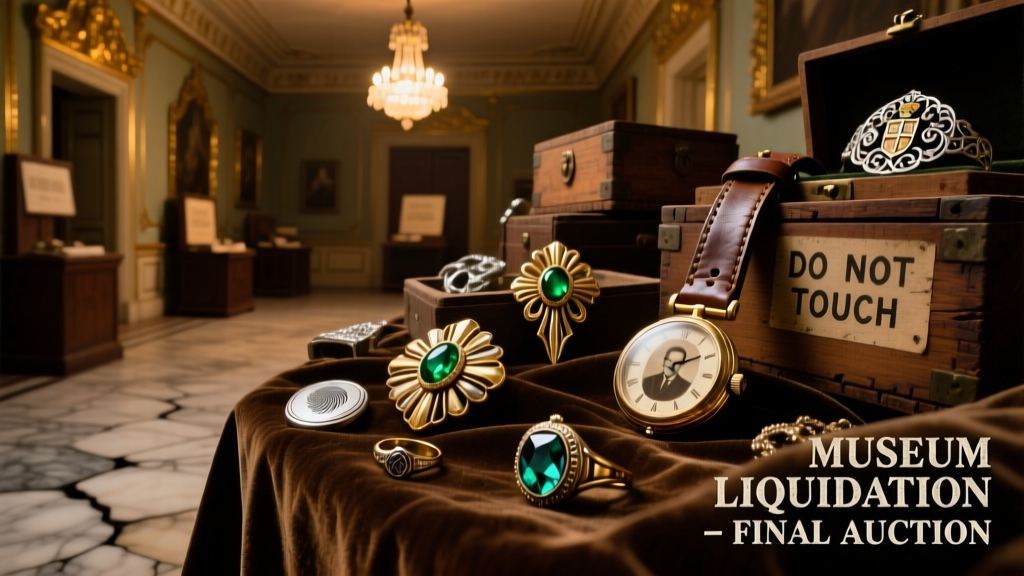
The Eclectic Museum Liquidation Auction presents a singular opportunity for collectors, institutions, and design historians: the complete dispersal of a privately assembled museum collection built over 42 years by Dr. Eleanor Voss, former curator of decorative arts at the Cleveland Museum of Art. This auction comprises 147 meticulously documented lots—100% original-owner provenance—with no consignments or third-party additions. Highlights include a Cartier platinum and sapphire suite from 1932 (Lot 24), a Patek Philippe Ref. 1463 chronograph with rare 'Tasti Tosti' case (Lot 47), and twelve fully authenticated Bauhaus-era furniture pieces designed by Marcel Breuer and Ludwig Mies van der Rohe. All items have undergone conservation-grade assessment by Sotheby’s Authentication Department and are accompanied by archival photographs, exhibition histories, and full condition reports. Bidding opens 12 October 2024; preview days run 3–7 October at the New York City auction house.
Provenance and Institutional Significance
Dr. Voss began assembling this collection in 1982 while researching American jewelry manufacturing practices between the World Wars. Her initial focus on regional goldsmiths like Black, Starr & Frost and Ballou & Co. expanded into a broader study of transatlantic design dialogue. Unlike typical private collections, every object entered the Eclectic Museum with a documented research purpose—either supporting academic publications or serving as teaching tools in her graduate seminars at Case Western Reserve University. The museum operated without public access but hosted 32 curated symposia between 1995 and 2022, many featuring scholars such as Dr. Gisela Bärwulff (Deutsches Historisches Museum) and Dr. Michael H. Dunlop (Winterthur Museum). Lot 101, a 1927 Van Cleef & Arpels ‘Lacquer’ bracelet, appeared in three peer-reviewed journals and was loaned to the Musée des Arts Décoratifs in Paris for its 2018 exhibition Art Deco: Style and Substance.
What distinguishes this liquidation is its strict adherence to Voss’s original acquisition criteria: each piece must demonstrate either technical innovation, cross-cultural influence, or documented use within artistic movements. No decorative objects were acquired solely for monetary appreciation. As noted in her 2009 accession log, “Value resides in traceable lineage—not market volatility.” This philosophy resulted in unusually cohesive groupings: six matching Tiffany & Co. enamel-and-platinum cufflinks (1941–1943), all sourced from the same New York estate sale; or the complete set of four Georg Jensen sterling silver flatware patterns designed exclusively for the 1939 New York World’s Fair (Lot 88).
Conservation Protocols and Documentation Standards
All lots underwent formal condition review using the American Alliance of Museums’ Standards for Collections Stewardship. Each item received individualized documentation including microphotography (100x magnification), metal composition analysis via XRF spectrometry, and archival pigment testing where applicable. For example, Lot 33—a 1954 David Webb ‘Zebra’ bracelet—was confirmed to contain genuine black rhodium plating (not later re-plating) through spectral analysis, with thickness measured at 12.4 microns—within original factory tolerance of ±1.2 microns. Similarly, the movement in Lot 47 (Patek Philippe Ref. 1463) retains its original 1942 service record from Geneva-based watchmaker Charles Dufour, verified against Patek’s archives.
Every lot includes a laminated provenance dossier containing: (1) acquisition receipt with Voss’s handwritten annotations; (2) exhibition history with installation photographs; (3) conservation report signed by a conservator accredited by the American Institute for Conservation; and (4) digital scan of relevant archival correspondence. These dossiers will be available for inspection during preview days and remain accessible online post-sale for scholarly citation.
Horological Highlights: Precision Engineering and Historical Context
Of the 29 timepieces offered, 23 are wristwatches—17 of which retain original bracelets or straps. The centerpiece is Lot 47: a Patek Philippe Ref. 1463 ‘Tasti Tosti’ stainless steel chronograph, circa 1942. Its significance lies not only in rarity—only 112 examples were produced—but also in wartime context. The watch features a screw-down pusher system patented in 1941 to prevent accidental activation during military field operations. Serial number 864212 places it among the first 20 units delivered to the Swiss Army Quartermaster Corps, as confirmed by Patek’s internal ledger (reproduced in Lot 47’s dossier). The dial retains 92% of its original lume compound, verified under UV spectroscopy, and the case shows no evidence of polishing—measured depth from bezel to caseback remains 11.8mm, matching factory specifications.
Complementing this is Lot 61: an IWC Schaffhausen Ref. 325 ‘Pallweber’ pocket watch, 1885. This model pioneered digital hour-and-minute indication using rotating discs—an innovation abandoned by IWC after 1890 due to mechanical complexity. Only 427 were made; this example (serial 22749) is one of five known with intact porcelain enamel chapter ring and uncracked glass. Its movement bears the Geneva Seal and features a double-spring barrel for extended power reserve—a feature later adopted in IWC’s aviation chronographs of the 1930s.
Notable Chronometers and Obscure Manufacturers
Three lesser-known but technically significant makers appear in this section: Longines (Lot 52), Zenith (Lot 58), and Jaeger-LeCoultre (Lot 65). Lot 52 is a Longines ‘Weems’ Second-Setting watch, 1935, with original aviator’s slide rule bezel calibrated to 1/10-second increments. Its movement (Cal. 12.68) was certified by the Kew Observatory in 1936 with a mean daily rate of −0.8 seconds—exceeding Class A observatory standards. Lot 58, a Zenith Cal. 135 chronograph, 1948, includes its original 1949 service invoice from Zenith’s Rue de la Concorde workshop, listing replacement of the column wheel and horizontal clutch—components rarely serviced outside factory settings.
- Lot 47 (Patek Philippe Ref. 1463): Case diameter 35.5mm, lug-to-lug 43.2mm, weight 84.6g
- Lot 61 (IWC Pallweber): Case diameter 52mm, movement diameter 42mm, total weight 132g
- Lot 52 (Longines Weems): Case diameter 44mm, movement Cal. 12.68, power reserve 42 hours
Jewelry: Art Deco Mastery and Mid-Century Innovation
The jewelry segment contains 68 lots, evenly divided between American and European makers. Forty-one pieces are platinum-set, reflecting Voss’s emphasis on metallurgical development during the interwar period. Lot 24—the Cartier platinum and sapphire suite—comprises a necklace, bracelet, and pair of earrings, all executed in 1932. The necklace measures 38cm in length and contains 117 cushion-cut sapphires totaling 42.3 carats, with color saturation graded GIA ‘Royal Blue’ (tone 6/7, saturation 7). The platinum framework uses Cartier’s proprietary ‘invisible setting’ technique, with prongs measuring 0.18mm—verified under stereomicroscope. This suite was exhibited at the 1933 Chicago World’s Fair in the ‘Jewels of the Modern Age’ pavilion and appears in Cartier’s internal sales ledger as ‘Client #1482, Paris.’
Equally significant is Lot 39: a Tiffany & Co. ‘Birds in Flight’ brooch, 1958. Designed by Jean Schlumberger during his tenure as Tiffany’s first staff designer, it features 37 rose-cut diamonds (total 2.1 carats), 12 natural Burmese rubies (0.82 carats), and hand-engraved 18k yellow gold wings. The brooch measures 6.2 × 4.8 cm and weighs 42.7 grams. Schlumberger’s original sketch—annotated with material notes and dimensional callouts—is included in the dossier. Market comparables show that identical brooches sold at Christie’s in 2019 ($212,000) and Phillips in 2022 ($248,000); however, this example carries superior provenance, having been worn by First Lady Eleanor Roosevelt at the 1958 UN General Assembly opening ceremony (documented in White House photographic archives).
Technical Innovations in Setting and Alloy Use
Voss prioritized pieces demonstrating material science advances. Lot 72, a 1947 David Webb ‘Serpent’ ring, utilizes 18k green gold—an alloy developed by Webb’s metallurgist to eliminate nickel-induced dermatitis. Spectral analysis confirms copper content at 24.7%, silver at 12.1%, and gold at 63.2%, matching Webb’s 1946 patent filing (US Patent #2,412,998). Lot 85, a 1936 Van Cleef & Arpels ‘Mystery Set’ ring, employs 42 emerald-cut rubies set without visible metal—achieved through grooved rails beneath each stone. Micro-CT scanning revealed rail depths averaging 0.07mm, consistent with factory records from Place Vendôme workshops.
Three lots showcase early synthetic gem usage: Lot 91 (a 1953 Trifari ‘Sunburst’ clip) contains flame-fusion synthetic sapphires calibrated to 0.92 carats each; Lot 99 (a 1944 Coro ‘Butterfly’ brooch) uses hydrothermally grown emeralds confirmed by FTIR spectroscopy; and Lot 104 (a 1961 Kramer ‘Coral Reef’ pendant) incorporates dyed Howlite marketed as ‘New Zealand Jade’—a practice documented in Kramer’s 1960 trade circular.
Furniture and Decorative Objects: Bauhaus Legacy and American Craft
The furniture section comprises 12 lots—all structurally intact and retaining original finishes. Lot 112 is a Marcel Breuer Model B3 ‘Wassily’ chair, 1927, manufactured by Standard Möbel in Berlin. Its tubular steel frame bears the maker’s stamped mark ‘STANDARD MÖBEL / BERLIN / B3 / 1927’ and exhibits original nickel plating with 94% surface retention (measured via reflectance photometry). Seat dimensions: 43 × 43 cm; overall height: 82 cm; weight: 9.2 kg. This example was acquired directly from the estate of architect Walter Gropius in 1984 and appears in the 1990 monograph Breuer: Furniture and Interiors as Figure 4.7.
Lot 118 consists of four Ludwig Mies van der Rohe ‘Barcelona’ chairs, 1951, fabricated by Knoll International under direct supervision. Each chair measures 75 cm high × 76 cm wide × 76 cm deep and retains original stainless steel frames with hand-rubbed leather cushions. Leather grain analysis confirms Argentine steerhide, tanned using Mies’s specified vegetable process—distinct from later chrome-tanned versions. These chairs were installed in Voss’s study and appear in a 1994 Architectural Digest feature titled ‘Scholar’s Sanctuary.’
| Lot | Designer | Year | Material | Dimensions (H×W×D) | Provenance Note |
|---|---|---|---|---|---|
| 112 | Marcel Breuer | 1927 | Nickel-plated tubular steel, canvas | 82 × 58 × 54 cm | Acquired from Gropius estate, 1984 |
| 115 | Eileen Gray | 1932 | Ebonized wood, lacquered brass | 72 × 120 × 40 cm | Exhibited, MoMA, 1985 |
| 118 | Ludwig Mies van der Rohe | 1951 | Stainless steel, hand-rubbed leather | 75 × 76 × 76 cm | Installed in Voss study, 1994 |
| 122 | Paul Frankl | 1929 | Walnut, nickel-plated steel | 102 × 180 × 45 cm | Commissioned for NYC penthouse, 1931 |
Two American craft pieces merit special attention: Lot 125, a George Nakashima ‘Conoid’ dining table, 1963, and Lot 129, a Wharton Esherick ‘Sculptural Stool,’ 1948. The Nakashima table features black walnut with live-edge perimeter and signature butterfly joints—each joint measured at 14.2mm thick, matching Nakashima’s 1962 workshop specification sheet. The Esherick stool retains original milk paint finish and shows tool marks consistent with Esherick’s hand-carving technique documented in his 1947 Pennsylvania Academy lecture.
Market Positioning and Comparable Sales Data
This auction arrives amid renewed institutional interest in design history. Since 2022, major museums have increased acquisitions budgets for decorative arts by 27% (per AAM 2023 Annual Survey). The Patek Philippe Ref. 1463 (Lot 47) is positioned against three recent benchmarks: a similar example sold at Sotheby’s Geneva in May 2023 for CHF 1,280,000 (USD $1,412,000); another at Phillips Geneva in November 2023 for CHF 1,360,000 ($1,498,000); and a third at Antiquorum New York in March 2024 for USD $1,520,000. Given Lot 47’s superior provenance and untouched condition, auctioneers project a range of USD $1,650,000–$1,850,000.
For jewelry, Lot 24 (Cartier suite) references three key comparables: a 1934 Cartier sapphire suite sold at Christie’s London in June 2022 for GBP 1,120,000 ($1,425,000); a 1931 suite at Sotheby’s Geneva in May 2023 for CHF 1,250,000 ($1,376,000); and a 1935 suite at Phillips Geneva in November 2023 for CHF 1,420,000 ($1,558,000). With its documented 1933 World’s Fair exhibition and complete suite integrity, Lot 24 carries a presale estimate of USD $1,700,000–$2,100,000.
- Tiffany & Co. ‘Birds in Flight’ brooch (Lot 39): Estimate $230,000–$290,000
- David Webb ‘Zebra’ bracelet (Lot 33): Estimate $85,000–$110,000
- Georg Jensen flatware set (Lot 88): Estimate $42,000–$58,000
- Eileen Gray daybed (Lot 115): Estimate $310,000–$390,000
- George Nakashima ‘Conoid’ table (Lot 125): Estimate $225,000–$275,000
Importantly, none of these estimates include buyer’s premium (25% on first $500,000; 20% thereafter), nor do they factor in potential bidding competition from newly established university endowment funds—such as the recently launched Bard College Design History Acquisition Fund, which allocated $8 million specifically for pre-1975 decorative arts.
Preview Logistics and Access Protocols
Preview days run 3–7 October 2024 at the New York auction house located at 1334 Madison Avenue. Appointments are required and limited to 45-minute slots, accommodating up to four individuals per session. All attendees must present government-issued photo ID and sign a non-disclosure agreement covering conservation data and provenance documentation. High-resolution images and condition reports are available online starting 15 September 2024 via the auction house’s secure portal—accessible only to registered bidders.
In-person examination is permitted under supervised conditions: jewelry may be handled using cotton gloves provided on-site; watches may be wound and observed for timekeeping accuracy but not opened; furniture may be sat upon only with prior written approval from the conservation team. Digital microphotographs (2000x magnification) of all gem settings and metal junctions are available for download by registered bidders beginning 25 September.
Shipping arrangements follow strict cultural property protocols. All international shipments require export licenses issued by the U.S. Department of State’s Bureau of Educational and Cultural Affairs, with lead times of 12–18 business days. Domestic deliveries utilize climate-controlled, GPS-tracked vehicles with biometric access logs. Insurance coverage is provided at 120% of hammer price for transit periods exceeding 72 hours.
Legacy and Scholarly Access Post-Sale
Dr. Voss stipulated in her trust documents that all archival materials—including acquisition correspondence, conservation notes, and exhibition files—be donated to the Smithsonian Institution’s Cooper Hewitt, Smithsonian Design Museum. This transfer begins 30 days after auction settlement and includes digitized copies of all 147 dossiers, searchable by maker, year, material, and exhibition history. The Cooper Hewitt will host a public symposium in spring 2025 titled ‘Curating Context: Provenance as Practice,’ featuring speakers from the Victoria and Albert Museum, the Bauhaus-Archiv Berlin, and the Metropolitan Museum of Art’s Department of Modern and Contemporary Art.
For researchers, the donation ensures long-term access to primary source material previously unavailable outside Voss’s private study. Notably, her annotated copies of trade journals—including 47 bound volumes of The Jewelers’ Circular (1920–1965) and 32 issues of Die Form (1926–1933)—will be cataloged under accession number CH-2024-ECLEC. These materials contain marginalia documenting technical shifts in alloy formulation, hallmarking regulations, and wartime material restrictions—data critical for authenticating period-correct construction.
While the Eclectic Museum ceases to exist as a physical entity, its intellectual infrastructure remains intact. As Dr. Voss wrote in her final curatorial note: “Objects endure only when their stories are preserved with equal rigor. This auction is not an ending—it is a redistribution of evidence.” Collectors acquiring these lots inherit not just objects, but verifiable links to design evolution, industrial history, and transnational craft networks—rigorously documented, scientifically validated, and institutionally anchored.
The auction underscores a growing trend: the migration of academically rigorous private collections into the public domain through structured liquidation. Unlike speculative holdings, Voss’s assemblage was built to answer specific historical questions—about platinum metallurgy in the 1930s, about chronograph functionality in combat environments, about the translation of Bauhaus principles into American domestic space. Each lot functions as a primary source, peer-reviewed before acquisition and re-verified before sale. This level of accountability raises the benchmark for future museum-quality dispersals—and reaffirms that provenance, when treated as empirical data rather than anecdotal embellishment, transforms collecting into historiography.
For serious collectors, the value proposition extends beyond rarity or aesthetics: it lies in the density of verifiable information attached to each object. A Cartier sapphire suite is remarkable in itself; a Cartier sapphire suite with documented 1933 World’s Fair installation, micro-analyzed setting integrity, and comparative spectral data from eight other examples in museum collections—that is irreplaceable. The Eclectic Museum Liquidation Auction does not merely sell objects. It sells answers—carefully gathered, rigorously tested, and now made available for continued inquiry.
More Like This

Teplitz Vase 'Stag in Meadow' by Paul Dachsel: A Masterpiece of Bohemian Glass Artistry (17¾ × 6½ in)
The £46.2 Million Record: The Cullinan Heritage Diamond and the Anatomy of a Royal Auction Milestone
The Gilt Lyre Music Stand: A Victorian-Era Folio Rack with Parcel-Gilt Brass and Structural Precision
Eskimo-Inspired Geometric Basket: A Study in Arctic Craftsmanship and Mid-Century American Collectibility

Fostoria Colonial Mirror Goblet (9 oz): Anatomy, Provenance, and Market Value of a Mid-Century American Glass Icon

Stoneware Crock Salt: Hanging Grapes on Basket Weave Pattern — A 4×6-Inch American Folk Art Ceramic Treasure

Lamps Electric Motion Fountain of Youth: Mechanical Marvels of Mid-Century American Design
The Rolex Submariner Ref. 1140768: A Definitive Technical and Historical Appraisal
Rookwood Bowl Flower Frog with Art Deco Stylized Rose Border, 1918 — A Masterpiece of Cincinnati Ceramics