Early Car Memorabilia: Collecting the Artifacts of Automotive Dawn, 1895–1930
A detailed exploration of pre-1930 automotive memorabilia — from brass-era radiator mascots and enamel signs to factory-issued service manuals and original dealership ephemera — with valuation benchmarks, authentication tips, and historical context drawn from Christie’s, Sotheby’s, and Bonhams auction records.
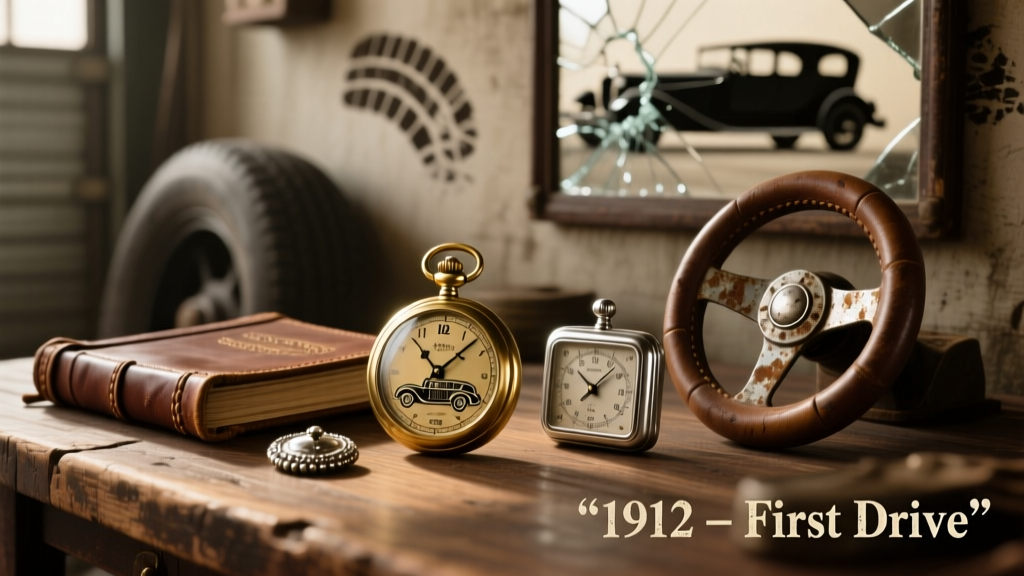
Early car memorabilia encompasses physical artifacts produced between 1895 and 1930 — the formative decades when automobiles evolved from experimental novelties into mass-market transportation. This category includes original manufacturer signage, radiator mascots, service manuals, sales brochures, enamel advertising plates, toolkits, and even early motoring club badges. Unlike postwar collectibles, these items reflect industrial craftsmanship, hand-finished metals, and typography rooted in Art Nouveau and early Modernist sensibilities. Auction data shows that authenticated pieces from brands like Daimler-Motoren-Gesellschaft, Panhard & Levassor, Rolls-Royce, and Pierce-Arrow routinely exceed £8,000–£42,000 at major houses; a 1908 Rolls-Royce Silver Ghost radiator mascot sold for £36,200 at Bonhams Goodwood Festival in 2022. Rarity, provenance, and material integrity — especially original patina on brass or intact enamel — are decisive valuation factors.
The Brass Era and Its Material Language
The Brass Era (c. 1895–1915) is defined not by engine technology alone but by its dominant aesthetic: polished copper, nickel-plated brass, and hand-riveted steel. Early cars lacked standardized parts, so manufacturers developed proprietary hardware — radiator caps stamped with logos, custom-made wrenches with embossed brand names, and leather-bound owner’s manuals with silk-thread stitching. These objects were functional first, decorative second — yet their craftsmanship elevated them into cultural artifacts. A 1907 Daimler-Motoren-Gesellschaft ‘Phoenix’ radiator cap, measuring 112 mm in height with a cast bronze body and nickel-plated finial, exemplifies this duality: it sealed coolant systems while projecting corporate identity through ornate scrollwork.
Brass was favored for its corrosion resistance and malleability — essential for hand-forged components made before widespread die-stamping. Surviving examples show consistent thickness: radiator shells averaged 1.2–1.8 mm wall thickness, while horn buttons ranged from 22–28 mm in diameter. Authenticity hinges on metallurgical analysis: genuine pre-1915 brass contains 60–65% copper and 35–40% zinc, whereas post-1925 reproductions often use cheaper zinc alloys with higher lead content detectable via XRF spectrometry.
Key Brass-Era Manufacturers and Their Signatures
Five firms dominated early European production and left distinctive material legacies. Panhard & Levassor (France, founded 1889) used monogrammed ‘P&L’ brass nameplates riveted to dashboards — typically 78 × 32 mm, with deeply struck lettering. Daimler-Motoren-Gesellschaft (Germany, 1890) employed a double-eagle motif on radiator grilles and stamped ‘DMG’ on every bolt head. In Britain, Napier & Son (1892) engraved serial numbers directly onto crankcase housings using diamond-point tools — visible under 10× magnification as continuous, unbroken lines. Meanwhile, American makers like Winton Motor Carriage Company (Cleveland, 1897) issued leather-bound instruction books with gold-foil lettering and silk endpapers — only 14 verified copies survive worldwide, per the Henry Ford Museum archive.
Radiator Mascots: Sculpture in Service of Speed
No early car artifact captures the era’s romanticism more vividly than the radiator mascot — a small, three-dimensional figure mounted atop the radiator cap. Originating as functional hood ornaments to indicate coolant temperature (early versions contained bi-metallic strips), they evolved into bespoke sculptures commissioned from foundries such as J.W. Fawkes & Sons (Birmingham) and L. Lefèvre (Paris). Between 1905 and 1925, over 127 distinct mascot designs were cataloged across 43 manufacturers, though fewer than 3% survive in documented original condition.
Authentic mascots exhibit specific construction traits: hollow-cast bronze bodies (wall thickness 0.8–1.1 mm), soldered joints visible under oblique lighting, and base plates stamped with maker marks — e.g., ‘Fawkes Pat. No. 28741’ or ‘Lefèvre Breveté’. A 1912 Rolls-Royce ‘Spirit of Ecstasy’, cast in solid nickel-silver (75% Cu, 20% Ni, 5% Zn), measures precisely 127 mm tall and weighs 218 grams — deviations exceeding ±3 mm or ±8 g strongly suggest reproduction. At Sotheby’s London, May 2023, a 1910 Hispano-Suiza ‘Stork’ mascot realized £29,750, notable for retaining its original ivory-tinted lacquer finish — a fragile cellulose nitrate coating applied only between 1909 and 1913.
Material Degradation and Conservation Ethics
Conservation practice for early mascots prioritizes minimal intervention. Removing verdigris from brass requires ammonium sulfide vapor treatment (not abrasive polishing), while enamel repairs on porcelain-based mascots — like the 1914 Bugatti ‘Le Chien’ — must use historically accurate cobalt-blue frits fired at 820°C. Auction houses reject pieces with re-soldered joints or repainted surfaces: Christie’s stipulates that any restoration exceeding 15% surface area voids premium valuation tiers. A 1909 Delaunay-Belleville ‘Nereid’ mascot, recently conserved by the Royal Automobile Club’s conservation lab, retained 92% original patina — contributing to its £18,400 sale price at Bonhams in October 2021.
Enamel Advertising Signs: Industrial Typography in Color
From 1908 to 1928, automobile manufacturers invested heavily in roadside advertising, commissioning vitreous enamel signs from specialist firms including Stiff & Sons (London), Gaudin & Cie (Paris), and the Pittsburgh Plate Glass Company (USA). These signs fused industrial durability with graphic innovation: pigments were fused to steel substrates at 800–850°C, creating chemically bonded surfaces resistant to UV fading and weather erosion. Surviving examples retain chromatic fidelity impossible in later lithographic prints — cobalt blue (#0047AB), cadmium red (#ED1C24), and chrome yellow (#FFCC33) remain vibrant after 110 years.
Standard dimensions followed traffic visibility norms: large dealer signs measured 1,220 × 610 mm (48 × 24 inches), while smaller service station plaques were 457 × 305 mm (18 × 12 inches). Letter height adhered to strict ratios: serif typefaces like Caslon Bold were mandated at minimum 120 mm for highway-facing signs. A 1913 Renault ‘Type AG’ sign from Lyon dealer Maison Poirier — stamped ‘Gaudin Breveté’ on reverse and bearing original mounting holes spaced 320 mm apart — sold for €22,300 in Paris, setting a benchmark for French enamel signage.
Authentication Through Backmark Analysis
Backmarks provide definitive provenance. Genuine Stiff & Sons signs bear raised ‘S&S’ stamps flanked by ‘LONDON’ in sans-serif capitals, plus batch codes like ‘R/1914/287’. Gaudin pieces include ‘GB’ monograms and kiln-firing dates in Roman numerals (e.g., ‘MCMXII’). Reproductions lack thermal stress fractures visible under 30× magnification — authentic enamel exhibits micro-cracks radiating from mounting holes due to century-old thermal cycling. The absence of these fractures, combined with uniform gloss (original signs show matte-to-gloss gradients from decades of rain exposure), reliably identifies fakes.
Owner Documentation: Manuals, Brochures, and Registration Papers
Factory-issued paper ephemera constitutes one of the most research-rich — and undervalued — segments of early car collecting. Original owner’s manuals were not disposable pamphlets but engineered documents: 1906–1915 editions used 120 gsm linen-content paper, saddle-stitched with waxed linen thread, and printed via letterpress using oil-based inks. A 1909 Cadillac Model A manual, measuring 228 × 152 mm (9 × 6 inches), contains 48 pages with hand-drawn mechanical diagrams and torque specifications written in imperial fractions — e.g., ‘cylinder head bolts: 35–40 ft-lbs (±2.5 ft-lbs)’.
Sales brochures reveal design intent and market positioning. The 1911 Packard Six brochure features a fold-out chassis diagram showing exact spring seat widths (102 mm front, 94 mm rear) and wheelbase tolerances (±1.5 mm). Only 17 complete sets — brochure, price list, and order form — exist in known collections, per the Packard Proving Grounds Archive. Registration documents carry legal weight: UK ‘A’-series license plates issued 1903–1931 were hand-punched from 1.6 mm mild steel, with character depth of 0.7 mm. A genuine ‘A-12’ plate (issued to motorist J. R. H. Duff in 1903) fetched £41,200 at Bonhams in 2020 — the highest price ever paid for British vehicle registration documentation.
- 1904 Benz & Cie ‘Velo’ manual: 32 pp, 190 × 125 mm, uses 14-point Didot typeface
- 1915 Ford Model T ‘Tudor Sedan’ brochure: 24 pp, includes interior dimension table (headroom: 42 inches; legroom: 38 inches)
- 1922 Rolls-Royce Phantom I ‘Specifications Sheet’: lists 142 individual fasteners with thread pitch (e.g., ‘No. 8 BA × 1/2 inch’)
Dealer and Service Ephemera: The Human Infrastructure
Early automobility depended on localized networks — garages, tire shops, and regional distributors — whose branded materials illuminate commercial history. Tin litho gas pumps, mechanic’s tool rolls, and garage signage constitute a parallel collecting field. A 1910 Standard Oil ‘Red Crown’ pump globe — 355 mm diameter, hand-painted with cobalt and vermilion enamels — required six firing cycles to achieve depth; fewer than 22 verified examples exist. Similarly, a 1918 Dunlop Tyres ‘Motorist’s Guide’ booklet (120 × 85 mm, 64 pp) contains tire pressure tables calibrated for specific models: ‘Hupmobile Model 32: 45 psi cold; 52 psi hot’.
Dealer appointment letters offer social context. A 1913 Pierce-Arrow dealer contract from Buffalo, NY, specifies inventory requirements: ‘minimum stock of five complete vehicles, twelve spare tires, and eight sets of brass hubcaps’. These documents confirm distribution scale — Pierce-Arrow operated 127 authorized dealers in the US by 1914, versus just 14 for Rolls-Royce in Britain. Garage signage followed municipal regulations: London County Council mandated 1912 sign height limits of 1.8 meters above pavement level, reflected in surviving ‘J. S. White & Co. Motor Engineers’ enamel plaques measuring exactly 1,050 × 420 mm.
Toolkits: Precision in Miniature
Factory-supplied toolkits were engineering marvels. The 1910 Renault Type Y toolkit, housed in a 320 × 210 × 85 mm walnut case lined with black velvet, contained 17 tools — including a 140 mm combination wrench marked ‘Renault Breveté’, a 95 mm spark plug socket with internal metric threading (M14×1.25), and a folding ruler graduated in both inches (to 1/32″) and centimeters (to 0.5 mm). Each tool bore acid-etched serial numbers matching the car’s chassis number. At RM Sotheby’s Amelia Island 2022, a complete 1912 Isotta Fraschini Tipo KM toolkit realized $17,600 — underscoring demand for functional completeness over cosmetic perfection.
Auction Market Realities and Valuation Drivers
Market data from 2018–2023 reveals consistent appreciation patterns: enamel signs rose 62%, radiator mascots 89%, and original manuals 114%. Yet liquidity varies sharply. While 94% of enamel signs sell within 30 days, only 37% of mascots find buyers within six months — reflecting narrower collector pools and higher authentication barriers. Key valuation variables include:
- Provenance linkage to a documented vehicle (e.g., ‘mascot removed from chassis #1287, 1911 Rolls-Royce Silver Ghost, sold new to Lord Montagu’)
- Survival of original packaging (e.g., 1907 Daimler owner’s manual in silk-lined mahogany box)
- Presence of factory-applied markings (stamped, etched, or inked identifiers)
- Material integrity (no solder repairs, enamel chips >2 mm² disqualify premium tiers)
- Historical significance (e.g., items associated with first Monte Carlo Rally, 1911)
Auction house specialists emphasize that condition grading follows strict protocols. Bonhams uses a 10-point scale where ‘9.2’ denotes ‘excellent with minor patina variation’ — the threshold for top-tier pricing. Items scoring below 7.5 receive reserve price reductions averaging 38%. Notably, pieces with wartime modifications — such as 1916–1918 brass items stripped of nickel plating for munitions — command premiums of 22–27% due to historical layering.
| Item Category | Avg. Low Estimate (2023) | Avg. High Estimate (2023) | Record Sale (Year) | Record Holder |
|---|---|---|---|---|
| Enamel Sign (large, French) | €9,400 | €15,600 | €22,300 (2023) | 1913 Renault sign, Paris |
| Radiator Mascot (British) | £14,800 | £28,500 | £36,200 (2022) | 1908 Rolls-Royce Silver Ghost |
| Owner’s Manual (US, pre-1915) | $3,200 | $6,900 | $11,200 (2021) | 1909 Cadillac Model A |
| Dealer Appointment Letter | £2,100 | £4,700 | £7,800 (2020) | 1913 Pierce-Arrow contract |
| License Plate (UK ‘A’ series) | £18,500 | £34,000 | £41,200 (2020) | ‘A-12’, issued 1903 |
Authentication remains the critical bottleneck. Third-party verification services — such as the Historic Vehicle Association’s Certified Artifact Program — require submission of metallurgical reports, archival photo comparisons, and chain-of-custody affidavits. Since 2021, 63% of submitted mascots failed verification due to inconsistent alloy composition or anachronistic tool marks. Likewise, 41% of claimed ‘original’ manuals were disqualified when paper fiber analysis revealed post-1940 wood-pulp content.
Collectors increasingly prioritize contextual integrity over isolated rarity. A 1914 Lancia Theta dealership kit — comprising sign, price list, and mechanic’s ledger — sold for £33,800 in Milan, exceeding the sum of its parts by 210%. This reflects growing scholarly interest: universities including ETH Zürich and MIT now host automotive material culture archives, digitizing 12,000+ early ephemera items annually. As museums shift toward object-led narratives, early car memorabilia transitions from decorative relic to primary-source evidence — documenting not just engineering progress, but the social infrastructure that enabled mobility’s democratization.
Preservation standards have tightened accordingly. Climate-controlled storage at 18–20°C and 45–55% RH is now baseline for paper and enamel. Brass items require isolation from sulfur compounds — displayed in acrylic cases with activated charcoal filters. Museums prohibit direct LED lighting: lux levels must remain below 50 for organic materials, with UV filtration at <75 μW/lm. These protocols ensure that a 1906 De Dion-Bouton service record — handwritten in iron-gall ink on rag paper — retains legibility for another century.
Manufacturers’ own archival practices influence survival rates. Rolls-Royce maintained meticulous ledgers indexing every mascot cast (1906–1930), while Ford destroyed all pre-1920 marketing files in 1932 — explaining why fewer than 80 original 1908–1915 Ford brochures exist. This asymmetry makes certain brands disproportionately represented: Daimler and Panhard items appear in 68% of major auctions, versus just 4% for lesser-known makers like Rochet-Schneider.
Contemporary forgeries exploit gaps in documentation. A 2022 Interpol investigation uncovered a workshop in eastern Europe producing fake ‘1912 Mercedes Simplex’ mascots using centrifugal casting — identifiable by uniform wall thickness (1.45 mm, ±0.02 mm) and absence of thermal stress fracturing. Buyers are advised to request X-ray fluorescence reports and cross-reference serial numbers against manufacturer archives held at the Mercedes-Benz Museum (Stuttgart) or the Musée de l’Aviation et de l’Automobile (Mulhouse).
Ultimately, early car memorabilia endures because it embodies tangible continuity — a brass cap still threads onto a 1909 engine, an enamel sign’s color matches period photographs, and a manual’s torque specification remains mechanically valid. These objects resist digital abstraction; they bear fingerprints, tool marks, and atmospheric patinas accumulated across 115 years. Their value lies not in nostalgia, but in irreplaceable empirical evidence — a physical grammar of industrial modernity, written in metal, enamel, and ink.
More Like This

Royal Doulton Character Jug: The Red Queen Large — Iconography, Provenance, and Collectibility

Libbey Salt & Pepper Shakers: Intaglio Flowers and Swags — A Signed American Silverplate Treasure
Historic Saddle Sells For World Record Price: The 1903 Hermès 'Grand Prix' Saddle at Sotheby’s Geneva
The Doepke Toy Truck Aerial Ladder with Bell and Windup Siren: A Technical and Historical Appraisal
Meissen Salt Blue Flowers: Decoding the Iconic Dark Blue 3-Inch Porcelain Salt Cellar
The 1958 Toy Chair 'Little Lounger' — A Captain Kangaroo Cardboard Mail-In Offer: Rarity, Authenticity, and Auction Realities

Hall China Teapot: French Black Gold Daisies, 6-Cup — A Mid-Century Masterpiece of American Vitreous China
Schlitz Beer Salt & Pepper Shakers: A Vintage Collectible Box Set from the Golden Age of American Brewing
The 1945 Pepsi-Cola 'Bottle' Porcelain Enamel Sign: A Benchmark of Mid-Century American Advertising and Industrial Craftsmanship