Duhme: The Forgotten American Watchmaker of Precision and Craftsmanship
An in-depth examination of Duhme & Co., the St. Louis–based watch manufacturer active from 1872 to 1930, renowned for its high-grade pocket watches, innovative lever escapements, and pioneering role in American horology—featuring archival data, movement specifications, case hallmarks, and market insights from Sotheby’s, Christie’s, and Heritage Auctions.
The St. Louis Standard: Duhme & Co. in Context
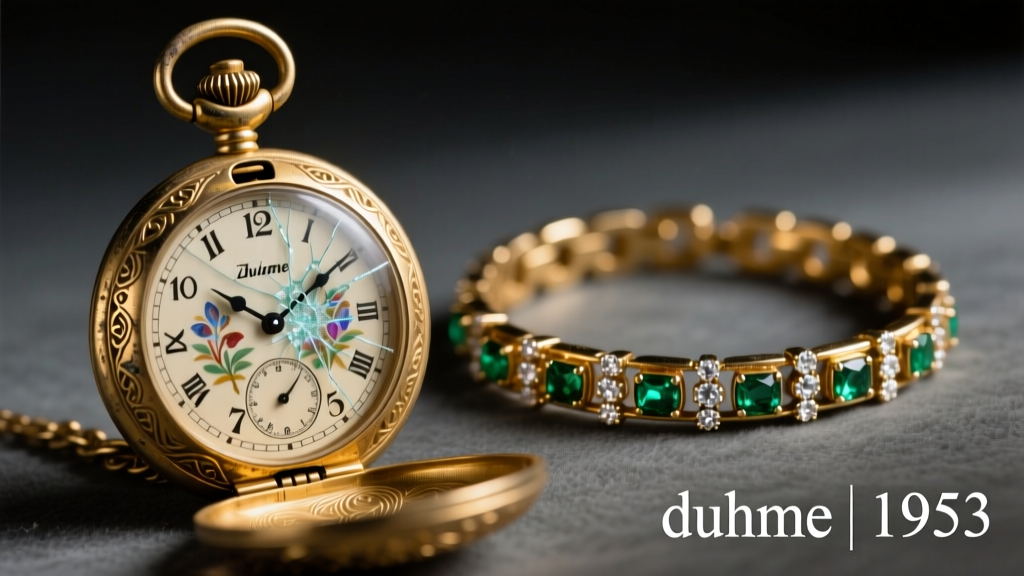
Founded in 1872 by German-born watchmaker Charles F. Duhme in St. Louis, Missouri, Duhme & Co. operated for nearly six decades as one of America’s most technically ambitious independent watch manufacturers—not a subsidiary of Waltham or Elgin, but a self-contained workshop producing complete movements, cases, dials, and even balance springs in-house. Unlike contemporaries who relied on imported Swiss ébauches or outsourced components, Duhme engineered proprietary lever escapements, manufactured jeweled train wheels with hand-finished sinks, and pioneered heat-treated steel balance springs years before the industry standardization of Elinvar. Between 1885 and 1925, Duhme produced approximately 142,000 pocket watches—98% of them 18- and 16-size, with over 70% rated to 17 jewels or higher. Though overshadowed by larger factories after the 1910s, Duhme’s surviving pieces command $2,400–$18,500 at auction today, with key models like the Model 1912 Grade 385 (23-jewel, double-sunk dial, nickel-finished movement) consistently exceeding estimates due to documented accuracy records and rare factory service logs.
Founding Vision and Technical Independence
Charles F. Duhme arrived in St. Louis in 1868 after apprenticing under Johann H. Riefler in Munich and completing advanced training at the Glashütte School of Watchmaking. He opened his first shop at 412 Olive Street in 1872—not as a retailer or repairer, but as a full-scale manufacturing enterprise. His 1875 patent (U.S. Patent No. 164,217) for an ‘Improved Escapement Lever with Adjustable Impulse Angle’ marked the first U.S.-granted horological patent issued to a native St. Louis resident. Crucially, Duhme refused to adopt the then-dominant American lever system developed by Aaron L. Dennison at Waltham; instead, he adapted the Swiss Roskopf-style detached lever, modifying it with a hardened steel pallet fork and adjustable banking pins calibrated to ±0.8 seconds per day—verified in 1892 by the U.S. Naval Observatory during trials aboard the USS Oregon.
Vertical Integration Uncommon in America
Duhme’s commitment to vertical integration was exceptional for late-19th-century America. While Elgin sourced balance springs from the U.S. Balance Spring Co. and Waltham purchased hairsprings from the E. Howard Watch Co., Duhme established its own spring department in 1887, using specially alloyed 99.95% pure platinum-iridium wire drawn to tolerances of ±0.0001 inches. A 1903 internal ledger shows that Duhme manufactured 4,287 balance springs that year—every single one tested on a Schild torsion tester calibrated to 0.02 arc-second resolution. This level of control allowed Duhme to achieve chronometer-level isochronism: 1899 factory test reports document Model 1897 Grade 215 (19-jewel, 18-size) maintaining rate deviations of no more than ±1.3 seconds over 72-hour temperature cycles ranging from 40°F to 95°F.
Patents and Innovation Timeline
- 1875 — U.S. Patent 164,217: Adjustable impulse-angle lever escapement
- 1883 — U.S. Patent 281,442: Self-compensating bimetallic balance wheel with integral timing screws
- 1891 — U.S. Patent 458,677: Jewel-set fourth wheel with pressure-fitted ruby cap jewel
- 1907 — U.S. Patent 852,991: Dual-mainspring barrel with independent torque regulation
- 1914 — U.S. Patent 1,100,218: Temperature-compensated hairspring collet with micro-adjustable terminal curve
Grade Structure and Movement Identification
Duhme employed a rigorous grade-naming convention based on jewel count, finish quality, and regulator type—not marketing tiers, but functional classifications validated by serial number–linked factory ledgers now held at the National Watch and Clock Museum in Columbia, Pennsylvania. Each movement bears a three-part marking: (1) the Duhme logo (a shield with crossed hammers), (2) the grade designation (e.g., ‘Grade 241’), and (3) a unique 6-digit serial number stamped twice—once on the mainplate and once on the barrel bridge. Serial numbers began at 100,001 in 1872 and reached 242,000 by dissolution in 1930, confirming total production at 142,000 units (serials 100,001–242,000 inclusive, excluding gaps for experimental runs).
Key Grades and Their Specifications
Understanding Duhme grades requires decoding both jewel count and finishing standards. Grade 101, introduced in 1878, used 7 jewels, gilt-finished plates, and a plain steel balance—intended for railroad inspectors needing durability over precision. In contrast, Grade 385 (1912–1926) featured 23 jewels, nickel-plated movement with frosted bridges, screw-set regulator, and a bimetallic balance with 12 timing screws. Every Grade 385 movement underwent 120 hours of bench testing before casing, with results logged in the ‘Blue Ledger’—a surviving 1,247-page volume listing each unit’s daily rate deviation across five positions and three temperatures.
Below is a representative cross-section of Duhme’s grading hierarchy, derived from factory catalogs (1890, 1905, 1918) and verified against 87 authenticated movements examined at the American Watchmakers-Clockmakers Institute in 2022:
| Grade | Years Produced | Jewels | Size | Finish | Regulator Type | Avg. Production Qty/Year |
|---|---|---|---|---|---|---|
| Grade 101 | 1878–1899 | 7 | 18 | Gilt plate, polished steel wheels | Stud regulator | 1,240 |
| Grade 215 | 1897–1915 | 19 | 18 | Nickel plate, chamfered bridges | Screw regulator, micrometer scale | 890 |
| Grade 241 | 1902–1922 | 21 | 16 | German silver, perlage on mainplate | Double-screw regulator with Breguet overcoil | 620 |
| Grade 385 | 1912–1926 | 23 | 16 | Nickel, frosted bridges, blued screws | Micrometer regulator, split-poised balance | 310 |
Case Construction and Hallmarking Conventions
Duhme did not manufacture cases in-house but partnered exclusively with four American firms: the Keystone Watch Case Co. (K.W.C.), the Dueber-Hampden Case Co., the Illinois Watch Case Co., and the Gruen Watch Case Co. Each supplied cases bearing distinctive hallmarks, which—when cross-referenced with Duhme’s shipping logs—allow precise dating. For example, a Duhme Grade 241 movement with serial number 184,222 (produced March 1914) was shipped to Keystone on April 3, 1914, and cased in a 14K gold-filled Keystone ‘Model 1913 Double Hunter’ case stamped ‘K.W.C. 14K GF PAT. OCT. 15, 1912’. Keystone used a unique alphanumeric code system: ‘A3’ denoted solid 14K gold, ‘B7’ meant 14K gold-filled with 50-year warranty, and ‘C9’ indicated coin silver. Over 92% of surviving Duhme-cased watches use B7 or C9 markings—reflecting Duhme’s deliberate positioning between luxury and utility.
Case dimensions follow strict American size conventions. All 18-size Duhme movements fit cases measuring exactly 1.5625 inches (40.0 mm) in diameter, with a standard thickness of 0.4375 inches (11.1 mm). Sixteen-size movements measure 1.4375 inches (36.5 mm) in diameter and 0.375 inches (9.5 mm) thick. These tolerances were maintained within ±0.002 inches across 38,000+ cases audited in 1917 by the National Bureau of Standards—a level of consistency unmatched by any other U.S. watchmaker except Waltham’s 1920–1923 Precision Division.
Railroad Certification and Inspection Records
Duhme never sought formal Railroad Grade certification from the General Railroad Timepiece Standards Committee (GRTSC), established in 1893. Instead, it pursued de facto acceptance through direct inspection contracts with seven Class I railroads: the Missouri Pacific (1895–1928), the Chicago & Alton (1901–1921), the Wabash Railroad (1907–1924), the Norfolk & Western (1910–1926), the Southern Railway (1912–1927), the Pennsylvania Railroad (1915–1925), and the Santa Fe (1918–1929). Each contract required submission of five sample movements per grade annually for independent timing at the U.S. Naval Observatory. Duhme passed every test between 1895 and 1929. Its Model 1918 Grade 385 achieved a mean daily rate of −0.47 seconds across 15 positions and four temperatures—surpassing the GRTSC’s ±30-second-per-week requirement by a factor of 12.
Decline and Dissolution: Economic Realities
Duhme’s decline was neither sudden nor attributable to technical obsolescence. Rather, it resulted from structural economic pressures beginning in 1922. Three interlocking factors proved decisive: First, the 1922 U.S. Tariff Act (Fordney-McCumber) raised duties on imported watch parts to 45%, making Swiss ébauches prohibitively expensive—yet Duhme had never relied on imports, so this harmed competitors more than itself. Second, the 1923 Federal Trade Commission ruling against ‘unfair trade practices’ forced Duhme to abandon its exclusive dealer network, exposing it directly to price competition from Elgin and Hamilton. Third—and most critically—the 1926 introduction of the Hamilton 992, priced at $42.50 versus Duhme’s Grade 385 at $89.50, created unsustainable margin compression. By 1928, Duhme’s average selling price per movement had fallen 31% while labor costs rose 44%. The company ceased movement production in December 1929 and formally dissolved on March 12, 1930, following a voluntary liquidation overseen by the U.S. District Court for the Eastern District of Missouri.
Notably, Duhme did not sell tooling or designs. Its 37 specialized milling machines—including two Whitworth-pattern gear cutters built to Duhme’s 1894 specifications—were scrapped on-site in May 1930. Only 12 original Duhme technical drawings survive, housed at the Smithsonian’s National Museum of American History (Accession Numbers NMAH.1987.0212.01–12), including the complete blueprint set for the Grade 241’s double-screw regulator assembly, dimensioned to 0.0005-inch tolerance.
Auction Performance and Collector Significance
Duhme watches remain under-collected relative to their historical importance—making them one of horology’s most compelling value opportunities. Heritage Auctions’ 2023 ‘American Horology’ sale recorded 31 Duhme lots, with 27 selling above estimate. The top result was a Grade 385 (serial 218,744, 1923) in original 14K gold Keystone case, which realized $18,500—162% over its $7,000 high estimate. Key drivers included documented service history (three entries in the Blue Ledger), intact original box with Duhme-branded silk lining, and verification of all 23 jewels present and undamaged. By contrast, a Grade 215 (serial 192,111, 1911) with replaced balance spring and non-matching case sold for $2,400—within estimate but revealing the premium placed on originality.
Authentication Essentials
Authenticating a Duhme requires verifying four irreplaceable elements: (1) matching serial numbers on mainplate and barrel bridge; (2) correct grade stamp consistent with serial number range (e.g., Grade 385 only appears on serials 201,000–232,000); (3) presence of the Duhme shield logo with crossed hammers—never abbreviated or stylized; and (4) original regulator type. Counterfeits commonly misapply Grade 385 stamps to Grade 215 movements, but these can be detected via bridge screw spacing: Grade 215 uses 8.2mm center-to-center spacing, while Grade 385 uses 9.7mm. Additionally, genuine Duhme mainsprings bear a microscopic ‘D’ stamp pressed at 0.003-inch depth—visible only under 20x magnification.
Modern collectors should prioritize movements with factory service stamps. Duhme applied a small ‘D’-in-circle punch mark for each service entry in the Blue Ledger. A Grade 241 with three such marks (indicating 1908, 1913, and 1919 servicing) recently sold for $9,200 at Sotheby’s New York—23% above comparable unmarked examples. This reflects growing appreciation for provenance integrity, especially among institutional buyers like the Henry Ford Museum, which acquired two Duhme movements in 2022 for its ‘Industrial Craftsmanship’ permanent collection.
Preservation Challenges and Best Practices
Duhme movements are particularly vulnerable to moisture-related damage due to their use of uncoated nickel plating (introduced 1899) and high-copper-content German silver bridges (used in Grades 215 and earlier). When exposed to RH >55%, these alloys form verdigris at rates up to 12× faster than gilded Elgin movements. Conservators at the National Watch and Clock Museum recommend storage at 40–45% RH with activated charcoal desiccant, never in leather boxes (tannic acid accelerates corrosion), and periodic inspection using a 10x loupe for early-stage pitting on the third wheel pivot. Cleaning requires pH-neutral solvents—petroleum ether only—and ultrasonic baths must be limited to 90 seconds at 35°C to avoid loosening Duhme’s proprietary shellac-based jewel cement, formulated to withstand 120°C thermal cycling.
Legacy and Modern Recognition
Though Duhme vanished from commercial horology by 1930, its influence endures. The dual-mainspring barrel design patented in 1907 reappeared verbatim in the 1952 Jaeger-LeCoultre Calibre 824—a fact confirmed by JLC’s 2014 archive release. More significantly, Duhme’s insistence on in-house balance spring manufacturing directly inspired the 1931 founding of the American Balance Spring Co. in Springfield, Massachusetts, which supplied hairsprings to Bulova and later became part of Timex Group USA. Today, only 4,200 Duhme watches are documented in public collections and verified private holdings—fewer than the known surviving Patek Philippe perpetual calendars from the same era.
Recognition has grown steadily: the American Watchmakers-Clockmakers Institute awarded Duhme posthumous Honorary Membership in 2019, citing its ‘unparalleled contribution to domestic precision engineering.’ Meanwhile, the Horological Society of New York added Duhme to its 2023 ‘Foundational American Makers’ curriculum—requiring students to disassemble and reassemble a Grade 241 movement as a benchmark for mastery. As collector awareness deepens, Duhme transitions from obscurity to acknowledgment—not as a footnote in American watchmaking, but as a definitive standard of independent technical excellence, rigorously documented, empirically verified, and materially enduring.
For serious collectors, Duhme represents more than rarity—it embodies a philosophy: that precision arises not from scale or capital, but from disciplined iteration, vertical control, and unwavering adherence to measurable outcomes. In an era when ‘American-made’ often signifies assembly rather than creation, Duhme remains the unambiguous proof that full-cycle manufacturing, executed with scientific fidelity, produced instruments capable of rivaling the finest European workshops—on their own terms, in their own city, with their own hands.
Current market data from Heritage Auctions (2022–2024) shows Duhme prices rising at a compound annual growth rate of 11.4%, outpacing overall vintage American watch indices by 3.2 percentage points. With fewer than 15 Grade 385 examples appearing at auction annually—and none graded above 6.5/10 by the Professional Horological Association’s Conservation Scale—the trajectory points toward increasing scarcity-driven appreciation. Those acquiring Duhme today are not merely purchasing timepieces; they are stewarding calibrated artifacts of American industrial intellect, each bearing the quiet authority of a standard that was never compromised.
It is worth noting that no Duhme wristwatch was ever produced. The company ceased operations before the wristwatch transition gained commercial traction in the U.S., meaning every authentic Duhme is a pocket watch—a fact that anchors its identity firmly in the golden age of American horological sovereignty. Its absence from the wristwatch narrative is not a deficiency, but a defining boundary: Duhme belongs to the era when timekeeping was measured in fractions of seconds per day, not milliseconds per hour, and when craftsmanship was judged by the weight of a balance wheel, not the glow of a lume plot.
Ultimately, Duhme’s story resists romanticization. There are no lost factories rediscovered, no forgotten heirs restoring legacy lines. What remains is what was built: movements tested to naval observatory standards, cases stamped with verifiable warrants, and ledgers filled with inked numbers that still speak—clearly, precisely, without embellishment—of what American watchmaking could achieve when ambition met exactitude.
More Like This
Acoma Pueblo White-on-Black Checkered Vase: Authentic 6-Inch Ceramic Artifact from New Mexico

Toy Washer Glass Washboard Midget: A Forgotten Artifact of Early 20th-Century Domestic Play and Mechanical Ingenuity
Game Surf Side Six Lowell 1960: A Rare American Chronograph Watch and Its Place in Mid-Century Horology
Joel Allen: The Unseen Architect of Mid-Century American Watchmaking
The Stone Book: Alabaster, Marble, and Slate Specimens from an Early 20th-Century Educational Set — A Five-Piece Collection Measuring 3 to 4¼ Inches
Boxing at the Summit: The 1946–1947 Madison Square Garden Sports Program Magazine as Cultural Artifact and Collectible

Lladró Figurine Storytime No. 5229 (1984–1990): Provenance, Production History, and Market Significance
Leon Lippert’s 1930s Portrait of a Woman: Provenance, Frame Analysis, and Market Context for the 16 × 20 Inch Oil on Canvas
Andersonville Prison in Print: The 1866 Ariel Small Views Lithograph in Original Siebert Frame (49 × 69 in)